Advocacy
The Yellowstone volcano
Deep beneath Yellowstone National Park lies one of the world’s largest supervolcanoes, a force of nature responsible for the park’s famous geysers and hot springs. However, this geological marvel also conceals a massive magma chamber, a reservoir far larger than previously imagined. In 2015, researchers from the University of Utah made a startling discovery: not only was the magma chamber significantly more extensive than expected, but there was also a second, even larger reservoir beneath it. Together, these two chambers hold enough magma to fill the Grand Canyon 11 times over.
By David Shoremekunabout a year ago in Earth
Deciphering the Enigma of Time
Time remains a profound mystery that eludes complete understanding. It is a linear construct universally acknowledged and utilized as a means of measurement. The tangible manifestations of time, such as clocks and calendars, merely hint at its intricate nature. Time progresses in a forward direction, driven by entropy and the concept of the arrow of time. Entropy, which quantifies disorder within the universe, has been on the rise since the inception of the Big Bang. At the quantum level, time behaves in a manner that challenges our conventional understanding of its flow and direction. The origins and future of the universe remain ambiguous. As the universe continues to expand and entropy escalates, there may come a moment when all entities are too distanced to interact. Quantum fluctuations could potentially lead to a random decrease in entropy, reminiscent of the Big Bang; however, to delve into these inquiries, it is essential to reconcile quantum mechanics with general relativity in a comprehensive Theory of Everything.
By Isaac Ekow Anyidohoabout a year ago in Earth
What if All The Clouds Disappeared Forever?. AI-Generated.
Clouds, ranging from delicate and wispy to large and fluffy, envelop approximately 70% of the Earth's surface at any given time. However, consider the scenario where, in an instant, they vanish completely. This sudden absence would likely astonish astronauts observing from the International Space Station. Conversely, an individual hiking in a desert environment may not immediately recognize the impending crisis on Earth. Within a few days, the initial indicator would manifest as increased humidity. This effect would be exacerbated for those residing near coastal areas. Typically, the sun's warmth causes water to evaporate, primarily from the ocean, with the resulting vapor forming clouds. Yet, if clouds were removed from the Earth's hydrological cycle, the moisture would linger in the atmosphere, leading to nearly 100% humidity levels. Should you board a flight during this time, you might encounter heightened turbulence. The absence of clouds, which normally reflect sunlight back into space, would result in increased solar heating of the Earth, generating more rising and uneven hot air.
By Brian Dickersonabout a year ago in Earth
The Biggest LIE About Climate Change. AI-Generated.
This is the tale of how your future financial security was pilfered without your knowledge or awareness. In the 1970s, everyone was in favor of peace, but Exxon, an oil business, was also founded. They were fixated on invention, a concept that currently fascinates us. Thus, Exxon decided to make scientific investments. Once more, Exxon employed experts who were among the first to publish a number of ground-breaking studies outlining how burning fossil fuels will affect the climate because the carbon dioxide emitted will have a greenhouse impact. Don't you think it's ironic that oil firms were the ones who uncovered climate change?
By Mariam Fathalrahman2 years ago in Earth
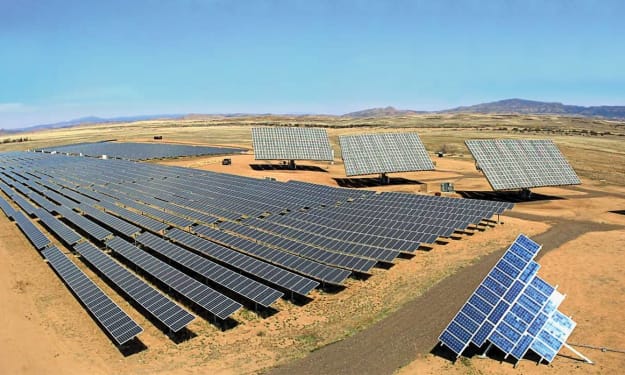
What If We Covered the WHOLE Sahara With Solar Panels?
This map shows the annual sunshine hours across the world. The sahara desert is well known for being the largest hot desert in the world, but it's probably much bigger than you even realize. It spans across ten different countries in three different time zones and receives an abundance of sunlight. There are some notable hot spots in North America, South America, and Southern Africa, but none receives as much as the sahara desert. Most of this China-sized chunk of land receives more than 3,600 hours of sunlight annually. And within that large area lies another area that receives over 4,000 hours of sunlight annually—nearly four times Germany's annual total. This is primarily due to the fact that the Sahara Desert is located almost exactly along the tropic of cancer, meaning that the sun is overhead it for most of the year. Additionally, clouds hardly ever form or even exist over the entire desert, meaning that the sunlight is never interrupted. As a result, the Sahara is the best place on Earth to install solar panels and establish solar farms.
By Mariam Fathalrahman2 years ago in Earth
The Weight of a Nation
In the small, landlocked country of Lankava, where mountains kissed the sky and rivers sang through the valleys, sports were more than just games—they were a source of identity and pride. Lankava, often overshadowed on the world stage, found its heroes in athletes who carried the nation's hopes with them. This year, all eyes were on one man: Arjun Desai.
By lala lalegende2 years ago in Earth
The Cracks Beneath the City
In the sprawling metropolis of Altagaz, a city perched on the eastern coast of Turkey, the skyline had changed dramatically over the past few decades. What was once a sleepy coastal town had transformed into a bustling urban hub, its silhouette dominated by towering skyscrapers and densely packed apartment blocks. The city’s rapid growth was fueled by an influx of people from rural areas, all seeking better opportunities, a brighter future, and a piece of the city's promise.
By Aminu Muhammad2 years ago in Earth