
What If We Covered the WHOLE Sahara With Solar Panels?
The Potential and Pitfalls of Solarizing the World's Largest Desert

This map shows the annual sunshine hours across the world. The sahara desert is well known for being the largest hot desert in the world, but it's probably much bigger than you even realize. It spans across ten different countries in three different time zones and receives an abundance of sunlight. There are some notable hot spots in North America, South America, and Southern Africa, but none receives as much as the sahara desert. Most of this China-sized chunk of land receives more than 3,600 hours of sunlight annually. And within that large area lies another area that receives over 4,000 hours of sunlight annually—nearly four times Germany's annual total. This is primarily due to the fact that the Sahara Desert is located almost exactly along the tropic of cancer, meaning that the sun is overhead it for most of the year. Additionally, clouds hardly ever form or even exist over the entire desert, meaning that the sunlight is never interrupted. As a result, the Sahara is the best place on Earth to install solar panels and establish solar farms.
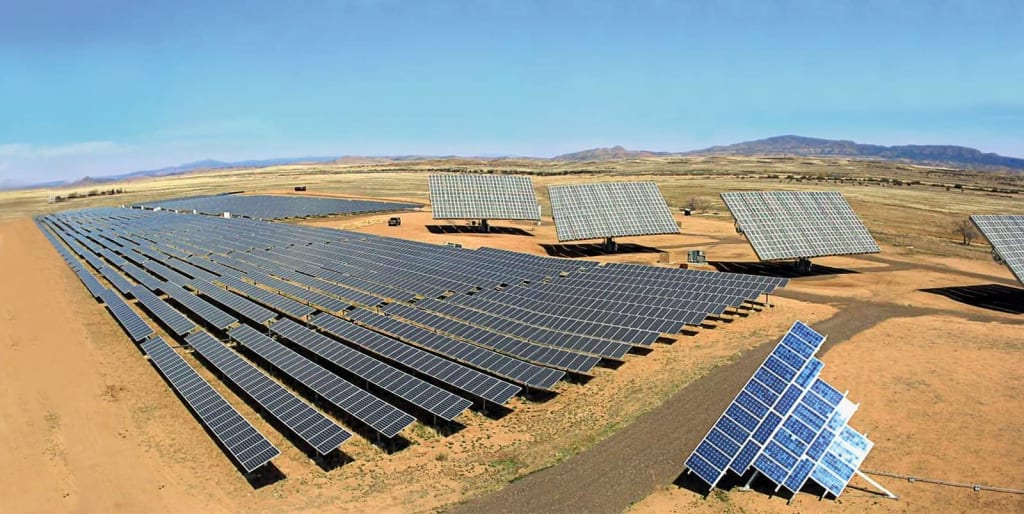
Then the question arises: How much energy could we really create if we covered the entire desert with solar panels? How would this affect our planet? Let's start here and take a closer look. This is the location of the solar power station in Morocco. When fully constructed and operational, the world's largest concentrated solar power plant will occupy an area of 25 square kilometers and produce 582 megawatts of electricity. This engineering marvel will also have the ability to store solar energy in the form of superheated molten salt. After spending more than $9 billion on solar energy, Morocco plans to build four more plants in the Sahara that will generate over 2,000 megawatts of electricity, which will be sufficient to meet about 38 of the country's annual electricity needs. This project will establish Morocco as the world leader in solar energy, and since it is the only country in Africa with a power cable connected to Europe, a large portion of the energy produced will be exported for profit to other EU member states. But all of this energy is produced from just five relatively small plants
what occurs when we imagine larger and scale things up a little bit, A small solar panel array in the Sahara could supply 100 percent of Germany's electricity needs, according to research and data from the German Aerospace Center by the German energy company Desertec, which also happens to be an investor in the Moroccan solar energy project. This is one of the few organizations considering producing solar energy in the Sahara for the future. This scale of array could power the whole European Union, and at about 18 trillion watts, an array this size alone could meet the world's present electrical demands.
Taking into account that an average solar panel produces approximately 350 watts of power, this earth-powering array would cover approximately 51.4 billion solar panels and roughly equal the size of the United States state of New Mexico. This is a sizable area of land, but nothing compared to the vastness of the Sahara, which is also extremely sparsely populated, with only about 2.5 million people living there. This means that the population density of the Sahara is comparable to that of Siberia, meaning that massive solar farms like this can be built there without having a significant detrimental effect on the locals. The Desert Tech Project doesn't exactly aim to turn the Sahara into a solar farm. This is a realistic plan that has undergone significant research and investment, but why are they only planning to build solar farms around the sahara's perimeter? Well, it's still quite ambitious. The general idea is to set up a series of massive solar farms across the sahara's perimeter and deeper into the Middle East. Once constructed, this collection of solar farms will provide for the majority of Africa's and the Middle East's electricity needs while shipping any excess power across cables to Europe that could supply as much as 15 of the continent entire
While building solar farms in the barren Sahara has many clear advantages, there are also many drawbacks. First of all, the emptiness of the Sahara is both a blessing and a curse. On the one hand, it means that very few people will need to be relocated or forced off their land, but on the other, there isn't any infrastructure to actually transport the vast quantities of supplies into place in a way that is economically feasible. Looking at the map, there are only about four roads that even cross the Sahara from north to south. There are also large areas of desert that are completely devoid of any roads.
Desert Tech only plans to build plants in the Sahara because some of these areas, like this northwest pocket of Chad, are more than 600 kilometers from the closest road. However, let's set that aside for a moment and consider the cost of the solar panels themselves in a Sahara-sized array. A typical 350-watt solar panel typically costs between $200 and $450 once fully installed on a residential roof today. We know that it will be expensive to transport and install all of them in the middle of one of the most remote locations. The 51.4 billion solar panels required to fit inside of our new mexico-sized array that will power the entire planet will cost a cool 51.4 trillion US dollars, for reference. That's approximately 60% of the global gross domestic product. However, it would enable us to immediately switch over to renewable solar energy, so that's pretty cool. We're going to stick with a high cost estimate here and tack on an additional 300 for delivery in infrastructure fees and 250 more dollars for installation fees. Conveniently, this math makes the total cost for each 350 watt panel exactly one thousand dollars.
All right, so let's just assume that we've turned on infinite money and that we expanded upon this by covering the entire Sahara Desert with solar panels. What will happen now? Well, to start, if we assume that the solar panels are 100 percent efficient, the entire Sahara Desert will probably now be producing somewhere in the neighborhood of 1.3 million terawatt hours of electricity annually. To put that figure into perspective, the collective energy consumption of the modern human species was approximately 173 000 terawatt hours in 2019, and that's not just electricity; that's all the energy needed for everything we did that year Even though this would bring revolutionary changes, harnessing the entire Sahara desert for solar power would not come without a price. A sahara desert covered in solar panels would generate more than seven times the amount of energy that the world's nearly eight billion people currently consume collectively. Of fact, the majority of the sunlight that reaches the Sahara will be absorbed by the black surfaces of the solar panels scattered over the region; only a small portion of this incoming energy will actually be transformed into power.
In some ways, covering the entire Sahara with solar panels will also unintentionally be transforming the desert into a green sahara, even though the vast majority will be returned to the environment as heat. This heat will cause a sort of feedback loop in which the heat emitted by the solar panels would create a steep temperature differential between the land and the surrounding oceans. This will ultimately lower the surface air pressure and cause moist air to rise and condense into clouds and rain across the desert. This will be beneficial because it will allow for the colonization of a vast area of land equivalent to China, which will be crucial for the rapidly developing economies of North Africa. However, there will also be negative effects. The Amazon rainforest in South America receives a lot of its nourishment from dust from the Sahara that is blown across the Atlantic, and the atlantic ecosystems themselves also benefit from this fertile dust. If the Sahara Desert's sand is removed, it could trigger a chain reaction of unanticipated events that could destroy entire ecosystems in the atlantic, the Amazon, and likely beyond, as well as cause an epic climate catastrophe unlike anything we have ever witnessed.
In conclusion, installing solar panels across the entire Sahara would be amazing, but it would also be impractical, possibly dangerous, and unnecessary. To meet the modern energy needs of the world's 8 billion people, solar panels only need to cover the area of Mexico; they don't even need to be placed in one spot; they can be dispersed throughout the world's deserts or anywhere that is sunny. Hopefully, by the end of the century, we'll have made some pretty decent progress in this regard.
About the Creator
Mariam Fathalrahman
Whether you’re a nature lover, a history buff, or simply someone who enjoys a good read, there’s something here for you, diving into topics as diverse as the mysteries of Earth and nature. Join me, and let’s explore the world together.
Keep reading
More stories from Mariam Fathalrahman and writers in Earth and other communities.
A "WALL" is Found At The EDGE Of Our Solar System
Our solar system has taught us a great deal over the past century, but what do you think is at the very edge the portal to another dimension? Perhaps our solar system merges with other parts of the universe at some point, unaffected by the Sun at its center? Decades of sending probes into space are finally providing some answers.
By Mariam Fathalrahman2 years ago in Earth
A Sound Has Been Echoing From the Bottom of the Ocean for 25 Years — And No One Knows What Made It
It started with a sound no one expected to hear. In 1997, deep in the Pacific Ocean, underwater microphones picked up something strange—something powerful enough to travel thousands of miles through the water. The signal was so loud that multiple sensors across the ocean detected it at the same time.
By Noman Khan 3 days ago in Earth



Comments (3)
incredible! solar energy is a well worthy alternative for current and future sustainability
Well done
Thanks for the analysis