



Living in West Africa, albino ball pythons stun with their amazing yellow and white patterns. They primarily eat rodents.

Blue Malaysian coral snakes are native to Southeast Asia. They have amazing bright, blood-red heads and tails, bluish-black bodies, and thin, sky-blue stripes down their sides. These snakes are reclusive and semi-fossorial spending most of their time burrowing in dirt. They inhabit heavily forested, mountainous areas. Blue Malaysian coral snakes can be aggressive and they have long venom glands with powerful cytotoxic venom. They prefer to feed on smaller snakes.

Blue pit vipers come from the Lesser Sunda Islands and Java in Indonesia. These are white-lipped pit vipers with either bright green or vibrant blue-green coloring. Blue pit vipers primarily eat small mammals, birds, and lizards.
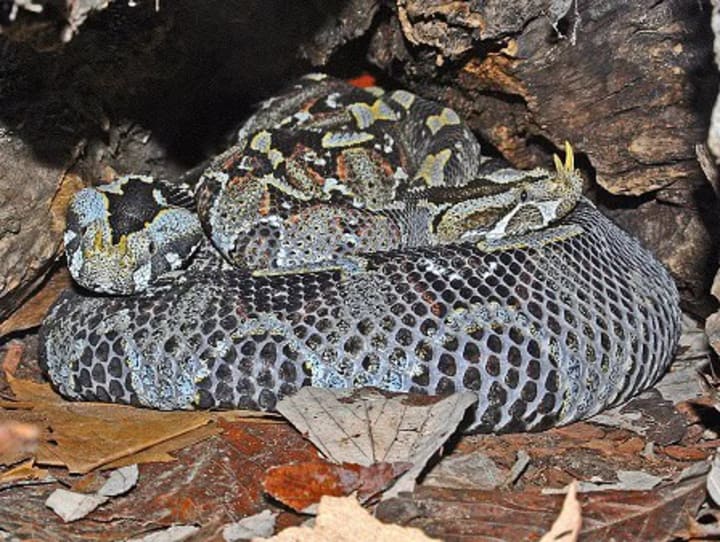
Butterfly vipers are native to West and Central Africa. They inhabit densely forested areas near water sources. These snakes hide in foliage and leaf litter on the forest floor during the daytime and hunt at night. These vipers have heavy bodies with ornate bluish-green diamond and hourglass-shaped markings running the length of their brown and olive-green bodies. Their heads are typically black, diamond-shaped, or triangular, splotched, with their trademark “horns” at the tip of their noses. The butterfly viper’s venom is both hemotoxic and neurotoxic. They feed mainly on small mammals, but in wetland habitats, they are also known to take toads, frogs, and even fish.

From the US are the California red-sided garter snakes. Of the other colorful subspecies, this is the most beautiful, with either vivid yellow or blue stripes stretching across their brightly colored red bodies. Their heads are bright red also, making them stand out against the swampy habitats they live in. These snakes are strong swimmers. They dine on small amphibians, fish, rodents, and at times, birds. They only have a mild venom.

Emerald tree boas are native to South America. They are known by their emerald green coloring accented by zig-zag white lines. As their name suggests, emerald tree boas are highly arboreal and skilled, muscular-bodied climbers. These snakes are non-venomous and are nocturnal hunters, preying on any small rodents, lizards, frogs, and birds that cross their path.
Eyelash vipers inhabit Central and South America. (pictured above) Their preferred habitats are low-elevation, heavily shaded, and densely forested areas close to water sources. They get their name from their incredible eyelashes which help them stay camouflaged among dense plant growth. Eyelash vipers are smaller than other pit vipers. These snakes are venomous and have very sharp fangs. Their diet includes frogs, rodents, lizards, and at times, birds.
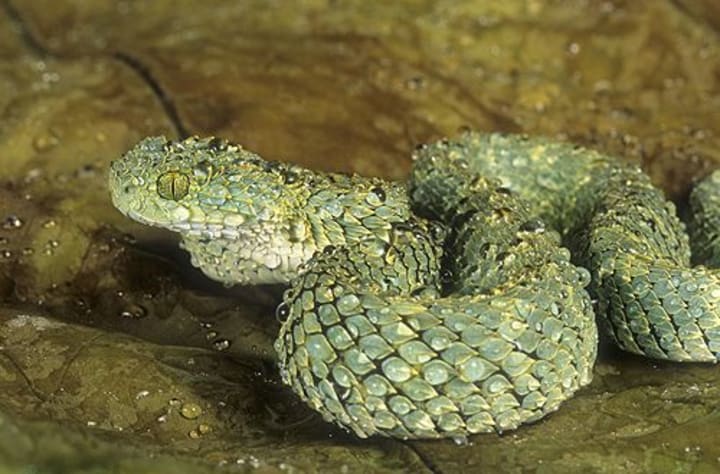
Hairy, rough-scaled bush vipers are native to Western and Central Africa and inhabit hot, humid rainforests. They are known for their outward-pointing, keeled scales, giving them a dragon-like appearance. These snakes are brightly colored with flat, broad heads, short snouts, and large, protruding eyes. Their coloration varies from bright greens and yellows to grays, browns, and oranges. Bush vipers have potent hemotoxic venom. Spiny bush vipers are solitary and nocturnal creatures that typically spend the daytime basking on top of flowering bushy plants. They are carnivores. Their diet typically consists of mammals, frogs, lizards, and sometimes birds.
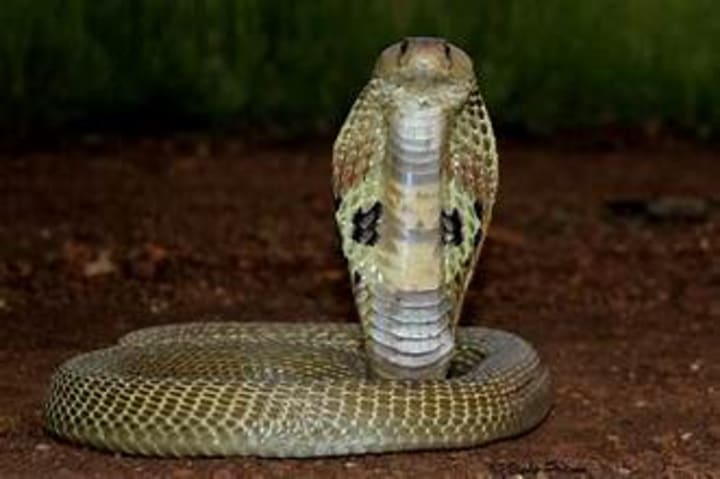
Indian cobras are known for their bespectacled eye-shaped marking on the back of their hoods. These are among the larger of the cobra species. They are native to India and some surrounding countries such as Pakistan, Nepal, and Sri Lanka. Indian cobras are hardy and highly adaptable and can thrive in a wide variety of different habitats, including urban areas. However, they most often live near water, spending much of their time hidden away in rocky outcrops, termite mounds, and hollowed-out trees. These cobras are venomous with both neurotoxic and cardiotoxic venoms. Indian cobras are carnivores and feed on rodents, frogs, and lizards.
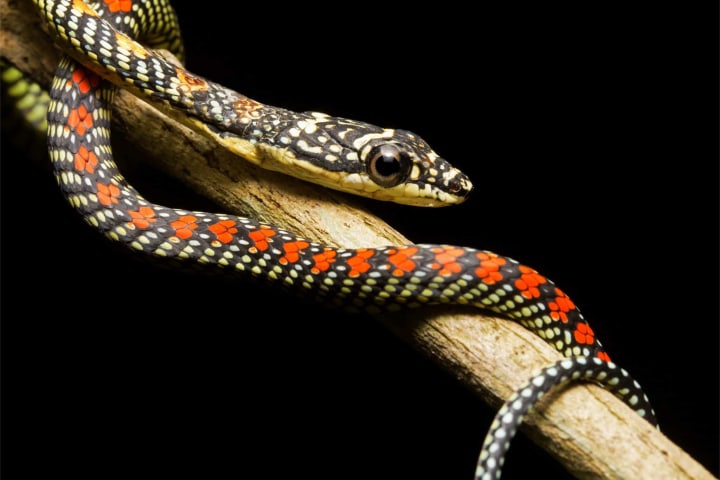
Paradise flying snakes can be found all throughout southeastern Asia in humid forests. These beautiful snakes easily glide from tree to tree using their strong abdominal muscles to grab onto tree branches. Their scales alternate in colors of green, orange, yellow, and red. Their heads typically have horizontal striping. Even though their called flying snakes the do not really fly but glide from tree to tree. They primarily eat tree-dwelling lizards and bats.

Rainbow snakes are also known as eel moccasins. These are aquatic snakes with bright coloration and alternating scale colors of bright red, yellow, black, brown, and orange. These snakes are reclusive and stay hidden in the water among dense plant growth in the marshes and swamps throughout the southeastern US. Rainbow snakes dine on frogs and salamanders. Heavy-bodied and muscular, they are non-venomous.

Sunbeam snakes are native to Southeast Asia and the surrounding islands. In the Xenopeitis genus there are two species, with the better known being Xenopeitis unicolor. The countries these snakes inhabit are Myanmar, southern China, Laos, Vietnam, Malaysia, and Thailand. They are beautiful, especially in full light, and known to shimmer in various colors due to their highly iridescent scales. These are very reclusive snakes and burrow underground. They hunt for food in the evenings and early morning hours with tiny rainbows dancing across their scales in sunlight. Their preferred prey are small amphibians, reptiles, and sometimes mammals.
About the Creator
Rasma Raisters
My passions are writing and creating poetry. I write for several sites online and have four themed blogs on Wordpress. Please follow me on Twitter.
Keep reading
More stories from Rasma Raisters and writers in Earth and other communities.
Snow Causes Rush Hour Misery: How a Winter Blast Disrupted Commuters Across the UK
Commuters across the UK faced widespread disruption as an unexpected snowstorm hit during morning rush hour, leaving roads treacherous, public transport in chaos, and many struggling to reach work on time. From London to Glasgow, icy conditions and snow-covered streets created a perfect storm of travel misery, prompting warnings from authorities and emergency services.
By Fiazahmedbrohi 5 days ago in Earth
Australia Heatwave Temperatures and the Cost of Endless Summers
There was a time when summer in Australia meant long afternoons, sunburnt shoulders, and the hum of cicadas at dusk. Heat was expected, even welcomed. But something has shifted. In recent years, summer no longer arrives gently. It presses down, day after day, with a weight that feels harder to escape. Australia heatwave temperatures are no longer short bursts of discomfort. They are long, exhausting stretches that change how people live, work, and rest. This article looks beyond the numbers to explore what these heatwaves feel like on the ground. It examines how rising temperatures are reshaping daily life, the land, and the quiet routines people once took for granted.
By Muqadas khan5 days ago in Earth
Bruce Lee and The God of War: Kuan Ti
It starts with love.. The Power to the God Of War and Wealth Walk into a Chinese restaurant (even in Oklahoma, USA), a Chinese police station, a kung fu martial arts studio or even a Chinese temple and you often see a red faced warrior holding a heavy quan-do (spear like weapon).
By WILD WAYNE : The Dragon King5 days ago in Chapters


Comments
There are no comments for this story
Be the first to respond and start the conversation.