
High Nitrate in a Fish Tank: Safe Levels, Symptoms, and How to Lower It Fast
What nitrate really does to fish health and the exact steps to control it long-term


Nitrate is the final byproduct of the nitrogen cycle in aquariums, produced when beneficial bacteria convert toxic ammonia and nitrite into a less harmful compound. Any level above 40 ppm is considered stressful for most freshwater fish, and levels above 80 ppm can cause serious health problems. Fish experience lethargy, loss of appetite, weakened immunity, and in extreme cases, organ damage. Immediate action includes a 50% water change, stopping feeding for 24 hours, and testing your water daily until nitrate drops below 20 ppm.
What Nitrate Actually Is
Nitrate (NO₃⁻) is the final nitrogen compound in aquariums, formed when beneficial bacteria convert toxic ammonia and nitrite into a less harmful substance that accumulates over time and must be removed through water changes or plant uptake.

Nitrate (NO₃) is a nitrogen compound that forms as the end product of biological filtration in aquariums. When fish produce waste and uneaten food decomposes, ammonia is released into the water. Beneficial bacteria called Nitrosomonas convert ammonia into nitrite, and then a second type of bacteria called Nitrobacter convert nitrite into nitrate.
This process is part of the aquarium nitrogen cycle explained in detail, where ammonia converts to nitrite and then nitrate over time.
Unlike ammonia and nitrite, which are highly toxic even at low concentrations, nitrate is relatively stable and less immediately dangerous. However, nitrate accumulates over time because bacteria do not break it down further in typical aquarium conditions. This is why regular water changes are essential—they physically remove nitrate from the system.
The nitrogen cycle progresses in this order: Ammonia (NH₃) → Nitrite (NO₂) → Nitrate (NO₃). Ammonia causes burns and gill damage within hours at levels above 0.5 ppm. Nitrite prevents oxygen transport in fish blood at levels above 0.5 ppm. Nitrate causes chronic stress and immune suppression at levels above 40 ppm.
Nitrate vs Nitrite (Quick Comparison)
- Nitrite causes acute poisoning; nitrate causes chronic damage
- Nitrite prevents oxygen transport; nitrate suppresses immune function
- Nitrite spikes require emergency action; nitrate requires long-term control
Nitrite poisoning in fish tanks is far more immediately lethal, while nitrate harms fish slowly over time.
Is Nitrate Dangerous to Fish?

Yes, nitrate is dangerous to fish, but its toxicity is chronic rather than acute. Most fish will not die immediately from elevated nitrate the way they would from ammonia or nitrite spikes. Instead, high nitrate levels create prolonged stress that weakens immune systems, stunts growth, damages organs, and shortens lifespan.
Chronic nitrate exposure above 40 ppm suppresses the immune system, making fish vulnerable to bacterial infections, fungal diseases, and parasites. Levels above 80 ppm can cause direct tissue damage to gills, liver, and kidneys. Some sensitive species, including discus, ram cichlids, and many wild-caught fish, show stress symptoms at levels as low as 20 ppm.
Unlike high ammonia in a fish tank, nitrate causes long-term damage rather than immediate poisoning.
Aquarists often underestimate nitrate because fish appear to tolerate moderate elevations without immediate visible symptoms. This false sense of security leads to neglect, allowing nitrate to climb to dangerous levels over weeks or months. By the time symptoms appear, organ damage may already be irreversible.
Nitrate Danger Levels
These thresholds apply to most common freshwater aquarium fish. Marine fish and reef invertebrates require much lower levels, typically below 5–10 ppm. Sensitive freshwater species like discus, cardinal tetras, and Apistogramma cichlids should be kept below 20 ppm.
Safe Nitrate Levels by Tank Type
- Freshwater community tanks: 0–20 ppm
- Sensitive freshwater species (discus, rams): under 10 ppm
- Heavily planted tanks: under 10 ppm
- Saltwater fish-only tanks: under 20 ppm
- Reef tanks: under 5 ppm
Symptoms of High Nitrate in Fish
High nitrate does not produce immediate, obvious symptoms like ammonia or nitrite poisoning. Instead, it causes gradual decline that many aquarists mistake for other problems or aging.
Behavioral symptoms:
- Lethargy and spending more time resting on the bottom
- Loss of appetite or refusing food
- Rapid breathing or gasping at the surface
- Reduced activity and hiding more than usual
- Lack of interest in spawning or territorial behavior
Physical symptoms:
- Faded or darkened coloration
- Clamped fins held close to the body
- Red or inflamed gills
- Increased mucus production on skin
- White spots or patches (secondary infections due to weakened immunity)
Long-term health effects:
- Stunted growth in juvenile fish
- Increased susceptibility to bacterial and fungal infections
- Organ damage, particularly to kidneys and liver
- Shortened lifespan
- Reproductive failure or weak offspring

Symptoms are delayed because nitrate toxicity is cumulative. Fish may tolerate 60 ppm for several weeks before showing visible stress, but internal damage is occurring throughout that period. This delayed response makes nitrate particularly dangerous by the time you notice symptoms, significant harm has already been done.
Common Causes of High Nitrate
1. Overstocking
Keeping too many fish produces more waste than the tank can process through water changes alone. Each fish continuously produces ammonia through respiration and waste, which eventually converts to nitrate. A tank stocked at 150% capacity will accumulate nitrate 50% faster than proper stocking levels allow you to remove it.
How to confirm: Calculate your stocking using the "one inch of fish per gallon" guideline as a baseline, then adjust for species-specific bioload. Messy eaters like goldfish and large cichlids require more space per inch.
2. Overfeeding
Uneaten food decomposes into ammonia, which converts to nitrate. Even food that fish consume adds to bioload—protein-rich diets produce more nitrogenous waste. Feeding twice the necessary amount doubles nitrate production.
How to confirm: Watch feeding closely. If food reaches the substrate or filter intake, you are overfeeding. Fish should consume all food within 2–3 minutes.
3. Infrequent Water Changes
Water changes are the primary method of nitrate removal in most aquariums. Without regular changes, nitrate accumulates at a rate that biological filtration cannot reduce. A tank that receives 10% weekly changes will have exponentially higher nitrate than one receiving 25% weekly changes.
How to confirm: Track your water change schedule. Missing even one scheduled change per month can allow nitrate to double in heavily stocked tanks.
4. Poor Plant Uptake
Live plants consume nitrate as a nutrient, but only if conditions support healthy growth. Tanks with insufficient lighting, no fertilization, or slow-growing species provide minimal nitrate removal. Fake plants offer zero nitrate consumption.
How to confirm: Inspect plants for vigorous growth, bright coloration, and new leaves. Yellowing, melting, or stagnant growth indicates plants are not consuming nutrients effectively.
5. Inefficient Filtration
Filters that are undersized, clogged, or lacking biological media cannot support adequate bacterial populations to process waste. While bacteria convert ammonia to nitrate, insufficient bacteria means more organic waste remains in the water to decompose slowly, causing nitrate spikes.
How to confirm: Check if your filter is rated for your tank size. Inspect media for clogs. If water flow is reduced or media hasn't been cleaned in over a month, filtration efficiency is compromised.

Why Is My Nitrate High Even After Water Changes?
- Overfeeding continues to add nitrogen waste
- Overstocking exceeds dilution capacity
- Tap water already contains nitrate
- Water change volume is too small to reduce accumulation
- Detritus trapped in substrate or filter media continues decomposing
How to Lower Nitrate Fast
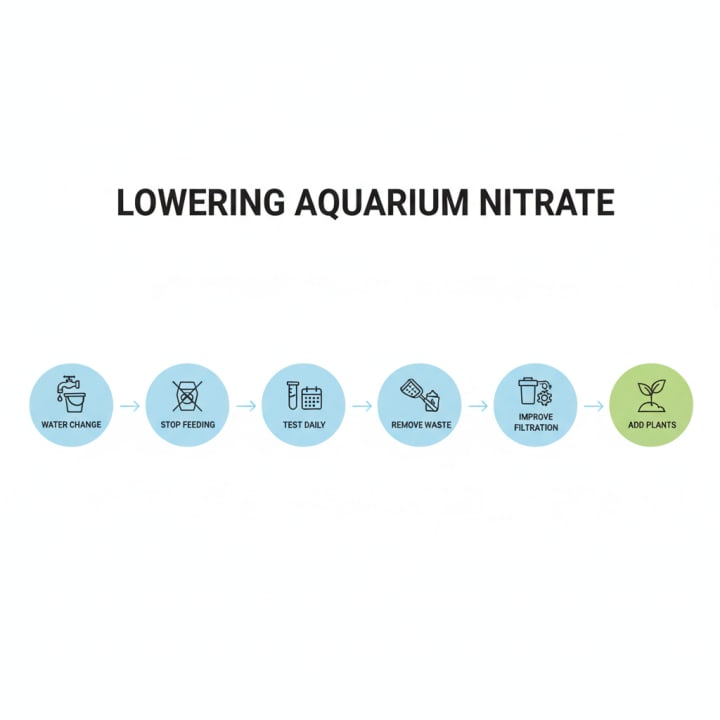
If nitrate exceeds 40 ppm, immediate dilution and waste control are required to prevent long-term damage.
- Perform a 50% water change immediately using dechlorinated water matched to tank temperature
- Stop feeding for 24 hours to reduce waste production
- Test nitrate levels daily and perform additional 25–30% water changes if levels remain above 40 ppm
- Remove any visible debris, uneaten food, or decaying plant matter from substrate
- Check and clean filter intake and media to restore full water flow
- Add fast-growing live plants like hornwort or water sprite if possible
- Avoid adding new fish or increasing feeding until nitrate stabilizes below 20 ppm
Step-by-Step Action Plan
Step 1: Emergency Water Change
Replace 50% of tank water with fresh, dechlorinated water. Match the temperature within 2–3°F of the tank to avoid shocking fish. Use a gravel vacuum to remove waste from the substrate during the water change. This single action can reduce nitrate by approximately 50% immediately.
Warning: Do not change more than 50% at once. Larger changes can cause rapid pH shifts that stress fish more than the nitrate itself.
Step 2: Stop Feeding
Withhold food for 24 hours to give the system time to process existing waste without adding new bioload. Most fish can safely fast for 3–5 days without harm, so one day causes no health issues. Resume feeding at half portions on day two.
Step 3: Daily Testing
Test nitrate every 24 hours using a liquid test kit. Nitrate levels should decrease by 10–20 ppm per day if water changes are effective and no new sources are added. If nitrate does not decrease or increases, identify and eliminate the source before continuing.
Step 4: Remove Physical Waste
Use a gravel vacuum or turkey baster to remove all visible detritus, uneaten food, and dead plant material. These organic materials decay into ammonia, which becomes nitrate. Removing them prevents further accumulation.
Step 5: Optimize Filtration
Clean or replace mechanical filter media (sponges, filter floss) to restore water flow. Rinse biological media in old tank water only—never tap water, which kills beneficial bacteria. Ensure the filter is rated for at least your tank's volume; upgrade if undersized.
Step 6: Add Live Plants
Introduce fast-growing species that consume nitrate rapidly. Hornwort, water sprite, anarchis, and floating plants like duckweed or salvinia absorb significant nitrate while improving water quality. Plant at least one stem per 5 gallons for noticeable effect.
Dosage guidance: For a 20-gallon tank with 80 ppm nitrate, add 4–6 stems of fast-growing plants and expect nitrate to decrease by an additional 5–10 ppm per week beyond water changes.
Step 7: Monitor for One Week
Continue daily testing for seven days. Nitrate should decline steadily toward 20 ppm or below. If levels plateau above 40 ppm despite interventions, increase water change frequency to 25% every two days until the target is reached.
What You Should Not Do Next
Avoid these common mistakes that worsen nitrate problems or delay recovery:
❌ Do not add chemical nitrate removers without understanding the cause.
These products mask symptoms without fixing overstocking, overfeeding, or poor maintenance. Nitrate will return immediately after treatment ends.
❌ Do not perform 100% water changes.
Complete water replacement crashes pH and removes all beneficial bacteria, causing ammonia and nitrite spikes that are more dangerous than nitrate.
❌ Do not increase feeding to "help fish recover."
Fish under nitrate stress need less food, not more. Additional feeding accelerates nitrate accumulation and worsens the crisis.
❌ Do not add more fish during recovery.
Any addition increases bioload and produces more nitrate, prolonging the problem.
❌ Do not skip testing because symptoms improve.
Fish may appear better while nitrate remains dangerous. Test until levels confirm safe conditions.
❌ Do not clean biological filter media in tap water.
Chlorine kills beneficial bacteria, eliminating your tank's ability to process ammonia and nitrite. Always rinse media in old tank water.
How Long It Takes Nitrate to Drop
Nitrate reduction depends on three factors: initial concentration, water change frequency, and whether the source has been eliminated.
Typical timelines:
- 50% water change: immediate 50% reduction (e.g., 80 ppm drops to 40 ppm)
- With proper maintenance: 10–20 ppm decrease per day
- Without identifying the cause: nitrate returns to original levels within 3–7 days
A tank at 100 ppm can reach 20 ppm in 5–7 days with daily 25% water changes and corrected maintenance. A tank that receives one 50% change but no follow-up will see nitrate climb back to 60–80 ppm within one week.
What progress looks like:
- Day 1 (100 ppm) → 50% water change → 50 ppm
- Day 2 (50 ppm) → 25% water change → 37 ppm
- Day 3 (37 ppm) → 25% water change → 28 ppm
- Day 4 (28 ppm) → 25% water change → 21 ppm
- Day 5 (21 ppm) → maintain with weekly 25% changes
When intervention has failed: If nitrate does not decrease after three consecutive water changes, or if it drops but climbs back within 48 hours, you have not addressed the root cause. Recheck stocking, feeding amounts, filter function, and dead organic matter.
Consider that tap water itself may contain nitrate test your source water before adding it to the tank. Many municipal tap water sources already contain 10–40 ppm nitrate, which means water changes alone may not lower tank nitrate unless source water is tested
Preventing High Nitrate Long-Term
Feeding Discipline
Feed fish once daily, providing only what they consume in 2–3 minutes. Overfeeding is the single most controllable cause of nitrate buildup. For most community fish, feeding 5–6 days per week is sufficient. Fasting one day per week reduces bioload by approximately 15%.
Stocking Pace
Add fish gradually, allowing bacterial populations to expand with bioload. Adding 3–5 fish per week gives beneficial bacteria time to colonize new surfaces and process increased waste. Overloading a tank with 20 fish at once will spike nitrate within days.
Stock conservatively. One inch of adult fish per gallon is a starting point, not a maximum. Messy species like goldfish, oscars, and plecos require double the space. A 20-gallon tank should hold 10–12 inches of community fish, not 20.
Plants
Live plants remove nitrate continuously without requiring water changes. Fast-growing stem plants (hornwort, cabomba, water sprite) and floating plants (duckweed, salvinia, frogbit) are most effective. Even slow-growing plants like anubias and java fern provide modest nitrate reduction.
For significant impact, plant density should cover at least 25% of substrate or surface area. A heavily planted tank can maintain nitrate below 10 ppm with less frequent water changes.
Filter Maintenance
Clean mechanical media every 2–3 weeks to maintain water flow. Rinse biological media every 4–6 weeks in old tank water to remove debris without killing bacteria. Replace chemical media (activated carbon, zeolite) monthly. An efficiently running filter processes waste before it decays into nitrate.
Upgrade filtration if your current filter is undersized. A filter rated for your exact tank volume is minimum; 1.5–2 times tank volume is ideal. A 30-gallon tank benefits more from a filter rated for 50 gallons than one rated for exactly 30.
Testing Schedule
Test nitrate weekly in established tanks and twice weekly in new tanks or after adding fish. Weekly testing catches rising nitrate before it reaches dangerous levels, allowing you to adjust maintenance before fish are harmed.

Keep a log of test results to identify trends. If nitrate consistently climbs from 10 ppm to 30 ppm between water changes, increase change frequency or volume. If nitrate remains stable at 5 ppm, your maintenance schedule is effective.
FAQs
What nitrate level is dangerous for fish?
Nitrate becomes dangerous to most freshwater fish above 40 ppm, causing chronic stress and immune suppression. Levels above 80 ppm significantly increase the risk of organ damage and death.
Is nitrate toxic to fish?
Yes, nitrate is toxic to fish through long-term exposure. Unlike ammonia or nitrite, nitrate causes chronic stress, weakened immunity, and organ damage when levels remain elevated.
How do I lower nitrate quickly in my aquarium?
Perform a 50% water change immediately, stop feeding for 24 hours, and remove visible waste. Continue 25–30% water changes daily until nitrate drops below 20 ppm.
Why is my nitrate high but ammonia is zero?
High nitrate with zero ammonia means the nitrogen cycle is complete, but nitrate is accumulating. This happens when water changes or plant uptake are insufficient.
Can fish survive high nitrate?
Fish can survive nitrate levels of 40–80 ppm short term, but prolonged exposure causes stress, disease, and organ damage. Long-term survival requires nitrate reduction below safe levels.
How long does it take nitrate to go down?
A 50% water change reduces nitrate by about half immediately. With daily water changes, nitrate typically drops 10–20 ppm per day.
What is the difference between nitrate and nitrite?
Nitrite is highly toxic and causes oxygen deprivation, while nitrate is less toxic but harmful over time. Nitrite spikes kill quickly; nitrate damages fish through chronic exposure.
Does water change remove nitrate?
Yes, water changes physically remove nitrate from aquarium water. A 50% water change removes approximately 50% of dissolved nitrate.
Can high nitrate cause algae?
Yes, nitrate above 20 ppm fuels algae growth by providing excess nutrients. Keeping nitrate below 10 ppm helps prevent most algae outbreaks.
Do nitrate-removing filter media work?
Nitrate-removing media work temporarily but do not fix the root cause. Water changes and live plants provide more reliable long-term nitrate control.
Final Summary
High nitrate is not an emergency toxin like ammonia or nitrite, but it is one of the most common causes of long-term fish health decline. Because nitrate accumulates silently, aquariums can appear stable while fish experience chronic stress, weakened immunity, and shortened lifespan. The key to nitrate control is not quick fixes, but consistent dilution through water changes, disciplined feeding, appropriate stocking, and biological balance. When nitrate is measured, understood, and managed proactively, it becomes one of the easiest water parameters to keep within safe limits.
- Nitrate is the final byproduct of the nitrogen cycle, less toxic than ammonia or nitrite but dangerous through chronic exposure above 40 ppm
- Safe nitrate levels are 0–20 ppm for most species; sensitive fish require levels below 10 ppm
- Symptoms include lethargy, loss of appetite, weakened immunity, and organ damage, but these appear gradually rather than immediately
- Primary causes are overstocking, overfeeding, infrequent water changes, insufficient plants, and poor filtration
- Emergency treatment requires immediate 50% water change, stopping feeding for 24 hours, removing waste, and daily testing until levels stabilize
- Long-term prevention depends on disciplined feeding, conservative stocking, regular maintenance, live plants, and weekly testing
- Water changes are the most reliable method of nitrate removal; expect 10–20 ppm reduction per day with proper intervention
- Never use high-percentage water changes (above 50%), clean biological media in tap water, or add fish during recovery
About the Creator
Arjun
Aquarium hobbyist sharing simple, real-world fixes for snail, shrimp, and plant problems. Clear guides, no fluff just practical tips to keep your tank healthy and thriving.
United States Malted Wheat Flour Market Size and Forecast 2025–2033
United States Malted Wheat Flour Market The United States Malted Wheat Flour Market is entering a phase of steady and value-driven growth, supported by evolving consumer preferences, technological advances in milling, and rising demand from bakeries, confectioneries, and craft breweries. According to Renub Research, the market is projected to reach US$ 19.54 billion by 2033, expanding from US$ 12.37 billion in 2024, at a compound annual growth rate (CAGR) of 5.21% from 2025 to 2033.
By jaiklin Fanandisha day ago in Earth



Comments
There are no comments for this story
Be the first to respond and start the conversation.