
Exploring the World of Spiders: Anatomy, Behavior, Habitats, and Myths
Exploring the Fascinating World of Spiders: Anatomy, Behavior, Habitats, Classification, and Myths
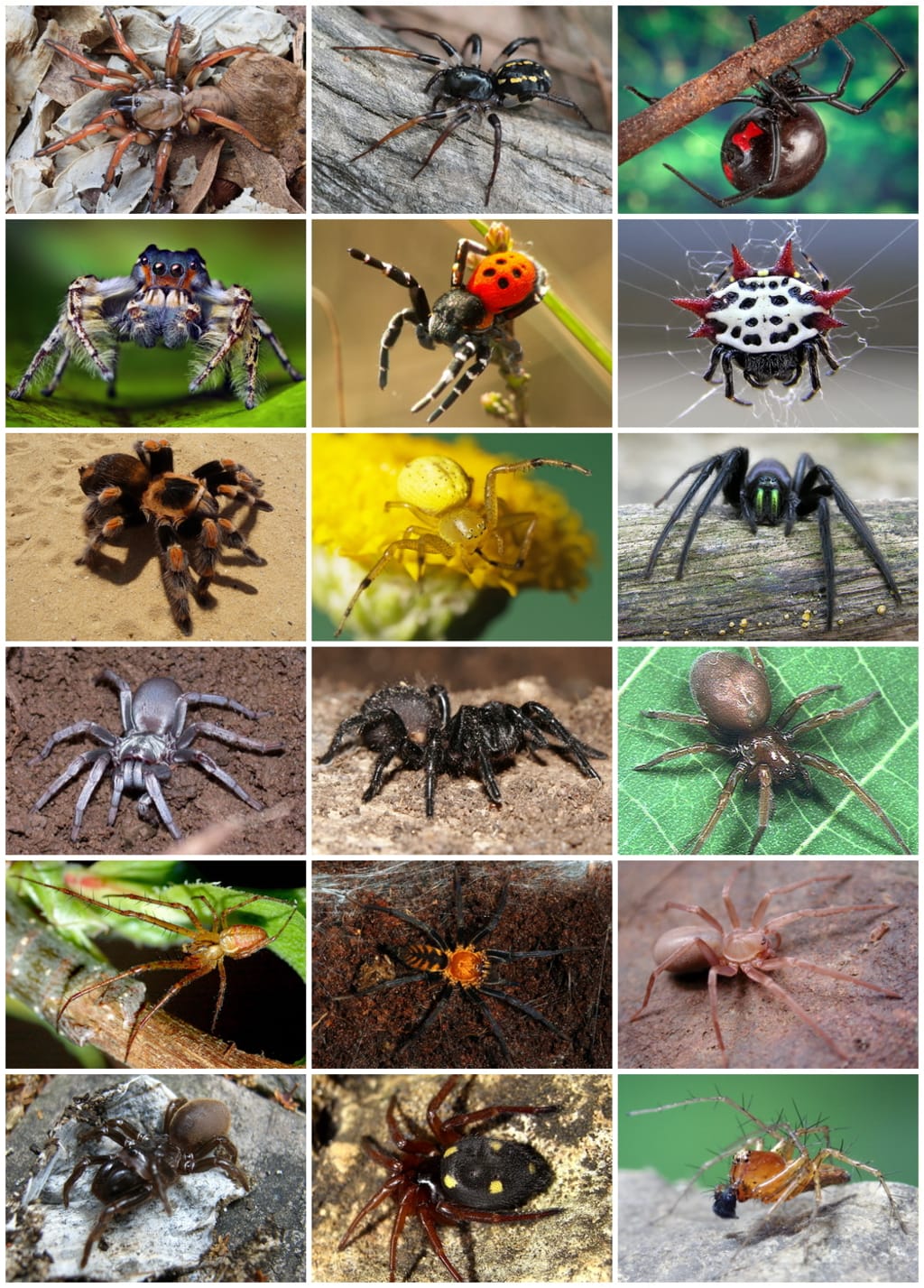
Spiders are one of the most fascinating and mysterious creatures on earth. With their eight legs and intricate webs, they have been the subject of countless stories and myths throughout human history. From the ancient Greeks who associated them with the goddess Athena, to modern-day horror movies that depict them as deadly predators, spiders have captured the imagination of people around the world. In this article, we will explore the world of spiders, their anatomy, behavior, and habitats.
Part 1: Anatomy of Spiders
Spiders belong to the class Arachnida and are characterized by their two main body parts, the cephalothorax and the abdomen. The cephalothorax is the head and thorax combined, while the abdomen is the rear portion of the spider's body. Spiders have eight legs, each consisting of seven segments. The first segment, the coxa, is attached to the spider's body, while the last segment, the tarsus, is the spider's foot.
In addition to their legs, spiders have two additional appendages known as pedipalps. These appendages are located near the spider's mouth and are used for sensory purposes as well as mating. Male spiders often have enlarged pedipalps, which they use to transfer sperm to the female during mating.
Spiders also have two pairs of simple eyes and sometimes additional pairs of eyes that are more complex. These eyes allow spiders to sense light and movement and are critical to their ability to hunt prey.
Part 2: Spider Behavior
Spiders are known for their ability to spin intricate webs, which they use to capture prey. Different species of spiders construct different types of webs, ranging from simple orb webs to complex trapdoor webs. The silk that spiders use to spin their webs is incredibly strong and elastic, making it ideal for capturing prey.
Spiders are also known for their ability to hunt using different techniques. Some species of spiders actively hunt for their prey, while others sit and wait for their prey to come to them. Some spiders are known for their ability to jump, while others can move quickly across surfaces.
Spiders are also known for their unique method of mating. Male spiders often approach the female carefully, tapping her legs to signal his intentions. If the female is receptive, the male will use his pedipalps to transfer sperm to the female. In some species, the female may then consume the male.
Part 3: Spider Habitats
Spiders can be found in almost every habitat on earth, from deserts to rainforests. They are particularly common in areas with abundant insect prey, such as agricultural fields and gardens.
Some species of spiders are adapted to live in water, while others live in trees or underground. Some spiders are nomadic and travel long distances to find food or mates, while others remain in one location for their entire lives.
Part 4: Spider Classification
Spiders belong to the class Arachnida, which includes other arachnids such as scorpions, ticks, and mites. There are over 45,000 known species of spiders, and new species are still being discovered today.
Spiders are further divided into two main groups: the mygalomorphs and the araneomorphs. Mygalomorphs are primitive spiders that have fangs that point straight down. Araneomorphs, on the other hand, have fangs that are angled inward.
Part 5: Spider Myths and Legends
Throughout human history, spiders have been the subject of countless myths and legends. In ancient Greece, spiders were associated with the goddess Athena, who was said to have transformed her mortal rival into a spider. In some Native American cultures, spiders were considered to be the weavers of fate, while.
About the Creator
Keep reading
More stories from Kamal Mourya and writers in Earth and other communities.
Caecilians: The Fascinating and Little-Known Limbless Amphibians
Caecilians are a fascinating group of limbless, elongated amphibians that belong to the order Gymnophiona. They are often mistaken for snakes or earthworms, but they are actually more closely related to frogs and salamanders. Caecilians are found in tropical regions around the world, including Africa, Asia, and Central and South America. Despite their relatively low profile, caecilians play an important role in their ecosystems, and they have some fascinating adaptations that make them unique among amphibians.
By Kamal Mourya3 years ago in Earth
The AI Boom Will Increase U.S. Carbon Emissions—But It Doesn’t Have to
Artificial intelligence is reshaping the U.S. economy at a breathtaking pace. From generative AI tools and cloud computing to data-driven healthcare and finance, the AI boom promises productivity gains, innovation, and economic growth. But beneath this technological optimism lies a growing concern: AI is energy-hungry, and without intervention, it could significantly increase U.S. carbon emissions.
By Muhammad Hassan4 days ago in Earth
Do Not Touch the Roses
There is a quiet power in the phrase “Do Not Touch the Roses.” It sounds like a warning, but it feels like an invitation — one that asks us to pause, admire, and respect something without claiming it. Roses have long symbolized love, beauty, and passion, yet they are also guarded by thorns. That contradiction makes them the perfect metaphor for many of life’s most meaningful things.
By Aarif Lashari7 days ago in Earth




Comments
There are no comments for this story
Be the first to respond and start the conversation.