
Caecilians: The Fascinating and Little-Known Limbless Amphibians
Exploring the Fascinating World of Caecilians: Physical Characteristics, Habitat, Diet, Reproduction, and Conservation
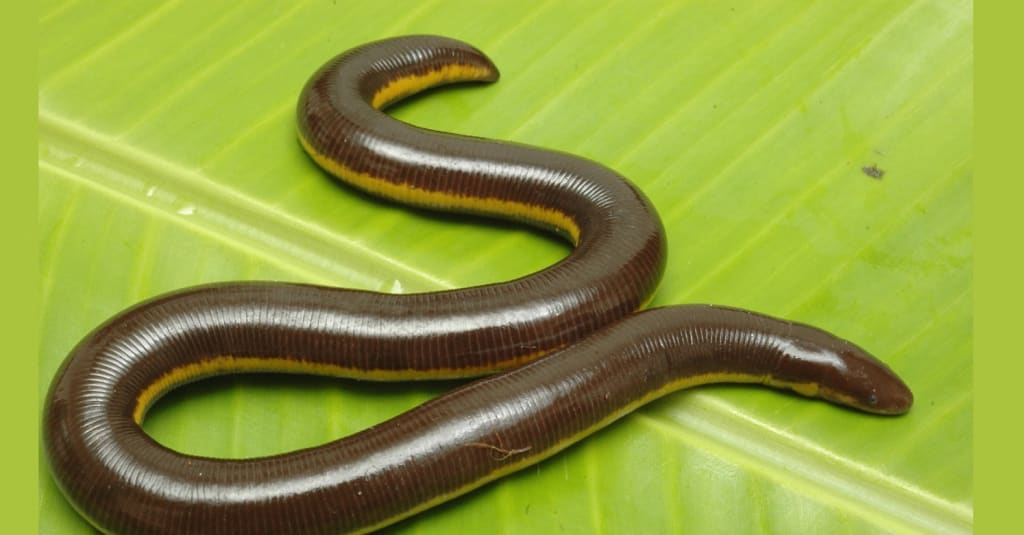
Caecilians are a fascinating group of limbless, elongated amphibians that belong to the order Gymnophiona. They are often mistaken for snakes or earthworms, but they are actually more closely related to frogs and salamanders. Caecilians are found in tropical regions around the world, including Africa, Asia, and Central and South America. Despite their relatively low profile, caecilians play an important role in their ecosystems, and they have some fascinating adaptations that make them unique among amphibians.
Physical Characteristics
Caecilians have a long, cylindrical body that can range in size from a few inches to nearly 5 feet. Unlike snakes, which have scales, caecilians have a smooth, slimy skin that is often mistaken for the skin of an earthworm. Their skin is also covered with tiny scales that are too small to see without a microscope. Caecilians have a small, flattened head with a slightly upturned snout that helps them burrow through soil and leaf litter.
One of the most distinctive features of caecilians is their eyes, which are covered by a layer of skin. Despite this, caecilians have surprisingly good vision, and they are able to detect movement and light. They also have a pair of tentacles located between their nostrils and eyes that are used to detect vibrations in the soil. These tentacles are covered with sensory cells that help the caecilian navigate its environment.
Caecilians are also unique among amphibians in that they have a set of tiny, retractable teeth that are used to grasp prey. Their jaws are able to expand to accommodate larger prey, and some species are able to swallow prey that is larger than their own body size.
Habitat and Distribution
Caecilians are found in a variety of habitats, including rainforests, swamps, and savannas. They are most commonly found in tropical regions, although some species have adapted to living in more arid environments. Caecilians are also able to burrow through soil and leaf litter, which allows them to create their own microhabitats within larger ecosystems.
There are over 200 species of caecilians, and they are found in a variety of locations around the world. Most caecilians are found in Central and South America, although there are also species in Africa and Asia. Some species are highly specialized and are only found in very specific microhabitats, such as cave-dwelling caecilians or those that live in ant or termite nests.
Diet and Feeding Behavior
Caecilians are carnivores, and they primarily eat small invertebrates such as worms, termites, and ants. Some larger species are able to take down small mammals or other amphibians, but this is relatively rare. Caecilians are able to detect prey using their sensory tentacles, and they use their small, sharp teeth to grasp and swallow their prey whole. Some species are able to use their bodies to create a vacuum that helps them suck in prey more efficiently.
Reproduction and Life Cycle
Caecilians are oviparous, which means that they lay eggs. However, unlike most other amphibians, caecilians do not have a larval stage. Instead, the eggs hatch into miniature versions of the adult caecilian. The young caecilians are able to feed and fend for themselves almost immediately after hatching.
In some species, the female caecilian will carry the eggs and young in a specialized chamber within her body. The young are born live, rather than hatching from eggs. This allows the female to protect her young from predators and ensure that they have the best chance of survival.
Conservation Status
Despite their unique adaptations and important ecological roles, caecilians are relatively
About the Creator
Keep reading
More stories from Kamal Mourya and writers in Earth and other communities.
Salamanders and Newts: The Fascinating World of Amphibians
Salamanders and newts are fascinating amphibians that have captured the imaginations of people for centuries. These animals belong to the order Caudata, which includes around 700 species of salamanders and newts. They are found all over the world, with the highest diversity in the Northern Hemisphere. Salamanders and newts are unique creatures that have many interesting features and adaptations. In this article, we will explore the world of salamanders and newts in more detail.
By Kamal Mourya3 years ago in Earth
Hotel Giant Collapses into Administration — 8,300 Employees Affected
In a shocking turn for the European hospitality sector, Revo Hospitality Group, one of the continent’s largest hotel operators, has filed for insolvency, putting about 8,300 jobs at risk. The move comes amid mounting financial pressures, rising costs, and an unstable post-pandemic market for travel and tourism.
By Aarif Lashari6 days ago in Earth
Rage
Content Warning: Domestic Violence, Assault Rage D. A. Ratliff “Who did this?” My voice echoed through the house. All I wanted was a cup of tea, but one of the twins, running through the house like maniacs, knocked it over. My nerves tingled, and every muscle in my body felt coiled like a spring. Survival seemed out of reach.
By D. A. Ratliff6 days ago in Fiction



Comments
There are no comments for this story
Be the first to respond and start the conversation.