
Discovery of the World Scientists’ Favorite New Species, the Red Orchid from Waigeo Island, Papua
The Royal Botanic Gardens, England have selected 10 favorite species from 74 plants and 5 new fungal species they discovered. One of them is the red orchid which comes from Waigeo Island, Raja Ampat, Indonesia.

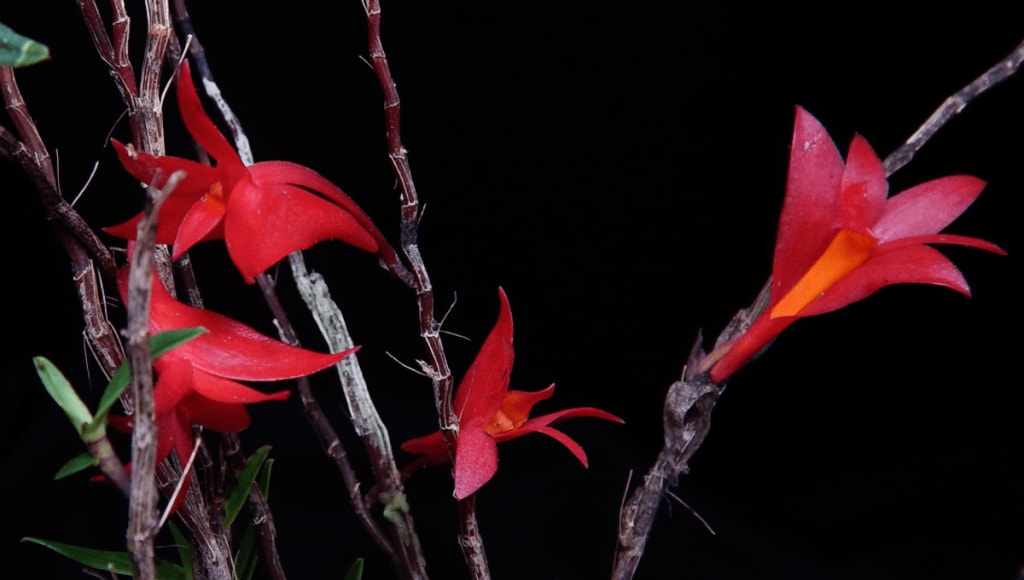
The ten new species are epiphytic orchids, underground trees, unique fungi, red orchids, underground flowering palms, snow fungus, dry land tobacco, endangered flowering plants, Indigofera abbottii and carnivorous plants.
The discovery of a new species of red orchid on Waigeo Island began with an expedition to Waigeo Island in 2020 carried out by a team from BBKSDA West Papua together with the Fauna & Flora International Indonesia Program to look for the Papuan blue orchid which is endangered and has never been seen. for about 80 years.
The expedition team then discovered a new type of bright red orchid that had never been described before. The new orchid was then given the name Dendrobium lancilabium subspecies wuryae.
Scientists working at the Royal Botanic Gardens, Richmond, UK and international partners have selected their 10 favorite new species. One of them is the red orchid which comes from Waigeo Island, Raja Ampat, Indonesia.
This selection is also in celebration of 2023 as a special year, because there are 74 plants and 5 mushrooms that were named by them and international partners. This good news comes amid reports that three of four undescribed plant species are threatened with extinction. Meanwhile, there are more than two million species of mushrooms that can still be found.
The ten new species are:
- Epiphytic orchid Aeranthes bigibbum (Madagascar)
- Underground tree Baphia arenicola (Angola)
- Unique mushroom Lichtheimia koreana (South Korea),
- Red orchid Dendrobium azureum (Indonesia),
- Ground flowering palm tree Pinanga subterranea (Malaysia),
- Snow fungus Arthonia olechiana, Sphaeropezia neuropogonis, and
- Sphinctrina sessilis (Antarctica),
- Tobacco on dry land Nicotiana spp. (Australia),
- The nearly extinct flower plant Microchirita fuscifaucia (Thailand),
- Indigofera abbottii (various countries), and
- Carnivorous plant Crepidorhopalon droseroides (Mozambique).
“It’s an exciting time to be a scientist, but even as we make these incredible new discoveries, we have to remember that nature is under threat, and we have the power to do something about it,” said researcher Martin Cheek. senior from the Royal Botanic Gardens, in a statement shared with the media.
The journey to find red orchids from Waigeo Island itself is quite unique. In 2020, a team from the West Papua Natural Resources Conservation Center (BBKSDA), and a team from the Indonesian International Fauna & Flora Program, carried out an expedition to the highest peak of Mount Nok (880 m) located on Waigeo Island.
One of the objectives of their expedition this time was actually to look for blue orchids from Papua (Dendrobium azureum) which had not been seen for approximately 80 years. This orchid, which was declared endangered by the IUCN, was first collected in 1938 by a British entomologist. The team succeeded in rediscovering an epiphytic orchid which is the only dark blue orchid out of 17 thousand orchids of this type.
The good news then increased when the team discovered a new type of bright red orchid that had never been described before. These findings were then written up in the German publication Orchideen Journal (2022).
The team consisted of Andre Schulteman (Royal Botanic Garden, England), Jimmy Frans Wanma (Faculty of Forestry, Unipa, Manokwari), Daniel Jemmy Oruw and Haerul Arifin (West Papua Regional Research and Innovation Agency, Manokwari), Yanuar Ishaq Dwi Cahyo and Kristian Maurits Kafiar (Fauna & Flora International Indonesia Program, Sorong), Muhamad Wahyu Hasibuan (BBKSDA West Papua, Sorong), and Charlie Danny Heatubun (RBG, Unipa, BRIDA).
It was later discovered that this orchid is endemic to Waigeo Island, and is found in most of the mountains on the Bird's Head peninsula (Southwest Papua) and Wandame (West Papua).
This epiphytic orchid grows on trees at a height of 8 to 12 meters from the ground. Orchids grow on mossy tree trunks or misty forests, at an altitude of 820 meters above sea level.
The newly discovered orchid was then given the name Dendrobium lancilabium subsp. wuryae. The name was given in honor of Vice President Ma'ruf Amin's wife, Wury Estu Handayani. Wury is considered to have contributed to supporting the conservation, preservation and sustainable use of local flora, especially orchids in West Papua.
"We assess that currently this type of orchid is very threatened because it only exists around Mount Nok and not in other areas," said Jimmy Frans Wanma, as quoted by Antara.
According to Jimmy, the expedition, which was carried out for about a week, also found various types of orchids. However, most of these have been discovered in previous research. In contrast to Dendrobium lancilabium subsp. wuryae that had never been known before.
The most prominent characteristic of this orchid is of course its bright red flowers. Both dorsal sepals, two lateral sepals, and both petals are all red. Although the labellum is orange, so are the columns and anthers. The flowers themselves measure 3.5 cm long and 3.2 cm wide. When discovered, this orchid, which was considered difficult to develop outside its habitat, flowered last February.
The stem of the red orchid is brownish red and upright and slender. Meanwhile, the roots are sparse, unbranched and smooth. The leaves are green, do not spread, and soon wilt. Meanwhile, the leaf midrib is purplish green, cylindrical in shape, and blackish when dry.
Mount Nok is an inactive volcano. This is the local name for Mount Buffelhoorn or buffalo horn which is in the East Waigeo nature reserve area, Raja Ampat Regency, West Papua. Mount Nok is Jurassic in age or between 201.3 and 145 million years ago.
This nature reserve with an area of around 100 thousand hectares is the habitat of various endemic animals, namely waigeo maleo (Aepypodius bruijnii), red bird of paradise (Paradiseae rubra), bald bird of paradise (Cicinnurus respublica). ) and spotted cuscus (Spilocuscus maculatus).
Waigeo, which means the waters and land of the Gi people, is currently facing the threat of destruction due to deforestation and illegal wildlife trade.
About the Creator
Wisnu ms
a simple man
Melting Antarctic Ice Did the Opposite of What Scientists Expected
The Antarctic ice sheet, one of the largest reservoirs of frozen water on Earth, has long been under close observation by climate scientists. Conventional wisdom suggested that as global temperatures rise, the ice sheet would steadily thin and retreat, contributing to accelerating sea-level rise. But recent research is showing that parts of Antarctica are behaving in ways scientists did not anticipate, potentially rewriting our understanding of how the southernmost continent reacts to climate change.
By Sajida Sikandar5 days ago in Earth
📢 Raise Your Voice Thread: 02/05/2026
Our “Raise Your Voice Threads” are hosted most alternating Thursdays at 12PM ET to offer creators more avenues to uncover exceptional stories on Vocal. As we are continuously searching for fresh creators and inspiring stories, this thread provides an opportunity to exchange and discuss the stories that have moved and motivated us on Vocal.
By Raise Your Voice by Vocal3 days ago in Resources



Comments (1)
Exquisite. I love learning about flowers.