
“Why Is a Raven Like a Writing Desk?”: Unriddling Lewis Carroll’s Most Perplexing Puzzle
A Scholarly Stroll Through Nonsense, Symbolism, and Literary Legacy

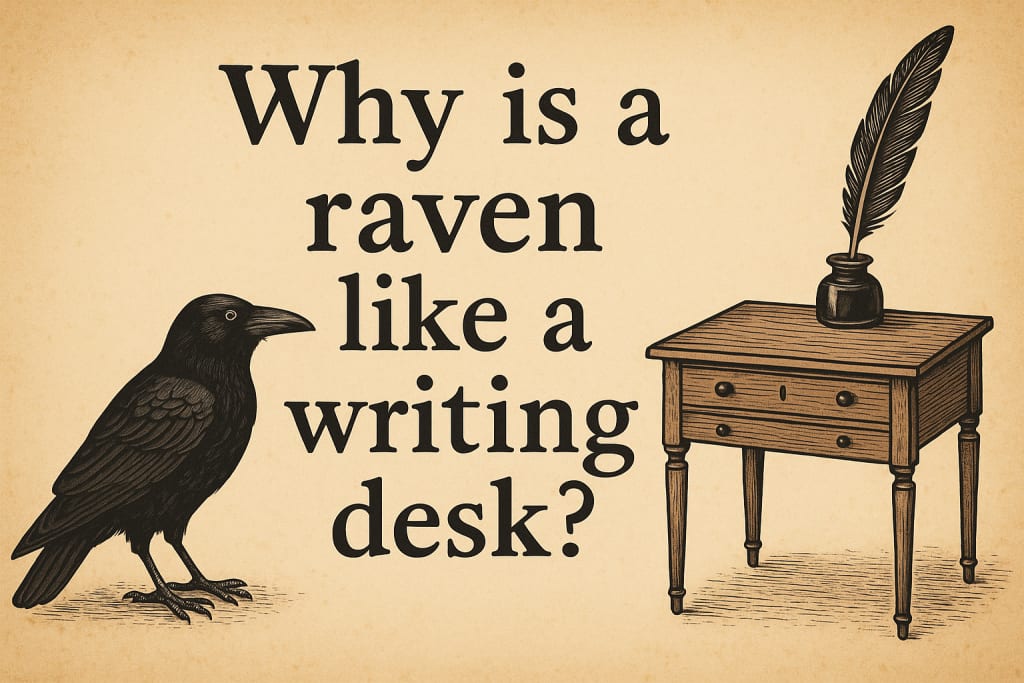
Introduction: A Riddle Wrapped in an Enigma, Inside a Mad Tea Party
In the annals of literary history, few riddles have provoked as much curiosity, consternation, and coffeehouse conversation as Lewis Carroll’s notorious brainteaser, “Why is a raven like a writing desk?” First posed in Alice’s Adventures in Wonderland (1865), the question emerges from the mouth of the Mad Hatter during a nonsensical tea party, and it quickly became one of the most iconic and confounding lines in children’s—and arguably adult—literature.
But unlike typical riddles, Carroll originally provided no answer. This absence of resolution sent generations of readers, scholars, and jokesters alike into a frenzied quest for meaning. Was it merely a trick? A satire of logic itself? Or a deeply buried metaphorical gem in the soil of Victorian whimsy?
This essay embarks on a 1,000-word expedition through the literary, cultural, and philosophical terrain surrounding the riddle, attempting not to solve it (which would be a sort of heresy), but to appreciate the dimensions of its enduring mystery.
---
Part I: The Origin of the Riddle in Wonderland
The riddle makes its debut in Chapter Seven of Alice’s Adventures in Wonderland, during the Mad Tea Party. Amidst nonsensical banter and poetic recitations about treacle wells and dormice, the Hatter suddenly asks Alice:
- “Why is a raven like a writing-desk?”
Alice, naturally, expects an answer. After all, riddles generally come with punchlines or revelations. But when she gives up, frustrated, the Hatter replies:
- “I haven’t the slightest idea.”
Even Carroll himself, when asked about it by readers, initially claimed it was meant to be without answer—a satire of riddling conventions and the Victorian compulsion to ascribe meaning to nonsense. Yet the very act of planting a question without a solution turned out to be a far more potent trick than offering a proper punchline. It became a sort of conceptual Trojan horse, sneaking ambiguity and doubt into the very heart of logic and language.
---
Part II: Carroll’s Later Commentary – A Backpedal or a Bonus?
Years after the book’s publication, perhaps worn down by an avalanche of correspondence, Carroll (born Charles Lutwidge Dodgson) provided a proposed answer in the preface to the 1896 edition of The Nursery “Alice”:
- “Because it can produce a few notes, though they are very flat; and it is nevar put with the wrong end in front!”
The word “nevar”—“raven” spelled backward—was said to be an intentional misspelling, later corrected by editors who, in an ironic twist, removed the pun entirely. Carroll’s answer was widely interpreted as tongue-in-cheek, satisfying no one fully but delighting everyone a little.
Carroll’s answer, in truth, was no more “correct” than any other. It was a nod to the futility of demanding logic in a world deliberately deprived of it. Like many of Carroll’s jokes and inventions, the answer undermines its own authority and further emphasizes the absurdity it sprang from.
---
Part III: The Avalanche of Answers – From the Sublime to the Silly
Despite—or because of—Carroll’s elusive stance, countless answers have been proposed over the years. Some are clever. Some are groan-inducing. A few are strangely poetic. Here are just a sampling:
“Because Poe wrote on both.”
A sly reference to Edgar Allan Poe, who wrote on (about) ravens and literally wrote on a writing desk. It's elegant and literary.
“Because there’s a ‘b’ in both and an ‘n’ in neither.”
Linguistic gymnastics at its punniest.
“Because they both stand on sticks.”
Not inaccurate, though one feels the riddle deserves better.
“Because they both come with inky quills.”
A delightful synthesis of Victorian imagery.
Each proposed answer, regardless of plausibility, functions as a reflection of the riddle’s cultural elasticity. The riddle becomes less about solving and more about participation. It invites us not to find the answer, but our answer.
---
Part IV: The Literary Function of the Riddle
Within the narrative context of Alice, the riddle performs a crucial function: it highlights the futility of applying traditional logic to a world governed by dream-logic and nonsense.
Carroll, a mathematician and logician, was acutely aware of how rules shape perception. By inserting a riddle with no answer into a chapter filled with circular reasoning and absurdity, he drew attention to the limitations of language and structured thought. The Mad Hatter’s riddle becomes a small but profound act of rebellion against rationalism.
It is worth noting that Carroll’s career as a lecturer in mathematics at Christ Church, Oxford, intersected with his love of wordplay and puzzles. The raven/writing desk riddle, then, can be seen as an artistic experiment with the boundaries between logic and nonsense—a liminal space where meaning disintegrates just enough to become intriguing.
---
Part V: Ravens, Writing Desks, and the Romantic Imagination
Beyond mere wordplay, both the raven and the writing desk carry heavy symbolic associations.
Ravens, in Western literature, often represent omens, darkness, death, and prophecy—most famously in Poe’s The Raven. Writing desks, meanwhile, are symbols of creation, contemplation, and the power of language. In juxtaposing the two, Carroll may be drawing attention—consciously or not—to the way in which darkness (the raven) and light (the desk, a tool of reason) must coexist in literature and life.
In this interpretation, the riddle is not nonsense, but poetry masquerading as nonsense. The two objects may be unalike on the surface, but both become vessels of voice—cawing or writing, they issue utterances into the world. Perhaps that's what makes the question so persistent: it's not really a joke at all, but a metaphor in disguise.
---
Part VI: Cultural Legacy and Modern Resonance
In the years since its publication, the riddle has leapt far beyond the confines of Alice. It’s appeared in song lyrics, television shows, scholarly essays (such as this one), and philosophical musings. Its survival is proof of its cultural magnetism.
The persistence of the question, even in meme culture and Internet forums, shows how Carroll’s playful jab at rationalism has taken on a life of its own. It is a kind of conceptual Rosetta Stone—a riddle that reveals not answers, but layers of inquiry. It doesn’t solve anything, but it starts something: a conversation, a chuckle, a moment of puzzlement. What more can art aspire to?
---
Conclusion: No Answer Required
So why is a raven like a writing desk?
Because Carroll wanted to tease us. Because readers needed something to unravel. Because the best questions often aren’t answered—they’re pondered, passed around, and turned over like stones in a stream. Because the point of the riddle was never the punchline, but the provocation.
In the end, Carroll’s riddle is a triumph not of nonsense, but of imaginative engagement. It whispers to each of us: Interpret me if you dare. But don’t expect to be done with me once you do. It is a literary zen koan, endlessly echoing in the minds of readers long after the tea has gone cold.
And perhaps that’s the real answer:
Because it continues to make us think—and smile.
About the Creator
Standing While Falling
Quotation from Friedrich Nietzsche "He who wrestles long with monsters should beware lest he himself become a monster. And if you gaze long into an abyss, the abyss also gazes into you. Man is not destroyed by suffering, but by the meaning he makes of it."
By LUCCIAN LAYTH11 days ago in Critique
''The Mule'' of 2026
Abstract This article examines the growing comparison between Peter Ayolov and the figure of the Mule from Isaac Asimov’s *Foundation* series as a metaphor for disruptive unpredictability in theoretical systems. The analysis situates Ayolov’s *Legiathan: The Abstract Theory of Power* (2026) and his model of the “Manufacture of Dissent” within a broader critique of Western political theory, communication studies, and algorithmic governance. Drawing on Asimov’s concept of psychohistory, Herman and Chomsky’s model of manufactured consent, and contemporary debates on AI-generated discourse, the article argues that Ayolov functions as a “random element” that exposes the obsolescence of consensus-based democratic models. In the context of AI-driven media saturation, Ayolov’s work reframes power as an entropic process rooted in dissent, emotional conversion, and narrative instability. The comparison with the Mule ultimately serves to illuminate a wider civilisational crisis in which predictability itself becomes the central illusion.
By Peter Ayolova day ago in Critique


Comments (1)
The 'raven vs writing desk' riddle's mystery has intrigued for ages. I remember pondering it as a kid.