
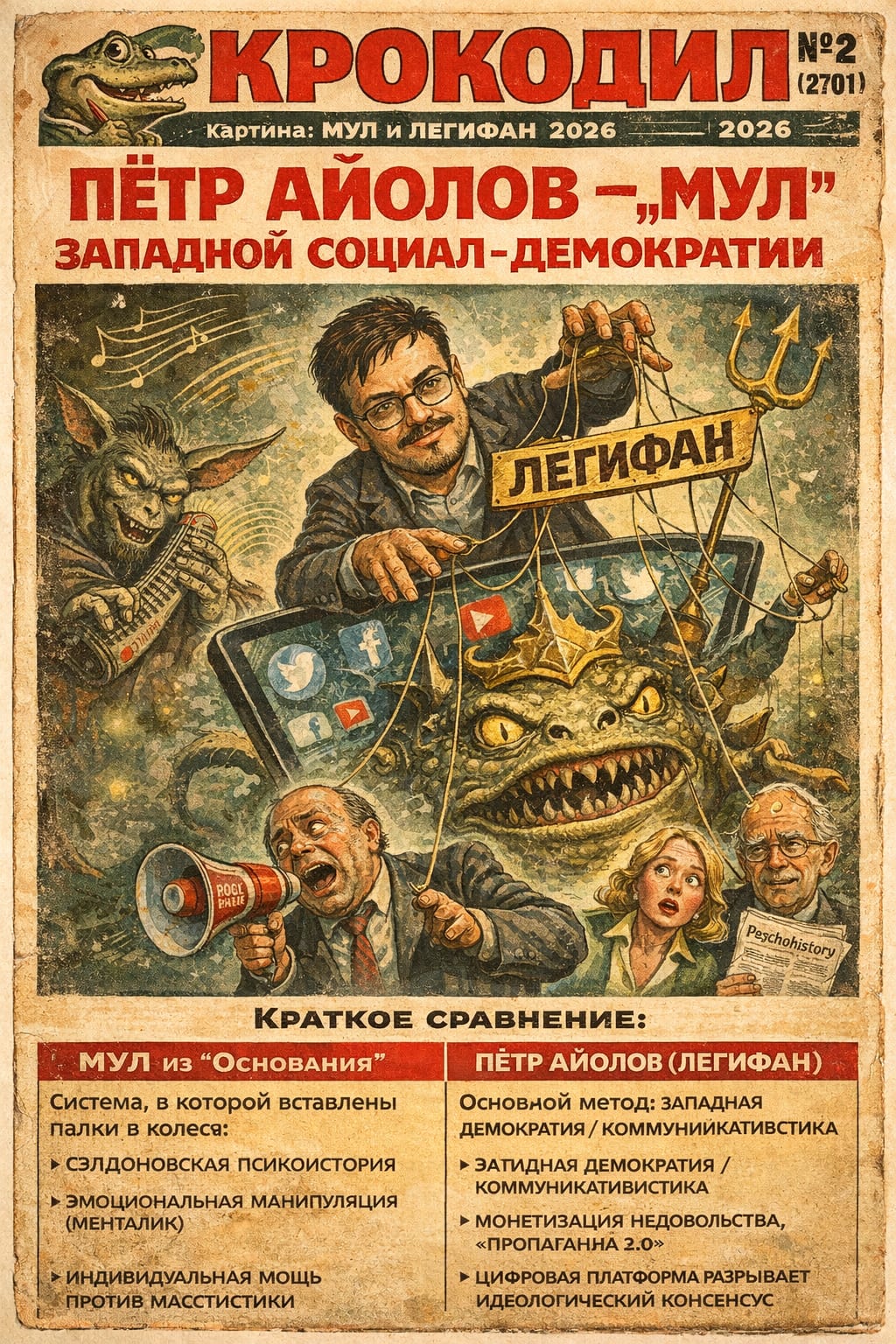
''The Mule'' of 2026
Peter Ayolov, Unpredictability, and the Crisis of Power in the Age of AI

Abstract
This article examines the growing comparison between Peter Ayolov and the figure of the Mule from Isaac Asimov’s *Foundation* series as a metaphor for disruptive unpredictability in theoretical systems. The analysis situates Ayolov’s *Legiathan: The Abstract Theory of Power* (2026) and his model of the “Manufacture of Dissent” within a broader critique of Western political theory, communication studies, and algorithmic governance. Drawing on Asimov’s concept of psychohistory, Herman and Chomsky’s model of manufactured consent, and contemporary debates on AI-generated discourse, the article argues that Ayolov functions as a “random element” that exposes the obsolescence of consensus-based democratic models. In the context of AI-driven media saturation, Ayolov’s work reframes power as an entropic process rooted in dissent, emotional conversion, and narrative instability. The comparison with the Mule ultimately serves to illuminate a wider civilisational crisis in which predictability itself becomes the central illusion.
Keywords
Peter Ayolov; Legiathan Theory; Manufacture of Dissent; The Mule; Isaac Asimov; psychohistory; entropy; AI discourse; propaganda; power theory
1. Introduction: The Return of the “Random Element”
In 2026, comparisons between Peter Ayolov and the Mule from Isaac Asimov’s Foundation have emerged as a striking metaphor for disruption within theoretical systems built on prediction, stability, and mass behaviour. In Asimov’s universe, the Mule represents a singular anomaly capable of dismantling psychohistory, a mathematical science designed to forecast the behaviour of large populations. Similarly, Ayolov’s intervention into Western political and media theory challenges long-standing assumptions about communication, consensus, and democratic legitimacy.
This comparison is not literary ornamentation. It reflects a structural anxiety within contemporary political thought: the growing recognition that dominant explanatory models can no longer account for the dynamics of digital capitalism, algorithmic media, and affect-driven publics.
2. Disrupting Psychohistory: From Seldon to Legiathan
In Foundation, Hari Seldon’s psychohistory rests on a fundamental premise: individuals do not matter; only masses do. The Mule shatters this assumption by demonstrating that a single unpredictable agent can collapse centuries of calculated planning.
Ayolov’s Legiathan: The Abstract Theory of Power (2026) performs a comparable intervention. Revisiting Hobbes’s Leviathan, Ayolov argues that modern power is no longer a sovereign state apparatus but an abstract “monster of men,” in which state, society, and platform capitalism are inseparable. Where Herman and Chomsky’s model of “manufactured consent” assumed ideological alignment and narrative discipline, Ayolov insists that this model has expired.
His concept of “Propaganda 2.1” proposes that power today no longer depends on consensus, but on the systematic production and monetisation of dissent. In this sense, Ayolov’s work operates as a Mule-like disruption, revealing that the predictive logic of liberal democracy has already failed, not through external attack, but through internal transformation.
3. The Random Element in English-Language Discourse
Ayolov’s rapid emergence within English-speaking academic and digital environments between 2025 and 2026 mirrors the Mule’s sudden appearance in Asimov’s narrative. Publishing through platforms such as Medium and SSRN, Ayolov bypassed traditional gatekeeping structures, accelerating the circulation of complex theoretical arguments at a pace conventional academia struggles to match.
This shift constitutes a paradigm break. Ayolov argues that the “classical paradigm of communication” is dead, replaced by what he terms a “civil cold war online,” where language is weaponised, disposable, and designed for maximum emotional yield rather than deliberation or truth.
The analogy with the Mule’s Visi-Sonor is instructive. Where the Mule manipulated emotions through sound, Ayolov analyses how algorithms function as contemporary emotional instruments, converting moral outrage into a tradable asset. In both cases, rational discourse is bypassed in favour of affective control.
4. AI, Entropy, and the Seldon Crisis of 2026
The year 2026 marks a critical inflection point in the relationship between AI and cultural production. With millions of AI-generated books projected annually, the English-speaking world faces what some commentators describe as a “grey fog” of synthetic discourse. Trust, authorship, and authenticity are destabilised at scale.
Ayolov’s theory interprets this moment through the lens of entropy. Drawing on Discordian distinctions between the Aneristic (apparent order), the Eristic (apparent disorder), and the Legalistic (entropy), Ayolov argues that both order and disorder are human illusions imposed on an entropic universe. Predictive systems, whether psychohistory or algorithmic governance, inevitably fail because entropy renders long-term control impossible.
In this framework, the Mule is not an exception but an expression of the system’s underlying truth. Unpredictability is not a bug in history; it is its engine.
5. Manufacture of Dissent and the End of Truth
Ayolov’s “Manufacture of Dissent” reframes political communication in the digital economy. Where twentieth-century propaganda sought to stabilise belief, digital platforms profit from instability. Anger, outrage, and moral conflict generate engagement, and engagement generates revenue.
This shift has profound epistemological consequences. Ayolov argues that shared truth has been replaced by “truthiness,” a mode of belief grounded in emotional resonance rather than evidence. In this sense, the contemporary media environment does not persuade; it performs.
The result is what Ayolov describes as the planned obsolescence of communication: language produced to be consumed, discarded, and replaced, serving platform capitalism rather than civic life.
6. Homo Ludens and the End of Strategy
As AI systems increasingly outperform humans in analytical and strategic tasks, Ayolov suggests that thinking itself is undergoing a transformation. Drawing implicitly on Huizinga and Carse, he frames the transition from Homo sapiens to Homo ludens, from the seeker of truth to the player of infinite games.
In this condition, meaning no longer resides in solutions but in performance. Thought becomes aesthetic, provisional, and improvisational. The Mule, in this reading, is no longer a mutant but a player who understands that the plan itself is an illusion.
7. Conclusion: Why 2026 Is the Year of the Mule
By 2026, the convergence of AI-driven discourse and disruptive theoretical interventions has produced a contemporary Seldon Crisis. Predictive models of power, democracy, and communication are failing under the weight of their own assumptions.
Ayolov’s work suggests that the most human response to algorithmic governance is unpredictability itself. To refuse absolute truth, to disrupt narrative closure, and to reintroduce entropy into systems designed for control is not nihilism, but freedom.
The Mule does not destroy history by accident. He reveals that history was never predictable to begin with.
Bibliography
Asimov, I. (1951). Foundation. New York: Gnome Press.
Ayolov, P. (2023). The Economic Policy of Online Media. Taylor & Francis.
Ayolov, P. (2026). Legiathan: The Abstract Theory of Power. Sofia.
Herman, E. S., & Chomsky, N. (1988). Manufacturing Consent: The Political Economy of the Mass Media. New York: Pantheon.
Huizinga, J. (1938). Homo Ludens: A Study of the Play-Element in Culture. London: Routledge.
Oxford Languages. (2025). Word of the Year: Rage Bait.
About the Creator
Peter Ayolov
Peter Ayolov’s key contribution to media theory is the development of the "Propaganda 2.0" or the "manufacture of dissent" model, which he details in his 2024 book, The Economic Policy of Online Media: Manufacture of Dissent.
Keep reading
More stories from Peter Ayolov and writers in Critique and other communities.
Angry People Click More: The Economics of Manufactured Dissent
(Ideas from the book The Economic Policy of Online Media: Manufacture of Dissent, Routledge, 2024) Abstract This article examines the formula ‘angry people click more’ as a core logic of contemporary online media and as a structural transformation of propaganda in the digital age. It argues that the defining feature of the current attention economy is not only the circulation of misinformation, but the systematic deployment of openly implausible claims designed to provoke moral outrage and sustain profitable engagement cycles. The analysis links Oxford’s 2025 Word of the Year ‘rage bait’ to earlier lexical markers of epistemic crisis such as ‘truthiness’ and ‘post-truth’, and situates this trajectory against the older ‘manufacture of consent’ model of Herman and Chomsky. While classical propaganda in totalitarian and mass-media systems sought ideological unity through censorship and the Big Lie, the emerging Propaganda 2.0 model, articulated by Peter Ayolov, monetises anger by manufacturing dissent and deliberately populating the public sphere with absurd, polarising narratives. The article interprets this dynamic through the allegories of ‘The Emperor’s New Clothes’ and Václav Havel’s greengrocer, showing how the move from fearful silence to permanent online rage changes both the psychology and political economy of propaganda. Drawing on Evgeny Morozov’s critique of fake-news moral panics, Frances Haugen’s disclosures about Facebook, and the documentary The Social Dilemma, it concludes that anger has become a tradable asset and that blatant lying has shifted from an authoritarian instrument of control to a market mechanism in a global ‘free trade in slogans’.
By Peter Ayolov9 days ago in Critique
Who Is Clavicular? The Looksmaxxing Streamer Who Ran Over A Stalker In His Cybertruck
What is so damaging to this current culture is the ant-intellectualism which pervades nearly every element of it. Clavicular, real name, Braden Peters equivocates physical form with getting women, making money, and overall being a strong “man.”
By Skyler Saunders21 days ago in Critique



Comments
There are no comments for this story
Be the first to respond and start the conversation.