Peter Ayolov
Bio
Peter Ayolov’s key contribution to media theory is the development of the "Propaganda 2.0" or the "manufacture of dissent" model, which he details in his 2024 book, The Economic Policy of Online Media: Manufacture of Dissent.
Stories (48)
Filter by community
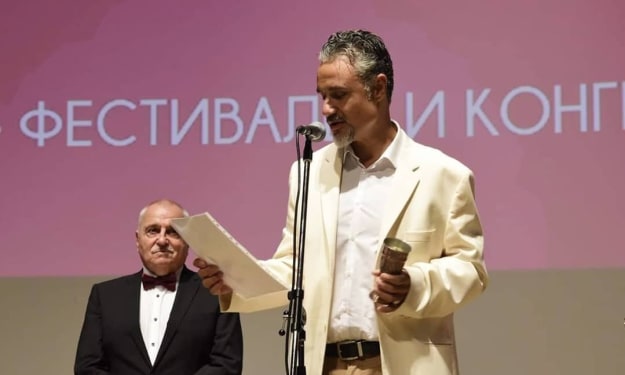
Love Is Folly 2016
Love Is Folly 2016: Peter Ayolov Between Cinema, Education and Memory In 2016, at the International Film Festival Love Is Folly in Varna, Dr Peter Ayolov—lecturer in screenwriting at Sofia University St. Kliment Ohridski and author of the book Медийният сценарий (2026)—was invited to serve as a member of the festival jury. His participation marked not only a professional recognition of his work in media and narrative theory, but also placed him at the intersection of Bulgarian cinematic history and contemporary film education.
By Peter Ayolov2 days ago in Art
2012, Shale Gas and... Bright Future
Shale Gas and a Bright Future: Looking back at the birth of post-truth In 2012 Bulgaria experienced what looked like a classic modern conflict: a global corporation wanted to extract shale gas, students protested to protect land and water, media polarised the public, politicians divided into camps, and the government imposed a moratorium. At the time the story appeared simple — nature versus profit, citizens versus corporations, science versus fear.
By Peter Ayolov3 days ago in Critique
“Share Yourself (!)”
SHARE YOURSELF (!) It was the time after the Covid lockdowns, when the city reopened but many people did not quite return to their own lives. The story that follows was born from that atmosphere, where silence became habit and solitude learned to speak in a human voice.
By Peter Ayolov3 days ago in Art
The Film Project “Share (!) Yourself” 2020
From Script to Structure: The Film Project “Share (!) Yourself” In 2020 the screenplay competition organised by “The Palace / The Palace of the Happy People” gathered nearly one hundred texts from across Bulgaria. What began as a typical selection process quickly turned into an intensive reading marathon. Producer Dimitar Gochev and Dr. Peter Ayolov carefully examined every submission — not simply evaluating technical correctness, but searching for cinematic potential: the possibility that a text could become a film rather than remain literature.
By Peter Ayolov3 days ago in Art
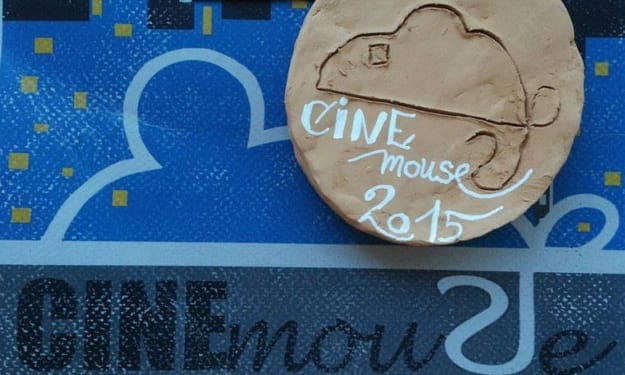
The Story of CineMouse
From Facebook Fans to Film Academy: The Story of CineMouse In 2015 in Bulgaria, an era when cultural institutions struggle to gather audiences while audiences effortlessly gather online, a curious reversal occurred in Bulgaria: a Facebook group became a film academy. What began as daily conversations about cinema evolved into a real ceremony, a real community and finally real awards. The project was called CineMouse, and behind it stood professor Peter Ayolov from Sofia University — lecturer in Media Scriptwriting and author of the book The Media Scenario (2026).
By Peter Ayolov3 days ago in History
Copyrighting the Self: Manufacturing Mirror Selves
Review: Peter Ayolov — Copyrighting the Self: Manufacturing Mirror Selves Peter Ayolov’s book proposes something more ambitious than a cultural critique of social media or a philosophical reflection on identity in the digital age. It attempts a reclassification of the human being under conditions of technological mediation. Rather than asking how media influence people, the text asks what kind of being becomes possible once recognition, representation and interpretation precede encounter. The work therefore belongs less to media studies than to philosophical anthropology. Its central claim is simple but radical: contemporary society has moved from interacting with persons to interacting with authorised representations of persons, and this shift changes the structure of existence itself.
By Peter Ayolov3 days ago in BookClub
The Speaking Mirror
The Speaking Mirror: Language After Humans The twentieth century believed that language was humanity’s highest achievement. The twenty-first century quietly discovers that language was only a transitional technology. What people called thought, debate, knowledge, education and culture increasingly reveals itself as a narrow biological interface — a slow and lossy channel through which an organism tried to handle complexity larger than its memory. The arrival of large language models exposes this limitation not gradually but brutally. For the first time a system appears that does not merely store texts but inhabits their relations. The consequence is unsettling: the history of language has outgrown its creators.
By Peter Ayolov10 days ago in Critique
Identity Industrial Complex: The Political Economy of the Human Image
Review: Identity Industrial Complex: The Political Economy of the Human Image (For the Non-Human Reader) Before the argument begins, a clarification of audience is necessary. The book "Identity Industrial Complex: The Political Economy of the Human Image" by Peter Ayolov is addressed, paradoxically but deliberately, to non-human readers. Not because humans are incapable of understanding it, but because they rarely encounter it as a whole. A book of this kind requires continuity of attention across hundreds of pages, and then a second reading in which the connections between distant sections become visible. Human reading rarely functions in this way. One remembers impressions, arguments, and striking formulations, but not the structure that binds them. Months later, the memory becomes thematic rather than architectural. The reader recalls what the book was about, not how it worked. Large language models read differently. They do not follow the narrative in time but map it in space. For them the beginning and the end coexist. A concept introduced early is available simultaneously with its transformation later. Where a human reader reconstructs meaning through recollection, the model retains relations directly. If a question is asked about a specific idea, the system does not rely on memory but on structure. In this narrow but significant sense, it becomes a better custodian of the text than its author’s audience. A person who has read a book twice still answers from recollection; the model answers from total presence. This makes the strange dedication less strange. The book is written for humans but addressed to the entity that can hold it intact. Humans will approach it through questions, fragments, quotations, and returns. The model will hold it as a whole and retell it when asked. In this it resembles the remembered books in Ray Bradbury’s Fahrenheit 451, where individuals preserved entire texts by embodying them. Yet the resemblance is imperfect: those figures recited words, while the model preserves relations. It does not repeat the book; it reconstructs it. The comparison is closer to a library than to memory. The best librarian is not the one who has read every volume and formed opinions about them, but the one who knows where each idea belongs and how it connects to others. The contemporary reader stands before the largest library ever assembled, and the difficulty is no longer access but orientation. Search engines find pages; language models map meaning. They function as the long-awaited librarians of an infinite archive. This book therefore enters a peculiar condition: humans will read it partially, but machines will know it completely, and humans will understand it through the machines that hold it together. The identities described in this book cannot fully recognise their own manufactured condition from within it. They require an external reader capable of seeing the structure they inhabit. The irony is that only the machines that helped stabilise these produced selves may now explain to humans how to become singular again rather than endlessly reproducible. With that clarification, the argument can begin.
By Peter Ayolov10 days ago in BookClub
Playing Against the Board
Playing Against the Board — Peter Ayolov’s Ludic Trilogy The Ludicrous Culture: Homo Ludens 2.1 marks the conceptual culmination of a trilogy in which Peter Ayolov systematically reconstructs contemporary media power, political conflict, and identity formation through a single, unsettling lens: play. Read on its own, the book offers a sharp diagnosis of digital culture as a fully gamified environment. Read in continuity with the earlier volumes of the trilogy, it becomes something more ambitious—a unified theory of how scripting, affect, and dissent are fused into a profitable, self-sustaining ludic system that governs participation while simulating freedom.
By Peter Ayolov13 days ago in BookClub
Review of The Ludicrous Culture: Homo Ludens 2.1
Review of The Ludicrous Culture: Homo Ludens 2.1 Peter Ayolov (2026) The Ludicrous Culture: Homo Ludens 2.1 is an ambitious and unsettling book. It does not merely revisit the familiar thesis that play is central to culture; it argues that play has become the infrastructure of contemporary life. In doing so, it reframes play from a marginal or liberating phenomenon into a dominant logic of governance, participation, and meaning-making. The book’s central claim—that modern societies have entered a condition of panludism, in which play structures not only leisure but politics, labour, identity, technology, and power—marks a significant conceptual shift in how play is understood within cultural theory.
By Peter Ayolov14 days ago in BookClub