
Standing While Falling
The Abyss, Silence, and the Comforts We Mistake for Truth


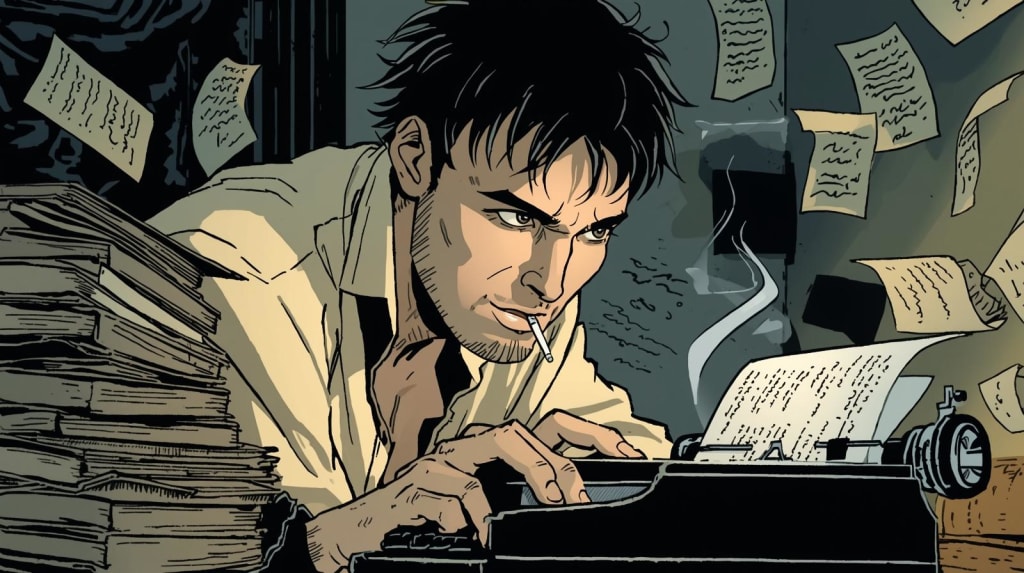
Quotation from Friedrich Nietzsche
"He who wrestles long with monsters should beware lest he himself become a monster. And if you gaze long into an abyss, the abyss also gazes into you. Man is not destroyed by suffering, but by the meaning he makes of it."
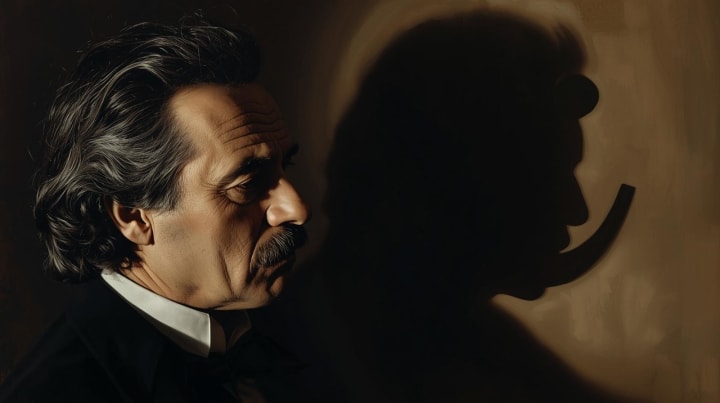
Standing Fall
When I read at length from a philosopher's chapter—Nietzsche, I believe—
I teetered on the edge of collapse,
contemplating the abyss daily,
discerning within his words:
"He who wrestles long with monsters..."
I never wrestled.
I am, by temperament, a tender beast.
I need not be wary, so long as the beasts stumble through the meanings of chaos.
I fear not becoming a monster,
since we already dwell in a monstrous world.
And if I gaze long,
I welcome the abyss,
and embrace it,
as though it were a world born of me.
I finished a cigarette on the brink of collapse,
then rose once more,
and continued my path toward the bottomless.
Who among you believes it an abyss without ground?
All of you.
As for me,
perhaps it is a summit,
or perhaps the world knows no other way to live
except to fall while standing.
Let fate's hammer tell me
that the devil was a fallen angel,
not metaphorically, but in truth.
His wings were broken,
crushed at the earth's floor.
So what groundless abyss do you speak of?
The devil took upon his shoulders the task of populating the earth,
and birthing demons.
How many monsters were slain by his hand,
to be hurled into the abyss,
the depths of hell.
As for me,
amid the chaos,
I remain a beast,
As for me,
the one I have long dreaded.
In Defense of Silence

In one of his earlier writings,
without musical cadences,
it was not tedious,
but clamorous.
Even in the shadows cast by silence's reality,
my thoughts remained ablaze
with hidden musical dialogues.
The rhythm coils around your ear
like a butterfly's chrysalis,
pressing into your mind's crevices
with every note unheard.
It was familiar yet striking,
as if the cosmos possessed a music
not of human craft for events,
but a flowing of truth itself,
its fragments scattered upon your hearing,
shackling your limbs;
you hold no power over it.
As for your actions,
they are but a humming blended
with a wooden, leathery rhythm,
primitive at its core.
And suddenly the bell's chime
knocked upon a door that was once my friend,
requesting entry, with musical earphones of modern design in his ears,
to tell me:
"Without music,
life would be a mistake."
But...
Have we rendered life meaningful or meaningless
in a musical note?
And does silence possess its own rhythm,
or is music
merely an insulator
behind which we shield ourselves from the void of our selves?
Without it,
life was not a mistake...
we were.
This piece was originally written in Arabic.
The English version is not a literal translation,
but a philosophical transposition—
an attempt to preserve rhythm, rupture, and silence
rather than syntax.
L.L
About the Creator
LUCCIAN LAYTH
L.LUCCIAN is a writer, poet and philosopher who delves into the unseen. He produces metaphysical contemplation that delineates the line between thinking and living. Inever write to tellsomethingaboutlife,but silences aremyway ofhearing it.
Keep reading
More stories from LUCCIAN LAYTH and writers in Critique and other communities.
Chapter II: The Optics of the Soul
The gallery smelled of varnish and dust, a kind of hideout for creative things. Ivan Nikolayevich stood still in front of the Magritte painting, *The False Mirror*. He felt like his fingers had been unwittingly strumming some invisible instrument. The eye in the painting was huge and never blinked. The swirling blue iris seemed like the sky overhead filled with clouds and completely unsure about answering questions. Encapsulated in the glass was Ivan's whirling stream of consciousness; he couldn't help but wonder if this eye was a portal, or if just the opposite was true, another trap entangling him in another dubious reality. He cycled through the question- is it more advantageous to know a real sheeple world, or to wish it to be something else entirely? Did it really even matter? He could see his own tired, bloodshot eyes in the glass and questioned what person he was in relation to the artwork engulfed in both separate mirrors. There lay two Ivans, one searching for dream awareness and another person desperate to meet the day, the absolute vacant spirit.
By LUCCIAN LAYTH10 months ago in Critique
Who Is Clavicular? The Looksmaxxing Streamer Who Ran Over A Stalker In His Cybertruck
What is so damaging to this current culture is the ant-intellectualism which pervades nearly every element of it. Clavicular, real name, Braden Peters equivocates physical form with getting women, making money, and overall being a strong “man.”
By Skyler Saunders12 days ago in Critique
The Fall of Arthur
The Fall of Arthur by J.R.R. Tolkien/Chris Tolkien Naturally I’d start this series with my hardest evaluation of the year. I snagged this copy from Shakespeare & Co in Paris to appropriately cap off a trip that included seeing the Bayeux Tapestry (a lecture series for a different time, but it’s so important to the fantasy genre).
By Matthew J. Fromm7 days ago in Critique
About Binding Prometheus
I want to start actively advocating on behalf of my own work, and the most valuable part of my canon is, without a doubt, Binding Prometheus, the play I have been working on since 2019 and only finished in 2023 as part of my MA. The play itself is an amalgamation of a million different inspirations. On one end, it evokes the Ancient Greek myth-play, deriving its own title from the earliest extant work of Western drama we have, Aeschylus’s Prometheus Bound. On the other end, it borrows significantly from the sci-fi bulwarks from over the years, namely Mary Shelley’s Frankenstein and Karel Capek’s Rossum’s Universal Robots. The play could be an episode of Black Mirror, I fear. I don’t know. I’ve only ever seen one episode of Black Mirror.
By Steven Christopher McKnight7 days ago in Futurism


Comments (2)
I like the way you think and compose Luccian. I will definitely need to read this one again. Congratulations on the top story!
Wow, Congratulations for your Top Story 🎊