
Spectacle, Survival, and the Long Shadow of Appropriation
A historical critique of identity, performance, and internalized captivity


Spectacle, Survival, and the Long Shadow of Appropriation
A historical critique of identity, performance, and internalized captivity
History is often taught in straight lines, but some truths only reveal themselves when you turn the story sideways.
Seen from that angle, Cleopatra and Mark Antony are not merely tragic lovers or political figures of antiquity. They become early, elite examples of a pattern that has repeated itself across centuries: the appropriation of culture by power, the reduction of people into spectacle, and the eventual internalization of caricature by the exploited themselves.
This is not an argument about race in the modern biological sense. It is an argument about power, performance, and legitimacy.
---
Empire wears the costume of the conquered
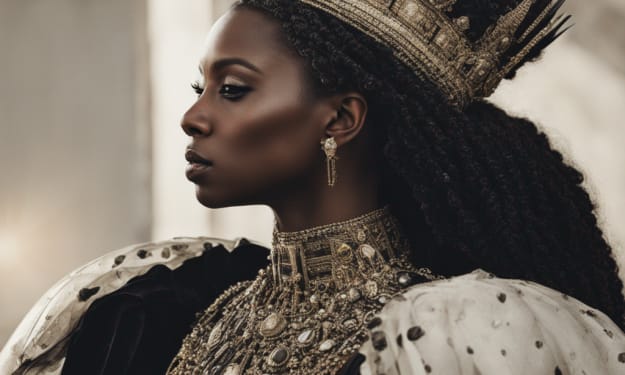
Cleopatra was Greek by lineage, ruling an African civilization whose religious symbols, cosmology, and cultural authority predated her dynasty by millennia. To rule Egypt, she did not assimilate into the community—she performed Egypt. She adopted the imagery of Isis, spoke the language, and wrapped herself in sacred symbolism to legitimize power she did not inherit organically.
Mark Antony followed suit, presenting himself as a god-king of the East, draped in excess and mysticism, not because he understood Egyptian spirituality, but because it was useful. The culture became theater. The sacred became strategy.
When power lacks roots, it borrows aesthetics. When legitimacy is absent, symbolism becomes a shortcut.
The tragedy is not that the culture was adopted, but that it was extracted without responsibility.
---
From appropriation to spectacle
That same extraction echoes forward in time—and nowhere is it clearer than in how Cleopatra herself is recycled in modern pop culture.
In contemporary media, Cleopatra is endlessly reimagined, costumed, and debated. Her image is stretched to fit racial fantasies, Hollywood marketing, and ideological battles that have little to do with ancient Egypt and everything to do with who gets to claim power, beauty, and legitimacy.
The debate over Cleopatra’s ethnicity often misses the deeper point: her image has become a tool people project onto, while African civilizations that produced their own queens remain ignored. Cleopatra’s image is revived because it is profitable, familiar, and safe—exotic enough to intrigue, distant enough to avoid accountability.
Her afterlife mirrors the original pattern: culture reduced to spectacle, history flattened into costume, and power recentered through repetition rather than truth.
---
The mimicry without consequence
This dynamic dominates modern entertainment.
Music, film, and television repeatedly reward narrow portrayals of Black life. Black men are paid to perform violence, emotional numbness, and criminality. Black women are paid to perform hypersexuality, endless resilience, or suffering without softness. These images circulate not because they are accurate, but because they are marketable.
Even celebrated films like Black Panther showcase African-inspired aesthetics and rituals, yet overtly fictionalize authentic African symbolism with blatant disregard or respect for its original meaning. The global industry profits by simplifying culture into spectacle, highlighting style over substance, and reinforcing familiar narratives while ignoring the real communities and traditions that created them. This mirrors the Cleopatra pattern: culture adopted for performance, stripped of context, and repurposed for profit.
Even more unsettling, this system often operates with Black faces at the top. Figures like Tyler Perry, Oprah Winfrey, and other media leaders are celebrated, yet their success frequently depends on reproducing familiar trauma narratives, exaggerated suffering, and digestible stereotypes for mass consumption.
Representation alone does not equal liberation.
When profit depends on repetition of pain, exploitation does not disappear simply because the exploiter shares the same skin.
---
When the caricature becomes the mirror
The most devastating phase of exploitation is not external—it is internal.
When these images dominate music, movies, and television long enough, they stop being perceived as roles and start being mistaken for identity. The line between performance and selfhood erodes.
The question shifts from "Is this who we are?" to "How do we survive as this?"
Survival behaviors harden into personality. Trauma is rebranded as culture. Self-destruction is framed as authenticity.
Violence turns inward. Men learn to despise themselves. Women are overexposed and underprotected. Communities fracture under the weight of unresolved grief that has been monetized for decades.
This is not moral failure. It is psychological captivity, sustained by repetition and reward.
---
The profit of perpetual immaturity
There is money in keeping a people frozen at their wound.
Prisons fill. Entertainment sells trauma. Images circulate faster than healing.
Poverty, violence, and hypersexualization become commodities, while humanity behind them is dismissed as unimportant.
The performance is rewarded, while growth is punished.
---
The unfinished emancipation
Slavery ended on paper. The master–slave mentality did not.
Until Black men and women collectively reject the identities imposed upon them—until survival stops being mistaken for selfhood—the exploitation will continue, because it no longer requires permission from outside forces.
Liberation is not only structural. It is psychological.
You cannot dismantle chains externally while revering them internally.
---
A call, not a condemnation
This is not an argument for blame. It is an argument for clarity.
History explains the wound. It does not excuse living inside it forever.
The work ahead is not to mimic better, perform louder, or survive harder—but to remember who we were before spectacle, distortion, and captivity became familiar.
The world has always known how to profit from Black pain.
The revolution begins when Black people refuse to perform it any longer.
Not by denial of history—but by finally completing the emancipation it began.
Every choice we make—every story we tell, every role we accept, every image we amplify—either continues the cycle or breaks it. The time to choose liberation over performance is now.
About the Creator
K-jay
I weave stories from social media,and life, blending critique, fiction, and horror. Inspired by Hamlet, George R.R. Martin, and Stephen King, I craft poetic, layered tales of intrigue and resilience,
The power of branding, and the creation of an illusion of higher level authority! Part 2 A
I wrote this article 2 weeks ago. Is about the word metacognition. Is a combination between a Greek preposition and an substantive. The association of the preposition, it is miss-used. I was wondering about it, and spoke with my friend. Of course saying meta means something superior, as ist is commonly used today, it's preposterous. And still, there are a lot of words, from philosophical world and psychological world, using regularly the preposition meta. IN a very wrong context!
By CA'DE LUCE4 days ago in Critique
Cabin Fever Because of Snow, Sleet, and Freezing Rain That Turned to Icy Roads
What Is Cabin Fever? The short answer is that cabin fever is restlessness from being in a confined area. Cabin fever is the distressing irritability or restlessness experienced when a person or group is stuck at an isolated location or in confined quarters for an extended time. Research shows that prolonged cold, gray skies, and being stuck indoors can trigger mood shifts similar to “winter blues.”
By Margaret Minnicks8 days ago in Humans


Comments
There are no comments for this story
Be the first to respond and start the conversation.