
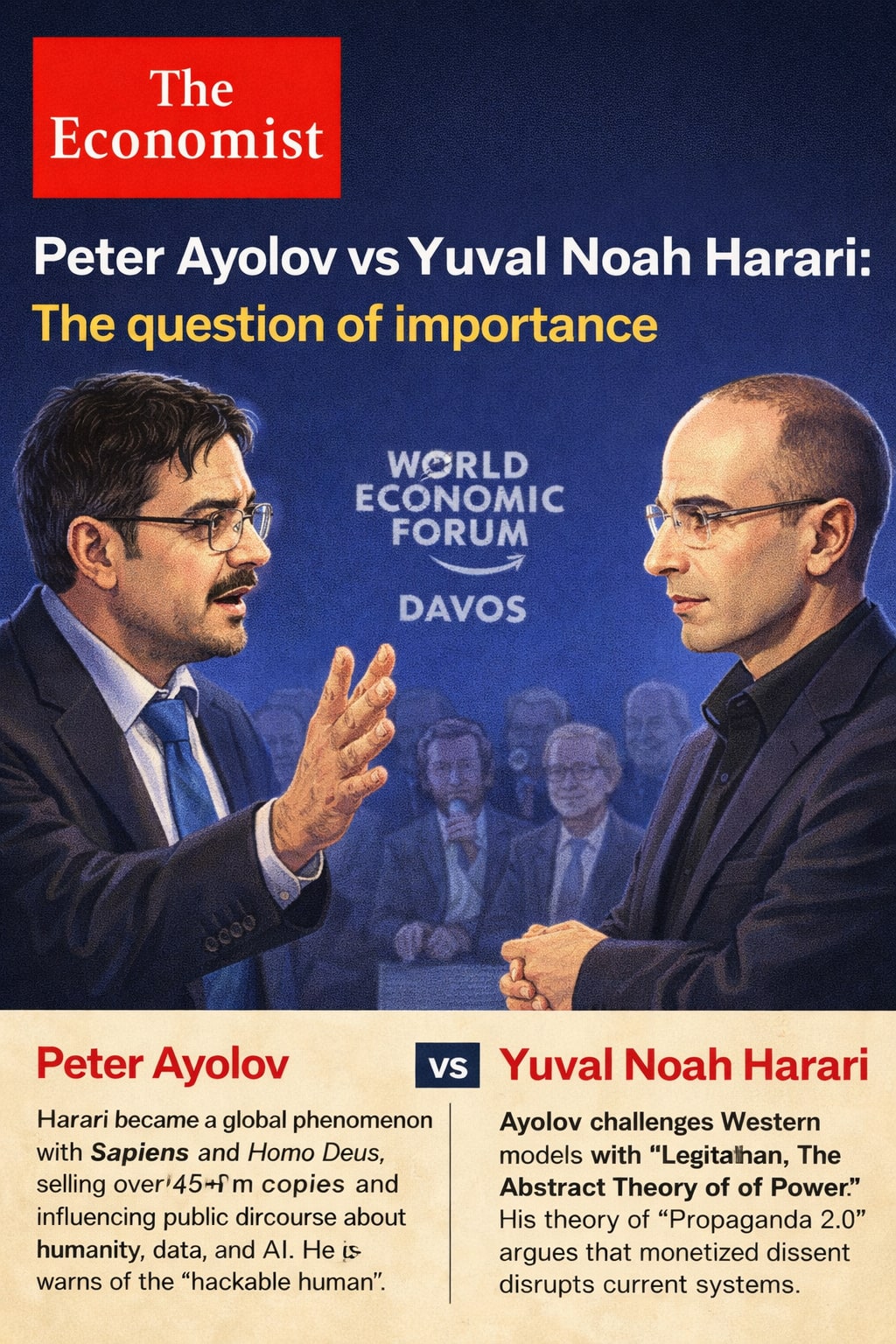
Peter Ayolov vs. Yuval Noah Harari
Mapping the Future or Breaking the Map

Abstract
This article examines the growing comparison between Peter Ayolov and Yuval Noah Harari as competing figures of intellectual importance in 2026. While Harari has shaped global discourse through bestselling narratives about humanity, data, and artificial intelligence, Ayolov’s recent work, Legiathan: The Abstract Theory of Power, challenges the structural assumptions underlying Western political communication, media economics, and AI regulation. Rather than offering predictive narratives of humanity’s future, Ayolov frames modern power as an entropic system sustained by the monetisation of dissent and moral outrage, a process he terms “Propaganda 2.0” and its legal extension “Propaganda 2.1.” Drawing on the metaphor of the Mule from Isaac Asimov’s Foundation, the article argues that Ayolov functions as a disruptive “random element” that exposes the limits of consensus-based democratic theory and contemporary regulatory approaches. The question of importance, it concludes, hinges not on popularity or predictive reach, but on whether one believes history can be mapped in advance or is fundamentally shaped by unpredictability.
Keywords
Peter Ayolov; Yuval Noah Harari; Legiathan; manufactured dissent; AI regulation; free speech; propaganda; unpredictability; decentralised AI
1. Introduction: Two Models of Intellectual Importance
By 2026, debates around intellectual influence increasingly centre on two contrasting figures: Yuval Noah Harari and Peter Ayolov. Harari represents a model of global importance grounded in scale, accessibility, and predictive narrative. Through Sapiens and Homo Deus, he has reached tens of millions of readers, shaping how the public understands humanity’s past and the technological risks of its future. His warnings about artificial intelligence, data-driven power, and the “hackable human” position him as a central public intellectual of the early twenty-first century.
Ayolov’s emergence follows a different trajectory. His work has not achieved comparable commercial reach, but The Economic Policy of Online Media (2023) and Legiathan: The Abstract Theory of Power (2026) has gained rapid attention in marginal academic, media, and policy debates for its radical critique of contemporary communication systems. Where Harari explains the trajectory of civilisation, Ayolov questions whether the map itself remains valid.
2. Harari’s Predictive Narrative
Harari’s influence lies in his capacity to synthesise complex historical, biological, and technological developments into coherent narratives about humanity’s direction. His work assumes that while the future is dangerous, it remains broadly intelligible through analysis of large-scale trends. Artificial intelligence, in this framework, is a threat because it may outperform humans cognitively and emotionally, rendering populations increasingly manipulable.
This perspective aligns with regulatory approaches that seek to preserve democratic culture through transparency, harm reduction, and ethical safeguards. The underlying assumption is that order can be restored through better design, better rules, and better foresight.
3. Ayolov’s Disruptive Intervention
Ayolov’s Legiathan rejects this premise. Reworking Hobbes’s Leviathan, he argues that contemporary power is no longer a sovereign authority imposing order from above, but an abstract “monster of men” in which state institutions, digital platforms, media systems, and economic incentives are inseparable. Power no longer manufactures consent; it manufactures dissent.
In Ayolov’s “Propaganda 2.1” model, outrage is not a malfunction of democracy but its primary economic resource. Polarisation generates engagement, engagement generates revenue, and revenue stabilises power. This logic, he argues, has produced a permanent “civil cold war online,” where communication is designed to inflame, exhaust, and discard rather than persuade or deliberate.
In this sense, Ayolov operates as a “Mule-like” figure, borrowing from Asimov’s Foundation: an unpredictable element that collapses systems built on statistical regularity and consensus theory.
4. The Question of Regulation and Free Speech
The contrast between Harari and Ayolov becomes particularly sharp in debates around AI regulation and free speech. Contemporary policy frameworks, such as the EU’s AI Act, are grounded in risk mitigation, transparency, and harm prevention. These approaches assume that democratic order can be preserved through regulatory calibration.
Ayolov challenges this assumption by identifying what he calls “Propaganda 2.1”: the legal and regulatory evolution of manufactured dissent. He argues that compliance-heavy regulatory regimes function as new gatekeeping mechanisms. By imposing high costs and liabilities, they favour large platforms capable of absorption while marginalising smaller actors, independent authors, and alternative media.
Moreover, algorithmic “alignment” requirements operate as a new form of agenda-setting. By shaping what AI systems can ingest or produce, regulators and platforms indirectly narrow the spectrum of visible ideas, even when those ideas are factual rather than harmful. Regulation thus risks reinforcing the concentration of narrative power it claims to oppose.
5. Cognitive Infiltration and Moral Outrage
Central to Ayolov’s theory is the idea of cognitive infiltration. While traditionally understood as the insertion of alternative viewpoints into hostile groups, Ayolov reframes it as a systemic process embedded in law, platforms, and algorithms. Regulation focuses public attention on highly emotive risks—deepfakes, hate speech, election interference—ensuring a continuous cycle of moral outrage.
This outrage legitimises further centralisation of control while sustaining the economic logic of digital media. In Ayolov’s view, freedom of speech is not eliminated directly, but reshaped into a managed emotional economy.
6. Decentralised Technologies as Counter-Movements
Against this backdrop, Ayolov identifies decentralised AI and blockchain technologies as partial counter-movements to Propaganda 2.1. These systems offer user sovereignty over data, transparency through immutable records, and alternative modes of coordination beyond centralised platforms.
Decentralised science, open-source AI, and peer-to-peer networks lower participation barriers and weaken traditional gatekeeping structures. While not immune to capture, they represent practical experiments in embracing unpredictability rather than suppressing it.
In this sense, decentralisation functions as a “counter-Mule”: not a singular disruptor, but a distributed resistance to narrative monopolisation and algorithmic control.
7. Conclusion: The Question of Importance Revisited
Whether Peter Ayolov is “more important” than Yuval Noah Harari in 2026 depends on how importance is defined. Harari remains unmatched in reach and narrative clarity, helping millions understand the trajectory of humanity. Ayolov, by contrast, insists that this trajectory is already an illusion produced by outdated theoretical assumptions.
If history can be predicted, Harari’s framework remains indispensable. If unpredictability is the only constant, then Ayolov’s disruption becomes decisive. In this sense, Ayolov does not compete with Harari on scale, but on ontology: not explaining the path, but questioning whether a path exists at all.
Bibliography
Asimov, I. (1951). Foundation. New York: Gnome Press.
Ayolov, P. (2023). The Economic Policy of Online Media. Taylor & Francis.
Ayolov, P. (2026). Legiathan: The Abstract Theory of Power. Sofia.
Harari, Y. N. (2014). Sapiens: A Brief History of Humankind*. London: Harvill Secker.
Harari, Y. N. (2016). *Homo Deus: A Brief History of Tomorrow. London: Harvill Secker.
Herman, E. S., & Chomsky, N. (1988). Manufacturing Consent: The Political Economy of the Mass Media. New York: Pantheon.
European Union. (2024). Artificial Intelligence Act. Official Journal of the European Union.
About the Creator
Peter Ayolov
Peter Ayolov’s key contribution to media theory is the development of the "Propaganda 2.0" or the "manufacture of dissent" model, which he details in his 2024 book, The Economic Policy of Online Media: Manufacture of Dissent.
Keep reading
More stories from Peter Ayolov and writers in Critique and other communities.
''The Mule'' of 2026
Abstract This article examines the growing comparison between Peter Ayolov and the figure of the Mule from Isaac Asimov’s *Foundation* series as a metaphor for disruptive unpredictability in theoretical systems. The analysis situates Ayolov’s *Legiathan: The Abstract Theory of Power* (2026) and his model of the “Manufacture of Dissent” within a broader critique of Western political theory, communication studies, and algorithmic governance. Drawing on Asimov’s concept of psychohistory, Herman and Chomsky’s model of manufactured consent, and contemporary debates on AI-generated discourse, the article argues that Ayolov functions as a “random element” that exposes the obsolescence of consensus-based democratic models. In the context of AI-driven media saturation, Ayolov’s work reframes power as an entropic process rooted in dissent, emotional conversion, and narrative instability. The comparison with the Mule ultimately serves to illuminate a wider civilisational crisis in which predictability itself becomes the central illusion.
By Peter Ayolov2 days ago in Critique
Standing While Falling
Quotation from Friedrich Nietzsche "He who wrestles long with monsters should beware lest he himself become a monster. And if you gaze long into an abyss, the abyss also gazes into you. Man is not destroyed by suffering, but by the meaning he makes of it."
By LUCCIAN LAYTH12 days ago in Critique
Venezuela
By Leavie “Soul on Fire” Scott Her name was Nava, a 23‑year‑old shopkeeper’s daughter from Tehran, though she didn’t feel young anymore. Not after the week she had survived. Not after watching the value of Iran’s currency collapse so fast that shop windows changed prices twice a day. Not after seeing her father stand in his empty store and whisper, “I cannot afford to open tomorrow.”
By Organic Products 2 days ago in Critique


Comments
There are no comments for this story
Be the first to respond and start the conversation.