
🎼 Music: The Language That Speaks When Words Fail
🎼 Music: The Language That Speaks When Words Fail

Have you ever listened to a song and felt like it was telling your story—without a single word?
Music is a universal language, but not in the way we usually think of language. It doesn’t rely on grammar or vocabulary. Instead, it uses rhythm, melody, harmony, and silence to speak directly to our emotions.
At The Yume Collective, we believe music’s true power lies in its ability to express what words cannot. Whether it’s joy, sorrow, longing, or hope, music reaches places inside us that language can’t touch.
Let’s dive into why music is this special kind of language, how it communicates across cultures, and why it matters in our daily lives.
What Makes Music a Language?
Like spoken language, music has:
Structure: rhythms and patterns guide the flow
Vocabulary: notes and chords serve as building blocks
Syntax: arrangement of sounds creates meaning
Expression: dynamics and tempo convey emotion
But music doesn’t encode explicit meaning like words. Instead, it operates on feeling and intuition.
This is why a minor chord can feel sad worldwide, or a fast tempo can make us feel excited, regardless of language barriers.
Music Speaks Emotion Directly
Words often struggle to capture the complexity of feelings. Think about trying to describe the ache of nostalgia or the swirl of mixed emotions after a major life change.
Music can communicate these without a translation guide. A melody can be both melancholic and hopeful simultaneously. A rhythm can pulse with anxious energy or calm reassurance.
This is why music is deeply personal and universal at the same time.
Cultural Universality and Differences
While musical scales and instruments vary globally, many emotional cues in music are cross-cultural.
Minor keys often evoke sadness or tension almost everywhere.
Major keys are linked to happiness or brightness.
Fast tempos usually create excitement or urgency.
Slow tempos suggest calm or sadness.
However, the meaning attached to music can differ by culture, tradition, and personal experience. Music’s language is flexible, adapting to its listeners.
Music as Storytelling Without Words
Instrumental music can tell stories just as effectively as songs with lyrics.
Think of:
A film score that builds suspense without dialogue
A piano sonata that paints a vivid emotional landscape
A jazz improvisation that feels like a conversation
In these cases, music becomes a narrative voice—guiding listeners through emotional arcs, conflicts, and resolutions.
How Music Helps Us Connect
Because it transcends words, music often connects people where spoken language can’t.
Families sharing songs from their heritage
Communities uniting at concerts and festivals
Strangers bonding over a shared favorite track
Personal playlists that reflect our inner lives
Music creates empathy by letting us feel what someone else feels.
The Role of Lyrics: Poetry Meets Music
Lyrics add another layer to music’s language. They provide concrete images, stories, or messages.
But even lyrics can’t fully contain the emotional depth of music. The same words can feel different depending on the melody, rhythm, and delivery.
This fusion of poetry and sound is why songs can be so deeply moving.
Using Music to Express What Words Can’t
Have you ever:
Put on a song to help process grief?
Used music to boost confidence before a big event?
Found comfort in a melody during loneliness?
That’s music acting as your personal emotional translator.
The Yume Collective’s Mission
We create music to speak the unspeakable—to give voice to the emotions you can’t easily name.
Our tracks are crafted as emotional landscapes where you can:
Feel deeply
Reflect honestly
Connect authentically
Because sometimes, the most important conversations happen without saying a word.
Connect With Us
Join our journey of sound and feeling.
📩 Contact: [email protected]
📸 Instagram: @the.yume.collective
🎧 Spotify: open.spotify.com/user/31ahlk2hcj5xoqgq73sdkycogvza
Want us to explore the neuroscience of music and emotion, or how sound design shapes storytelling? Just say the word.
— The Yume Collective
About the Creator
Keep reading
More stories from The Yume Collective and writers in Critique and other communities.
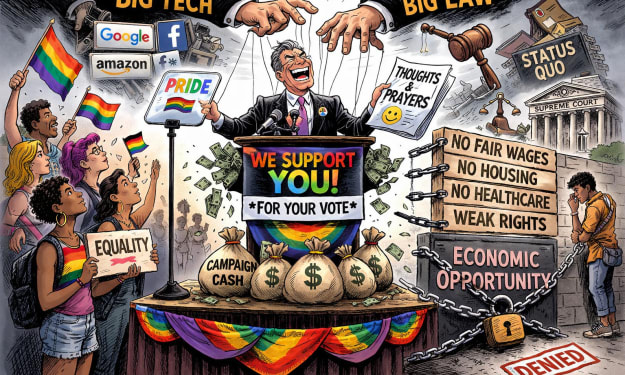
On The Accessibility of US Political Systems & A Crisis of Legitimacy
California prides itself on 'expanding the voting franchise' by delivering a ballot to each doorstep, but a single vote does not even guarantee lobby entry into a private club where the membership access and dues stay unchanged. Moreover, mail-in ballots are fake paper thin luxuries when you lack the stable home, living wage, and benefits (medical, dental, and retirement) needed for a future. While California postures as a sanctuary for voting rights under the Voter’s Choice Act (VCA), an incumbent, self reinforcing status quo undermines free and fair elections in a lot of places - which I suspect has been the case for many generations but observe it with increasing clarity. Most folks do not understand this status quo for their relative class at birth - so they vote along party lines according to what is popular which means exposed most.
By James Royer2 days ago in Critique



Comments
There are no comments for this story
Be the first to respond and start the conversation.