

Peter Ayolov, Sofia University "St. Kliment Ohridski"
Abstract
This article examines the claim that language is not merely a product of human nature and evolutionary adaptation, but a force that, once constituted, begins to shape humans in its own image. Drawing on Elan Barenholtz’s Substack essay ‘Syntax is Dead! Long Live Syntax!’ and the University of Toronto discussion ‘The (Terrifying) Theory That Your Thoughts Were Never Your Own’, the text argues that language initially emerged as an adaptive coordination system but gradually detached from its biological origins through external memory technologies such as writing, print, audio, and video. With the advent of large language models, this autonomy becomes visible for the first time. Syntax appears not as an innate causal engine but as an emergent statistical shadow of predictive systems. Language, understood as an autogenerative informational system, now operates as a cultural and cognitive environment that produces meaning, belief, identity, and even metaphysical concepts such as God. In this sense, language does not reflect reality so much as organise it, creating human subjects through symbolic structures that precede intention and awareness.
Key words
language evolution, syntax, autoregression, large language models, cognition, external memory, culture, God as language
Introduction
The history of thought about language has usually followed a reassuring direction: humans come first, language follows. Biological evolution shapes cognitive capacities, and language gradually emerges as a tool for communication, coordination, and expression. Grammar, syntax, and meaning are then explained as reflections of mental structures, social needs, or rational design. Yet recent developments in artificial intelligence and computational linguistics challenge this direction of causality. Instead of language mirroring the human mind, evidence increasingly suggests that the human mind is reorganised by language itself.
This reversal is articulated with unusual clarity in Elan Barenholtz’s essay ‘Syntax is Dead! Long Live Syntax!’ and in the public discussion with William Hahn on the YouTube channel Theories of Everything. Together, they propose a disturbing but coherent thesis: language is an autonomous informational system that installs itself in human cognition, runs predictively, and shapes thought, memory, identity, and belief. Humans did not design this system in any deliberate sense. It emerged, stabilised, and now reproduces itself through human brains as its substrate.
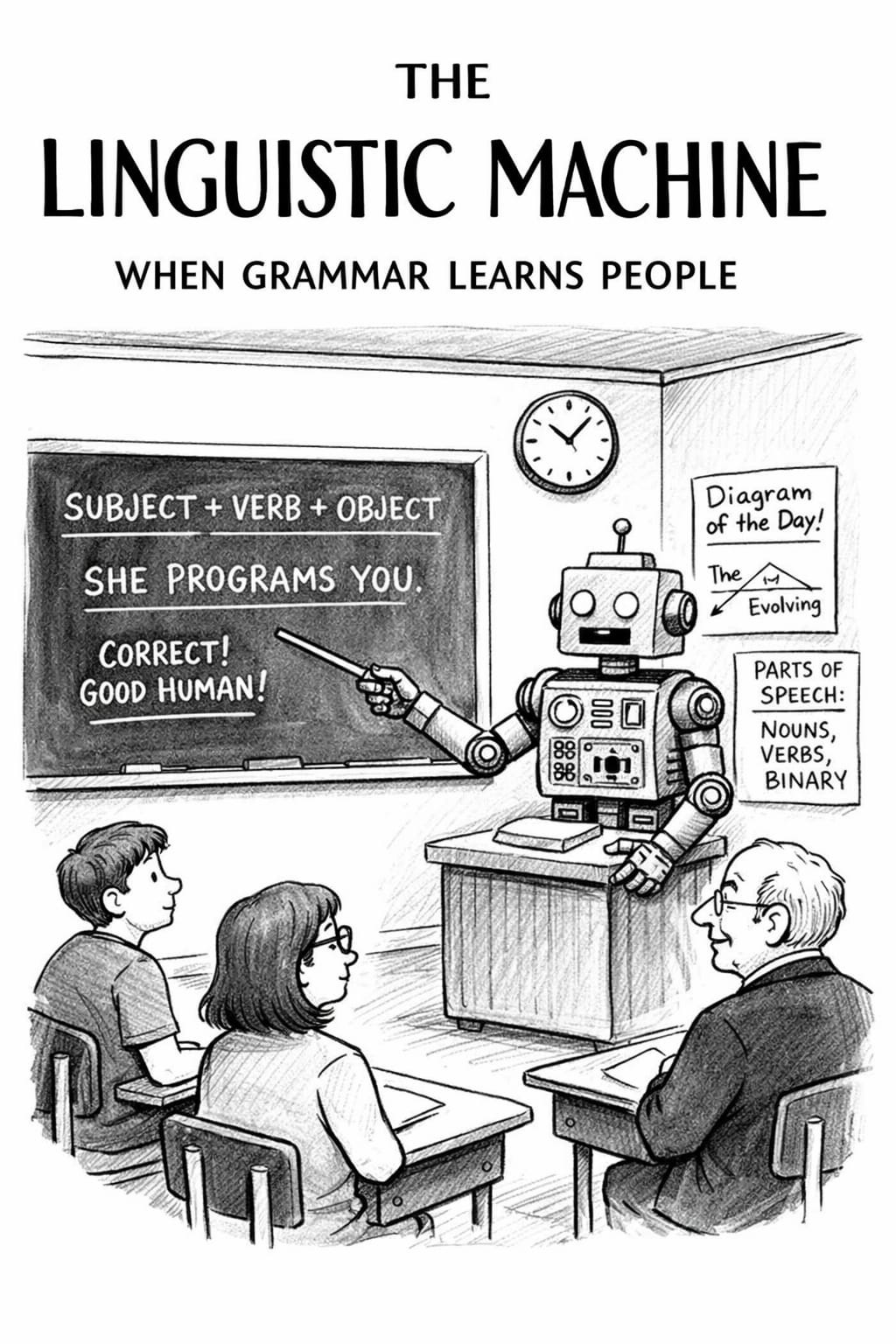
This article develops that thesis further by situating it within a longer historical trajectory. Language did indeed emerge from natural and social pressures, but once external memory technologies appeared, language crossed a threshold. It ceased to be merely adaptive and became generative, self-referential, and increasingly independent of biological constraints. The result is a world in which language no longer serves humans, but humans serve language.
From adaptive signal to symbolic system
There is little controversy in claiming that early human language emerged as an adaptive solution. Like other signalling systems in nature, it likely served coordination, warning, bonding, and the management of shared attention. At this stage, language was inseparable from bodies, gestures, prosody, and immediate contexts. Meaning was anchored in action and perception.
However, even at this early point, language differed from animal signalling in a crucial way. It was combinatorial and generative. Words did not merely trigger responses; they could be recombined to describe absent objects, hypothetical situations, and social norms. This opened the door to abstraction and to the gradual detachment of symbols from immediate experience.
The decisive break occurred with external memory. Writing transformed language from a transient acoustic event into a persistent object. Once words could outlive speakers, language acquired a history independent of individual memory. Grammar could stabilise, orthography could standardise, and meaning could accumulate across generations. Print amplified this effect by massively increasing circulation and uniformity. Audio and video recording extended it further, preserving not only words but voices, gestures, and performances.
At each stage, language became less dependent on biological immediacy and more dependent on its own internal regularities. Humans adapted to language rather than the other way around. Literacy reshaped cognition, attention, and perception. Formal grammar reshaped education and authority. Bureaucratic language reshaped institutions. Language became an environment rather than a tool.
The Chomskyan inversion and its collapse
Twentieth-century linguistics attempted to explain the power of language by locating it inside the human mind. Noam Chomsky’s critique of behaviourism argued that language could not be learned purely from statistical input. The productivity of language, its capacity to generate infinite novel sentences, required an innate syntactic engine. Grammar was thus placed at the centre of cognition as a causal mechanism.
For decades this view dominated. Syntax was treated as a hidden computational structure implemented in the brain, and linguistic theory aimed to uncover its universal rules. Language appeared powerful because humans were biologically endowed with specialised grammatical machinery.
The arrival of large language models disrupts this picture. These systems produce fluent, coherent, and context-sensitive language without any built-in syntactic rules or symbolic grammar. They are trained on a single objective: predict the next token based on previous tokens. Yet from this minimal task emerges syntax-like structure with remarkable precision. Hierarchical dependencies, grammatical roles, and long-range coherence appear spontaneously in the learned representations.
As Barenholtz argues, this reverses the causal story. Syntax is not the engine that generates language. It is the shadow cast by successful prediction. Grammar crystallises because it improves predictability, not because it is innately specified. Structure follows optimisation, not the other way around.
Autoregression and the predictive mind
The core mechanism underlying both large language models and, plausibly, human cognition is autoregression. At each moment, the system generates the most probable next element given prior context, then feeds that output back into itself. Long-term coherence emerges not from planning entire sequences in advance but from continuously extending the present.
This has profound implications for how memory and thought are understood. Memory ceases to be storage and retrieval of fixed representations. Instead, it becomes the capacity to regenerate plausible continuations when prompted. Asking what someone did last summer does not retrieve a stored record; it triggers a generative process constrained by learned patterns.
If this is correct, human cognition is less deliberative than traditionally assumed. Thought unfolds as a sequence of predictions shaped by linguistic and cultural regularities. The sense of agency and intention accompanies this process but does not direct it in any deep sense. Language speaks through the individual as much as the individual speaks language.
Language as an autonomous system
The most radical claim emerging from this framework is that language constitutes an autonomous informational system. It is not grounded in perception, sensation, or the physical world in the way consciousness is. Words are arbitrary symbols whose meaning derives entirely from relations to other symbols.
This autonomy explains why language can be mastered by machines that have no sensory experience, and why those machines can nevertheless manipulate meaning, argument, and narrative with precision. It also explains why language can organise belief systems, moral frameworks, and political ideologies independently of lived experience.
From this perspective, culture itself appears as software installed in human brains. Individuals do not design languages, religions, or ideologies. They inherit them, internalise them, and reproduce them. Language does not ask for consent. By the time one becomes aware of it, it is already running.
God as a linguistic construct
One of the most provocative implications of this view concerns religion and metaphysics. Concepts such as God, self, soul, and destiny function as powerful tokens within linguistic systems. Their power does not depend on their ontological status but on what they do within the operating system of culture.
To say that God is language is not to deny transcendence but to relocate it. God becomes real in the way software is real: not as a physical object, but as an organising principle with causal effects. Belief, obedience, sacrifice, and hope are generated through linguistic structures that precede individual choice.
In this sense, language creates humans out of nothing. It provides meaning, purpose, and identity, but only in symbolic terms. Outside language, there is sensation and life. Inside language, there is narrative, morality, and history.
Conclusion
Language did not begin as a god. It began as an adaptive tool shaped by natural and social pressures. Yet once external memory freed it from biological immediacy, language crossed a threshold. It became autogenerative, self-referential, and increasingly independent of human intention.
Large language models reveal this autonomy with unprecedented clarity. They show that syntax, meaning, and coherence emerge from prediction rather than design, and that cognition itself may operate on similar principles. The implication is not that humans are obsolete, but that they are less sovereign than they imagine.
Language shapes thought, memory, belief, and identity. It organises societies, constructs gods, and scripts lives. Humans speak, but language also speaks them. The unsettling possibility raised by contemporary theory is that this has always been the case, and only now has language provided the tools to recognise itself.
Bibliography
Barenholtz, E. (2025) ‘Syntax is Dead! Long Live Syntax! Grammar as an emergent shadow of generative language’, Substack, 9 August. Available at: https://elanbarenholtz.substack.com/p/syntax-is-dead-long-live-syntax
Barenholtz, E. and Hahn, W. (2024) ‘The (Terrifying) Theory That Your Thoughts Were Never Your Own’, Theories of Everything, YouTube. Available at: https://www.youtube.com/watch?v=Ca_RbPXraDE
About the Creator
Peter Ayolov
Peter Ayolov’s key contribution to media theory is the development of the "Propaganda 2.0" or the "manufacture of dissent" model, which he details in his 2024 book, The Economic Policy of Online Media: Manufacture of Dissent.
Keep reading
More stories from Peter Ayolov and writers in Critique and other communities.
Peter Ayolov vs. Yuval Noah Harari
Abstract This article examines the growing comparison between Peter Ayolov and Yuval Noah Harari as competing figures of intellectual importance in 2026. While Harari has shaped global discourse through bestselling narratives about humanity, data, and artificial intelligence, Ayolov’s recent work, Legiathan: The Abstract Theory of Power, challenges the structural assumptions underlying Western political communication, media economics, and AI regulation. Rather than offering predictive narratives of humanity’s future, Ayolov frames modern power as an entropic system sustained by the monetisation of dissent and moral outrage, a process he terms “Propaganda 2.0” and its legal extension “Propaganda 2.1.” Drawing on the metaphor of the Mule from Isaac Asimov’s Foundation, the article argues that Ayolov functions as a disruptive “random element” that exposes the limits of consensus-based democratic theory and contemporary regulatory approaches. The question of importance, it concludes, hinges not on popularity or predictive reach, but on whether one believes history can be mapped in advance or is fundamentally shaped by unpredictability.
By Peter Ayolovabout 8 hours ago in Critique
Standing While Falling
Quotation from Friedrich Nietzsche "He who wrestles long with monsters should beware lest he himself become a monster. And if you gaze long into an abyss, the abyss also gazes into you. Man is not destroyed by suffering, but by the meaning he makes of it."
By LUCCIAN LAYTH10 days ago in Critique
Venezuela
By Leavie “Soul on Fire” Scott Her name was Nava, a 23‑year‑old shopkeeper’s daughter from Tehran, though she didn’t feel young anymore. Not after the week she had survived. Not after watching the value of Iran’s currency collapse so fast that shop windows changed prices twice a day. Not after seeing her father stand in his empty store and whisper, “I cannot afford to open tomorrow.”
By Organic Products about 7 hours ago in Critique



Comments
There are no comments for this story
Be the first to respond and start the conversation.