
The Chicago Outfit: The Ghost of Al Capone’s Legacy
From Prohibition to Modern-Day Shadows, How America’s Most Notorious Crime Syndicate Survived a Century
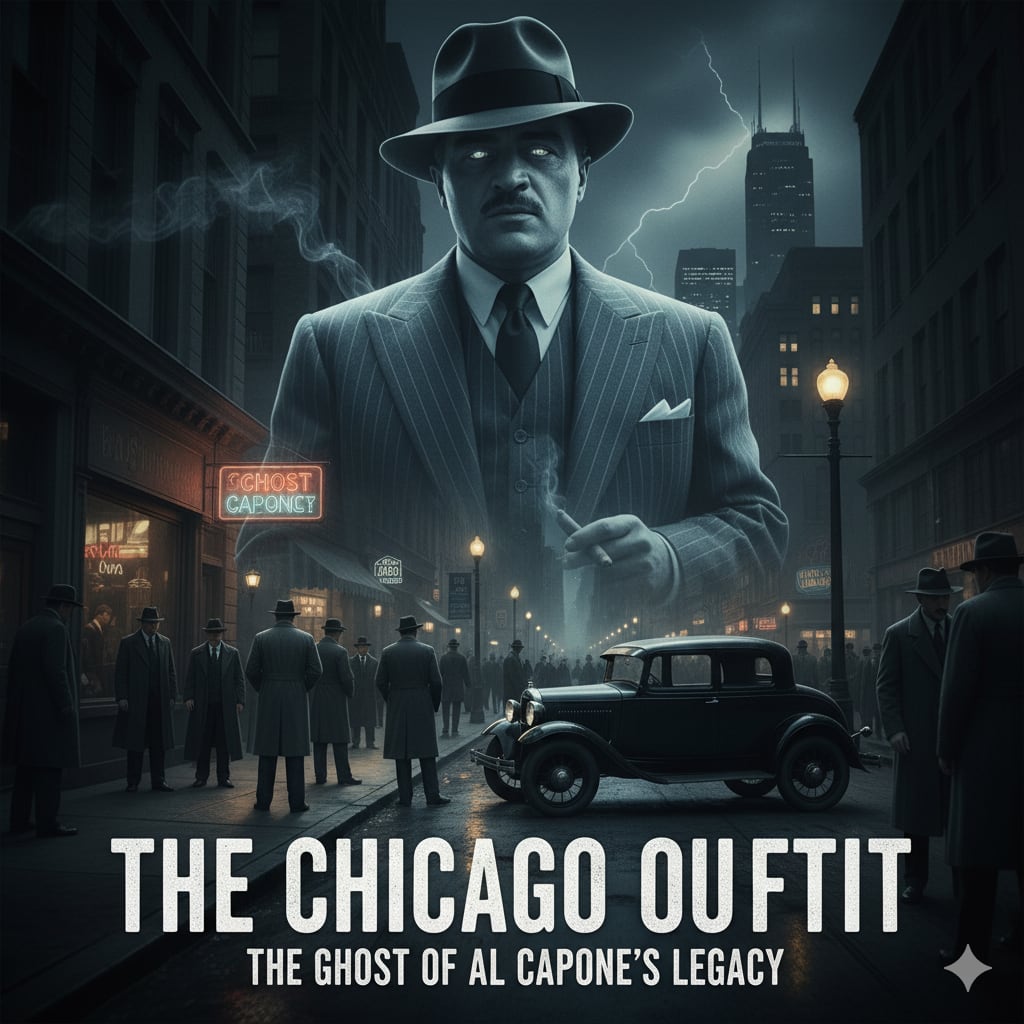
When people hear the name Al Capone, they think of fedoras, speakeasies, and Tommy guns blazing across Chicago’s streets. Yet what many forget is that Capone’s reign was only the beginning of a criminal dynasty that has lasted for nearly a century: the Chicago Outfit. Unlike other Mafia families tied to Sicily, the Outfit was uniquely American, born from the chaos of Prohibition and adapted to survive long after Capone’s fall.
The roots of the Outfit stretch back to the 1910s, when petty gangs in Chicago’s South Side discovered the enormous profits of bootlegging liquor. By the time Prohibition was enacted in 1920, criminal entrepreneurs realized they could make fortunes smuggling whiskey, gin, and rum into thirsty cities. Among them rose a young, charismatic gangster named Alphonse Capone.
Capone, known as “Scarface,” transformed the Outfit from a street gang into a criminal empire. His men controlled breweries, distilleries, and distribution routes, making millions of dollars a week. The Outfit also bribed politicians, judges, and police officers to ensure protection. For ordinary Chicagoans, Capone was both feared and admired—he handed out free food during the Great Depression, even while his men waged bloody wars against rival gangs.
The most infamous of these clashes came on Valentine’s Day, 1929, when seven members of Bugs Moran’s gang were lined up against a wall and machine-gunned in a North Side garage. Though Capone was never officially charged, the massacre cemented his reputation as America’s most ruthless gangster.
But power invites enemies. Federal authorities, desperate to take Capone down, finally nailed him not for murder or smuggling, but for tax evasion. In 1931, he was sentenced to 11 years in prison. By the time of his release, his empire had shifted to other hands. Many assumed the Outfit would crumble without him. Instead, it grew stronger.
The genius of the Chicago Outfit lay in its ability to adapt. Leaders like Frank Nitti, Tony “Joe Batters” Accardo, and Sam Giancana expanded the Outfit’s reach far beyond liquor. They moved into gambling, extortion, labor racketeering, and eventually narcotics. Unlike the flashy Capone, these bosses preferred the shadows, keeping a low profile while making billions.
By the 1950s and 1960s, the Outfit was more than a local gang—it was a national powerhouse. Giancana, with his political connections, allegedly helped influence elections and maintained ties with the CIA. Some historians even claim the Outfit played a role in plots against Cuban leader Fidel Castro.
The mob’s influence wasn’t limited to politics. In Las Vegas, Outfit associates funded and controlled casinos, skimming millions from the gaming tables before federal regulators could track the money. Hollywood also felt their presence—singers like Frank Sinatra were rumored to have close ties to Outfit bosses, though Sinatra himself always denied involvement.
Yet as the decades passed, law enforcement grew more sophisticated. Wiretaps, undercover operations, and witness protection programs began dismantling the once-untouchable syndicate. In the 1980s, the infamous “Family Secrets Trial” revealed decades of murders, bombings, and extortion plots. Top bosses and hitmen were finally convicted, exposing the Outfit’s bloody history.
Still, unlike many Mafia families in New York, the Outfit never fully disappeared. Part of its strength lay in its structure—it didn’t rely solely on Sicilian traditions or rigid hierarchies. Instead, it adapted to the American landscape, operating more like a corporation than a family. Even today, whispers remain of Outfit activity in Chicago’s construction industry, illegal gambling, and loan-sharking.
The Outfit’s survival is a testament to its ability to evolve. While the golden age of Tommy guns and speakeasies has long passed, the lessons of the Outfit endure: criminal empires thrive not just on violence, but on the ability to stay invisible, to blend into legitimate society, and to wield influence without attracting headlines.
Al Capone may be the name etched in history, but the Outfit he left behind became something greater—a ghostly presence that haunted Chicago for a century. Even now, its legacy remains a reminder that organized crime doesn’t die; it transforms.
About the Creator
shakir hamid
A passionate writer sharing well-researched true stories, real-life events, and thought-provoking content. My work focuses on clarity, depth, and storytelling that keeps readers informed and engaged.
Keep reading
More stories from shakir hamid and writers in Criminal and other communities.
The Disappearing Prescriptions
On a humid summer evening in Barcelona, the streets of the Gothic Quarter were alive with music and chatter. Tourists filled the cafés, sipping cold drinks under the fading sun, while locals hurried home after work. The air smelled faintly of grilled seafood drifting from nearby restaurants.
By shakir hamid4 months ago in Criminal
Donald Trump Withdrawing U.S. Forces From Qatar Amid Fears of Iranian Escalation
Donald Trump Considers Withdrawing U.S. Forces From Qatar Amid Fears of Iranian Escalation The recent killing of approximately 2400 protesters in Iran has once again drawn global attention to the deep political and security crisis inside the country. These deaths, linked to widespread demonstrations against economic hardship, political repression, and government authority, have intensified regional tensions and raised serious concerns about Iran’s internal stability. As unrest grows and the risk of external escalation increases, the security balance in the Middle East has come under renewed scrutiny.
By America today 4 days ago in Criminal



Comments
There are no comments for this story
Be the first to respond and start the conversation.