
From Defense to War: What a U.S. “Ministry of War” Would Mean
If America renamed its Department of Defense to the Ministry of War, the change would be more than symbolic—it could redefine U.S. identity, global alliances, and the balance of power.
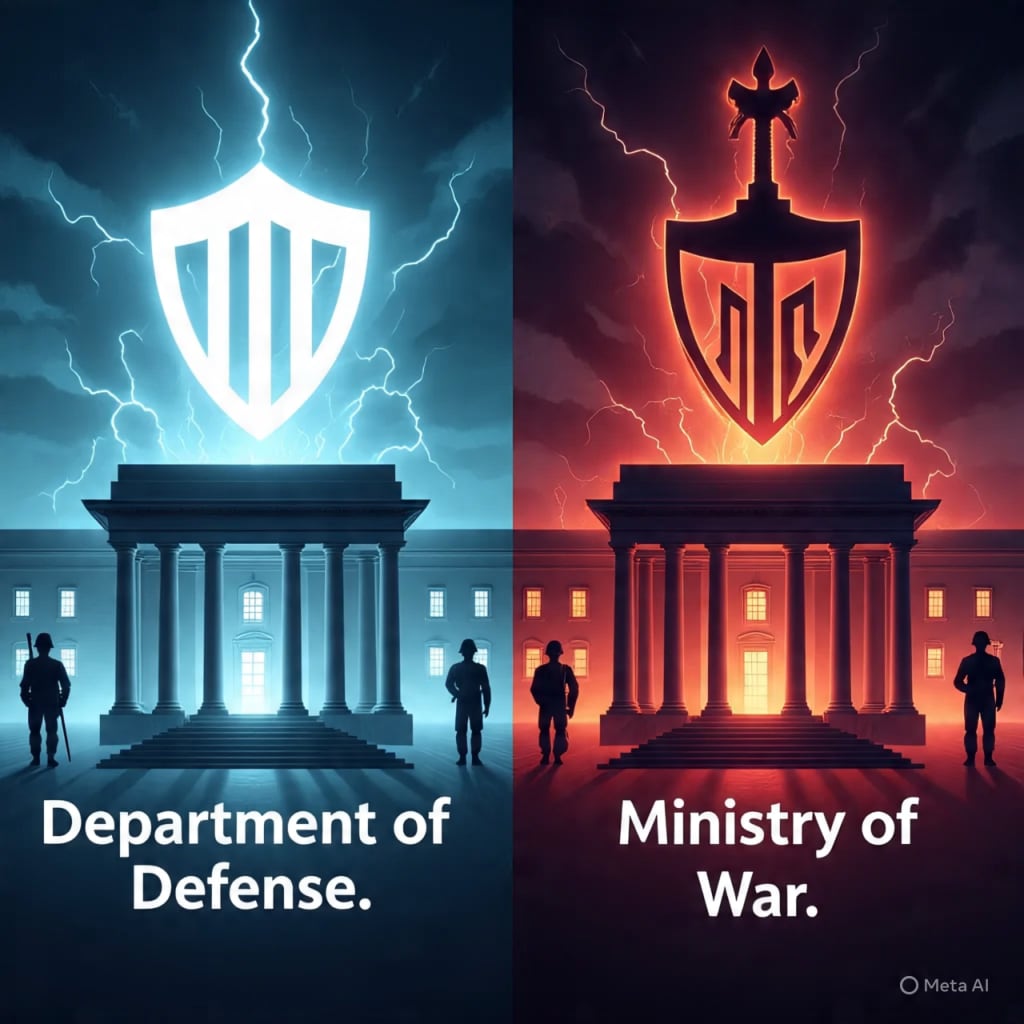
What if the United States government announced tomorrow that it was renaming the Department of Defense to the Ministry of War? At first glance, it might seem like nothing more than a change in language. But in politics, language is never just language—it shapes perception, frames policy, and influences how nations see themselves and one another. A shift in terminology from “defense” to “war” would represent a dramatic transformation in America’s identity and global posture.
This article explores the history of the Department of Defense, the symbolic and strategic implications of renaming it, and the possible consequences for both U.S. citizens and the world.
---
A Brief History of the Department of Defense
The United States was not always governed by a “Department of Defense.” When the nation was young, the original institution was called the Department of War, founded in 1789 under President George Washington. Its purpose was straightforward: to oversee the military forces of a nation still finding its place in the world.
After the devastation of World War II, however, America faced a new era. The Cold War loomed, and U.S. leaders wanted to project an image of guardianship rather than aggression. In 1947, the government restructured its military leadership and officially renamed the Department of War to the Department of Defense (DoD). The change in terminology was deliberate: “defense” implied security, peacekeeping, and responsibility. It was a word meant to reassure the public at home and signal to allies abroad that America was a protector, not a conqueror.
---
Why Words Matter in Government
Government institutions carry power not just in what they do, but in what they are called. Consider the difference between “Patriot Act” and “Domestic Surveillance Act”—the first inspires loyalty, the second suspicion. In the same way, Defense and War are not neutral synonyms.
Defense suggests protection, safety, and reaction to threats.
War suggests aggression, attack, and domination.
Changing the name of the Pentagon’s central institution would therefore alter how America defines its military mission—and how the rest of the world interprets that mission.
---
The Message of a “Ministry of War”
If the United States were to adopt the term Ministry of War, the implications would be profound.
1. A More Aggressive Posture
Such a title would suggest that the U.S. is no longer presenting itself as a peacekeeper or defender of democracy, but as a nation unafraid to admit that war is central to its policy. Instead of emphasizing protection, it would emphasize power projection.
2. Psychological Shift at Home and Abroad
Citizens may feel pride in the honesty of the title—an acknowledgment that America has been involved in nearly continuous military operations for decades. But many others would see it as disturbing proof that the U.S. accepts being in a perpetual state of conflict. Internationally, adversaries would treat the name change as proof that America sees itself as the world’s enforcer.
3. Transparency or Escalation?
Supporters might argue that renaming the department would make U.S. policy more transparent. After all, the country has fought wars in Korea, Vietnam, Iraq, Afghanistan, and beyond since adopting the “Defense” title. Critics, however, would say that dropping the mask of “defense” would make the U.S. appear more threatening, increasing global tensions.
---
Global Reactions and Diplomatic Consequences
The world would not ignore such a symbolic move.
Allies’ Concerns: NATO members and long-term partners may view the renaming with unease. If the U.S. is openly calling its defense ministry a “War Ministry,” what does that say about its commitment to diplomacy and peaceful solutions?
Adversaries’ Justification: Countries like Russia, China, and Iran could use the renaming as propaganda, claiming that America has officially admitted to being a warmongering nation. They might accelerate their own military expansion in response.
Neutral States and Peace Organizations: Nations that try to remain neutral, as well as global NGOs, might openly criticize the U.S. for choosing confrontation over cooperation. The United Nations would likely express concern that America was abandoning its role as a stabilizing force.
---
Domestic Debate and Political Fallout
Inside the United States, renaming the Department of Defense would spark fierce debate.
Public Opinion: Some Americans might applaud the honesty of the title, while others would see it as dangerous symbolism that could make the nation less safe.
Political Divides: Conservatives and progressives alike would find reasons to either support or oppose the change. For example, some conservatives might argue it reflects strength, while others warn it undermines diplomacy. Progressives might see it as a wake-up call to reduce militarism—or condemn it as glorifying war.
Impact on the Military: For soldiers and veterans, the new name could feel like a badge of honor or a burden. Would they be defenders of freedom or warriors of empire? The psychology of service could change dramatically.
About the Creator
Keep reading
More stories from Muhammad Ibrahim and writers in Criminal and other communities.
AI for the Mind
The Rise of Digital Therapy Tools In recent years, mental health has become a central topic across Europe, with rising awareness about depression, anxiety, and burnout. Traditionally, access to therapy has been limited by long waiting times, high costs, and stigma. This is where artificial intelligence (AI) has stepped in, offering new ways to make mental health support more accessible.
By Muhammad Ibrahim5 months ago in Fiction
Crime Chronicles: Darya Nikolaevna Saltykova
A little while ago, we covered the story of Delphine LaLaurie (1787 - 1849), the New Orleans socialite who tortured and murdered her slaves. We also covered Erzsebet Bathory (1560 - 1614), who did the same thing in Hungary around 200 years before that; I didn't think I'd find another one, but I did - in Russia.
By Greg Seebregts4 days ago in Criminal
Flames of Deception: Boston’s Arson Epidemic
Welcome to The True Crime Reader, the podcast that goes deep into the world of true crime literature, bringing you the stories behind today’s most gripping investigative works and in this episode, we take you to a city under siege—not by an outside force, but from within.
By Kristen Barenthaler4 days ago in Criminal
A Dart at Dusk
Seconds ago, the sullen sun set on the two of us… my exuberant furry companion and me. A fresh breeze embraces us, delivering welcome relief from the day’s oppressive heat. His typical stumbling and staggering along — apace with a sloth — has turned into trip-trapping, high-stepping, almost skipping along.
By Angie the Archivist 📚🪶5 days ago in Petlife




Comments (1)
I'm a veteran of the US Army from 2000 to 2003. I hate to say it. But I do agree with your perspective. After getting out of the military and looking at all of the things happening in the world. America does seem so aggressive and pro conflict. We are so quick to believe what our new says and our leaders propaganda. We as Americans don't want to think that we can or could be the bad guys. It's very sad