
Flames of Deception: Boston’s Arson Epidemic
The True Crime Reader


Welcome to The True Crime Reader, the podcast that goes deep into the world of true crime literature, bringing you the stories behind today’s most gripping investigative works and in this episode, we take you to a city under siege—not by an outside force, but from within.
Imagine Boston in the early 1980s: neighborhoods cloaked in darkness, the skyline glowing red each night with fire after fire. More than 264 buildings set ablaze. The arsonists? Not faceless criminals, but city insiders—three Boston police officers, a firefighter, and their close associates. At the heart of unraveling this bizarre, destructive conspiracy was ATF Special Agent Wayne M. Miller, whose book Burn Boston Burn exposes the full, incredible story of the country’s largest arson case.
Today, we’ll guide you through the real-life events that inspired the book, break down its main themes, and analyze both the city’s historical context and the determined efforts that broke the case wide open. You’ll meet the key players—both the arsonists and the investigators—and learn how shifts in politics, public sentiment, and investigative tactics collided to set and finally douse Boston’s two-year inferno.
So dim the lights, cue the suspense, and prepare for the true story of when Boston burned—with a vengeance.
Burn Boston Burn is not just a chronicle of fire; it’s a study in the intersection of politics, desperation, criminal conspiracy, and endurance. In this deeply-researched, 478-page true crime account, Wayne M. Miller—who was at the center of the investigation—takes the reader on a journey through an arson spree that was as methodical as it was senseless.
The book tells how, in the wake of Massachusetts’ Proposition 2 1⁄2—a severe property tax cap law that took effect in 1981—hundreds of firefighters and police officers lost their jobs. A loosely-knit group, largely composed of so-called “fire buffs”—including civil servants meant to protect the public—channeled their frustration and misplaced loyalty into a campaign of terror: burning buildings across Boston and its suburbs to “wake up the city” and force politicians to restore the public safety jobs cut by the tax policy.
Night after night, Boston was gripped by fear. More than 200 firefighters were injured; damages ran into tens of millions of dollars. The arson ring, characterized by brazen tactics and almost theatrical defiance, operated under the noses of those tasked with stopping them.
Miller’s account is immersive. He offers chilling detail, such as a cop waving a gun at a fire scene while being filmed by a TV cameraman—a break that proved to be a turning point in the case. He gives voices to both perpetrators and investigators, building suspense through first-person experience and thorough documentation.
Burn Boston Burn is compelling not only for its dramatic events but also for the deep themes it explores:
Political and Social Upheaval: At the core, the arson spree was a misguided protest against the budget cuts wrought by Proposition 2½. This political act warped into “domestic terrorism,” turning government wheels against the very citizens they were meant to serve.
Betrayal of the Public Trust: The involvement of sworn city employees—police officers and a firefighter—caused a public outcry and deepened the sense of collective betrayal.
Psychology of Conspiracy and Groupthink: The arsonists weren’t motivated purely by self-interest. Many were self-described fire buffs, obsessed with firefighting culture and, paradoxically, keen to bolster the system’s ranks by destroying it from within. The book examines the psychological and emotional makeup of these individuals, challenging the archetype of the criminal outsider.
Dogged Investigation: Miller highlights the unwavering persistence and creativity required to unravel a sprawling conspiracy. It’s a tale that celebrates both technological and human resourcefulness amid scarce evidence, reluctant witnesses, and public panic.
Community Fear and the Human Cost: Through hundreds of human stories—firefighters injured, families left homeless, neighborhoods gripped by terror—the book moves beyond the mechanics of arson to the very human consequences of systemic breakdown.
To truly understand why Boston burned, we have to understand Proposition 2½. Passed by referendum in 1980 amid a national wave of anti-tax sentiment, the law capped any city or town’s property tax revenues at 2.5% of the total assessed value, sharply restricting both tax increases and overall municipal income.
For Boston and its surrounding communities, this spelled disaster for public safety budgets. The city’s firefighter ranks plummeted, with Boston’s Fire Department going from 2,000 to 1,400 firefighters, scaling back to just 55 firefighting companies from a previous 773. Police departments suffered similar cuts.
This climate of austerity bred resentment among those who saw themselves as on the front lines of civic protection—and set the stage for radical, criminal activism disguised as public service. The arson ring’s actions were a dramatic, destructive reaction to a sense of institutional abandonment.
Let's walk through the critical sequence of events that shaped this tragedy and investigation.
December 1981 40 dumpster fires in South Boston, an apparent test run by conspirators
June 11–13, 1982 Citywide fire wave: 30 alarms in a single day, 101 alarms sounded in 12 hours
July 16, 1982 Major coordinated blazes in Dorchester, Jamaica Plain, Roxbury; outside help brought in
July 23, 1982 “Mr. Flare” note sent to WBZ-TV, threatening more fires if demands not met
August 13, 1982 Eight fires in five hours; damage estimated at $80,000
October 2, 1982 Marine Corps barracks fire injures 20+ firefighters, two left permanently disabled
November 6, 1982 Massachusetts Fire Academy destroyed by arson ($2 million loss)
November 21, 1982 TV footage captures officer Robert Groblewski at fire scene brandishing his gun
January 13, 1984 Groblewski confesses, implicates others
July 25, 1984 Justice Department indicts seven conspirators on federal charges
December 14, 1984 Guilty pleas and sentencing; sentences ranging up to 40 years
This illustrates not just the chronology, but the escalation and brazenness of the crimes, juxtaposed with the investigative breakthroughs that finally brought relief to the battered city.
Key Figures and Their Roles:
Wayne M. Miller ATF Special Agent, author and central investigator; led much of the casework
Robert Groblewski Boston police officer, arsonist, later informant; his confession broke the conspiracy
Gregory Bemis Sergeant, Boston Housing Authority PD; ringleader, contributed key information post-arrest
Ray J. Norton Jr. Firefighter, aided the group, provided inside intel, convicted of conspiracy
Donald Stackpole Insurance executive, set numerous fires, received harshest sentence
Wayne Sanden, Leonard Kendall Housing Authority officer and Air Force firefighter; core conspirators
Nat Whittemore WBZ-TV cameraman; filmed Groblewski at the scene, catalyzing the investigation
Boston Fire Department Victimized institution; over 200 firefighters injured during the arson spree
Community Witnesses Ordinary Bostonians, some of whom provided critical tips and testimony
The mix of public servants, thrill-seeking “fire buffs,” and peripheral supporters created a group dynamic that blurred lines between citizenship and criminality. Miller draws out the contradictions and rationalizations these men held: some believed their crimes were a twisted method of “saving the city,” while others simply sought excitement or release.
The investigation into Boston’s fire crisis involved an unprecedented federal-local task force, formed amid mounting pressure from Boston City Hall, Congress, and an increasingly frantic public.
Resourcefulness in Crisis: With budgets slashed, the Boston Fire Department relied on mutual aid from surrounding towns and adopted new investigative techniques. The ATF’s new Boston Arson Task Force operated with minimal technological support compared to modern times—no cell phones, digital surveillance, or widespread security cameras.
Surveillance and Undercover Work: Investigators set special arson patrols, staked out suspected targets, and used creative techniques such as following up on anonymous tips and untangling the web of “fire buff” social networks. It was the camera work of Nat Whittemore, capturing Groblewski waving a weapon at a rogue fire scene, which finally gave investigators a solid lead.
Interrogation and Informant Tactics: When caught, Groblewski confessed and agreed to cooperate, donning a wire and helping investigators record co-conspirators who discussed plans to hide him and obstruct justice. The prosecution marshaled 17 undercover contacts, countless interviews, and hours of surveillance to secure convictions.
Evidence Gathering: Among the most chilling pieces of evidence was an arsonist’s journal, providing not only specific details on how the fires were set but also insight into the perpetrators’ thought processes and group dynamics.
Fishy coincidences, such as a police cruiser turned “Arsonmobile” and fire alarm boxes removed to delay firefighter response, underscored the perpetrators' inside knowledge and the unique challenge facing the investigators.
The Boston Fire Department, already stripped to the bone by budget cuts, was tested as never before:
Manpower Crisis: The reduction of firefighters and closure of fire companies meant that many nights saw every available company in the city dispatched to fires—sometimes as many as seven in a single night—leaving entire neighborhoods unprotected from fire or other emergencies.
Physical Danger: Injuries abounded. Perhaps the most harrowing moment came during the Marine Corps barracks fire in October 1982, when the roof caved in and more than 20 firefighters fell into the fire below—two emerging permanently paralyzed.
Resource Scarcity: Department officials lamented the lack of trucks, gear, and functioning fire alarm boxes. In some cases, arsonists had purposely removed alarm boxes, so that by the time fires were reported, buildings were beyond saving.
The cumulative toll on Boston’s firefighters was staggering. Over 200 firefighter injuries were officially recorded during the reign of the spree, some leaving lasting disability.
This was an era before 24/7 news, yet Boston’s fires made national headlines. The narrative was irresistible—and horrifying: a city turned into “the arson capital of the world,” under nightly siege, with the shocking revelation that the conspirators were those trusted to protect and serve.
Journalists dubbed the perpetrators the “Friday Firebugs” and later the “urban terrorists” in headlines. The sight of flames rising against the Boston skyline—and the knowledge that the next blaze could be anywhere, at any time—left an indelible impression on residents. Many became too afraid to sleep, even moving trash bins away from wooden porches in the hope of deterring the next blaze.
Media exposure also played a key role in the eventual unraveling of the plot, proving that vigilant journalism can sometimes pierce even the most insular conspiracies.
The investigation’s conclusion was dramatic:
Arrests and Indictments: In July 1984, seven men—including multiple public safety officers—were indicted by a federal grand jury on charges including conspiracy, arson of federal and interstate facilities, manufacture of incendiary devices, and obstruction of justice2.
Plea Deals and Testimonies: Following the domino effect of Groblewski’s confession, the government orchestrated a wave of plea deals. Several conspirators, in exchange for lighter sentences, testified against their co-defendants. Stackpole and Norton’s cases went to full trial, resulting in sentences of 40 and 6 years, respectively11.
Key Legal Themes: Prosecutors showcased evidence such as the threatening “Mr. Flare” note, the arsonists’ journals, and audio recordings of plans to subvert justice. Federal Judge Rya Zobel did not mince words, labeling the ring “urban terrorists” at sentencing.
The judicial process underscored the magnitude of the betrayal and the weight the justice system placed on holding accountable sworn officers who turned criminal.
Focusing on the book itself, Wayne M. Miller is uniquely equipped to tell this story. Over a career spanning 25 years as an ATF Special Agent and Certified Fire Investigator, he examined more than 2,300 fire and explosion scenes and testified as an expert in over 40 cases. His involvement spanned the full arc of the Boston arson investigation—from the chaos of its inception through the tense, methodical pursuit of the arson ring, to the courtroom denouement and, decades later, ongoing dialogue with those who survived and perpetrated the crisis13.
Miller’s commitment to his craft hasn’t waned. He has become an educator—lecturing across the US and Canada, teaching at Cape Cod Community College, and speaking at more than 80 fire-related events. His continued contact with at least one former arsonist, who has provided supplemental material for his book, testifies to both his tenacity and journalistic rigor.
Beyond Burn Boston Burn, Miller’s writing and teaching emphasize the importance of accountability, thorough material evidence, and the persistent human impact of crime.
True crime audiences demand not just accuracy, but narrative power. Wayne Miller’s Burn Boston Burn and its story are a rich source for the evocative podcast treatment:
First-Person Credibility: As a participant-observer, Miller’s narration bridges the personal and the factual, a hallmark of compelling true crime storytelling.
Alternating Perspectives: The book, like this episode, weaves together the parallel stories of the “firebugs” and the investigators. Listeners are carried from scenes of mayhem to moments of quiet paranoia, shifting perspectives for tension and empathy.
Vivid Scene-Setting: Ambient sounds—sirens, flames, shouts, the distinctive clang of Boston’s fire alarm boxes—plunge the audience into the historical nightscape15.
Character-Driven Narrative: Deep dives into the backgrounds, motivations, and ultimate fates of both the perpetrators and those who stopped them give the story depth and nuance.
Direct Use of Documentary Evidence: Reading from the actual “Mr. Flare” letter or arsonist journals, or reenacting snippets of interrogation sessions, supplies emotional resonance and immediacy.
Structuring: Use of pauses for suspense, shifting pacing to mirror the escalation of arson attacks, and returning repeatedly to the mounting challenge faced by the firefighters and police.
In conclusion, as the ashes settled and the trials ended, Boston was left both traumatized and forever changed. The events recounted in Burn Boston Burn are not just a tale of criminal ingenuity and institutional betrayal—they are a testament to the resilience of a community and the dogged perseverance of its public servants, especially those like Wayne M. Miller.
By revealing the human cost behind the headlines and the complexities lurking within those sworn to serve, Miller’s work urges us to ask difficult questions: What happens when those entrusted with public safety see violence as a tool for change? How fragile is the line between righteous anger and criminal destruction? And what can we learn, as both citizens and storytellers, from Boston’s nightmarish ordeal?
In the end, the fires in Boston were extinguished not just by water and effort, but by investigative brilliance and community resolve. The legacy of those years is carried in the city’s collective memory, in every firehouse, and in every law officer’s oath.
Thank you for joining us on The True Crime Reader for this exploration of Burn Boston Burn. To learn more, check out Wayne M. Miller’s book for a firsthand account rich in detail and humanity. If you found this episode insightful, please subscribe and share—we’ll see you next time, as we open another page in the annals of true crime.
If you or someone you know has been impacted by arson or public service layoffs, support organizations such as [local firefighter’s benevolent societies] or the [National Center for Victims of Crime] are always available. For further reading, Wayne M. Miller’s Burn Boston Burn is available through booksellers everywhere.
Stay safe, stay curious, and remember—the stories behind the headlines often reveal as much about us as they do about the events themselves.
About the Creator
Kristen Barenthaler
Curious adventurer. Crazed reader. Librarian. Archery instructor. True crime addict.
Instagram: @kristenbarenthaler
Facebook: @kbarenthaler
Keep reading
More stories from Kristen Barenthaler and writers in Criminal and other communities.
Two Teens, One Bus, and a Nation Watching
Hello, and welcome to “The True Crime Reader,” where we dig beneath the headlines to unravel the stories that shape our understanding of crime, justice, and society. Today’s episode takes us to Oakland, California, for the story behind Dashka Slater’s powerful nonfiction book, “The 57 Bus”—a case that stunned the Bay Area and reverberated across the country.
By Kristen Barenthalerabout 20 hours ago in Criminal
The Murder Sheet Podcast links TX killing To KY Cold Case
At a time when violent crimes are at historical lows (despite what the current administration claims), there are more true-crime podcasts, books, TV shows, and general interest in the genre. True-crime podcasts are extremely expensive to make because of research costs, public records requests, potential investigator fees, out-of-studio recording costs, and production expenses.
By Frank Racioppiabout 21 hours ago in Criminal
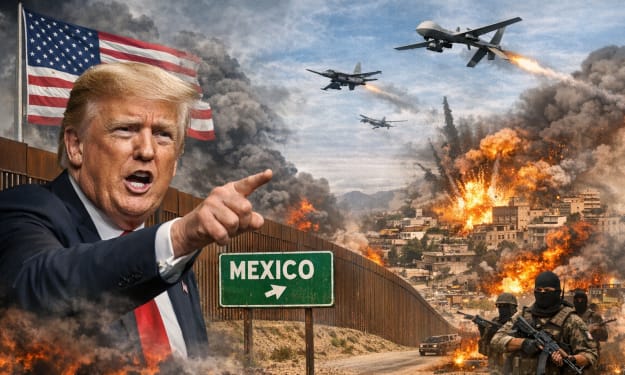
Donald Trump Threatens to Strike Mexico: A New Escalation in Political Rhetoric
Donald Trump Threatens to Strike Mexico: A New Escalation in Political Rhetoric Recent statements attributed to former US President Donald Trump have sparked widespread debate after he suggested the possibility of military action against Mexico. The comments, framed around combating drug cartels and cross-border crime, immediately drew attention from media outlets, political analysts, and the public. While such remarks are not entirely new in Trump’s political style, the idea of striking a neighboring sovereign nation has raised serious concerns about diplomacy, international law, and regional stability.
By America today 7 days ago in Criminal



Comments
There are no comments for this story
Be the first to respond and start the conversation.