
A Day Never Forgotten
The 9/11 Attacks: A Day That Changed the World

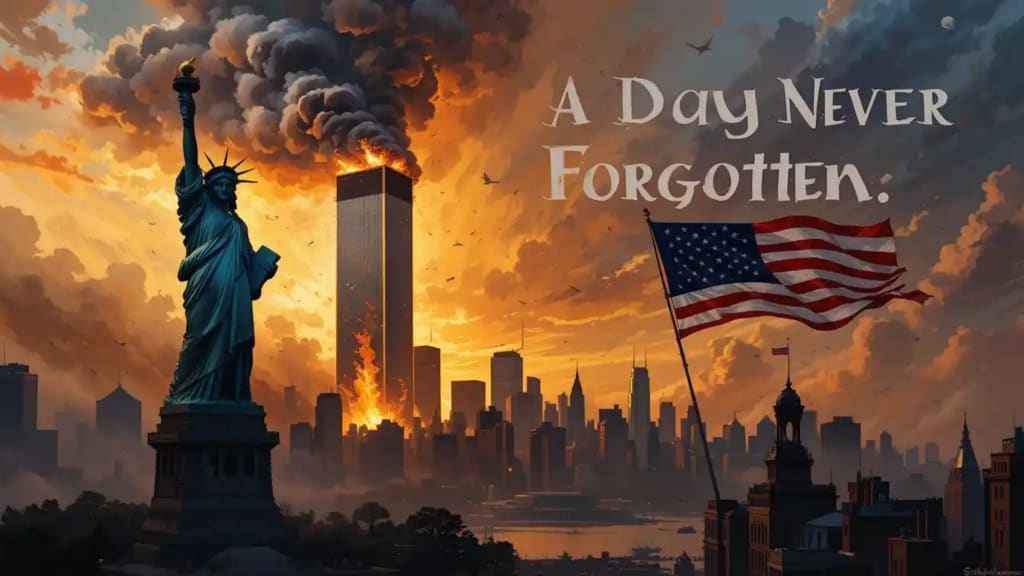
On the morning of September 11, 2001, the United States experienced the deadliest terrorist attack in its history—a tragedy that reshaped global politics, security, and the psyche of a nation. Often referred to simply as "9/11," this catastrophic event was more than just a day of destruction; it marked a profound turning point in the 21st century. The attacks not only shattered the lives of thousands of innocent people but also set into motion a chain of events that continue to reverberate around the world.
The Morning of Terror
It was a clear, late-summer Tuesday morning in New York City. Commuters were making their way to work, children were settling into their classrooms, and the world seemed to be going about its regular business. At 8:46 a.m., American Airlines Flight 11 crashed into the North Tower of the World Trade Center, ripping a fiery hole into the building and shocking the world.
Just 17 minutes later, at 9:03 a.m., United Airlines Flight 175 struck the South Tower. The second impact confirmed what millions feared—this was no accident. America was under attack.
At 9:37 a.m., a third plane, American Airlines Flight 77, hit the Pentagon in Arlington, Virginia, further fueling panic. And at 10:03 a.m., United Airlines Flight 93 crashed into a field near Shanksville, Pennsylvania. The passengers, having learned about the earlier attacks, fought to take back the plane from the hijackers. Their bravery likely prevented another catastrophic strike, possibly aimed at the White House or U.S. Capitol.
The Toll
The destruction was unimaginable. Both towers of the World Trade Center collapsed within 90 minutes of being hit, sending massive clouds of dust and debris through the streets of Lower Manhattan. Thousands of emergency responders rushed to the scene, many of whom would lose their lives in the effort to save others.
In total, 2,977 victims died as a result of the 9/11 attacks, including citizens from over 90 countries. The death toll included 343 firefighters, 60 police officers, and 8 EMTs. The emotional, psychological, and physical scars left on survivors, families, and rescue workers are still felt decades later.
Who Was Behind the Attack?
The attacks were carried out by 19 terrorists affiliated with the extremist Islamic group al-Qaeda, led by Osama bin Laden. The hijackers had spent months, even years, planning and training for the mission, exploiting gaps in airport security and immigration systems.
Al-Qaeda’s motivations were rooted in anti-American sentiment, fueled by U.S. military presence in the Middle East, support for Israel, and perceived oppression of Muslims. While these ideological motivations were not new, the scale and audacity of the 9/11 attacks brought them into terrifying focus.
America Responds
Within hours of the attacks, the United States was on high alert. President George W. Bush, addressing the nation from a secure location, declared that America would not rest until justice was served. The following days saw a massive outpouring of grief and unity across the country and the globe. Flags flew at half-staff, candlelight vigils were held, and strangers comforted one another in shared sorrow.
On September 14, 2001, President Bush stood atop the rubble of Ground Zero with a bullhorn and proclaimed to the rescue workers, "I can hear you! The rest of the world hears you! And the people who knocked these buildings down will hear all of us soon." His words became a rallying cry for a nation determined to respond with strength.
Soon after, the U.S. Congress passed the Authorization for Use of Military Force (AUMF), which gave the president broad authority to use military force against those responsible. This led to the invasion of Afghanistan on October 7, 2001, where the Taliban regime, accused of harboring bin Laden, was quickly overthrown.
The War on Terror
The aftermath of 9/11 ushered in a new era—the Global War on Terror. Over the next two decades, the U.S. engaged in prolonged military campaigns in Afghanistan and Iraq. While the Taliban was toppled quickly, the war evolved into a long and complex conflict. In 2011, U.S. Navy SEALs killed Osama bin Laden in Pakistan, bringing some closure to the families of 9/11 victims.
Domestically, the U.S. overhauled its security infrastructure. The Department of Homeland Security was established, and sweeping legislation like the USA PATRIOT Act was passed to bolster surveillance and intelligence-gathering capabilities. Airport security became far more stringent, and intelligence agencies began sharing information more aggressively.
Cultural and Social Impact
The 9/11 attacks left deep emotional wounds on American society. Memorials were created to honor the victims, including the National September 11 Memorial & Museum at Ground Zero, where two massive reflecting pools now stand in the footprints of the fallen towers.
Art, literature, and cinema began to reflect the new reality. The attacks challenged perceptions of safety and forced Americans to confront global terrorism and religious extremism more directly. Unfortunately, this also led to a rise in Islamophobia and xenophobia, as some equated the actions of extremists with the broader Muslim community—a stereotype still challenged today.
Global Ripples
The effects of 9/11 were not confined to the U.S. The attacks led to the redefinition of global security policies. Countries worldwide tightened their own border controls and expanded counterterrorism efforts. International alliances like NATO invoked Article 5, treating the attacks as an attack on all member states—an unprecedented move.
Yet, the legacy of 9/11 is mixed. While al-Qaeda was severely weakened and many terror plots thwarted, new extremist groups such as ISIS emerged. The wars in the Middle East resulted in hundreds of thousands of deaths, massive displacement, and long-term instability in the region.
A Day Never Forgotten
More than two decades later, the shadow of 9/11 still lingers. Annual memorial ceremonies are held, bells toll at 8:46 a.m., and the names of the victims are solemnly read aloud. For many, the day serves not just as a remembrance of loss, but as a reminder of resilience, unity, and the enduring fight against hatred.
Though time has passed, the legacy of that day remains etched in the minds of millions. September 11, 2001, was not just a day of horror—it was a defining moment in modern history that changed the course of nations, challenged the strength of democracy, and reminded the world of both the worst and best of humanity.
About the Creator
The Last Train from Lahore
M Mehran On a fog-drenched winter night in Lahore, the last train pulled away from the platform with a tired metallic scream. Vendors packed up their tea stalls. Porters stretched their aching backs. The city exhaled. But in coach C-7, a crime was already in motion. His name was Hamza Iqbal. To his neighbors, he was polite. To his mother, devoted. To the law, invisible. And to the passengers on that train, he was about to become a nightmare. A Criminal Who Studied People, Not Locks Hamza wasn’t the kind of criminal who relied on force. He relied on observation. For months, he had studied human behavior at railway stations—who traveled alone, who carried expensive gadgets, who looked distracted, who trusted too easily. He learned patterns. Businessmen guarded briefcases but ignored backpacks. Students protected phones but forgot wallets in jacket pockets. Families assumed safety in numbers. Hamza didn’t steal randomly. He selected with precision. But what made him different from petty thieves was his long game. He wasn’t after wallets. He was after identities. The Perfect Setup Inside coach C-7, Hamza smiled warmly at an elderly couple struggling with luggage. “Let me help,” he offered. They thanked him. Trust was built in seconds. Across the aisle, a young tech entrepreneur tapped away on his laptop. Hamza noticed the company logo on his bag. Startup founder. Likely successful. Likely careless. As the train rolled into darkness, Hamza moved like a shadow. He didn’t snatch. He didn’t threaten. He cloned. With a small wireless device hidden inside his power bank, he skimmed unsecured data from nearby phones and laptops connected to the train’s public Wi-Fi. Passwords. Banking apps. Email logins. Most passengers never realized their digital doors had been left open. By the time the train reached Karachi, Hamza had stolen more than cash could ever buy. He had stolen access. When Theft Becomes Destruction Within days, bank accounts were drained. Cryptocurrency wallets vanished. Confidential business proposals leaked online. Victims filed complaints, confused and ashamed. No one remembered being robbed. No physical evidence. No witnesses. Cybercrime units suspected phishing scams. Malware. International hacking rings. But Hamza worked alone. He operated from a modest apartment, using public networks and temporary devices. After each operation, he destroyed hardware. Burned SIM cards. Wiped drives. He believed himself untouchable. And for a while, he was. The Investigator Who Refused to Guess Enter Detective Ayesha Khan of the Federal Investigation Agency. Unlike others, Ayesha didn’t begin with technology. She began with geography. She mapped every victim’s travel history. One connection stood out: each had taken the Lahore–Karachi night train within the same three-month window. Coincidence? Criminal investigations rarely reward coincidence. Ayesha rode the train herself. She watched. Listened. Waited. And she noticed something subtle—one passenger who never seemed to sleep, never seemed to panic, never seemed to disconnect from the public Wi-Fi. Hamza. The Psychology of a Criminal Criminal profiling suggests that repeat offenders develop rituals. Habits. Comfort zones. Hamza always chose coach C-7. Always boarded last. Always offered help to elderly passengers to avoid suspicion. It wasn’t greed that motivated him. It was superiority. He believed he was smarter than the system. Smarter than his victims. That belief would become his weakness. The Trap On her third undercover ride, Ayesha deliberately connected a decoy laptop to the train’s Wi-Fi. It contained traceable bait—fake financial credentials monitored by cyber forensic teams. Within minutes, the system detected an intrusion attempt. The signal originated only meters away. Ayesha felt her pulse steady, not race. Criminal apprehension isn’t about adrenaline. It’s about timing. When the train slowed near Hyderabad, officers in plain clothes quietly surrounded Hamza. He tried to remain calm. But calm cracks under certainty. Inside his backpack, they found modified signal boosters, portable data skimmers, and encrypted storage drives containing hundreds of stolen identities. The silent thief of the rails was finally visible. In the Interrogation Room “Why?” Ayesha asked him. Hamza shrugged. “Because they made it easy.” It wasn’t poverty. It wasn’t desperation. It was opportunity. He saw society’s dependence on technology and recognized its vulnerability. Public Wi-Fi networks. Weak passwords. Blind trust. He didn’t see faces. He saw access points. Psychologists later described him as a high-functioning cybercriminal driven by intellectual thrill rather than necessity. But thrill fades. Consequences don’t. The Impact of Modern Crime Hamza’s arrest exposed more than one man’s wrongdoing. It revealed a larger truth about modern criminal activity: Digital theft can be more damaging than physical robbery. Cybercrime leaves victims confused and self-blaming. Public networks are fertile ground for exploitation. News outlets across Pakistan covered the case extensively. Security experts warned travelers to avoid unsecured Wi-Fi. Banks strengthened authentication systems. The Lahore–Karachi train added cybersecurity advisories to ticket confirmations. Crime had evolved. And so had fear. The Sentence In court, Hamza showed little emotion as charges were read: identity theft, cyber fraud, illegal data interception, financial crimes. He was sentenced to fifteen years. Some called it harsh. Others called it justice. For the entrepreneur who lost his startup funding overnight, it was closure. For the elderly couple whose savings disappeared, it was relief. For Detective Ayesha Khan, it was a reminder: Criminals adapt. So must those who chase them. The Moral Behind the Crime Story This criminal story isn’t just about one man on a train. It’s about vulnerability in a connected world. It’s about how trust, convenience, and technology can become weapons in the wrong hands. Hamza didn’t wear a mask. He wore normalcy. And that is what makes modern criminals so dangerous—they blend in. The next time you connect to public Wi-Fi, glance around. The quiet passenger helping with luggage. The man who never seems to sleep. The stranger who smiles too easily. Crime no longer needs a gun. Sometimes, it only needs a signal. And somewhere, on another train slicing through the night, someone may already be watching the bars of your connection rise—waiting for them to fall.
By Muhammad Mehrana day ago in Criminal



Comments
There are no comments for this story
Be the first to respond and start the conversation.