Humanity
China learns lessons from the Ukraine war
The eyes of those interested in international relations continue to focus on China, to monitor the development of its positions on the Russian-Ukrainian war. Will it be inclined to persuade Russia to bet on peace in Ukraine, or will it use this crisis to weaken the West, which makes it the next target, which must be controlled? China adopted a cautious attitude at the beginning of the conflict, but soon began to adopt a sharp tone toward the United States.
By Zernouh.abdo4 years ago in Confessions
Earth Day and messages that don't die with age
These days are the forty-sixth anniversary of the Glorious Land Day, and attention is directed to historic Palestine, after the recent confrontations in the Negev, Beersheba, Hadera, Bani Brak, Ramat Gan and Umm al-Fahm, which restored the glow of that glorious historical day.
By Zernouh.abdo4 years ago in Confessions
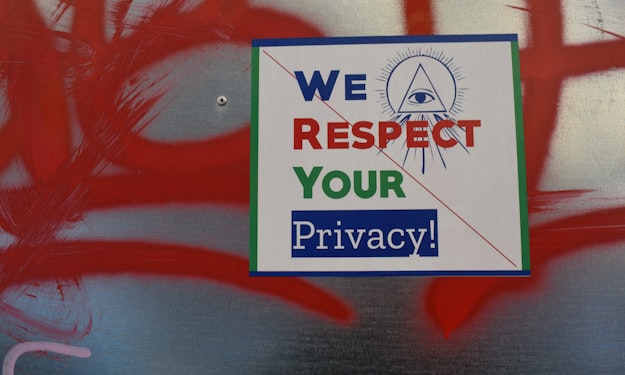
The Notice of Privacy Statement
I was at the pharmacy the other day, and it tickled me that I had to sign a form to acknowledge I was aware of my privacy rights - to be more specific, I had to sign at the bottom of this form, under a long list of other customer names with stickers out beside each one that indicated how many prescriptions each person received.
By Aleeza4 years ago in Confessions
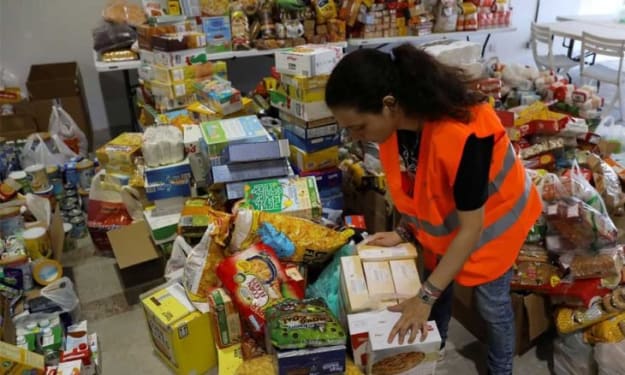
What will the Arab countries do with the food crisis imposed by the Ukraine war?
. Everyone is now warning of a global food crisis that will hit many regions of this world due to the Russian war on Ukraine and the dependence on grain supplies coming mainly from both sides, and even started talking about a famine that will occur in certain regions, the most important of which is Africa. The latest of these shouts came from the Director-General of the International Monetary Fund, Kristalina Georgieva, when she said unequivocally that “the war in Ukraine means hunger in Africa,” but not only Africa is threatened with severe repercussions, but many other regions even in Europe, as it is a major country like France. Its president declares that "we are about to enter into an unprecedented food crisis" at a time when Europeans are currently facing a significant increase in the prices of various agricultural products, but it is certain that the repercussions will be more severe and catastrophic for Africa and the Middle East. The warnings did not stop at people's livelihood in these areas, but extended to the United Nations Secretary-General saying that "the world will witness a storm of famine and a collapse of the global food system." Such talk was accompanied by a worrying warning that this would inevitably lead not only to difficult humanitarian conditions there, but would certainly be accompanied by unrest and political turmoil whose extent no one knows from now. If Europe is currently searching with all effort for specific exits for such a possibility, as the French President called at the recent G7 summit of the need to go to search for the best and fastest ways to develop a collective plan that seeks to raise agricultural production in Europe, then we are in Africa and in our countries Arab countries are affected more than others. We have seen nothing but an expression of fear without moving a finger, even though the food threat came to it, accompanied by the rise in energy prices, so two calamities met with it, not just one. The paradox here is that agricultural and food experts in the European Union are currently complaining about the absence of a clear and solid European agricultural vision before this crisis, and they point out that Europe does not possess a reliable strategic reserve of grain (Germany is almost the only one with such reserves) at a time when countries were Like China or India, it is working strongly in this direction, and the result is that China has a 9-month stockpile, while the European Union has only a 36-day stockpile. And if this is the situation of an organized bloc like the European Union, then what will the situation be in some Arab countries?! In the list of the top 10 importers of wheat in the world, we find two Arab countries, Egypt and Algeria, where Egypt is the largest importer and consumer of wheat in the world, as it imports annually more than 13 million tons, or more than two-thirds of its needs of this strategic commodity. Russia and Ukraine constitute the source of about 85 percent percent of the imported quantities. Although a country such as Algeria, which is considered among the largest importers of soft wheat in the world, has France as a major supplier of this material, and deals to provide the required quantities of wheat with about 20 countries, it is also concerned about the possible disruption of Russian wheat that returned to its markets after A break of about five years. As for Morocco, which is the third consumer of wheat in Africa, after Egypt and Algeria, and is among the ten countries in the world that import the most grain, it is no less disturbed than others, as Ukraine and Russia come in second and third, after France, among the exporters of soft wheat to the Kingdom, while Canada ranks The first place among its suppliers of durum wheat. Perhaps Tunisia is among the most affected, especially as it is already experiencing a severe financial crisis with delays in the payment of salaries and a shortage of basic foodstuffs such as grain, sugar, oil and some medicines. What makes the situation worse is the deep political crisis there and the state of denial of its president, who believes that many of the country’s problems are due to conspiracy against him, to the extent that the shortage of foodstuffs brought him back to monopoly, although he does not explain everything, especially since some ships loaded with grain have turned back. From Tunisian ports because the state did not have the ability to pay, in a dangerous precedent that carries very frightening omens about the future. The political cost of all of the above is currently unknown, especially in both Egypt and Tunisia, with rising prices and more suffocation of people in their livelihood. Do not forget that both of them lived in the eighties of the last century major popular uprisings called the bread uprisings after the increase in their prices. As for reminding most Arab countries that a country like Sudan would have been the safe food basket for all of them, if there was vision and insight, there is no point in talking about it..
By Zernouh.abdo4 years ago in Confessions
Thousandaire
There was a science prof at the college where I got my BA, whose name was Bill Miller, and some of the students who knew him (and he was a popular, well-liked guy for good reason) would refer to him as the "Billion Million" because Bill Miller knew a "million billion" things on all matter of subjects, and also it was funny to follow the bigger number with a smaller number. I don't know if Bill Miller actually knew a "billion million" things, I never took his classes because I was strictly humanities all the time except for when I was busy flunking Applied Mathematics (seriously, my undergrad institution was desperate to see me through a math class) which was basically "math for math dummies." And even Math For Math Dummies 101 was a struggle for me.
By Allison Gruber4 years ago in Confessions
Have You Had A Publishers Clearing House (PCH) Experience?
My husband calls my stacks of mail from the publisher’s clearinghouse ‘piles’. He says, “I don’t want your piles on my side of the table.” I decided to order Christmas presents from PCH to stay in the contest for the prize.
By Denise E Lindquist4 years ago in Confessions
Amelia Begins Again
Amelia. Yes, Amelia. That's my name. Though the sound of it gives me pause. Like it never really fit. The great Dale Carnegie said, "Names are the sweetest and most important sound in any language." My Hospitality Management professor once told us that hearing the sound of one's own name is the most precious sound to a person (which is why we require service agents to say a customer's name in their interactions). But I always had trouble with mine. Seriously. Always. I have vivid memories of lying to my classmates in kindergarten about my last name, for instance. It wasn't my father's, or my grandmother's (whom I lived with), or even my mother's at that point. It was my mother's maiden name. And I was the only one in my vicinity that carried that god-awful thing. Tunstall. Pronounced "tuhn-stuhl." Ugh. Worse, I'm not called by my first name. Hell, or even my middle name, really! Kaslynn Amelia Tunstall was called Milly. What in the 1984 hell was going on? Anyway, the fact was - and still is- my name was never a sweet or precious sound to me. Instead, a reminder that no one could quite figure out who I was supposed to be, which remains problematic some thirty+ years later.
By K.M. Lewis4 years ago in Confessions