
Earth Day and messages that don't die with age
These days are the forty-sixth anniversary of the Glorious Land Day, and attention is directed to historic Palestine, after the recent confrontations in the Negev
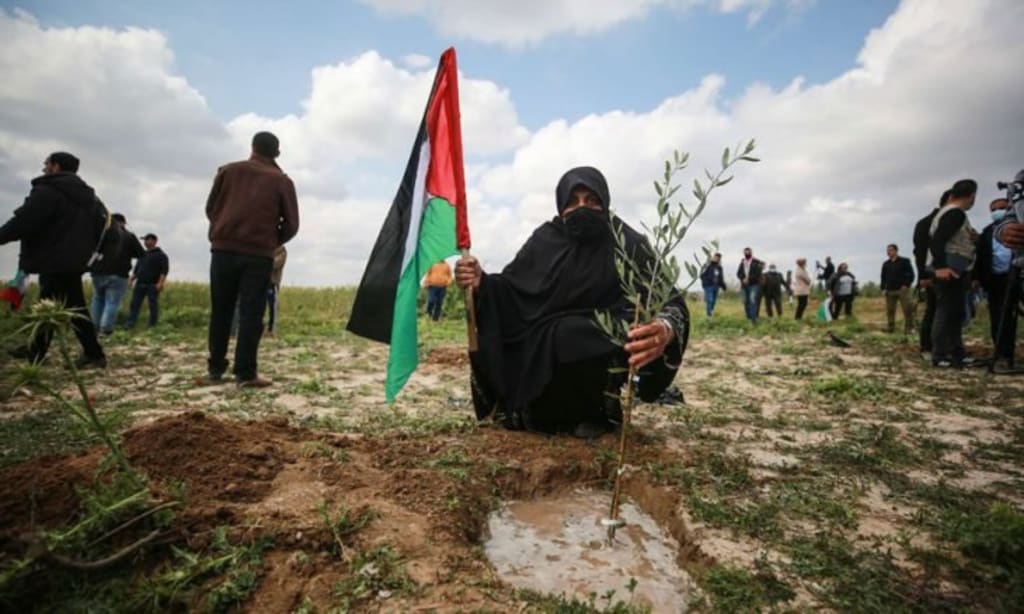
These days are the forty-sixth anniversary of the Glorious Land Day, and attention is directed to historic Palestine, after the recent confrontations in the Negev, Beersheba, Hadera, Bani Brak, Ramat Gan and Umm al-Fahm, which restored the glow of that glorious historical day.
Several marches and festivals were launched in Sakhnin, Araba, Taybeh, and other Palestinian cities and towns in honor of the six martyrs, who faced the Zionist machine of oppression in defense of their land. Celebrating that anniversary is necessary and a national action par excellence, and a lesson from which we draw many lessons and lessons, which express the continuity of generations of the Palestinian people who carry the banner of struggle until complete liberation is achieved and the refugees return to their homeland, and the entire Palestinian people exercise the right of self-determination on the land of their forefathers and ancestors. And builds his democratic state that does not discriminate between its citizens on the basis of color, religion, gender, belief or language.
On this occasion, I would like to recall some major facts, great lessons and messages that cross time and generations, which do not die with age, but rather increase in value and credibility and reveal the importance of the Glorious Land Day, which has returned the glow to the true narrative of the struggle over the one land, one people, and full rights.
First: The Land Day confrontations revealed the nature of this entity, which is in essence a colonial, exclusionary, substitutionary entity based on canceling and expunging the indigenous people of the country and bringing in strangers in their place from all over the world, under the pretext of the divine link and the illusions of divine promises. The truth is clear that the Zionist movement is the product of the colonial movement, which matured in the bosom of colonialism, was brought up under it and implemented on the ground with the support of it, especially the old state Britain.
Second - The Land Day confrontations proved that the conflict is basically based on the land, and has nothing to do with mythology and myths of divine promises - the enemy wants the land without inhabitants.. It has acquired more than 90% of the lands of our people inside who did not leave their homes and issued two dangerous laws in the beginning The age of the entity - the right of return for any Jew in the world, and the Absentee Property Law, which authorizes the authorities to seize the lands of Palestinians who have been forcibly displaced from their cities and villages.
Third - The Land Day confrontations proved that the Palestinian people are one and their cause is one, and that all Palestinian communities are concerned with defending their national cause and confronting the plans of eviction, emptying and land seizure. Those confrontations exposed the notion of a democratic state and the story of the Palestinians' integration into the Zionist political structure and the restriction of their demands to improving their living conditions. That was the beginning of the radical transformation in the national belonging of the Palestinian people in historic Palestine and their national project and the establishment of national parties, groupings and civil organizations committed to the rights of the national Palestinian people and its authentic narrative based on the unity of land, people and rights.
Despite the rupture of this ancient people and its severing in parts of the earth, and the imposition of many borders, barriers, identities and passports, involuntarily or voluntarily, its affiliation to its cause only increased in depth, spread and lofty, as a natural result of the establishment of this strange entity that Western colonial powers planted in the heart of the Arab nation . Despite the passage of 74 years since the establishment of the entity, the successive generations, generation after generation, have remained committed to their national identity and belonging to the homeland.
Fourth - The Zionist enemy does not find anything to protect its existence except by resorting to weapons and conspiracies, sowing discord and fragmenting the Palestinian existence. He knows that he is a thief of this land, and he knows that he does not belong to this region, nor to its culture, nor to its history, nor to its demographic, ethnic and civilizational composition. Therefore, he protects his existence with weapons that he wants to monopolize its use in arrangement with the colonial powers and the weak Arab regimes.
That gift was a massive popular uprising in all of historic Palestine. After that, the enemy began to work to disintegrate the Arab ranks, and succeeded in removing Egypt from the arena of conflict and singling out the rest of the ring countries and Iraq, and the Palestinian leadership succumbed to Arab pressure and had to leave Lebanon in 1982. The great Palestinian response was to launch its great uprising in 1987 that almost toppled this regime The stranger forcefully implanted in the body of the nation, but the Zionist scheme based on splitting the Arab and Palestinian ranks succeeded in signing the surrender agreements in Oslo (1993) and Wadi Araba (1994) all the way to the Ibrahim Agreements 2020, which embodied a great breakthrough in the body of the nation and a dangerous deviation from the systems of normalization and scrambling, Especially the Oslo Authority, which transformed the contemporary Palestinian revolution into a security apparatus that watches over the security of the enemy and its settlers, in exchange for material gains for a small group whose interests are linked to the survival of the occupation and the apartheid regime.
What was true then is true now and in the future. Rights are taken and not granted. Negotiations that are not based on force are a path to surrender, and an appeal to the international community will not liberate land, will not close a settlement, or stop an incursion. This enemy knows only the language of continuous, continuous and growing resistance.
Hold on to the identity inside
Adherence to the national identity that distinguishes the Palestinian from these strangers was the main title of the early stages of our people's struggle at home. From here we understand the poetry of Mahmoud Darwish, Samih al-Qasim, Tawfiq Ziyad and Rashid Hussein, the novels of Emile Habibi, the spread of popular poets and singers, the establishment of dabkeh circles at weddings, the reliance on authentic Palestinian clothes, customs, traditions and the Arabic language, leading to the launch of the national struggle movements, the most important of which is the “Sons of the Country Movement” in Umm al-Fahm in 1972. The poet Rashid Hussein used to say that the spinning poems we write are a form of resistance, and Darwish described the poem as a ticket to prison, and wrote his famous masterpiece, “Identity Card,” and Ziyad addressed the Zionists, saying, “You stay on your chest like a wall.” The Nakba of 1948 left a leadership vacuum inside, as historian Émile Thomas emphasized, but this crisis was temporary as three forces crystallized: The national popular forces that confronted the policy of national oppression, to which the Arab communists aligned themselves, leaving behind their Jewish comrades who advocated assimilation, and the nationalist forces that represented the petty bourgeoisie, merchants and intellectuals, while a small force formed behind Israel itself of clan leaders, dignitaries and sectors of the Bedouin, and tried to join The Zionist parties, however, remained small, isolated and marginal. After the epic Land Day 1976, the Palestinians turned to broad popular organizations and formed the Democratic Front for Peace and Equality, the Progressive Movement for Peace, the National Democratic Rally Party and the Equality Charter movement. Then the Islamic movement was established, which became a strong third trend alongside the nationalist and communist movements.
The historical responsibility of the Palestinian interior
The Zionist political elite now considers the two million Palestinians to be Israel’s number one enemy, and 50% of the Israelis support the expulsion of Arabs from all of the country, according to a “Poll” poll in March 2016. This position was embodied in the issuance of the racist Nationality Law in 2017, which considers that the report Fate is the exclusive right of the Jews, and that the country's identity is only Jewish. This law put the Palestinians inside the first line of confrontation. Before 1982, the resistance factions abroad carried the torch of the national struggle, and after the organization’s deportation from Lebanon, the torch of struggle moved to the interior, which is under direct occupation in the West Bank, Gaza and Jerusalem, so the Palestinian people launched two great uprisings there. We believe that the torch of struggle in the next stage will pass to the hands of the Palestinians at home, and contemplate what is happening in the Negev, Beersheba, Umm al-Hiran, Qalansuah, Umm al-Fahm, Lydda and Nazareth. The May 2021 gift came to embody this trend and move the confrontation with the entity to all sectors of the Palestinian people in all parts of historic Palestine. From here we understand the importance of Earth Day, which opened a new page in the face of the entity that still exists today. The best expression of this sentiment is the speech delivered by Jalila Abu Raya, the daughter of the Land Day Martyr, Raja Abu Raya, at the Land Day celebrations in the town of Sakhnin. She said: "My father bequeathed me a message to pass on to my children and grandchildren: We will complete the path that my father built with his blood, which is the way to preserve our land because it is our identity and our existence."
Lecturer at the Center for Middle Eastern Studies at Rutgers University, New Jersey
About the Creator
Keep reading
More stories from Zernouh.abdo and writers in Confessions and other communities.
Europe and Ukrainian refugees
With the Russian war on Ukraine, Europe found itself facing an unprecedented challenge, not only in the strategic and military sense, but also in the humanitarian and societal sense, with this large and continuous influx of Ukrainian refugees towards its various countries.
By Zernouh.abdo4 years ago in Confessions
The Royal News That Made Me Pause: Why This Upcoming Visit Feels Different
There are moments when a piece of celebrity news makes you stop and think a little deeper than usual. For me, that moment happened recently when I heard that Prince Harry and Meghan Markle might soon visit Australia again.
By CelebCast Centrala day ago in Confessions


Comments
There are no comments for this story
Be the first to respond and start the conversation.