
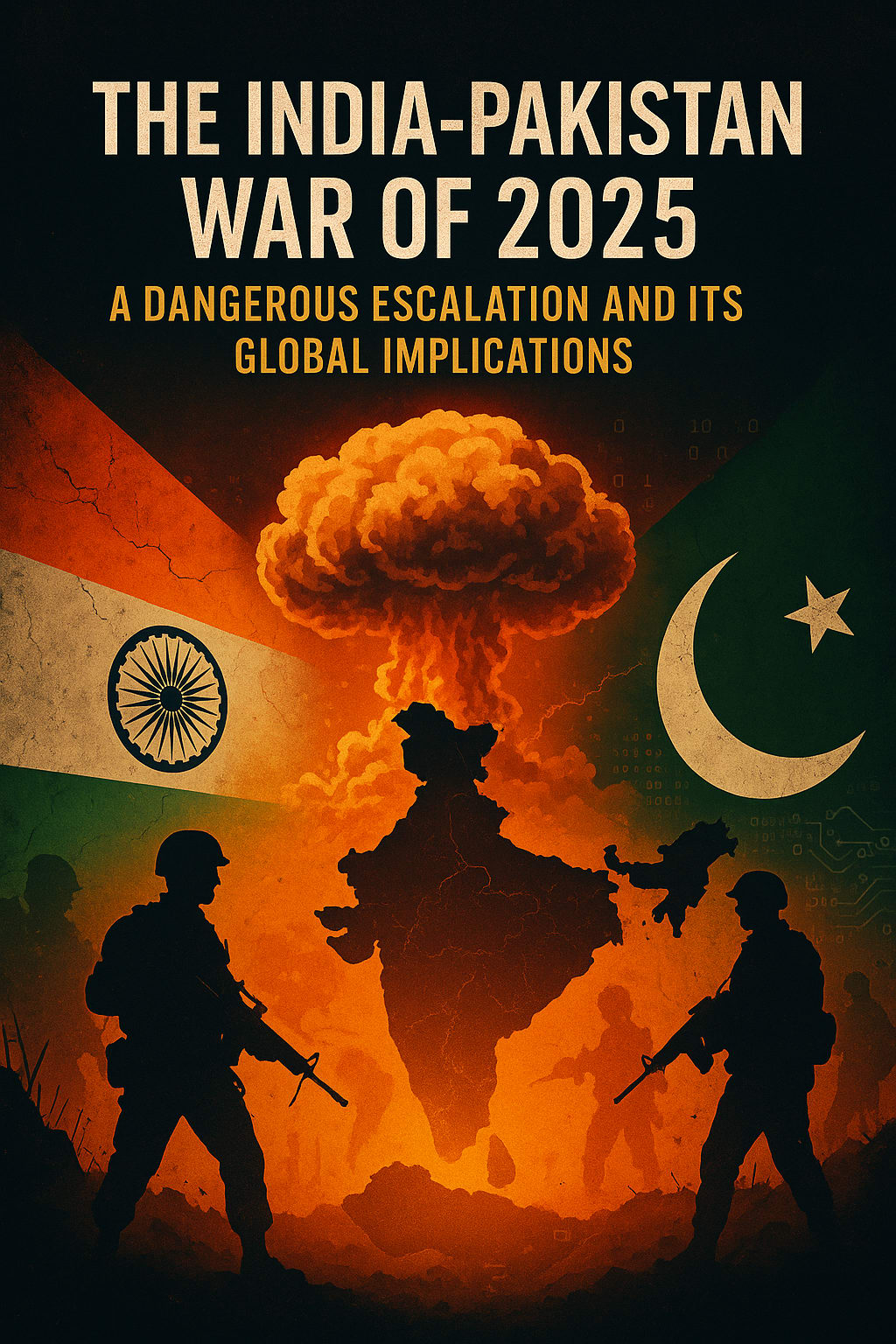
The India-Pakistan War of 2025: A Dangerous Escalation and its Global Implications
An In-Depth Analysis of the Triggering Event, Military Build-Up, and Global Repercussions of the 2025 Conflict Between Two Nuclear-Armed Neighbors

Introduction
The conflict between India and Pakistan has been one of the most persistent and perilous geopolitical struggles of the modern era. Despite multiple ceasefires and attempts at diplomacy, the relationship between these two nuclear-armed neighbors has been fraught with tension and conflict. The year 2025 marks a significant chapter in this long history, as both nations find themselves on the brink of war once again. The catalyst for this dramatic escalation was a deadly terrorist attack on April 22, 2025, in the Indian-administered region of Jammu and Kashmir, which has sparked a series of retaliatory military and diplomatic measures.
This article delves deep into the complex history and events leading to the 2025 India-Pakistan war, analyzing the political, military, and global dimensions of the conflict. By examining the historical context, key flashpoints, and the responses from both nations, this piece aims to provide a comprehensive understanding of the ongoing crisis and its potential global consequences.
Section 1: Historical Background of Indo-Pakistani Conflicts
To fully understand the gravity of the 2025 conflict, it is essential to grasp the historical backdrop of India-Pakistan relations. Since their partition in 1947, the two nations have fought three major wars—1947, 1965, and 1971—with Kashmir emerging as the central issue in every conflict. The Kashmir dispute has remained unresolved despite numerous attempts at negotiations and peace agreements, including the famous Shimla Agreement of 1972 and the Lahore Declaration of 1999.
The Kargil War of 1999 marked the last major military confrontation between India and Pakistan, although tensions have never fully dissipated since. The presence of nuclear weapons in both countries has acted as a deterrent against large-scale war, but it has also increased the potential for catastrophic escalation. For the past two decades, both nations have focused on counter-insurgency operations, military build-up, and proxy wars, particularly in the Kashmir region.
The global community has frequently intervened diplomatically, urging both sides to refrain from military action and pursue peace. Yet, as of April 2025, it became clear that neither side was willing to back down, leading to the dangerous situation at the precipice of full-scale war.
Section 2: The Trigger Event – The Pahalgam Attack
On April 22, 2025, the peaceful town of Pahalgam in Jammu and Kashmir became the scene of one of the deadliest terrorist attacks in recent years. A group of gunmen ambushed a caravan of Hindu tourists traveling to the scenic Baisaran Valley, killing 26 individuals, including women and children. The Resistance Front (TRF), a Pakistan-based insurgent group, claimed responsibility for the attack, further exacerbating the already fragile situation between India and Pakistan.
India immediately accused Pakistan of orchestrating the attack through its proxies. The TRF is widely believed to operate with the support of the Pakistani military’s Inter-Services Intelligence (ISI), making this attack not just a random act of terrorism, but a direct assault on Indian sovereignty. The Indian government, led by Prime Minister Narendra Modi, vowed to take swift and decisive action against those responsible.
Pakistan, on the other hand, vehemently denied any involvement in the attack. The Pakistani government condemned the violence but insisted that it was the result of internal insurgency rather than state-sponsored terrorism. This denial only fueled India’s accusations, escalating diplomatic tensions between the two nuclear-armed nations.
Section 3: Diplomatic Breakdown and Economic Measures
In the days following the attack, India took several immediate steps to punish Pakistan and send a clear message. The Indian government expelled several Pakistani diplomats and recalled its own diplomats from Islamabad. Additionally, India announced the suspension of the 1960 Indus Waters Treaty, a bilateral agreement that governs water-sharing between the two countries, citing national security concerns and Pakistan’s failure to curb cross-border terrorism.
India also imposed severe travel and visa restrictions on Pakistani nationals, closing the border between the two countries for all non-essential movements. Economic ties, which had already been strained in recent years, were further strained as trade routes were suspended, and Pakistan’s airspace was closed to Indian aircraft.
Pakistan retaliated by expelling Indian diplomats, and the government declared that it would suspend the Simla Agreement, a historic 1972 accord that established the framework for peaceful bilateral relations. Pakistan also imposed its own travel and trade restrictions on India, further deepening the divide between the two nations.
Despite international calls for restraint, both countries hardened their positions. The diplomatic standoff seemed increasingly intractable, with little prospect for dialogue in the near future.
Section 4: Military Escalation – A Dangerous Path
The diplomatic breakdown quickly gave way to military confrontations along the Line of Control (LoC) in Kashmir, the de facto border between India and Pakistan in the disputed region. Border skirmishes, artillery exchanges, and cross-border infiltrations escalated, with both sides accusing each other of violating ceasefire agreements. The LoC, which has long been a hotspot for military tensions, became a flashpoint once again, and the possibility of full-scale war seemed imminent.
India began mobilizing its forces along the LoC, calling up additional troops and deploying advanced weaponry in preparation for potential escalation. Pakistan, too, moved its military forces to key positions, ready to respond to any provocation. Both nations conducted military drills in the region, showcasing their respective military capabilities.
The risk of escalation was high. Both India and Pakistan are nuclear-armed states, and the thought of a nuclear confrontation became a real possibility. While both nations had refrained from using nuclear weapons in previous conflicts, the situation in 2025 was far more volatile. With military tensions escalating rapidly, there were growing fears that a miscalculation or a reckless move by either side could lead to devastating consequences.
Section 5: The Role of International Powers
The international community closely monitored the situation, and major world powers such as the United States, China, and Russia weighed in on the unfolding crisis. The United Nations called for an immediate ceasefire and urged both countries to engage in diplomatic dialogue. However, the international response was largely reactive, and there was little in the way of tangible pressure on either nation to de-escalate.
China, which shares a border with both India and Pakistan, expressed concern about the rising tensions, particularly given its ongoing territorial disputes with India. However, Beijing’s approach was more neutral, as it sought to maintain good relations with both countries. Russia, a longtime ally of India, expressed support for India’s right to defend its sovereignty but also urged both sides to exercise restraint.
The United States, historically a key ally of Pakistan, found itself in a delicate position. The Trump administration, which had cultivated close ties with India in recent years, was caught between its strategic partnerships with both nations. Despite calls from some factions within the U.S. to intervene diplomatically, the U.S. chose not to take direct action, preferring to issue statements urging both sides to refrain from further escalation.
Section 6: Cyber Warfare and Intelligence Operations
In addition to conventional military strategies, both India and Pakistan engaged in cyber warfare and intelligence operations during the 2025 conflict. Both nations have developed advanced cyber capabilities, and the conflict saw a rise in cyberattacks targeting critical infrastructure, government institutions, and defense systems.
India accused Pakistan of launching sophisticated cyberattacks on Indian government websites and military networks, while Pakistan claimed that India had attempted to disrupt its communications and military operations. Both countries also increased their intelligence gathering efforts, with reports of espionage, surveillance, and covert operations aimed at destabilizing each other’s political and military establishments.
While cyber warfare remains an underreported aspect of modern conflicts, it played a significant role in the 2025 India-Pakistan war, highlighting the growing importance of digital battlegrounds in contemporary warfare.
Section 7: Nuclear Deterrence and Strategic Posturing
One of the most critical aspects of the 2025 conflict was the nuclear dimension. Both India and Pakistan possess nuclear weapons, and the specter of nuclear war loomed large over the crisis. In the past, nuclear deterrence had kept both sides from engaging in full-scale conventional warfare, but the 2025 conflict brought this delicate balance into question.
In response to India’s military build-up, Pakistan’s military leadership emphasized its readiness to use nuclear weapons if its territorial integrity was threatened. Pakistan’s strategic doctrine, which includes the use of tactical nuclear weapons, was put on full display, signaling that any large-scale attack by India could provoke a nuclear response.
India, for its part, maintained its traditional stance of “No First Use” (NFU) of nuclear weapons. However, as the situation grew more tense, there were growing concerns that India might abandon this policy and retaliate with nuclear strikes in the event of a Pakistani first strike.
The potential use of nuclear weapons in the 2025 war raised alarms worldwide, and the prospect of a regional nuclear conflict was a major point of concern for global security.
Section 8: Media Narratives and Public Sentiment
Both India and Pakistan’s domestic media played a crucial role in shaping public sentiment during the 2025 conflict. In India, the media largely supported the government’s stance on military retaliation, framing the conflict as a fight against terrorism and Pakistan’s support for militant groups. Nationalistic rhetoric and calls for revenge against Pakistan for the Pahalgam attack were widespread, and there was little tolerance for any suggestions of dialogue or compromise.
In Pakistan, the narrative was focused on defending the country against Indian aggression. Pakistani media outlets portrayed India as the aggressor, accusing it of using the Kashmir issue as a pretext to launch military operations against Pakistan. The portrayal of Indian forces as occupying aggressors resonated with many Pakistanis, further solidifying anti-Indian sentiments.
Public opinion in both countries became increasingly polarized, with little room for dialogue or peace-building. The role of media in inflaming tensions and fueling nationalism cannot be overstated, as both nations continued to move further away from any peaceful resolution.
Section 9: Economic Fallout and Trade Impacts
The economic repercussions of the 2025 war were immediate and severe. Both India and Pakistan suffered significant losses due to the conflict, with trade routes being closed and economic sanctions imposed. India, as one of the world’s fastest-growing economies, faced disruptions to its supply chains, particularly in the defense, manufacturing, and technology sectors.
Pakistan’s economy, already fragile due to years of political instability and economic mismanagement, took a direct hit from the conflict. The suspension of trade, coupled with the closure of the border and airspace, led to widespread economic uncertainty. The country’s reliance on exports, particularly to India, meant that the conflict had a devastating impact on its financial system.
The war also led to a decline in foreign investments in both countries, as global markets became wary of the geopolitical risks in South Asia. The economic fallout of the war will likely have long-term consequences for both nations, further deepening their reliance on military spending at the expense of domestic development.
Section 10: Future Scenarios – Diplomacy, Deterrence, or Disaster?
Looking ahead, the question remains: What is the future of India-Pakistan relations after the events of 2025? Several scenarios could unfold, depending on the actions of both governments and the role of international powers in facilitating peace.
1. Diplomacy and De-escalation: Both sides may recognize the catastrophic consequences of further conflict and opt for diplomacy, leading to a return to peace talks. However, given the deep mistrust and animosity, such a scenario remains unlikely without significant international mediation.
2. Continued Deterrence: Both India and Pakistan may continue their respective strategies of deterrence, maintaining a fragile peace. The nuclear threat, while a deterrent to large-scale conflict, could remain a permanent feature of their relationship.
3. All-Out War: The most catastrophic scenario is an all-out war, with conventional battles escalating into nuclear exchanges. While unlikely, this remains a real risk, especially if either side perceives existential threats to their national security.
Conclusion
The 2025 India-Pakistan war represents a critical moment in the history of South Asia. The complex web of historical grievances, nuclear deterrence, and the ever-present specter of terrorism has brought these two nations to the brink of disaster. While the conflict may yet subside, the lessons learned from the events of 2025 will undoubtedly shape the geopolitical landscape for years to come. The world watches with bated breath as India and Pakistan decide whether to return to diplomacy or spiral further into the abyss of war.
---
About the Creator
Umair Ali Shah
Writer exploring life, truth, and human nature through words. I craft stories, essays, and reflections that aim to inspire, challenge, and connect. Every piece is a step on a shared journey of thought and emotion.
Keep reading
More stories from Umair Ali Shah and writers in Chapters and other communities.
The Security Dilemma: Challenges in Khyber Pakhtunkhwa
Khyber Pakhtunkhwa (KP), once known as the frontier province, has been at the epicenter of Pakistan's battle with militancy, extremism, and insurgency. The region’s security challenges are not just a matter of political discourse but have profound implications for the future of Pakistan itself. With its proximity to Afghanistan, the porous border, and a long history of regional and ethnic complexities, Khyber Pakhtunkhwa’s security dilemma is a microcosm of the larger global struggle against terrorism and extremism.
By Umair Ali Shah 9 months ago in Chapters
Search for a Sister, Chapter Two
4-H-N heard not a word about her secret mission around Headquarters over the following days, so had to conclude either Mini-Flash Phytolith hadn’t been listening in after all, or she’d misjudged him. She hoped it was the latter, as she wanted the pair of them to get on, even if he wasn’t going out of his way to make it easy for her.
By Doc Sherwood19 days ago in Chapters


Comments
There are no comments for this story
Be the first to respond and start the conversation.