
Indus Waters Treaty (IWT): Pakistan vs India – What it is, how it worked, and why it has just broken down
Six Rivers, Two Nations: The East‑West Split Explained

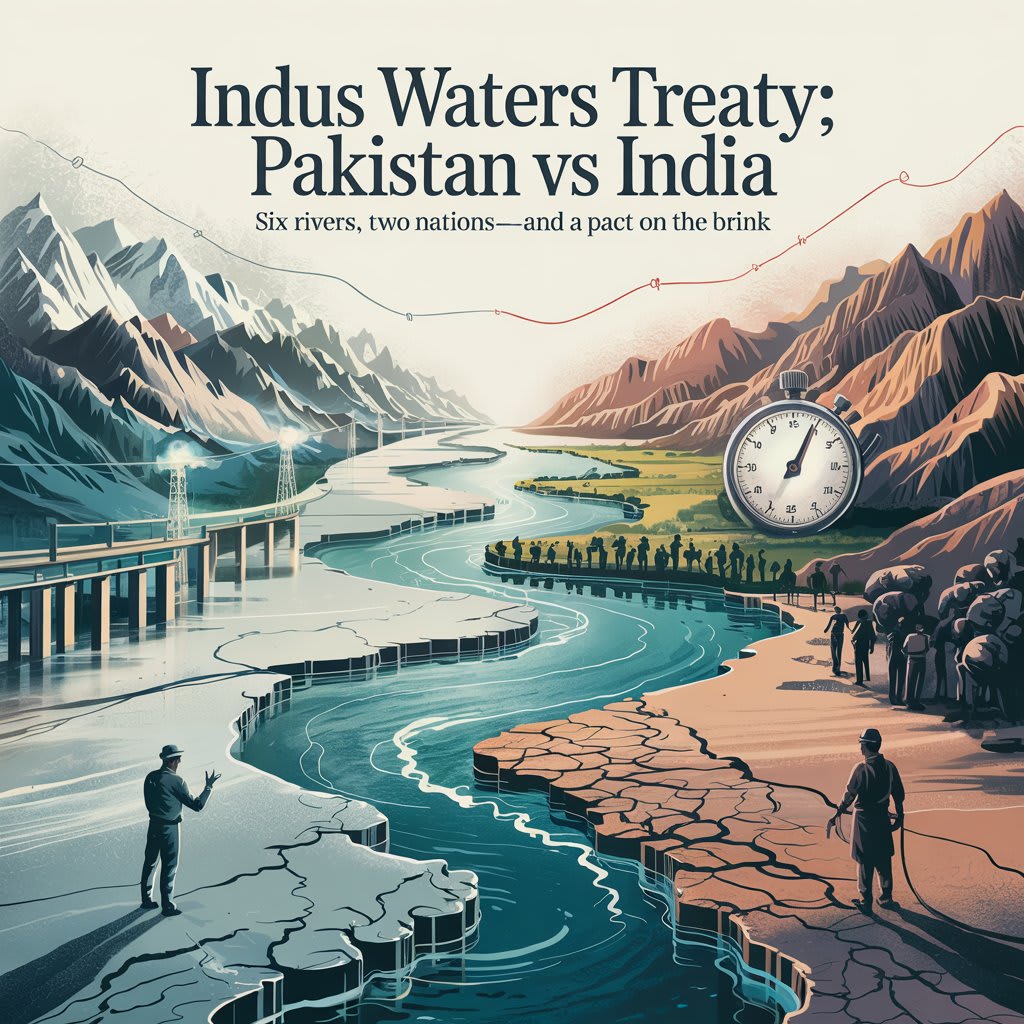
TABLE OF CONTENTS
1. Introduction: A Lifeline Turns into a Fault‑Line
2. Genesis of the Treaty (1947‑1960)
3. The East–West Allocation: Engineering Diplomacy into a River
4. How the Machinery Ran for Six Decades
5. Dam Wars and Legal Battlefields (1990‑2024)
6. The April 24 2025 Shock: India Presses the “Suspend” Button
7. Technical Fallout: Gauges, Gates, and Growing Uncertainty
8. Food Security, Energy Dreams, and Climate Stress
9. International Law, the World Bank, and Precedent Risk
10. Scenarios for 2030: From Renegotiation to Runaway Rivalry
11. Conclusion: Can a Hydrological Truce Survive Geopolitics?
—----------------------------------------------------------
1. Introduction: A Lifeline Turns into a Fault‑Line
For six decades the Indus Waters Treaty (IWT) was cited in textbooks as the model of conflict‑proof water sharing. Signed in 1960, the pact sliced the world’s fifth‑largest river system between arch‑rivals Pakistan and India with surgical precision yet remarkable simplicity. Even as the two countries fought hot wars in 1965, 1971, and 1999—and skirmished routinely along the Line of Control—the treaty’s hydraulics ran on autopilot, delivering water to Pakistan’s breadbasket and hydropower to India’s hill states.
That “miracle” ended on 24 April 2025 when New Delhi announced a unilateral “suspension” of the treaty, hours after a suicide bombing killed twenty‑six tourists in the Kashmiri resort of Pahalgam. Delhi framed the move as “temporary yet necessary leverage” to compel Islamabad to clamp down on “cross‑border terrorism.” Pakistan replied that water was being weaponised for the first time since partition, calling the suspension ultra vires under international law.
The stakes could not be higher: 80 percent of Pakistan’s irrigated agriculture and over 60 percent of India’s planned Himalayan hydropower depend on the IWT’s careful choreography. As climate change accelerates glacial melt and seasonal variability, cooperation—not disengagement—was already an existential need. Yet the treaty now stands on ice, replaced by duelling press releases, court filings, and the palpable dread of a water‑security spiral in South Asia.
---
2. Genesis of the Treaty (1947‑1960)
At midnight on 14–15 August 1947 the British Raj dissolved, cleaving the Indus basin between two newborn states. The head‑works of Punjab’s canal grid fell on Indian territory, while the command areas lay in Pakistan—an engineering absurdity that threatened immediate famine. An ad‑hoc “Standstill Agreement” kept the sluice gates open, but by April 1948 India briefly cut off the upper Bari Doab Canal, jolting Pakistan into frantic diplomacy.
Enter the World Bank, then eager to prove its relevance beyond post‑war reconstruction loans. Bank president Eugene Black brokered talks that dragged for twelve years, marshaling American, British, Swedish and Dutch engineers to translate hydrometrics into politics. Washington sweetened the pot with US $174 million in grants; Canada and Australia chipped in; India and Pakistan together bore less than a quarter of the eventual US $1.2 billion cost. The result was an audacious engineering compromise: India would get “exclusive” use of the three eastern rivers—Ravi, Beas, Sutlej—while Pakistan would receive “unrestricted” flows of the three western rivers—Indus, Jhelum, Chenab—supplemented by a massive canal‑link system and two replacement dams (Mangla and Tarbela) funded by the Bank’s Indus Basin Development Fund.
Prime Minister Jawaharlal Nehru and President Ayub Khan signed the final accord on 19 September 1960 in Karachi. Critics in both countries cried sell‑out: Indian Punjab felt deprived of future storage, and Pakistani hardliners accused Ayub of ceding half the basin. Yet the treaty endured, precisely because it drew a bright, easily justifiable line between east and west while embedding a dispute‑resolution ladder sturdy enough to withstand war.
—
3. The East–West Allocation: Engineering Diplomacy into a River
The IWT is deceptively straightforward:
Rivers Assigned to India (Eastern)
Ravi, Beas, Sutlej
→ Absolute control for consumptive use, storage, and diversion after a 10‑year transition (ended 31 March 1970).
Rivers Assigned to Pakistan (Western)
Indus, Jhelum, Chenab
→ India may undertake run‑of‑river hydropower and “non‑consumptive” uses subject to design constraints:
Max live storage: 3.6 million acre‑feet (MAF) aggregate.
Max irrigation: 1.34 million acres.
Design requirements: ungated spillways or low‑gate settings; mandatory downstream flow during pond filling.
The brilliance lay in matching each country’s topography and development stage. India’s then‑underutilised eastern rivers could be tamed for the Green Revolution in Punjab and Haryana, while Pakistan’s flat expanses required dependable western flows to feed the world’s largest contiguous irrigation network.
The Institutional Triad
1. Permanent Indus Commission (PIC) – Two commissioners exchange data, clear designs, and meet at least twice a year.
2. Neutral Expert (Annex F) – Swiss‑chaired technical tribunal for “differences” (e.g., whether a dam’s gated spillways breach paragraph 8 c).
3. Court of Arbitration (PCA, Annex G) – A Hague‑based ad‑hoc panel for “disputes” involving treaty interpretation; binding award.
This stair‑step structure allowed routine engineering issues to be sorted quietly but offered escalation paths short of war. Until 2005 the machinery ran with only minor hiccups.
---
4. How the Machinery Ran for Six Decades
From 1960 to 2004, the PIC exchanged near‑daily hydrological telemetry. Forty‑three Indian projects on the western rivers were vetted; many were modified at the design stage to assuage Pakistan. The treaty weathered geopolitics: during the 1971 war India’s army occupied parts of Pakistan’s canal head‑works yet did not cut water; in 1999, despite the Kargil conflict raging yards from the Kishanganga alignment, data flowed on schedule.
Economically, the pact underwrote two miracles. Pakistan’s Indus Basin Project added 2 MAF per year of canal supplies and 6,500 MW of hydro capacity by the 1980s, turning Sindh’s deserts into cotton fields and powering Karachi’s factories. India, meanwhile, channelised the Ravi‑Beas to irrigate 13 million acres and built Bhakra, Pong and Thein dams, catapulting North India into surplus food production.
Yet success bred complacency. Neither side updated design norms for climate extremes; telemetry remained 1990s‑era; glacial monitoring was sparse. These gaps, once tolerated, became pressure points as trust eroded in the 2000s.
---
5. Dam Wars and Legal Battlefields (1990‑2024)
Baglihar (Chenab) – The First Crack
When India began Baglihar (450 MW) in 1999, Pakistan objected to gated spillways capable of draw‑down flushing. Talks deadlocked; Pakistan invoked Annex F. In 2007 Neutral Expert Raymond Lafitte largely sided with India, allowing gates but recommending marginal crest‑height tweaks. India hailed victory; Pakistan felt the bar had shifted.
Kishanganga / Neelum‑Jhelum – Diversion Dispute
India’s 330 MW Kishanganga would divert water from the Neelum (Kishanganga) into the Jhelum basin via a 23 km tunnel—reducing flows to Pakistan’s downstream Neelum‑Jhelum plant under construction. In 2013, a PCA ruled India could divert but must maintain a minimum 9 m³/s downstream flow. Both sides spun partial victory narratives, yet litigation costs and delays hardened attitudes.
The “Package” Cases: Ratle, Pakal Dul, Lower Kalnai
By 2016 India had announced or begun four more western projects. Pakistan wanted a single arbitration covering cumulative impacts; India insisted on project‑by‑project expert appraisal. The World Bank, caught between incompatible requests, paused both fora in 2017, freezing resolution for six years. Trust plummeted; Pakistani media portrayed every new Indian megawatt as theft, while Indian analysts accused Pakistan of “lawfare.”
2023: Dual Tracks Resume
On 6 July 2023 the Bank finally constituted a seven‑member PCA while, in parallel, appointing a Chilean Neutral Expert—an unprecedented dual process. India boycotted the PCA hearings, arguing it had “no jurisdiction until the Expert reports.” The PCA proceeded ex parte; Delhi hinted it might ignore any award. The treaty’s carefully tiered dispute ladder now resembled a game of snakes and ladders.
Political Overhang
Each dam dispute coincided with terror attacks or border crises, fusing water and security in the public imagination. The 2016 Uri attack saw India’s Prime Minister Modi warn “blood and water cannot flow together,” leading to a review of India’s “rights under IWT.” Though no flows were cut, the phrase became shorthand for weaponising water.
By 2024, with Indian‑administered Kashmir split into two Union Territories and Pakistan deep in economic crisis, the treaty was less a technocratic compact than a pressure valve for broader hostility—one that now squeaked ominously under stress.
---
6. The April 24 2025 Shock: India Presses the “Suspend” Button
Timeline of Events
24 Apr 2025, 09:15 IST – Suicide bombing in Pahalgam, Kashmir.
12:00 – Indian Cabinet Committee on Security meets; intelligence blames Jaish‑e‑Mohammed (JeM) cells “sheltered across the border.”
18:40 – Foreign Minister issues statement: “Until Pakistan dismantles terror infrastructure, India places the Indus Waters Treaty in abeyance.”
20:00 – Wagah‑Attari border closed; visas suspended.
Legally, Delhi cited the Vienna Convention’s Article 60: a treaty may be suspended after a “material breach.” India argued persistent cross‑border terrorism constitutes such breach, making continued hydrological cooperation untenable. Notably, Article XII of the IWT bars unilateral termination but is silent on suspension, a loophole Delhi exploited.
Pakistan’s Response
Prime Minister Maryam Nawaz termed the move “environmental blackmail.” Islamabad dispatched demarches to Washington, Beijing and the World Bank, urged the International Court of Justice to order provisional measures, and placed its armed forces on alert to guard head‑works at Marala and Guddu.
Regional Reaction
China, building CPEC dams in Pakistan‑held Kashmir, warned of “trans‑basin instability.” The United States expressed “serious concern,” reminding both parties that water cooperation is “non‑negotiable under international norms.”
Yet on the ground, nothing changed overnight—flows continued by hydraulic inertia. The true impact would surface gradually as India began exercising its newfound liberty to store monsoon surpluses or draw down winter flows.
---
7. Technical Fallout: Gauges, Gates, and Growing Uncertainty
Data Blackout
The IWT mandated daily telemetric uploads from 238 gauge stations. Within 48 hours of suspension, Indian servers ceased transmission. Pakistani hydrologists must now rely on 44 cross‑border gauges, satellite imagery, and guesswork—reducing forecast lead‑time for floods from 48 hours to barely 12.
Project Vetting Halted
Eighteen Indian run‑of‑river schemes, totalling 4,300 MW, were in the PIC pipeline. These now proceed without Pakistani design review. Key among them:
If all are built with full permissible storage (now unconstrained), India could impound nearly 2.5 MAF, enough to shave 10 percent off Pakistan’s early‑winter canal supplies in a dry year.
Flood Early‑Warning Gap
During the 2010 super‑floods, Indian upstream bulletins gave Pakistan 36 hours to issue evacuation orders, saving thousands of lives. Without this, low‑lying Sindh faces higher fatality risk as climate‑intensified monsoon pulses surge downstream unannounced.
Military Signalling
Indian engineers commenced flushing Baglihar reservoir on 1 May 2025, an annual maintenance routine but—this time—televised. Pakistan interpreted it as coercive signalling, deploying drone surveillance near the Chenab. A hydrological act thus migrated into the security domain, blurring civilian and military thresholds.
---
8. Food Security, Energy Dreams, and Climate Stress
Pakistan’s Achilles Heel: Rabi Season
Pakistan’s wheat, sown in November and harvested in April, relies on winter releases from Mangla and Tarbela replenished by steady Indian inflows on the Jhelum and Chenab. Any upstream impoundment from October to January could cripple wheat output, already squeezed by heatwaves. The Ministry of Food Security estimates a 1 MAF shortfall reduces national wheat production by 1.6 million tonnes—enough to force emergency imports worth US $650 million.
India’s Hydropower Imperative
India targets 70 GW of hydropower by 2030 to balance its solar‑heavy grid. Nearly one‑fifth of that potential sits in the western Indus tributaries. Suspension removes cumbersome design consultations, shaving an estimated two years off project timelines. Delhi’s calculation: short‑term diplomatic backlash is outweighed by long‑term energy security.
Climate Overlay
Himalayan glaciers feeding the Indus could lose 75 percent of ice by 2100 under high‑emission trajectories. Meltwater is projected to peak by 2050 then decline, turning today’s flood risk into mid‑century drought. Adaptive management requires basin‑wide flow forecasting, sediment‑sharing, and flexible storage rules. Yet cooperation has never been weaker, making climate resilience collateral damage.
Groundwater Knots
Pakistan already over‑pumps 50 billion m³ of groundwater annually. Reduced surface supplies will push farmers to drill deeper, further salinising soils and ballooning energy bills for tube‑wells. India’s Punjab faces similar aquifer depletion, but now has the option to divert Beas surplus westward via proposed link canals—projects once shelved for fear of violating the IWT but now politically re‑energised.
---
9. International Law, the World Bank, and Precedent Risk
Scholars call the IWT a lex specialis superseding general international water law. By suspending it, India risks eroding a carefully carved exception that had shielded both states from broader upstream‑downstream wrangles.
Vienna Convention Test
Under Article 60, suspension requires (a) a material breach by the other party, and (b) proportionality. India’s terrorism claim stretches the definition of treaty breach, for the IWT concerns water, not security guarantees. Pakistan argues the proportionality test fails because civilians dependent on irrigation are not combatants.
Guarantor Conundrum
The World Bank, as signatory and financier, long disclaimed an enforcement role. Post‑suspension, it faces awkward choices: declare India in breach (risking its large India portfolio), stay neutral (undermining credibility), or broker ad‑hoc interim arrangements (requiring consent that is absent).
Precedent Domino
If India can link terrorism to water treaties, other states may follow suit, jeopardising 3,600 trans‑boundary river accords worldwide. Already, Ethiopian commentators cite the “India model” vis‑à‑vis Egypt on the Nile; Turkish analysts mull similar leverage over Iraq on the Tigris‑Euphrates.
—
10. Scenarios for 2030: From Renegotiation to Runaway Rivalry
1. IWT 2.0 — A Renegotiated Treaty (≈35 % likelihood)
This cooperative outcome would be driven by climate‑shock realism. A glacial‑lake burst in Ladakh and, a year later, a mega‑drought that parches Sindh could convince Delhi and Islamabad that unilateralism is simply too costly. Both China and the United States, heavily invested in CPEC projects and India’s green‑energy build‑out, would wield debt‑relief carrots and clean‑infrastructure cash to prod the rivals back to the table. Powerful farm lobbies in Punjab and Sindh—hit hard by erratic canal deliveries—would add domestic pressure. The result could be an “IWT 2.0” with a climate‑risk annex, a joint flood‑forecasting centre, and an adaptation fund underwritten by multilateral banks.
2. Managed Drift — Neither War nor Marriage (≈30 %)
In this middle path the 2025 suspension quietly remains in place, yet neither side wants to kill the treaty outright. India enjoys the freedom to fast‑track hydropower; Pakistan plugs its data gaps with satellite feeds supplied by Chinese partners and deepens groundwater pumping to offset winter deficits. Pragmatism forces the two Indus Commissioners to exchange flow figures informally before each monsoon, but nobody announces a formal revival. The basin muddles through—functional enough to avert disaster, but too fragile for real joint planning.
3. Litigation Spiral — Lawfare Takes Over (≈20 %)
Here, the conflict shifts from riverbanks to courtrooms. Suppose Pakistan secures provisional measures from the International Court of Justice in 2026 and India dismisses them as non‑binding. Islamabad retaliates by lobbying the WTO and IMF to tie loans to treaty compliance. Nationalist media in both countries frame compromise as capitulation, so leaders double down on lawsuits instead of dialogue. Years of hearings, appeals, and injunctions consume diplomatic bandwidth while practical water management withers.
4. Runaway Rivalry — From Water Leverage to Shooting War (≈15 %)
The darkest scenario begins with a multi‑year Himalayan drought (2027‑29) that slashes Chenab inflows just as India’s Bursar dam becomes operational. To protect its own agriculture, Delhi retains extra winter storage; wheat output in Pakistan collapses, triggering street protests and a hard‑line political backlash. A skirmish along the Line of Control escalates when Pakistani drones target an Indian diversion tunnel; India responds with air‑strikes on Pakistan’s Neelum‑Jhelum powerhouse. International markets reel as South Asia’s cotton and rice exports plummet, and the Indus Basin becomes the world’s first live example of climate‑driven, water‑borne conflict.
---
These narrative pathways highlight the political, climatic, and economic forces that could steer Pakistan and India toward renewed cooperation—or propel them into ever‑deeper confrontation—over the Indus in the second half of this decade.
--
11. Conclusion: Can a Hydrological Truce Survive Geopolitics?
The Indus Waters Treaty was more than a plumbing manual; it was an act of political imagination that ring‑fenced a lifeline from the vagaries of rivalry. By suspending it in April 2025, India has unlatched Pandora’s sluice gates, letting geopolitics flood the channels once reserved for engineers and farmers.
Yet treaties are rarely killed outright; they fade, mutate, or—under pressure—reborn. The water still flows, indifferent to flags and frontiers. Scarcity, climate shocks, and 300 million basin dwellers will eventually drag Islamabad and New Delhi back to the table, whether under the old banner of the IWT or a re‑branded framework fit for a warmer, more volatile century.
When that day comes, the lessons of 1960 remain instructive: success lay in grand but balanced concessions, hefty third‑party finance, and political courage to sell compromise at home. Re‑imagining “Six Rivers, Two Nations” for the twenty‑first century will require similar audacity—plus the humility to accept that in the Anthropocene, no nation can truly place a river in abeyance.
---
About the Creator
Umair Ali Shah
Writer exploring life, truth, and human nature through words. I craft stories, essays, and reflections that aim to inspire, challenge, and connect. Every piece is a step on a shared journey of thought and emotion.
Keep reading
More stories from Umair Ali Shah and writers in Writers and other communities.
The Security Dilemma: Challenges in Khyber Pakhtunkhwa
Khyber Pakhtunkhwa (KP), once known as the frontier province, has been at the epicenter of Pakistan's battle with militancy, extremism, and insurgency. The region’s security challenges are not just a matter of political discourse but have profound implications for the future of Pakistan itself. With its proximity to Afghanistan, the porous border, and a long history of regional and ethnic complexities, Khyber Pakhtunkhwa’s security dilemma is a microcosm of the larger global struggle against terrorism and extremism.
By Umair Ali Shah 9 months ago in Chapters
Wild Card Weekend Recap: What Happens Now?
I think I figured out why I love Wild Card Weekend so much. It's because it's the first playoff anything of the calendar year. The NFL season starts in the fall, and once upon a time, the champion was crowned either on or slightly before New Year's. The evolution of the NFL schedule has resulted in the playoffs starting just into the New Year, and currently, the final week of the season falls on the first weekend of the New Year, with Wild Card Weekend coming a week after that. So yes, chronologically, the NFL's Wild Card Weekend serves as the first playoff anything of the calendar year.
By Clyde E. Dawkins7 days ago in Unbalanced



Comments
There are no comments for this story
Be the first to respond and start the conversation.