Stacey King
Bio
Stacey King, a published Australian author and historian. Her writing focuses on her mission to build global awareness of the plight of the indigenous Banaban people and her achievements as a businesswoman, entrepreneur and philanthropist.
Stories (29)
Filter by community
Between a (Banaban) Rock and a Hard Place
What began as a friendly inter-island rugby game between Banaban and Fijian youths in the early 1980s unexpectedly turned sour, forcing the peace-loving Banabans to confront the precarious nature of life on their new island home, Rabi. As Banaban elders instructed women and children to remain behind locked doors, boatloads of Fijian youths arrived, seeking to settle scores from matches held earlier that day.
By Stacey King10 months ago in History
Snippets of Ocean Island/ Banaba History
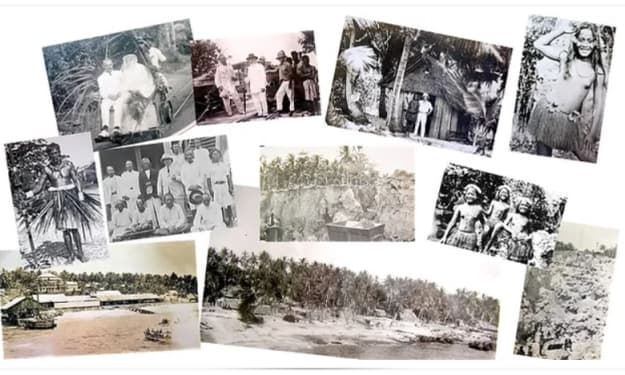
Four generations of Stacey King's family were involved with the early phosphate mining industry on Banaba (Ocean Island) over thirty years between 1901-31. Stacey felt compelled to research her family's history after discovering hundreds of her great grandfather's, John Francis Williams’s old photographs. She was surprised by the wealth of information his photographs and documents provided, an authentic glimpse of the past that supported many family stories she had been told. Her first step in uncovering further information was just a few handwritten names scrawled on the back of some images. Starting with a mailing list of 50 British Phosphate Commission (BPC) staff names, her letter writing quickly grew to over 300. In 1992, she founded the Banaban/ Ocean Island News to source a vast array of historical information globally and from the indigenous Banaban people. For more information on How it all began go to Come Meet the Banabans [1]
By Stacey Kingabout a year ago in History
Banaban Landowners Visit their homeland
This 'Snippet’ of Ocean Island history was supplied by Banaban Heritage Society (BHS) [1] member, Marion Laritz from an article written by a fellow Island resident, Mr. R. Williams and published in the local newsletter, The Nautilus, Volume 2, Edition 3, November 1967.
By Stacey King2 years ago in History
Ocean Island Kart Club
The following ‘snippet’ was from Banaban Heritage Society member Brian Bailey about the introduction of go-kart racing and the set-up of the Ocean Island Kart [1] Club during the 1960s. His story appeared in 'A Snippet From the Past", Banaba/Ocean Island News, Issue No. 12 (Nov-Dec 1994) [2]
By Stacey King2 years ago in History
Returning to Ocean Island-Post War
Joan Ramsay from New Zealand, was one of the first European women to return to Ocean Island Post War. Her husband was working for the Gilbert & Ellice Island Colony (GEIC) [1] government. Her story is adapted from a radio interview she gave for NZ radio about her life spent on the islands.
By Stacey King2 years ago in History
Imminent Peril: Ocean Island on the Brink of Invasion
Maureen White was seventeen years old and one of the people who survived the sinking of the British Phosphate Commission (BPC) ship, SS TRIONA, by German Raiders prior to the evacuation of Banaba—known during the phosphate mining period as Ocean Island. Maureen and her mother, Letitia, were taken prisoners by the Germans before being released on a remote island in New Guinea.
By Stacey King2 years ago in History
Shipwrecks of Ocean Island / Banaba: PART TWO
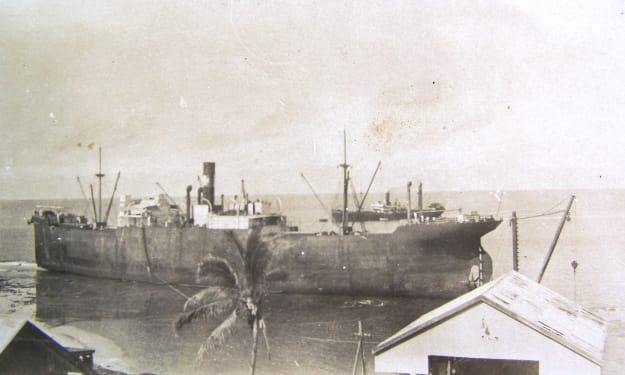
The following information was provided by Captain Brant, Master of SS ROWANBANK, which loaded phosphate at Ocean Island (Banaba) on 20 April 1967. It was a sentimental journey recalling his time as serving as second mate aboard SS TITENBANK which sailed from Nauru to Ocean Island to stand by at the time SS KELVINBANK went on the reef 14 years before. Captain Brant supervised the salvaging of Bank Line stores from the stricken ship." [1]
By Stacey King2 years ago in History
Shipwrecks of Ocean Island / Banaba: PART ONE
The following information was provided by the late British Phosphate Commission (BPC) employee, Roger Anderson. The original article was written by Captain John Marine Fisk. Captain Fish had been Master of one of the BPC charter ships, KOMATA, which was sun at Nauru by the German Raiders in December 1940. He became the master of the RIVER BURDEKIN that liberated Nauru and Banaba after the War. [1]
By Stacey King2 years ago in History
Come Meet the Banabans
The Come Meet the Banabans [1] website was first created and launched in 1993 by Australian woman, Stacey King. The Banaban people are the indigenous inhabitants from a small remote Pacific Island, originally called Ocean Island. Today the Island is known by its indigenous name - Banaba.
By Stacey King2 years ago in History
Banaban Tradition of Frigate Bird Snaring / Taming
Today, the majority of the Banaban community resides on Rabi Island, Fiji, with only around 300 Banabans inhabiting their homeland in the Kiribati Islands group. The traditional Banaban ritual of te kabwane eitei, also known as frigate bird snaring, has been lost due to various factors. These include the introduction of Christianity in the late 1980s, the arrival of te I-Matang's (Europeans) in 1900 following the discovery of phosphate, and the forced removal of Banabans from their homeland by invading Japanese forces in 1943 during World War II.
By Stacey King2 years ago in FYI