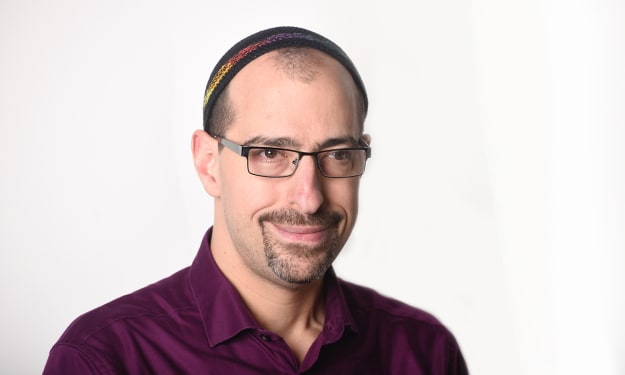
Scott Douglas Jacobsen
Bio
Scott Douglas Jacobsen is the publisher of In-Sight Publishing (ISBN: 978-1-0692343) and Editor-in-Chief of In-Sight: Interviews (ISSN: 2369-6885). He is a member in good standing of numerous media organizations.
Stories (140)
Filter by community
Fumfer Physics 39: Anthropic Principle, Cosmic Scale, and Why We Live in the Middle
Scott Douglas Jacobsen and Rick Rosner explore whether the ratio between the observable universe and the smallest physical scales carries deeper significance. Rosner situates the question within the anthropic principle: observers necessarily arise in regions and eras compatible with simple life. Humans exist near an active star, within the universe’s luminous core, because complex or long-lived civilizations would occupy very different energetic regimes. Rosner extends this reasoning to human history itself, noting that the present era contains the largest concentration of humans who have ever lived, making it statistically unsurprising that we find ourselves “now.” The result is not cosmic centrality, but observational inevitability.
By Scott Douglas Jacobsenabout a month ago in Interview
Fumfer Physics 38: Information, Quantum Fuzziness, and the Hidden Architecture of the Universe
Scott Douglas Jacobsen revisits a long-standing idea with Rick Rosner, tracing it from an Errol Morris documentary to Rosner’s current thinking about information and cosmology. Rosner reflects on the proton–electron mass ratio as potentially non-arbitrary, speculating that it may encode something fundamental about the universe’s informational structure. He connects quantum fuzziness, mass, curvature, and collapsed matter to a broader picture in which much of the universe’s information is hidden in gravitationally dense regions tied to earlier cosmic eras. Framed explicitly as speculation, Rosner’s view treats particle precision as possibly emergent from the universe’s total informational budget.
By Scott Douglas Jacobsenabout a month ago in Interview
Rabbi Debra Bennet on Jewish Community, the Ethics of Belonging, and Building Inclusive “Third Spaces” at a JCC
Rabbi Debra Bennet is the Director of Jewish Life & Learning at the Mid Island Y JCC in Plainview, NY. Ordained in 2007, she has served as Rabbi Educator at Temple Beth Torah in Melville and Associate Rabbi at Temple Chaverim in Plainview, where she developed programs to engage teens and strengthen the Jewish community. Rabbi Bennet focuses on the ethics and practice of belonging, fostering dialogue across differences, navigating pastoral and communal challenges, and creating inclusive, connected communities in synagogues, schools, and Jewish organizations.
By Scott Douglas Jacobsenabout a month ago in Interview
William Dempsey: Supporting LGBTQ+ Youth Mental Health, Safety, and Resilience
William Dempsey, LICSW, is a Boston-based clinical social worker and LGBTQ+ mental-health advocate. He founded Heads Held High Counselling, a virtual, gender-affirming group practice serving Massachusetts and Illinois, where he and his team support clients navigating anxiety, depression, trauma, ADHD, and gender dysphoria. Clinically, Dempsey integrates EMDR, CBT, IFS, and expressive modalities, with a focus on accessible, equity-minded care. Beyond the clinic, he serves on the board of Drag Story Hour, helping expand inclusive literacy programming and resisting censorship pressures. His public scholarship and media appearances foreground compassionate, evidence-based practice and the lived realities of queer communities across North America.
By Scott Douglas Jacobsenabout a month ago in Interview
Elena Sabry on Outages, Survival, and Human Dignity: Life in Kyiv Under Winter Strikes
Elena Sabry is a Ukrainian-American executive career coach at Career Academy, based in Las Vegas. With family in Kyiv and constant contact with friends and colleagues in Ukraine, she follows the war's daily realities through Ukrainian news, social media, and direct conversations. Sabry previously worked in Kyiv hospitality, including at the InterContinental Kyiv, and has lived abroad in the United Arab Emirates, sharpening her perspective on language, culture, and migration. Shaped by early economic hardship after her father died in 1992, she now helps clients build resilient careers and supports Ukrainian communities through advocacy, practical guidance, and storytelling during prolonged crises.
By Scott Douglas Jacobsenabout a month ago in Interview
Is This the Rights' Fight? Wrong Turn on Right 5: Charlie Kirk Case, Prosecutor Disqualification, and Israel Debate
Irina Tsukerman is a human rights and national security attorney based in New York and Connecticut. She earned her Bachelor of Arts in National and Intercultural Studies and Middle East Studies from Fordham University in 2006, followed by a Juris Doctor from Fordham University School of Law in 2009. She operates a boutique national security law practice. She serves as President of Scarab Rising, Inc., a media and security strategic advisory firm. Additionally, she is the Editor-in-Chief of The Washington Outsider, which focuses on foreign policy, geopolitics, security, and human rights. She is actively involved in several professional organizations, including the American Bar Association’s Energy, Environment, and Science and Technology Sections, where she serves as Program Vice Chair in the Oil and Gas Committee. She is also a member of the New York City Bar Association. She serves on the Middle East and North Africa Affairs Committee and affiliates with the Foreign and Comparative Law Committee.
By Scott Douglas Jacobsenabout a month ago in Interview
Blessing Platinum-Williams on Church Belonging, Family, and Accountability: Community as Sacrifice and Care
Blessing Platinum-Williams is a London-based, self-taught software developer and the creator of Tonely AI, an “auto-reflect” keyboard for iOS and Android that surfaces the likely tone and intention behind a message as you type. Tonely aims to reduce everyday digital harm by prompting users to reconsider wording that may sound blunt, passive-aggressive, or manipulative. Privacy is a core design choice: Tonely runs tone detection on-device and, per its terms and privacy policy, does not upload or store your messages. She founded Tonely AI Ltd in Britain. She also has a law degree and a therapy-informed perspective on language for everyone.
By Scott Douglas Jacobsenabout a month ago in Families
Dr. Richard Kannwischer on Christian Community in a Digital Age: Koinonia and the Ethics of Belonging
Dr. Richard Kannwischer is Senior Pastor of Peachtree Presbyterian Church and has served more than 25 years in pastoral ministry. He earned a Master of Divinity from Princeton Theological Seminary and a Doctor of Ministry from Fuller Theological Seminary. A gifted communicator, he is passionate about helping people see how the story of God speaks with clarity, depth, and relevance to everyday life. His preaching and writing blend theological rigor with storytelling, making complex truths accessible and engaging. Whether in the pulpit, on the page, or in conversation, he invites audiences into practical, life-giving Christian faith for seekers and believers.
By Scott Douglas Jacobsenabout a month ago in Education
Wesley Farnsworth: On Authentic Christian Community with Evidence, Human Rights, and Critical Thinking
Wesley Farnsworth is an author, speaker, and communications professional whose work centers on faith, transformation, and the formation of authentic Christian community. With more than 16 years of experience in visual storytelling, branding, and digital communication—including service in military public affairs—he helps individuals, churches, and nonprofits communicate with clarity, integrity, and purpose.
By Scott Douglas Jacobsenabout a month ago in Education
Dr. Sam Adeyemi on Belonging, Discipline, and Restoration: Theology of Community in Christianity
Dr. Sam Adeyemi is an Atlanta-based CEO, executive coach, and author who leads Sam Adeyemi, GLC, Inc. He founded and serves as executive director of Daystar Leadership Academy, whose programs have graduated 45,000+ alumni. With a large social-media following, he delivers leadership and organizational-growth guidance to executives worldwide. Adeyemi earned a Doctorate in Strategic Leadership from Regent University and belongs to the International Leadership Association. His books include Dear Leader: Your Flagship Guide to Successful Leadership and SHIFTS. He also cofounded Daystar Christian Centre in Lagos, Nigeria, where he is Senior Pastor. He lives in Atlanta with his wife, Nike.
By Scott Douglas Jacobsenabout a month ago in Education
Rabbi Shlomo Slatkin, M.S., LCPC on Imago Dialogue, Repair, and Relationship Safety
Rabbi Shlomo Slatkin, M.S., LCPC, is founder and therapist at The Marriage Restoration Project in the Baltimore area. An ordained rabbi and Certified Imago Relationship Therapist and workshop presenter, he guides couples through intensives, retreats, and counseling aimed at restoring safety, communication, and connection after conflict or crisis. He holds a master’s in Counseling Psychology from Loyola University Maryland and trained with the Imago Relationship Institute. Slatkin earned a B.A. in Middle Eastern Studies, with undergraduate study at George Washington University and Oxford, and authored The Five Step Action Plan to a Happy & Healthy Marriage. He also co-edited curricula.
By Scott Douglas Jacobsenabout a month ago in Education
Rabbi Ilan Glazer on the Ethics of Belonging, Conflict, and Community in Jewish Life
Rabbi Ilan Glazer is a Jewish clergy leader whose work centers on community, ethics, and ritual life. He has served in congregational settings, including a synagogue in Memphis, Tennessee, and has also worked in non-congregational rabbinic roles. Drawing on experience in Israel and the United States, he reflects on how communities balance welcome and boundaries, manage conflict, and build accountability. Glazer speaks candidly about power dynamics, professional burnout, and the pressures of constant digital access. He emphasizes Shabbat as an anchor of Jewish time and highlights b'tzelem Elohim as a guiding ethic of human dignity in contemporary synagogue life today.
By Scott Douglas Jacobsenabout a month ago in Education