Muhammad Saad
Stories (465)
Filter by community
Towards an Unknown Destination
The morning sun rose gently over the distant hills, casting golden rays on the narrow dirt path that wound its way through the valley. The air was crisp and alive with the scent of wet earth and blooming wildflowers. Arman stood at the edge of the road, a small backpack on his shoulder and determination in his eyes. He didn’t know where the road would lead — only that it led somewhere. And for the first time in years, that was enough. For too long, Arman had lived a life of predictable patterns — same job, same town, same thoughts replaying in his head like a song stuck on repeat. One evening, as he sat by his window watching the rain fall, he felt a strange emptiness creep in. His life was safe but stagnant, full but unfulfilled. The next morning, without overthinking, he packed a few clothes, a journal, and his old camera, and left home — walking towards an unknown destination. The first few days were difficult. The road was long and uneven, and the silence often too loud. He missed familiar voices, warm meals, and the comfort of his bed. Yet every step carried a strange peace — as if with each mile, he was shedding the weight of everything that once held him back. On the third day, he reached a small village nestled between green hills. The villagers greeted him with smiles and offered him water and bread. He sat with an old farmer who was fixing a broken fence. “Where are you going, son?” the farmer asked. Arman smiled faintly and said, “I don’t know yet.” The farmer laughed, “Sometimes not knowing is the best way to find out.” That night, Arman stayed in the village. He helped the children gather firewood and listened to stories around the bonfire. He realized how content these people were with their simple lives — no rush, no noise, just gratitude. It made him question everything he had once chased. As the days turned into weeks, Arman’s journey took him through forests, rivers, and small towns. He began to notice things he had once ignored — the way sunlight danced on the water, how the wind carried whispers through the trees, how silence could be more healing than words. Every stranger he met taught him something new. A potter showed him patience, a traveler spoke of courage, a monk shared wisdom about letting go. In one quiet mountain village, Arman met a young boy named Rafi who dreamed of becoming a teacher but had no books or school nearby. Arman spent a few days with him, teaching him letters and numbers using sticks and stones. When he finally left, Rafi hugged him tightly and said, “One day, I’ll build a school here, and I’ll remember you.” Arman walked away smiling — for the first time, he felt that his journey had meaning beyond himself. But the path was not always easy. There were moments of doubt and loneliness, especially when the road stretched endlessly through barren plains. One stormy night, drenched and exhausted, Arman took shelter under a tree. The darkness around him mirrored the uncertainty in his heart. He questioned why he had left home, what he was truly looking for. Yet, as thunder echoed across the sky, he realized something profound — maybe the journey wasn’t about reaching a place at all, but about becoming a different person along the way. Months later, Arman reached the edge of a vast sea. The setting sun painted the sky in hues of orange and purple. He sat by the shore, listening to the rhythm of the waves. His reflection shimmered in the water — he looked the same, yet felt entirely new. The road behind him had changed him in ways he couldn’t put into words. He had learned that destinations don’t always exist on maps — sometimes, they exist within us. The unknown he had once feared had become his greatest teacher. As stars began to appear one by one, Arman took out his journal and wrote, “I set out to find a place, but I found myself instead.” He smiled, stood up, and looked once more at the endless horizon. The journey wasn’t over — it was simply beginning again, in a new direction. With calm confidence, he took a deep breath, tightened his backpack, and began walking once more — towards another unknown destination.
By Muhammad Saad 4 months ago in Earth
The Day Mr. Bean Tried Yoga
It was a sunny Saturday morning, and Mr. Bean woke up feeling unusually energetic. The birds were chirping, the air was fresh, and his mirror reflection looked back at him with a confident grin. “Today,” he announced proudly to his teddy bear, “I become flexible!” Mr. Bean had recently seen a yoga commercial on TV showing calm people twisting their bodies like pretzels while smiling peacefully. “If they can do it, so can I,” he declared, puffing out his chest. So, with great determination, he dusted off his old tracksuit, grabbed a rolled-up mat from under the bed (which had not seen daylight since 2002), and marched off to the local yoga studio. As soon as he entered, the soft scent of lavender and the calm music hit him. Everyone spoke in quiet voices, moving slowly like graceful swans. Mr. Bean tried to copy them—only to knock over a water bottle, bump into a potted plant, and get tangled in his yoga mat all within the first thirty seconds. The instructor, a peaceful woman named Miss Lily, smiled kindly. “Welcome, everyone. Let’s begin with some deep breathing.” Mr. Bean sat cross-legged, closed his eyes, and inhaled deeply. But instead of calm breathing, he began wheezing loudly, sounding like a broken vacuum cleaner. Everyone turned to look. Mr. Bean coughed, gave a thumbs-up, and whispered, “All good!” The first pose was “Mountain Pose.” That sounded simple enough—just standing tall. Mr. Bean straightened his back, puffed out his chest, and looked proud… until his balance gave way and he almost fell onto the lady beside him. Next came “Downward Dog.” The instructor demonstrated gracefully. Mr. Bean followed—but his hands slipped on the mat, and his legs went flying. For a brief second, he was upside down, staring at the ceiling lights. “Interesting view from here,” he thought before landing with a thump. The class giggled quietly, but Mr. Bean wasn’t one to give up easily. He tried again, determined to master at least one pose. Then came “Tree Pose.” “Focus on your balance,” said Miss Lily softly. Mr. Bean raised one leg and tried to stay still. Unfortunately, the calm music made him sleepy, and as he yawned, his raised leg wobbled. He grabbed onto the shoulder of the man next to him for support—who toppled like a domino into another person. Soon, the entire row of “trees” had fallen. The instructor clapped gently. “Remember, it’s about finding your inner peace,” she said, trying not to laugh. By now, everyone was smiling, including Mr. Bean. He wiped sweat from his forehead, took a deep breath, and decided to enjoy the process. When the instructor guided them into “Child’s Pose,” Mr. Bean sighed with relief. Finally—a pose that involved lying down! He stretched out comfortably, even letting out a small snore. Miss Lily tiptoed over and whispered, “Mr. Bean, we’re still doing yoga.” He blinked awake, smiled sheepishly, and pretended he’d just been “meditating deeply.” At the end of the class, they sat quietly for meditation. The lights dimmed, the room grew still, and the peaceful music played. But suddenly—growl! Mr. Bean’s stomach decided to join the session. The loud rumble echoed through the room. Several people chuckled. Mr. Bean blushed, holding his tummy. “Must be the energy flowing,” he whispered. When the class ended, everyone left smiling. Miss Lily walked up to him and said kindly, “You brought a lot of joy to the room today, Mr. Bean. Come again!” On his way home, he felt proud. He hadn’t mastered yoga poses, but he had mastered laughter. “Not bad for a beginner,” he told his teddy bear as he stretched his sore arms. That evening, he made himself a cup of tea, sat cross-legged on the couch (sort of), and smiled at the sunset. “Yoga isn’t about perfection,” he said thoughtfully. “It’s about peace… and maybe a good nap afterward.” And with that, Mr. Bean closed his eyes and dozed off—dreaming of doing the perfect Tree Pose someday, without knocking anyone over.
By Muhammad Saad 4 months ago in Gamers
Steps to the Sky
The first light of dawn brushed the horizon with soft gold as Maya tightened her hiking boots. The mountain loomed before her — tall, steady, and glowing faintly in the early sun. She had admired it from her window for years, always telling herself that one day she would climb it. Today, that day had come. The morning air was crisp, filling her lungs with a rush of energy. Birds chirped from hidden perches, and the forest floor sparkled with dew. Every breath tasted like new beginnings. Maya started up the trail, her backpack light but her heart full of excitement. The path wound gently at first through tall pine trees. Shafts of sunlight pierced the branches, forming golden ladders that danced on the ground. The mountain seemed alive — whispering, creaking, and humming with quiet strength. Maya felt it welcoming her, step by step. She paused by a stream that sang its way through smooth stones. Kneeling, she dipped her hands into the cold, clear water and splashed her face. The chill made her laugh out loud. A family of butterflies flitted past her, blue wings flashing like tiny sparks. Everything felt vivid and alive, as if the world itself had been freshly painted. As the trail grew steeper, her breath deepened. Sweat dampened her hair, but she didn’t mind. Each turn offered a new view — valleys wrapped in mist, wildflowers swaying in the breeze, the distant glimmer of a lake catching the sun. She began to understand that hiking wasn’t just about reaching the top; it was about learning to love the journey itself. Midway up, Maya met another hiker — an elderly woman with silver hair tucked under a sunhat. She was sitting on a boulder, sipping tea from a small thermos. “Morning!” the woman said cheerfully. “Beautiful day to chase the sky, isn’t it?” Maya smiled and joined her for a moment. “It is. I didn’t expect it to feel this peaceful.” The woman nodded knowingly. “The mountain teaches us that peace isn’t found by stopping, but by moving forward with care. Every step matters.” They shared a few almonds and stories, laughing easily as though they had known each other for years. When it was time to part, the woman raised her cup and said, “Keep climbing. The view will steal your breath — in the best way.” Encouraged, Maya pressed on. The trees thinned, giving way to open slopes scattered with wild grass. The air grew cooler, the sky closer. Her legs ached, but her spirit soared. Every gust of wind carried the scent of freedom. Finally, after hours of steady climbing, she reached the summit. For a moment, Maya stood still, stunned into silence. Before her stretched an endless sea of peaks, rolling away into the horizon. The clouds drifted below her like soft silver waves. She felt as though she were standing at the edge of the world. A joyful laugh burst from her chest. She dropped her backpack, lifted her arms, and spun slowly in the wind. Up here, the noise of life was gone — no phone calls, no rush, no worries. Only the whisper of the wind and the heartbeat of the earth beneath her feet. She sat on a rock and pulled out her journal. With a trembling hand, she wrote: “I climbed not to conquer the mountain, but to find myself within it.” The sun began to lower, tinting the sky in pink and gold. Maya closed her eyes and breathed deeply, feeling peace settle over her like a soft blanket. The mountain had given her what she didn’t know she was missing — stillness, gratitude, and joy. When she finally began her descent, she felt lighter, as if the mountain had taken her burdens and replaced them with courage. At the foot of the trail, she looked back one last time. The peak glowed in the fading light, a gentle reminder that beauty waits for those who dare to take the first step. Maya smiled. She knew she would return. After all, the mountain still had stories to tell — and so did she.
By Muhammad Saad 4 months ago in Earth
The Rhythm of Words: Discovering the Power of Poetry
Under the golden glow of a late afternoon sun, Maya sat by her window, pen poised above her notebook. Outside, the wind whispered through the trees, and somewhere in that soft rustle, she felt a poem waiting to be found. She didn’t think of herself as a poet — just someone trying to make sense of the world through words. But that quiet moment, like countless others before her, echoed a truth as old as time: poetry lives in all of us. Poetry has been humanity’s companion since the dawn of language. Long before written words existed, people used rhythm and rhyme to remember, celebrate, and share. Ancient tribes chanted verses around fires; storytellers in Greece recited epics like The Iliad and The Odyssey; and across the world, poems were sung to honor gods, love, nature, and loss. Poetry was not just art — it was memory, emotion, and history woven together. In every era, poetry has changed its shape but not its purpose. The medieval sonnets of Shakespeare explored love and time, while the powerful verses of Maya Angelou and Langston Hughes gave voice to freedom and identity. From haikus in Japan to ghazals in Persia, from African oral traditions to modern slam poetry, verse has always found a way to speak what the heart cannot say in prose. Maya thought of this as she wrote. She loved how poetry didn’t need perfection — just honesty. A poem could be three lines or three pages. It could rhyme or dance freely across the page. It could whisper softly or shout like thunder. What mattered most was the feeling it carried. As she scribbled her thoughts about the fading day — the amber sky, the whispering leaves, the quiet ache of time passing — she realized she wasn’t just writing about nature. She was writing about herself, too. That’s the quiet magic of poetry: it turns the personal into the universal. A single poem can make a reader halfway across the world nod and think, Yes, I’ve felt that too. Whether it’s heartbreak, hope, or joy, poetry creates bridges between souls. It is both mirror and window — reflecting who we are, and showing us what others see. Modern poetry has found new homes in surprising places. On social media, short verses travel farther than books once did, reaching millions in seconds. A few carefully chosen lines can stop someone mid-scroll, reminding them to breathe, to feel, to think. Poetry readings and slam competitions bring verses to life through rhythm, performance, and passion. In classrooms and therapy sessions, poetry is used to heal — helping people find words for pain that once felt unspeakable. For Maya, poetry became a daily ritual, a way to listen to herself. Sometimes she wrote to celebrate, sometimes to grieve. When words failed, she found comfort in reading others’ poems — lines that seemed to understand her even before she did. She kept a small notebook of favorites: Rumi’s mystic whispers, Mary Oliver’s tender reflections on nature, Amanda Gorman’s courageous call to hope. Each poem was a light, guiding her through different seasons of her life. One evening, she gathered the courage to share her own poem online. It was short — only a few lines about learning to love silence. To her surprise, people responded with warmth, saying the words had touched them. In that moment, she understood what poetry truly was: a conversation between hearts, across time and distance. Poetry reminds us that beauty doesn’t always need to be explained. Sometimes it’s found in a single word, a fleeting image, a pause between lines. It teaches us to slow down, to notice, to feel deeply. Whether carved in stone or typed on a glowing screen, poetry endures because it speaks to what makes us human — our longing, our wonder, our endless search for meaning. As night settled outside her window, Maya closed her notebook, smiling. The day’s poem was complete, but its rhythm still lingered — a soft heartbeat in her mind. Tomorrow, new words would come. And through them, she would keep listening to the quiet music of life.
By Muhammad Saad 4 months ago in Poets
Threads of Light: The Story of Humanity’s Shared Journey
From the moment the first sparks of fire danced in a dark cave, humanity’s story has been one of connection. Those early flames were not just about warmth or safety—they were a signal, a gathering point, an invitation to come closer. Around that fire, stories were told, fears were eased, and communities were born. The light that flickered across the faces of our ancestors was more than physical illumination—it was the beginning of something deeply human: the sharing of knowledge and hope. Across millennia, that light spread in countless forms. When ancient farmers carved irrigation channels through the dry earth, they shared the idea with neighbors and travelers, carrying the wisdom from one valley to another. When scribes in Mesopotamia pressed the first marks into clay, they preserved stories that could outlive their tellers. And when explorers set sail across unknown seas, they carried not just the courage to discover, but also the curiosity that defines our species. Each generation added new threads to this great web of progress. Some were threads of invention: the wheel, the compass, the printing press. Others were threads of compassion: the healing hands of physicians, the kindness of teachers, the bravery of those who stood up for justice. Together, these threads wove a fabric strong enough to withstand wars, disasters, and doubt—a fabric made not of perfection, but of persistence. Humanity’s greatest achievements have always come from our ability to reach beyond ourselves. We are a species that thrives on cooperation. The vast cities of today are not monuments to a single person’s genius, but to the collective effort of countless hands and minds. Every bridge, every vaccine, every symphony is the result of shared ideas—the blending of creativity, labor, and love. Yet, our story is not without shadows. The same fire that warms can also burn. Throughout history, fear and greed have often pulled at the threads that bind us. Empires rose and fell on the backs of the oppressed. Knowledge was hidden or destroyed. Walls—both real and imagined—divided us by race, class, and creed. But even in those darkest moments, the light never went out completely. Somewhere, someone always kept it alive: a scholar preserving banned books, a doctor treating the wounded on both sides, a stranger offering food to another in need. In recent centuries, that web of light has grown brighter and faster than ever before. The telegraph, the radio, and the internet have turned the planet into a whispering, humming network of connection. Today, a thought born in one corner of the world can inspire action in another within seconds. We have mapped the stars, decoded our own DNA, and glimpsed the beginnings of life in distant galaxies. We’ve come to understand that our planet—fragile and luminous—is a shared home that demands care from us all. And yet, in this age of abundance and knowledge, humanity faces some of its greatest tests. Climate change, inequality, and misinformation threaten to unravel the delicate web we’ve woven. The challenge before us is not just scientific or political—it is deeply human. Can we remember that the threads binding us together are stronger than the forces pulling us apart? Signs of hope are everywhere. Around the world, young people are planting trees where forests once stood, coding solutions to global problems, and creating movements that transcend borders. Scientists from rival nations collaborate to fight diseases. Artists use digital canvases to share stories that heal and unite. Ordinary people, connected by compassion, are proving that humanity’s greatest strength has always been its ability to care. If we were to stand on a hill and look at the Earth from afar, we might imagine it wrapped in those threads of light—each one representing an act of kindness, a shared discovery, a moment of understanding. They shimmer and overlap, forming an ever-growing tapestry that tells our story: imperfect, beautiful, and unfinished. The future of humanity depends on how we tend to these threads. Will we guard them, strengthen them, and weave new ones of justice and empathy? Or will we allow them to fray through neglect and division? The answer lies not in the hands of a few, but in the hearts of all. For as long as we continue to reach out—to listen, to learn, to lift one another—the light will endure. It may flicker in the wind, but it will never fade. Because the story of humanity is not just about survival; it is about connection. And every time we choose compassion over fear, we add another radiant thread to the fabric of our shared journey.
By Muhammad Saad 4 months ago in Humans
"Tourism for Good: How Travel Enriches Communities and Cultures". Content Warning.
Tourism for Good: How Travel Enriches Communities and Cultures In the small town of Ubud, Bali, where lush rice terraces stretch across the land and temples stand as quiet guardians of tradition, the sound of laughter rings out from a local art market. A group of travelers gathers around Wayan, a skilled woodcarver, as he demonstrates the intricate techniques passed down from his grandfather. His hands move gracefully over the teak, shaping a figure that tells a centuries-old story of his people. The visitors are captivated—not just by the craft, but by the connection they feel. This is the essence of tourism done right. Tourism is often seen through two lenses: the economic benefits and the environmental or cultural concerns. But there’s a growing global movement toward responsible, sustainable tourism—a kind of travel that goes beyond sightseeing and selfies, and instead fosters genuine cultural exchange, protects natural beauty, and supports local communities. The Power of Positive Tourism When travelers choose to engage respectfully and consciously, tourism can be a powerful force for good. It creates jobs, supports small businesses, and helps preserve cultural heritage. In many countries, tourism is a key driver of the economy. According to the UN World Tourism Organization, tourism accounts for about 10% of global GDP and supports one in every ten jobs worldwide. In rural areas especially, tourism brings opportunities where few exist. Local guides, guesthouse owners, artisans, and restaurant workers all benefit from the influx of visitors. These jobs not only provide income but also help keep families rooted in their communities instead of migrating to cities in search of work. Take, for example, the mountain villages of Peru’s Sacred Valley. For generations, these communities depended solely on agriculture. But with the rise of cultural tourism around Machu Picchu, locals have opened eco-lodges, guided treks, and weaving cooperatives that allow travelers to experience authentic Andean life. Visitors learn traditional dyeing techniques or share meals cooked with native crops, while their money directly supports local livelihoods. Culture Sharing, Not Culture Selling Responsible tourism is about mutual respect and exchange. Travelers gain a deeper understanding of the places they visit, and locals feel pride in sharing their culture. This exchange builds empathy, reduces prejudice, and strengthens global citizenship. In Morocco, for instance, community-based tourism has helped Berber villages showcase their traditions while maintaining their way of life. Visitors stay in earth-brick homes, learn to cook tagine, and hear oral histories passed down through generations. Rather than turning culture into a product, these experiences honor and preserve it. Of course, there are challenges. Over-tourism can strain resources, damage fragile ecosystems, and drive up local prices. But many destinations are addressing this with sustainable strategies—limiting visitor numbers, promoting off-the-beaten-path locations, and enforcing eco-friendly policies. A Better Way to Travel As travelers, we have the power to shape the tourism industry through our choices. Supporting locally owned accommodations, eating at family-run restaurants, and hiring certified local guides are simple ways to ensure your money stays in the community. Avoiding unethical activities—like elephant rides or exploiting sacred sites—also helps protect the dignity and environment of the places we visit. Technology, too, is playing a role. Apps and platforms now help travelers find eco-lodges, carbon-offset flights, or ethical volunteer opportunities. Social media is being used not just to document trips, but to inspire more conscious travel choices. A Shared Journey In a world that often feels divided, tourism reminds us of what connects us. When done thoughtfully, travel becomes more than recreation—it becomes a bridge between people, a celebration of diversity, and a source of shared hope for a better future. As Wayan finishes his carving in Ubud, he smiles and hands it to a young couple, who thank him not just for the souvenir, but for the story. In that moment, tourism becomes more than an economic transaction—it becomes a meaningful human connection. And in the end, that’s what the best journeys are all about.
By Muhammad Saad 4 months ago in Earth
Understanding Narcotics: Knowledge for a Safer Future
In a small community nestled between rolling hills, something powerful was happening—quietly, steadily, and with purpose. What once was a town struggling with rising drug misuse was becoming a place of understanding, support, and second chances. The change began not with a crackdown, but with a conversation. It started with a simple idea from a local teacher, Ms. Ana Lopez, who saw that many of her students were asking questions—some out of curiosity, others out of personal experience. She realized they needed more than warnings; they needed honest education. “I kept hearing the word ‘narcotics’ thrown around, but most of them didn’t really know what it meant,” Ana said. “Some thought it was just a street drug. Others didn’t realize certain pain medications at home were also narcotics. I knew we had to start with knowledge.” With the help of the school, local health professionals, and community leaders, Ana helped launch a program called Clear Choices—a school and community initiative focused on narcotics education, prevention, and recovery support. The program was built around three core principles: education, empathy, and empowerment. First came education. In classrooms and community halls, people learned the truth about narcotics—what they are, how they work, and the difference between medical use and misuse. They learned that narcotics include powerful drugs like morphine, oxycodone, and fentanyl, which are used in hospitals for pain relief, but can be dangerous if misused. Students discussed how addiction can begin, even unintentionally, and how it affects the brain and body. One of the guest speakers, Dr. Raj Patel, a local physician, made a lasting impression. “Narcotics are not evil,” he told the group. “They are tools. But like all tools, if used the wrong way or without proper care, they can cause harm. That’s why understanding is the first step toward safety.” The second principle was empathy. Many in the town had friends or family affected by addiction. Rather than shame or blame, Clear Choices promoted compassion. They invited people in recovery to share their stories—not to scare, but to humanize the issue. One such speaker was Marcus, a 28-year-old who had once struggled with opioid addiction but was now three years sober and working as a peer counselor. “I used to think addiction was a weakness,” Marcus said to a packed school gym. “But now I know it’s a health issue. What saved me wasn’t judgment. It was someone who believed I could change.” His words struck a chord. The town started seeing those struggling not as problems, but as people needing help. Finally, the program focused on empowerment. Teens were trained to become peer educators. Parents attended workshops on how to talk openly with their kids. Doctors reviewed their prescribing practices. Even law enforcement officers received training in harm reduction and crisis response. The results were encouraging. Within two years, opioid-related incidents in the town dropped. More people sought treatment earlier. A recovery center opened nearby. But perhaps the biggest change was in how people talked—with less fear, and more hope. One evening, during a Clear Choices community event, a young student named Emily stood up to speak. “I used to think drugs were something that happened to other people,” she said. “But now I know that awareness can protect us. I learned how to help a friend, how to ask questions, and how to say no without shame.” Her voice, though young, carried wisdom beyond her years. The journey toward a drug-aware and safe community wasn’t easy, but it showed that positive change doesn’t come from silence or fear—it comes from knowledge, empathy, and unity. As Ana Lopez watched her students grow into leaders, she smiled. “We’re not just teaching them about narcotics. We’re teaching them how to care for themselves and each other. And that’s the kind of lesson that changes lives.” --- End Note: Understanding narcotics is not just about knowing the risks, but also recognizing the importance of medical science, responsible use, and recovery support. Education and compassion can transform not just individuals, but entire communities.
By Muhammad Saad 4 months ago in Education
The Day the Results Came In
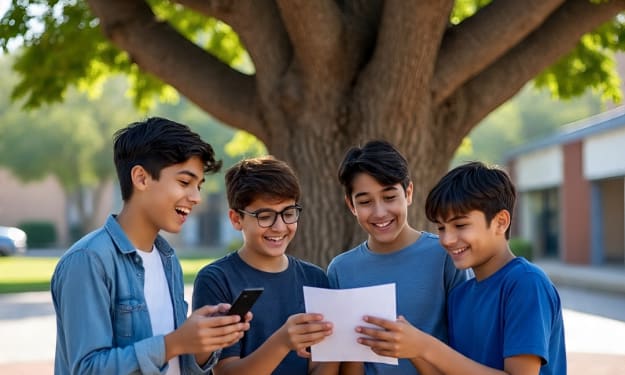
The Day the Results Came In How One Group of Students Discovered More Than Just Their Grades The morning sun poured over the red-brick walls of St. Alder High School, turning the courtyard into a warm, golden glow. It was results day — the one date circled, highlighted, and whispered about for months. The gates had barely opened when clusters of students began to gather, envelopes clutched in nervous hands, their laughter and chatter hiding the shared thrum of anxiety beneath. Mia stood at the centre of it all, her stomach twisting in knots. She’d been dreaming about this day since the exams ended, running through every possible scenario in her head. She had studied harder than she ever had before — late-night flashcards, group calls, endless practice papers — but the uncertainty still gnawed at her. Around her, her friends—Eli, Zara, and Noah—were trying to look casual, leaning against the wall and joking about who would faint first. “Can’t believe this is it,” Noah said, spinning his envelope between his fingers. “Months of suffering in that library, and it all comes down to this piece of paper.” Zara laughed, though her voice trembled slightly. “If I open this and it says I passed maths, I’m framing it.” Mia smiled faintly, grateful for the light-heartedness. The sound of envelopes tearing open began to ripple through the courtyard. Gasps, squeals, sighs — all blending into a strange symphony of relief and emotion. She took a deep breath, felt her heartbeat in her fingertips, and opened hers. For a moment, all she saw were the numbers, neatly typed in black ink. Then they began to make sense. Her grades were better than she dared hope — not perfect, but enough. Enough to get into the university she wanted. Enough to feel that the long nights and self-doubt had been worth it. She looked up, a wide grin spreading across her face before she could stop it. “I did it!” she said, almost breathless. Zara let out a cheer. “You did? Let me see!” Within seconds, they were all comparing results — some shouting in triumph, some hugging in quiet relief. Eli, who had always been the calm one, smiled as he looked at his paper. “Looks like we’re all going to make it,” he said softly. But not everyone was smiling. A few steps away, another student sat on a bench, staring at her paper, tears welling up. Mia hesitated for a moment, then walked over. It was Sophie — someone she’d worked with on a group project but didn’t know well. “Hey,” Mia said gently. “You okay?” Sophie shook her head, trying to smile through her tears. “I didn’t get the grade I needed. I thought I would. I really thought I would.” Mia sat beside her. “I get it. It feels awful right now. But this isn’t the end. You’re still one of the hardest workers I know. You’ll find another way — you always do.” Sophie gave a small laugh at that. “You sound like a teacher.” “Guess I’ve heard enough pep talks to start giving them,” Mia said with a grin. As they sat together, the rest of the courtyard buzzed with life — laughter, chatter, hugs, and selfies. It was a celebration of more than just numbers on paper. It was a celebration of effort, friendship, resilience. When the group finally left the school grounds, the late-morning sun was shining even brighter. They walked down the familiar street, their envelopes now folded and tucked safely away, but their spirits light. There was something freeing about it — not just knowing their results, but realizing that they were moving forward, together. Later that day, when Mia’s mum asked how it went, she smiled and said, “It was a good day. We all learned something — and not just about grades.” Because in the end, the day the results came in wasn’t just about who scored what. It was about discovering what really mattered: courage, kindness, and the belief that every ending is just the beginning of something new.
By Muhammad Saad 5 months ago in Education
The Power of Precision: Crafting Correct Poetry
In a quiet village nestled between rolling hills and ancient forests, lived a young poet named Elara. She had always been enchanted by words—their rhythm, their weight, their beauty. From childhood, she filled journals with flowing verses, letting her heart spill onto every page. Her poetry was raw, emotional, and brimming with imagery. Yet, despite her passion, Elara felt that something was missing. One day, she gathered the courage to show her poems to Mr. Bellwyn, an old, retired literature professor who once taught in the city and had returned to the village for peace in his later years. Known for his stern demeanor and sharp wit, Mr. Bellwyn was not the type to offer empty praise. After reading a few of her poems, he looked at her over his spectacles. “You have a gift, Elara. But talent without discipline is like a wild river—it may flow beautifully, but it floods everything in its path.” Elara frowned. “I thought poetry was about feeling, not rules.” Mr. Bellwyn smiled gently. “Feeling is the soul, yes. But structure is the body. Without both, poetry cannot stand.” Thus began Elara’s journey into the world of correct poetry—a world she had once resisted. Mr. Bellwyn introduced her to meter, rhyme schemes, enjambment, caesura, and the musicality of syllables. He showed her how the great poets—Shakespeare, Dickinson, Keats, and Frost—used precise forms not to cage emotion, but to shape it, elevate it, and make it resonate. At first, Elara struggled. The idea of counting syllables, maintaining iambic meter, and following specific forms like sonnets or villanelles felt restrictive. Her free verse seemed to flow more naturally. But as weeks passed, something began to change. She found that the boundaries of form didn’t limit her voice—they sharpened it. One evening, she wrote a sonnet about the passing of seasons. Each line was carefully constructed in iambic pentameter, the rhymes deliberate and purposeful. When she read it aloud to Mr. Bellwyn, she felt the difference. The poem didn’t just express her thoughts—it echoed them, each line reinforcing the other, rhythm carrying meaning like waves against the shore. “Now,” said Mr. Bellwyn with a nod, “you’re not just writing about something. You’re building something. This is poetry that will last.” Over time, Elara came to understand that precision in poetry wasn’t about following rules blindly—it was about choosing the right form to amplify the feeling. A haiku could capture a fleeting moment in seventeen syllables. A villanelle could explore obsession through repetition. A well-placed line break could shift meaning or emotion in a single breath. She still wrote free verse, of course, but with new eyes. Now, every word had weight. Every choice—where to pause, how to end a line, which word to use—was intentional. Elara’s poetry matured. It was no longer a wild river, but a powerful one, with carefully carved banks guiding its flow. Her work began to gain recognition beyond the village. Local publishers took notice, and eventually, she was invited to share her poems at literary events in the city. Yet she never forgot her roots or her teacher. On the day her first collection was published, she visited Mr. Bellwyn’s cottage, placing a copy of the book in his hands. The dedication read simply: "To the one who taught me that form does not stifle the heart—it gives it strength." As Elara walked home that day, she paused to write a quick verse in her pocket notebook. It was short, structured, and carefully worded, yet it sang with emotion. The sun dipped low over the hills, casting golden light across the village, and she smiled. Poetry, she now knew, was both art and craft. Feeling gave it life. Precision gave it purpose. And in that delicate balance, true poetry was born.
By Muhammad Saad 5 months ago in Poets
The Living Verse
The Living Verse How Poetry Evolved to Captivate Hearts Across Generations For as long as humanity has spoken, we’ve sung. Long before we had books or screens, we had verses—chanted around fires, whispered between lovers, shouted in protests, and written into the fabric of our cultures. Once, poetry lived in the voices of ancient storytellers. In dusty temples of Mesopotamia and the open-air theatres of Greece, people gathered not to read but to listen. Words had rhythm and music then, echoing like drumbeats through time. Homer’s Iliad, chanted by bards, wasn’t just a tale of war—it was a heartbeat passed from one generation to the next. In ancient China, poets like Li Bai painted emotions with brushstrokes of verse. In India, the Vedas sang of creation and spirit. In Persia, Rumi’s poetry spun with love so profound it’s still quoted on social media today—centuries later. As time turned its pages, poetry changed its form, but never its soul. In the Middle Ages, monks preserved poems in illuminated manuscripts, gilded with gold and hope. In the Renaissance, sonnets bloomed in the hands of Shakespeare and Petrarch, capturing the ache of love in fourteen lines. Romantic poets like Wordsworth and Shelley later carried us into nature’s arms, while Emily Dickinson quietly revolutionized verse from her room, her poems found only after her death. And then—something remarkable happened. The printing press. Suddenly, poetry could travel. It no longer needed to be memorized and passed on by word of mouth. It was printed, bound, and shared. A book of poems could sit on a kitchen table, a library shelf, or be passed from hand to hand. And people read—sometimes alone, sometimes aloud, always together in feeling. The 20th century brought yet another evolution. Poets like Langston Hughes gave voice to the African American experience. Maya Angelou reminded us, “Still, I rise.” Bob Dylan wrote verses that danced with protest and peace. Poetry moved into jazz clubs, street corners, schools. It became accessible, raw, real. And then came the internet. Suddenly, everyone had a voice—and poetry, long thought to be fading, bloomed like never before. Spoken word artists filled cafes and auditoriums. Poems, once confined to dusty textbooks, became viral sensations. A few lines typed on a phone could move millions. Instagram poets like Rupi Kaur wrote about love, loss, healing—and connected with readers around the globe. TikTok poets recited verses that went straight to the heart. Poetry was no longer just for the elite or the academic. It belonged to everyone. Teenagers scribbled poems in journals and posted them online. Grandparents discovered verses that spoke to memories they hadn’t touched in years. At protests, rallies, and vigils, people turned to poetry—not to escape the world, but to understand it. Schools introduced poetry slams and creative writing clubs. Hospitals used poetry therapy to help patients heal. Parents read bedtime poems to children, planting the seeds of imagination. And here we are today—standing in the flow of that river of verse. We scroll past a poem on a screen and stop. A few short lines capture exactly how we feel. We send it to a friend, and they reply: “That’s exactly what I needed.” We realize that poetry—this ancient, evolving art—isn’t old-fashioned or distant. It’s alive. And it lives in us. The power of poetry is not just in rhyme or rhythm, but in recognition. In seven words, it can say what we’ve struggled to explain for years. It connects us across cultures, generations, and continents. In an age of endless noise, poetry offers quiet truth. From cave walls to Twitter feeds, from sacred texts to slam poetry stages, from love sonnets to healing verses—poetry has never died. It simply changes clothes. It remains what it always was: The voice of the soul, speaking in its most beautiful form. And in every heart it touches, it lives again.
By Muhammad Saad 5 months ago in Poets
Echoes of Now
🌐 Echoes of Now A Poetic Reflection on the Pulse of the Modern Age In cities crowned with neon haze, We walk through screens in mirrored days. Our voices bounce through satellites, Yet hearts grow quiet in the lights. A thousand faces in our hands, We scroll through lives like shifting sand. Connection blooms in silent texts, While eye-to-eye feels too complex. The clock ticks fast, the world rewinds, Yet somehow we are far behind. In chasing speed, we've lost our place— A name, a thought, a touch, a face. Still, in the hum of data streams, We stitch together scattered dreams. A spark survives beneath the code, The human thread within the load. So let us pause and breathe again, Remember joy, remember pain. The future’s built from what we sow— Even now, in this bright echo.
By Muhammad Saad 5 months ago in Poets
"Shaping Tomorrow: Innovations and Unity in Today’s World"
In a time often dominated by uncertainty and challenge, a quieter revolution is unfolding—one driven by innovation, unity, and a growing global determination to shape a better tomorrow. From bustling labs in Singapore to clean energy farms in rural Kenya, people across the globe are collaborating in new and exciting ways. At the heart of this global movement is a common understanding: our biggest challenges—from climate change to inequality—require shared solutions. One of the most inspiring stories of the past year comes from a coalition of nations working to combat climate change. In 2025, the Global Green Accord was launched, a multi-nation initiative aiming to support the transition to clean energy in developing countries. Backed by more than 80 governments and hundreds of private organizations, the accord has already funded over 3,000 solar projects, bringing electricity to previously unpowered communities. Maya Fernandez, an energy engineer from Chile working on the accord, says it best: “We used to talk about who was responsible. Now we talk about who can help. That shift has changed everything.” And it’s not just energy. In the field of medicine, scientists from India, Germany, and South Africa recently co-developed a universal vaccine platform that can be rapidly customized for new viruses. Built using cutting-edge AI tools and open-source research, the technology has the potential to save millions of lives in future pandemics. “We’ve seen what happens when countries work in isolation,” says Dr. Neha Kapoor, one of the lead researchers. “This platform is proof that shared knowledge leads to shared survival.” Meanwhile, innovation is transforming education. In response to post-pandemic learning gaps, several countries have launched the Global Classroom Project. This initiative connects students from different continents through live-streamed classes, shared projects, and language exchange. A 12-year-old in Ghana now collaborates weekly with a peer in Norway on climate science experiments. “It’s not just about learning facts,” says Sofia Andersson, a teacher involved in the program. “It’s about building empathy, communication, and a sense of global citizenship in the next generation.” Technology is playing a central role in this transformation, but not at the expense of humanity. A growing movement toward ethical innovation is ensuring that AI, robotics, and digital tools are developed responsibly. In Japan, for example, a group of engineers partnered with elder care workers to create AI companions that enhance emotional well-being for seniors. Instead of replacing human caregivers, the technology supports them—reminding patients to take medication, offering mental stimulation, and even facilitating video calls with distant family members. And there’s more. Farmers in Nigeria are using satellite data to optimize crop yields and water usage. Entrepreneurs in Indonesia are creating biodegradable packaging from seaweed to combat plastic pollution. Artists in Ukraine and Poland are collaborating on virtual museums to preserve culture amid conflict. These efforts, though scattered across the globe, are deeply connected by one thread: hope. Of course, the world still faces complex problems. Climate disasters, political unrest, and economic inequality persist. But what’s different now is the sense that we are finally facing these challenges not as isolated nations or competing interests, but as a shared global community. International summits that once ended in vague promises are now producing action plans with real funding and measurable goals. Social movements are crossing borders, uniting people around values of justice, sustainability, and human rights. There is still work to be done. But if you look beyond the headlines, a different story is emerging—one of innovation, resilience, and unity. The future is not something we’re waiting for. It’s something we’re building—together. As the sun rises on a new chapter of human history, it’s clear that the most powerful force shaping our world isn’t fear or division. It’s the growing realization that together, we are capable of extraordinary things.
By Muhammad Saad 5 months ago in History