
The Living Verse
How Poetry Evolved to Captivate Hearts Across Generations

The Living Verse
How Poetry Evolved to Captivate Hearts Across Generations
For as long as humanity has spoken, we’ve sung. Long before we had books or screens, we had verses—chanted around fires, whispered between lovers, shouted in protests, and written into the fabric of our cultures.
Once, poetry lived in the voices of ancient storytellers. In dusty temples of Mesopotamia and the open-air theatres of Greece, people gathered not to read but to listen. Words had rhythm and music then, echoing like drumbeats through time. Homer’s Iliad, chanted by bards, wasn’t just a tale of war—it was a heartbeat passed from one generation to the next.
In ancient China, poets like Li Bai painted emotions with brushstrokes of verse. In India, the Vedas sang of creation and spirit. In Persia, Rumi’s poetry spun with love so profound it’s still quoted on social media today—centuries later.
As time turned its pages, poetry changed its form, but never its soul.
In the Middle Ages, monks preserved poems in illuminated manuscripts, gilded with gold and hope. In the Renaissance, sonnets bloomed in the hands of Shakespeare and Petrarch, capturing the ache of love in fourteen lines. Romantic poets like Wordsworth and Shelley later carried us into nature’s arms, while Emily Dickinson quietly revolutionized verse from her room, her poems found only after her death.
And then—something remarkable happened.
The printing press. Suddenly, poetry could travel. It no longer needed to be memorized and passed on by word of mouth. It was printed, bound, and shared. A book of poems could sit on a kitchen table, a library shelf, or be passed from hand to hand. And people read—sometimes alone, sometimes aloud, always together in feeling.
The 20th century brought yet another evolution. Poets like Langston Hughes gave voice to the African American experience. Maya Angelou reminded us, “Still, I rise.” Bob Dylan wrote verses that danced with protest and peace. Poetry moved into jazz clubs, street corners, schools. It became accessible, raw, real.
And then came the internet.
Suddenly, everyone had a voice—and poetry, long thought to be fading, bloomed like never before.
Spoken word artists filled cafes and auditoriums. Poems, once confined to dusty textbooks, became viral sensations. A few lines typed on a phone could move millions. Instagram poets like Rupi Kaur wrote about love, loss, healing—and connected with readers around the globe. TikTok poets recited verses that went straight to the heart.
Poetry was no longer just for the elite or the academic. It belonged to everyone.
Teenagers scribbled poems in journals and posted them online. Grandparents discovered verses that spoke to memories they hadn’t touched in years. At protests, rallies, and vigils, people turned to poetry—not to escape the world, but to understand it.
Schools introduced poetry slams and creative writing clubs. Hospitals used poetry therapy to help patients heal. Parents read bedtime poems to children, planting the seeds of imagination.
And here we are today—standing in the flow of that river of verse.
We scroll past a poem on a screen and stop. A few short lines capture exactly how we feel. We send it to a friend, and they reply: “That’s exactly what I needed.” We realize that poetry—this ancient, evolving art—isn’t old-fashioned or distant.
It’s alive. And it lives in us.
The power of poetry is not just in rhyme or rhythm, but in recognition. In seven words, it can say what we’ve struggled to explain for years. It connects us across cultures, generations, and continents. In an age of endless noise, poetry offers quiet truth.
From cave walls to Twitter feeds, from sacred texts to slam poetry stages, from love sonnets to healing verses—poetry has never died. It simply changes clothes.
It remains what it always was:
The voice of the soul, speaking in its most beautiful form.
And in every heart it touches, it lives again.
About the Creator
Keep reading
More stories from Muhammad Saad and writers in Poets and other communities.
Echoes of Now
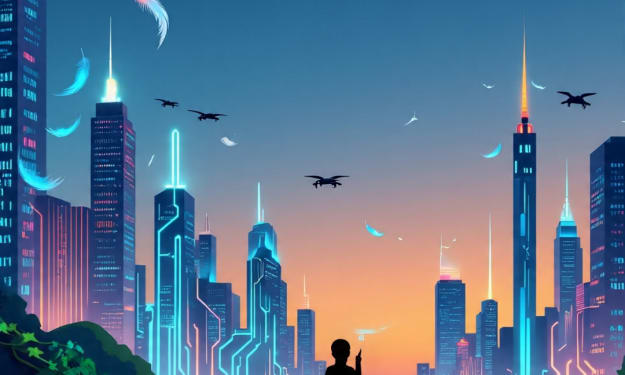
🌐 Echoes of Now A Poetic Reflection on the Pulse of the Modern Age In cities crowned with neon haze, We walk through screens in mirrored days. Our voices bounce through satellites, Yet hearts grow quiet in the lights. A thousand faces in our hands, We scroll through lives like shifting sand. Connection blooms in silent texts, While eye-to-eye feels too complex. The clock ticks fast, the world rewinds, Yet somehow we are far behind. In chasing speed, we've lost our place— A name, a thought, a touch, a face. Still, in the hum of data streams, We stitch together scattered dreams. A spark survives beneath the code, The human thread within the load. So let us pause and breathe again, Remember joy, remember pain. The future’s built from what we sow— Even now, in this bright echo.
By Muhammad Saad 5 months ago in Poets


Comments
There are no comments for this story
Be the first to respond and start the conversation.