Khalid Khan
Stories (9)
Filter by community
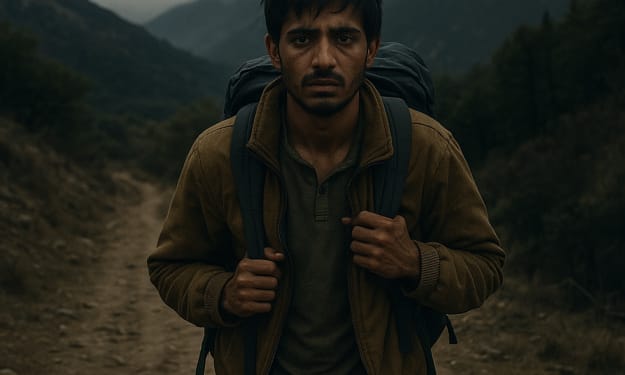
The Long Road to Somewhere
I. The Beginning of the Road The sun had barely risen when Adeel zipped up his old, frayed backpack for the last time. The streets of Lahore were still asleep, but his thoughts were not. He was leaving behind more than just dust and familiarity—he was abandoning his past, his people, and a country that had forgotten how to make space for his dreams.
By Khalid Khan8 months ago in Fiction
Where the Heart Writes
Where the Heart Writes I wrote you first in lines of light, Where shadows bowed to morning’s might. No voice had named you — still, I knew, The way the sky leans into blue. Before your hands had touched my skin, You lived in every song within. Each verse I penned, each silent prayer, Held pieces of you, unaware. Love is not found — it’s softly grown, In words we speak when we’re alone. It blooms between the lines we share, In ink, in breath, in whispered care. I write of you not just in rhyme, But in the turning wheel of time. In fleeting glances, held too long, In aching silence between song. You’re there in pages left unread, In thoughts I think but never said. In coffee warm and nightfall's hush, In every bloom, in every blush. You linger like a sacred hymn, Soft on the air, yet full and brimmed. A rhythm only hearts can feel, Too wild to name, too true to steal. I’ve seen you in a stranger’s laugh, In mirrored dreams split clean in half. I’ve heard your voice in waves that break, In every dawn my soul could take. And though the world may never see The full, unspoken depths of “we,” I’ll write — as if the stars conspire To set these trembling lines on fire. For love, when true, needs not be loud. It speaks in hearts, not to the crowd. And if my words are all I give — Then know: in them, we’ll always live. So let the poets think it art, But what I write — I write from heart. Each letter shaped, each phrase begun, Is proof that two can live as one.
By Khalid Khan8 months ago in Fiction
In The Time Between Heartbeats
“In the Time Between Heartbeats” They met in autumn, when the world was ablaze in crimson and gold. Her name was Elena, a painter with a soul so soft it could quiet storms. He was Adrian, a violinist with hands that had known both war and wonder. The first time they saw each other, it was raining. She stood beneath a maple tree in Central Park, sheltering her canvas from the downpour, eyes locked on a world only she could see. Adrian, soaked to the bone, passed by with his violin case slung over one shoulder. Their eyes met—and something ancient stirred. He smiled first. She didn’t. But later, he would say he knew from that moment. They met again at a corner café two weeks later. She was sketching a sleeping dog by the fireplace. He was playing in a quartet across the room. Their eyes met again—this time, she smiled. It began, as most beautiful things do, quietly. Elena painted the way she loved: with slow, deliberate devotion. She told Adrian she feared impermanence—how colors faded, how people disappeared. Adrian told her music was just as fleeting, notes vanishing the moment they were born. But he would play for her anyway. Every night, beneath the stars or in the silence of her sunlit studio, he filled the air with sound, and she filled it with color. They loved like there was no such thing as later. They kissed like each breath might be the last. He played for her while she slept. She painted him when he thought she wasn’t looking. There was no proposal. No diamond. Just a Tuesday morning and two mugs of coffee, and Elena saying, “I’d marry you even if the world ended next week.” And Adrian saying, “Then let’s love like it will.” They were married in a garden, under a tree that remembered the rain of the day they met. It was just the two of them and the wind. No vows, no priest. Just his music and her laughter. It was perfect. For two years, they lived in a world they built together—a world of music and paint, of quiet breakfasts and deep kisses, of joy so gentle it almost hurt. Then came the diagnosis. Elena had a tumor behind her left eye. It was rare. Inoperable. Aggressive. She was twenty-eight. He fell apart in ways no one saw. Except her. Always her. “You must keep playing,” she told him. “When I forget the sound of your voice, let the music remind me.” She refused to be afraid in front of him. She painted until her hands shook too much to hold a brush. He played until his fingers bled. When she began to forget things—his name, the name of their street, the day of the week—he would sing to her. Songs he had written just for her. And for a while, she remembered. One night, she woke in the middle of a seizure. He held her through it, whispering that he loved her, over and over, like a prayer. After, she looked at him with wide, frightened eyes. “I’m slipping,” she said, barely a whisper. “You’re still here,” he said, placing her hand over his heart. “Every beat, you’re here.” Her final days came like fog—quiet, slow, inevitable. On her last morning, she asked him to take her to the tree where they were married. He carried her, though his back screamed with pain. She was nothing but bones and air in his arms. He sat with her beneath the branches, the wind threading through her hair. She looked at him as if seeing a memory. “Adrian,” she whispered. “You stayed.” He kissed her forehead. “Always.” She closed her eyes with a smile. And then—silence. Adrian never stopped playing. Each concert, each note, was a love letter across time and death. He composed an entire symphony in her name. Audiences wept without knowing why. They said his music made them feel like they were remembering something beautiful they'd never actually lived. But Adrian knew. He played for the girl who loved autumn, who painted storms into stillness, who promised forever on a Tuesday morning. And every time the bow touched string, he felt her. Still here. In the time between heartbeats.
By Khalid Khan8 months ago in Fiction
Notes Between the Pages
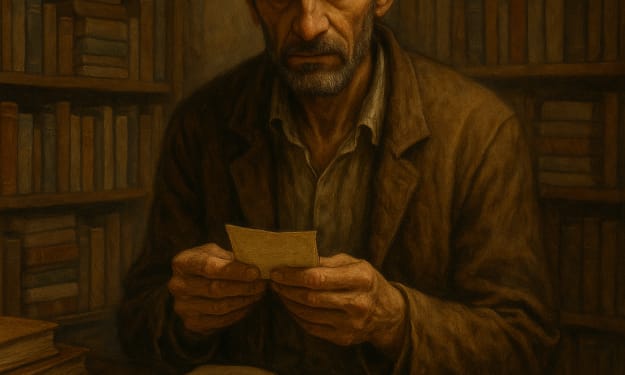
In the heart of a crumbling alley, where old bricks bled history and the wind whispered forgotten verses, stood a modest bookstore—dusty, dimly lit, and nearly hidden behind the canopy of a gnarled fig tree. It was not much to look at, certainly not for the passersby who chased noise and neon, but for the few who sought depth over display, it was a sanctuary.
By Khalid Khan8 months ago in Fiction
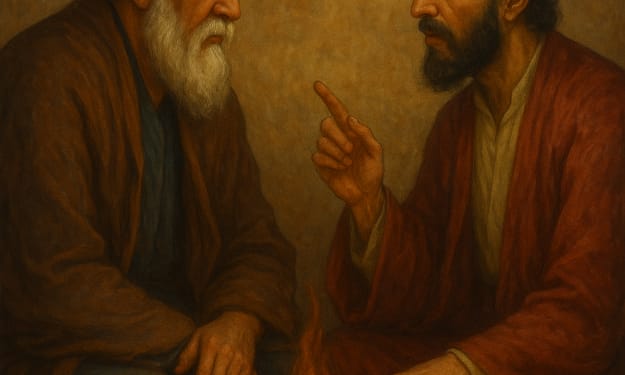
When Fire Met the Flame: A Dialogue Between Rumi and Shams of Tabriz
"Do not seek the water. Become thirsty. Only then will the water seek you." — Shams of Tabriz The sun was tilting toward the horizon when Shams of Tabriz walked into the small courtyard where Rumi was seated, deep in contemplation. The air was still, as though listening. The sky, a burning tapestry of gold and crimson, mirrored the inner fire both men carried—one seeking, the other, flame.
By Khalid Khan8 months ago in Fiction
The Silence Between Chapters
"The Silence Between Chapters" The first time she noticed him, he was sitting in the corner of the university library, hunched over a thick book, his glasses slipping down his nose. A soft beam of sunlight fell across his cheek, dust floating around him like a constellation. His lips moved ever so slightly as he read, completely unaware of the world.
By Khalid Khan8 months ago in Fiction
When the River Forgot Mercy
It was supposed to be a day of joy. The Kareem family—fifteen members, spanning three generations—had set out early that morning for a picnic near the riverbank. Children laughed as they chased each other through the tall grass, elders sipped tea under the shade of a tree, and parents smiled at the rare peace that life seldom offered. No one suspected that the sky above, gray and quiet, was holding back a storm that would soon rewrite their fate. By late afternoon, the winds began to howl. The river, once calm and silver, turned into a roaring beast. Water rushed in with a fury no one had predicted—certainly not the underfunded local weather office, which had failed to issue a proper warning. Within an hour, their picnic spot became an island of stone, surrounded by waves that clawed at their feet like hands desperate to pull them under. They called for help. Again and again. Phones rang unanswered. Emergency lines were jammed. The state’s disaster response team, crippled by poor coordination and a lack of resources, couldn’t even locate them on the map. Officials sat behind desks, watching weather reports with mild concern while lives were slipping beneath water. Night fell. The children cried themselves to sleep in the arms of their parents. Hope faded with every crashing wave. By morning, the river had swallowed the island whole. No bodies were found. No rescue ever came. Just silence. They did not die because nature was cruel. They died because the system was blind.
By Khalid Khan8 months ago in Writers