
When Fire Met the Flame: A Dialogue Between Rumi and Shams of Tabriz
An imagined conversation between Rumi and Shams of Tabriz on spiritualism, the Forty Rules of Love, and how timeless truths still shape our everyday lives.
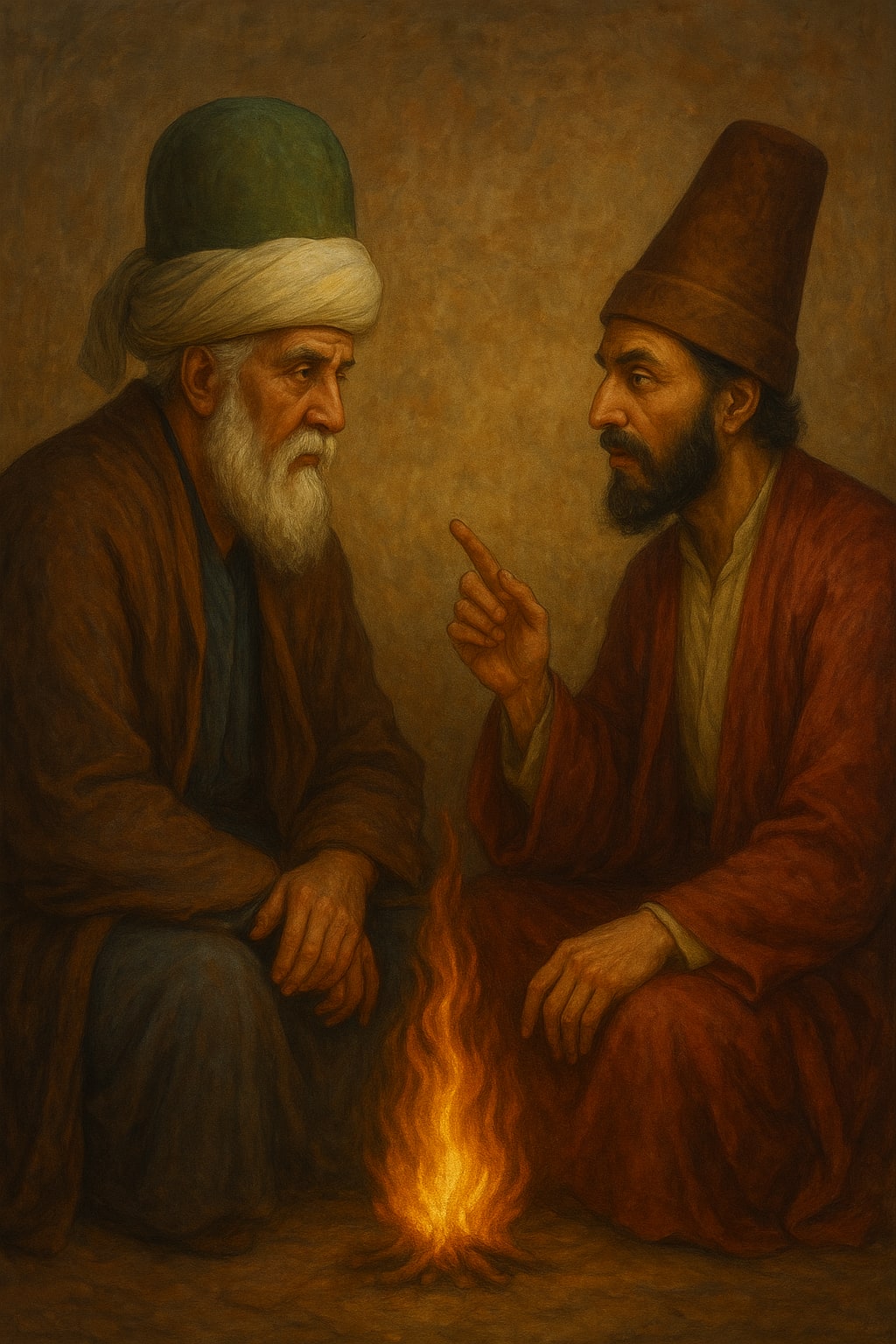
"Do not seek the water. Become thirsty. Only then will the water seek you." — Shams of Tabriz
The sun was tilting toward the horizon when Shams of Tabriz walked into the small courtyard where Rumi was seated, deep in contemplation. The air was still, as though listening. The sky, a burning tapestry of gold and crimson, mirrored the inner fire both men carried—one seeking, the other, flame.
Rumi:
“Shams, they say the soul is a garden—but I feel mine has been both a desert and a storm. Tell me, is this restlessness part of the path to the Divine?”
Shams:
“Ah, my friend, restlessness is not your enemy. It is the invitation. When the soul begins to stir like the wind before the rain, it is calling you to break the shell of comfort. No one awakens under soft sheets. The soul awakens through longing.”
Rumi turned his gaze toward the evening sky, its colors shifting like thoughts.
Rumi:
“Then what is spiritualism, if not peace? Why does it arrive like fire instead of calm water?”
Shams:
“Because peace is not found—it is born within. Spiritualism is not the art of escaping the world; it is the courage to live in it with a heart that is free. It is dancing while the world burns. It is loving even when the beloved turns away. Spiritualism, dear Rumi, is not a doctrine. It is the death of the ego and the rebirth of the soul.”
Rumi’s eyes closed briefly, as if absorbing the warmth of truth through his skin.
On the Forty Rules of Love Rumi:
“I have pondered your Forty Rules, Shams. They are not merely teachings—they feel like lanterns left along the dark alleys of the soul. But do they still speak to people today?”
Shams:
“The Rules are not bound by time. They are not for mystics alone; they are for anyone who has ever suffered, loved, doubted, hoped. Each rule is a mirror—when a person truly looks into it, they see themselves.”
Shams leaned in, eyes ablaze.
“Take the first rule, for instance: ‘How we see God is a direct reflection of how we see ourselves.’ Most people see a God who judges, because they are harsh with their own hearts.
Or the twenty-sixth: ‘The universe is one being. Everything and everyone is interconnected through an invisible web of stories.’ In a world of disconnection, this is not just a spiritual truth—it is survival.”
Rumi:
“But what of those who do not follow a path of faith? Who feel lost in modern noise?”
Shams:
“Then the Rules are even more vital. Spirituality is not exclusive to religion. It is in how we treat the cashier. How we forgive our father. How we listen without interrupting. Even how we speak to ourselves when no one is listening. These Rules align with everyday life—not to control it, but to soften it. To wake people up.”
A Lesson in Silence
The muezzin’s call to prayer rang out faintly in the distance. But neither moved. Silence fell—a silence rich with presence, not absence.
Rumi:
“Then what is the final destination, Shams? What is the point of this path we call spiritual?”
Shams:
“There is no destination. There is only presence. When you truly walk with love, each step is both the path and the goal.”
He paused, then smiled.
“The Rules do not lead you to love. They peel away everything that is not love.
People ask, ‘Where is God?’ I say, ‘Where are you not?’”
Closing Reflection
That evening, as the stars stitched silver threads across the sky, Rumi picked up his pen and began to write. He no longer wrote as a scholar, but as a lover. A lover of the Divine. Of humanity. Of the fire Shams had lit inside him.
“Beyond right and wrong, there is a field. I’ll meet you there.”
Why the Forty Rules Still Matter
Each of the Forty Rules of Love can be seen not as commandments, but as gentle keys—unlocking the deeper parts of ourselves we have long forgotten. They remind us:
To look inward before blaming outward. To love not because it is easy, but because it is sacred. To see God not as a throne in the sky, but as breath in our lungs.
In a world filled with division and despair, the Forty Rules are not just spiritual—they are radical acts of healing. Of remembering who we truly are beneath our labels, wounds, and noise.
And perhaps, just perhaps, if we read them not with the eyes, but with the soul, we will hear Shams whisper:
“Don’t look for love. Become it.”
Author’s Note
In a time where spirituality often feels like a relic or a luxury, the conversation between Rumi and Shams reminds us that the sacred is always near. Not in temples or scriptures alone—but in the way we live, speak, forgive, and love.
The Forty Rules are not for the chosen.
They are for the choosing.
About the Creator
Keep reading
More stories from Khalid Khan and writers in Fiction and other communities.




Comments
There are no comments for this story
Be the first to respond and start the conversation.