
Notes Between the Pages
When words are left unsaid, books become the only place love can speak
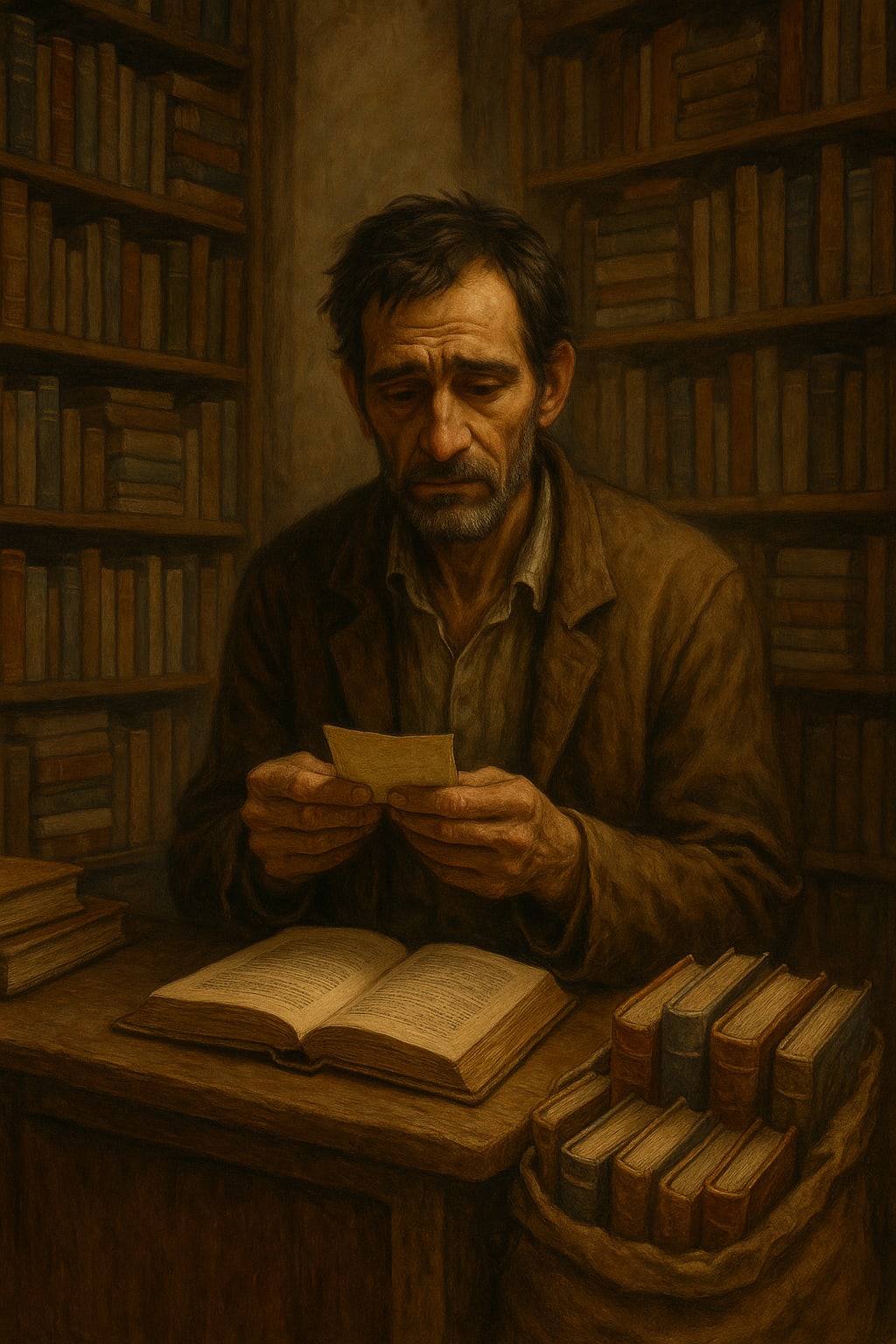
In the heart of a crumbling alley, where old bricks bled history and the wind whispered forgotten verses, stood a modest bookstore—dusty, dimly lit, and nearly hidden behind the canopy of a gnarled fig tree. It was not much to look at, certainly not for the passersby who chased noise and neon, but for the few who sought depth over display, it was a sanctuary.
Behind its creaking wooden counter lived a man with nothing but books—and everything because of them. His name was Aahil.
Aahil was poor, yes, painfully so. His shoes had stitched smiles, and his shirts knew the sting of many winters. But in the silence of his suffering bloomed an entire universe. The books lining his shelves were not for sale to him; they were soulmates. Each spine, each page, held a memory, a heartbeat, a revelation. He hadn’t merely read Dostoevsky; he had wept with Raskolnikov. He hadn’t just turned the pages of The Alchemist or Brida; he had walked the deserts with Santiago and danced under the moon with Brida.
He quoted Dickinson with the reverence of a prayer, whispered Keats to the shadows, and sometimes, in moments of lonely courage, recited Darwish aloud to the moths circling his dim light. Shakespeare's sonnets, memorized in the stillness of many nights, were the lullabies that rocked his broken dreams to sleep.
Students came often—wide-eyed and burdened with reading lists—and Aahil, always seated like a sage among paper worlds, would lift their confusion with clarity. He had no degree, no accolades, but he knew what few professors knew: the breath behind the words.
Then one day, she came.
Her name was Amara. She didn’t ask for help. She simply browsed. And yet Aahil could tell—this one read. She ran her fingers over titles like one touches sacred scripture. She opened books with reverence, her eyes absorbing more than letters. She chose The Prophet first. When she returned it, there was a folded note inside:
"There is more truth in a poem than in a promise. Do you agree?"
Aahil smiled. No one saw it, but it lit his whole being. He wrote back inside the next book she returned:
"Truth in poetry is like water in cupped hands—it slips, but you remember its touch."
And so it began.
They never spoke. Not once. Their exchange lived in margins and on back pages, through thoughts scribbled underlines and quotations wrapped in ink. She read The Unbearable Lightness of Being; he answered with a Camus quote. She underlined Dickinson’s line: “Hope is the thing with feathers”—he replied beneath it: “And still it perches, even in this cage of mine.”
Each book returned came back heavier with their hearts.
She would sometimes leave a pressed flower, a tiny dried leaf, a torn corner with a single word—longing, freedom, home.
He would match it with verses. He would wait each day—not anxiously, but as one waits for rain in a drought, knowing the clouds must come, eventually.
But one morning, the bookstore didn’t open.
The lock rusted untouched. The fig leaves trembled alone in the breeze.
No one knew where Aahil had gone. Some said he returned to his village. Others believed he had fallen ill. Some thought the weight of poverty had dragged him under.
But Amara knew.
She came that evening, as always. The window was covered in dust. The shelves, abandoned. Yet in the drawer where Aahil kept his ink pens, she found a note.
It was his final whisper:
"I dreamed of pages, but compulsion makes a man compel. I carry your words in every step I take. Forgive me. — Aahil"
No other note. No explanation. But he had taken with him every book she had touched. Every one. As if he couldn’t leave her behind—not truly.
And so she comes still, each day, not to speak, not to cry, but to breathe in the ghost of him that lived in paper and ink. She holds a book to her chest, closes her eyes, and swears she can still feel his presence in the yellowing pages.
He had nothing—but he had everything.
A man whose wealth lay not in coins, but in quotes. Not in bricks, but in bound books. Not in noise, but in notes passed between the silence.
And though the world called him poor, Amara knew the truth—
He was the richest soul she had ever known.
“I have measured out my life with coffee spoons,” wrote Eliot.
But Aahil—he measured his with chapters, with letters never spoken aloud, with love so quiet it echoed through time.
About the Creator
Keep reading
More stories from Khalid Khan and writers in Fiction and other communities.
When Fire Met the Flame: A Dialogue Between Rumi and Shams of Tabriz
"Do not seek the water. Become thirsty. Only then will the water seek you." — Shams of Tabriz The sun was tilting toward the horizon when Shams of Tabriz walked into the small courtyard where Rumi was seated, deep in contemplation. The air was still, as though listening. The sky, a burning tapestry of gold and crimson, mirrored the inner fire both men carried—one seeking, the other, flame.
By Khalid Khan8 months ago in Fiction
Lightning Never Strikes Twice
The distant rumble, the sudden deluge, the crescendo of sound, the flash of light, the explosive energy — it never gets old. I became an amateur storm chaser about two years ago. My wife, Cindy suggested it. Sort of. She said, "Alex, you know this cancer is killing me. I've come to terms with that, but you're smothering me. Go join a band, write a book, or become a storm chaser, for all I care. I love you, but you need a hobby."
By Julie Lacksonen5 days ago in Fiction
The Knights of the Dead
The image is hauntingly consistent across centuries of folklore: a silent procession of armored figures winding through a moonlit forest, the rhythmic clanking of steel muffled by an unnatural mist. Their banners are tattered, their horses are skeletal, and their eyes—if they have any at all—glow with a cold, pale light. This is the Knights of the Dead Army, a trope that has marched through European mythology, romantic literature, and modern fantasy.
By Richard Weberabout 24 hours ago in Fiction


Comments (1)
Beautifully written