Julio Javier
Stories (59)
Filter by community
Sending honey badger in snake island
Have you ever wondered what would happen if a honey badger was put on an island with poisonous snakes? Well, honey badgers are known for being the number one enemy of poisonous snakes. They can easily choose snakes like they're chewing candy! Honey badgers are also resistant to poison and aren't afraid of anything or anyone. They can even take on a big family of snakes! Sometimes, we see honey badgers fighting with just one snake. So, what would happen if a honey badger was sent to an island with poisonous snakes? We'll have to watch the video to find out! But first, let's learn a little bit about honey badgers. They're the toughest animals on earth and don't have nerves of fear. They eat porcupines and snakes, break hives for honey, steal from low birds, and snatch live prey. They're so stubborn that even lions and hyenas are tired of them! Honey badgers emit an unpleasant odor to defend themselves and have a unique fur color that makes them stand out.
By Julio Javier3 years ago in FYI
Snake Island: Dangerous place in the world
About half a million islands exist, one of which is Cue Mata Grande. It is known to be one of the most perilous travel destinations worldwide. We will inspect why it is so dangerous in this article. The island appears to be a fantastic resort, located in the Atlantic Ocean. However, it does not host any tourists. Situated just 35 kilometers off the shore of Brazil, south of Sao Paulo, humans are prohibited from entering the island due to the dangerous local snakes. The locals named the island 'snake' for good reason. The territory inhabits approximately 12,000 venomous snakes, averaging five snakes per square meter of the island's land. According to one theory, the island separated from Brazil about 11,000 years ago due to a significant rise in sea levels. The snakes that remained found themselves in isolation and struggled to find food, affecting their future descendants' aggressiveness. The migrating birds that used the island as a stopover became the snakes' food source. The snakes are excellent tree climbers and can effortlessly hunt birds and lizards. They are very aggressive, can camouflage themselves, and adapt to their surroundings. The island hosts thousands of snake species, including the most dangerous snake in the world, the Bothrops insularis. Its bite results in the necrosis of muscle tissue. The Bothrops insularis, also known as the golden lancehead pit viper, is a venomous species that is critically endangered and can only be found naturally on the island. The snake feeds on birds and has been stranded on the island for thousands of years due to the rising ocean levels that occurred after the last ice age. As a result of this isolation, the snakes have undergone rapid evolution to adapt to their new surroundings, leading to a significant increase in their population. This has made the island too dangerous for public visitation, and only the Brazilian Navy and a select few researchers who have been screened by the Chico Mendes Institute for Biodiversity Conservation - a Brazilian federal conservation unit - are granted access.
By Julio Javier3 years ago in FYI
Why honey badger is so daring and ferocious?
The Mellivora capensis, commonly known as the honey badger or ratel, is a mammal found extensively across Africa, Southwest Asia, and the Indian subcontinent. Its habitat diversity and wide distribution have led to its classification as Least Concern on the IUCN Red List. The honey badger, the sole living species in the Mellivora genus and Mellivorinae subfamily of mustelids, differs notably from other badger species and shares more characteristics with weasels. Predominantly carnivorous, this species faces few natural predators owing to its strong defense mechanism, thickness of skin, and power. Honey badgers are the largest terrestrial mustelids in Africa, with males weighing between 9 to 16 kg (20 to 35 lb) and females weighing between 5 to 10 kg (11 to 22 lb) on average. They can measure up to 28 cm (11.0 in) in shoulder height and 77 cm (30 in) in body length, with an additional 12-30 cm (4.7-11.8 in) of tail length. Studies show that this species can weigh anywhere between 6.4 to 12 kg (14 to 26 lb), with an average weight of around 9 kg (20 lb). The honey badger ranks as the third largest known badger and fourth largest terrestrial mustelid, following the European badger, hog badger, and wolverine. However, some honey badgers found in Iraq have weighed up to 18 kg (40 lb), which is comparable to male European badgers and wolverines in late autumn. Conversely, honey badgers in India were relatively smaller, with an adult female and two males weighing 6.4 kg (14 lb) and a median of 8.4 kg (19 lb). Male honey badgers have a skull length of 13.9–14.5 cm (5.5–5.7 in), while females have a skull length of 13 cm (5.1 in).
By Julio Javier3 years ago in FYI
How fatal is headshot?
A headshot is often fatal, but it's important to understand what happens when a bullet enters someone's skull. It's important to note that we're only discussing pistols and rifles, as shotguns are self-explanatory. When a bullet is fired from a pistol or rifle, it travels through a rifled barrel. The grooves in the barrel cause the bullet to spin, which flings cranial tissue outward upon penetration. The tissue expands to roughly 12.5 times the diameter of the bullet, but quickly returns to its normal size in just 5 to 10 milliseconds. The size of the wound depends on the caliber of the bullet, with a 22-caliber bullet creating a 2.7 inch-wide wound, a 38-caliber bullet creating a 4.4 inch-wide wound, and a 45-caliber bullet creating a five-inch wide wound. The expanded cavity caused by the bullet creates a vacuum effect, which makes the cranial cavity expand, causing secondary fracture lines that spread out from the wound. Fractures are most common at soft locations such as the temples and orbital plates behind the eyes. The more powerful the firearm, the more secondary fracturing of the skull, particularly at thicker and harder locations such as the front and back. Velocity is the most important factor contributing to the damage a bullet inflicts on the human body. The equation for kinetic energy explains why.
By Julio Javier3 years ago in Criminal
The eggs and heart disease
Back in 1961, a guy named Ansel Keyes said that eating too much saturated fat and cholesterol could cause heart disease. People believed him even though there was evidence that said he might be wrong. But now, doctors and scientists are starting to question whether he was right or not. Some studies have shown that eating foods like eggs, cheese, butter, and liver (which people used to think were bad for your heart) might actually be good for you. There are also some groups of people, like the French, who eat a lot of butter and cheese but don't have a lot of heart disease. And get this: only half of the people who have heart attacks have high cholesterol! Some studies even suggest that having higher cholesterol might help you live longer. So, it's not as simple as just saying that cholesterol and saturated fat are bad for your heart.
By Julio Javier3 years ago in FYI
What happen to your body if take fish oil everyday?
Fish oil is highly beneficial for heart health as it contains omega-3 fatty acids, specifically DHA, EPA, and ALA. Research has shown that DHA and EPA can decrease inflammation in arteries, reducing the risk of atherosclerosis and heart disease. Additionally, fish oil can prevent blood clots from forming in narrowed arteries, lowering the risk of heart attack and stroke. It may also protect against irregular heartbeat and arrhythmia by stabilizing electrical impulses in the heart muscle cells. Fish oil supplements can benefit people with high triglycerides by decreasing levels by up to 50% after three months of treatment. Furthermore, the omega-3 fatty acids in fish oil can improve brain function and may even protect against cognitive decline and dementia, including Alzheimer's disease. DHA and EPA are essential for healthy brain development and function, and those with low levels of these fats have an increased risk of cognitive decline. Studies indicate that those who consume higher amounts of DHA have better clarity than those who consume less or none at all. Finally, fish oil is a great source of vitamins A and D, specifically retinol, which is important for healthy skin, vision, and immune system function. While most people get enough vitamin A from their diets, those who don't eat many fruits and vegetables may benefit from taking fish oil supplements.
By Julio Javier3 years ago in FYI
What happen to your body if you eat ginger?
Ginger is a unique and valuable spice, thanks to its abundant natural oil called gingerol. This oil is responsible for the distinct aroma and taste of ginger - but it's more than just a flavor enhancer. Gingerol is also a potent medicinal compound that has the attention of scientists and health experts around the globe. One of ginger's primary benefits is its natural anti-inflammatory properties, which can help soothe a wide range of issues, from digestive troubles to joint pain. Gingerol is also an antioxidant that fights harmful free radicals that can cause premature aging and various diseases. Think of ginger as your personal bodyguard, working tirelessly to protect your health. Ginger offers a host of daily benefits as well. For example, it's highly effective at calming an upset stomach. While many people reach for ginger ale to soothe their tummies, it's the ginger itself that's the real hero. Studies have shown that ginger is a powerful anti-nausea agent, with just one gram significantly reducing symptoms in pregnant women and those with motion sickness. Whether you're planning a boat trip or simply feeling queasy, ginger can be your ally.
By Julio Javier3 years ago in FYI
How long you live in other planets?
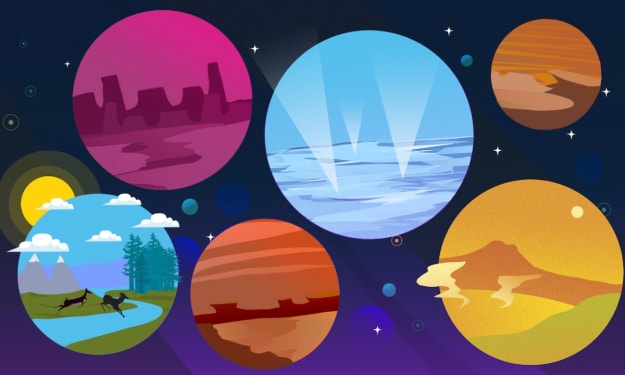
If you went to Mercury, you'd notice that it's really close to the sun. It's actually the closest planet to the sun and the smallest one too. But even though it's close, it's not the hottest planet. Venus is hotter! It takes Mercury 88 days to orbit the sun, which is more than three months. During the day, it's really hot on Mercury, with temperatures over 800 degrees Fahrenheit! But at night, it gets really cold, like negative 300 degrees Fahrenheit. That's because Mercury doesn't have an atmosphere to hold in the heat. It's like a desert, which is why there's no moisture, clouds, or rain. If you could somehow stay in between the hot and cold parts of the planet, you could survive. But there's no oxygen in Mercury's atmosphere, so you can only hold your breath for so long. Plus, there are plasma tornadoes from the sun that create a magnetic field. Venus is even hotter than Mercury, with temperatures almost reaching 1,000 degrees! But the gravity is similar to Earth's, so you could walk around and go jogging. However, the extreme heat and pressure would crush you like a can. Mars is called the red planet, but it's actually really cold. It takes almost two years to orbit the sun and has 25 hours in a day, just like Earth. The atmosphere is thin and unbreathable, with lots of dust storms and carbon dioxide on the polar caps. You wouldn't freeze, but you'd need some thick clothes to survive.
By Julio Javier3 years ago in Earth
The Black Hole
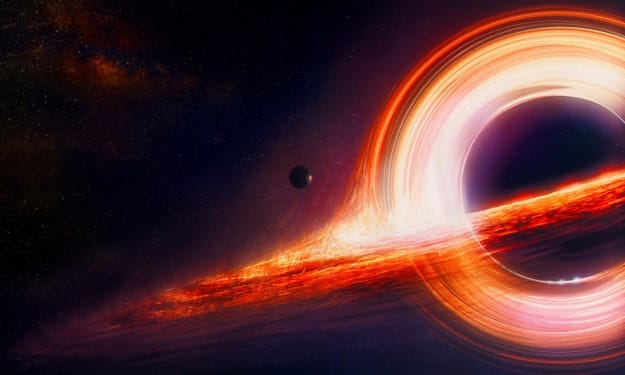
A black hole is a space zone that possesses immense gravitational force. This force is so strong that nothing, including light or other forms of electromagnetic waves, possesses adequate energy to break free from it. According to the theory of general relativity, a sufficiently condensed mass can distort spacetime to create a black hole. The event horizon is the boundary from which no escape is possible. Despite its significant influence on the destiny and circumstances of any matter that crosses it, the event horizon has no locally detectable features according to general relativity. In several aspects, a black hole functions like an ideal black body since it does not reflect any light. Additionally, quantum field theory in curved spacetime predicts that event horizons radiate Hawking radiation, with a similar spectrum as a black body of a temperature inversely proportional to its mass. This temperature is approximately a few billionths of a kelvin for stellar black holes, making it almost impossible to observe directly.
By Julio Javier3 years ago in Earth
How High Jumping on Different Planets?
Gravity is responsible for keeping our feet firmly planted on the ground. This is why the average person can only jump about one and a half feet straight up. However, if we were to live on another planet, such as Venus or Saturn, we would face a variety of difficulties. Let's take a look at Mercury first, as it is the closest planet to the sun. The gravity on Mercury is less than half of that on Earth, allowing you to jump about four feet high. However, the temperatures on the sunny side are scorching, reaching 800 degrees, making it feel like standing neck-deep in dark red lava on the slopes of a volcano. The night brings little respite, as the scorching air quickly chills to minus 280 degrees. Furthermore, a day on Mercury lasts 176 Earth days. If we were to hop from this inhospitable place to an even less welcoming planet like Venus, we would see Earth from there, if not for the whirling mass of clouds above. These clouds create a monstrous greenhouse effect as well as immense atmospheric pressure. If you were to jump on Venus, you would only make it just shy of 1.7 feet high because the mass and size of Earth and Venus are almost similar, with Venus being slightly smaller. Besides the constant temperature of a blazing furnace, rain on Venus wouldn't bring relief as the clouds up there are made of sulfuric acid. Skipping our home planet, let's go straight to its moon, Luna. Here, gravity is less than a fifth of that on Earth, allowing you to jump almost nine feet in the air and not touch the ground again for several seconds. It's hard to believe that this desolate piece of space rock impacts the tides on Earth. If you were to stay on the moon long enough, a couple million years, you would see how much further it's gone from our home planet. Moving on, our next destination is Mars, the red planet.
By Julio Javier3 years ago in Earth
If We Never Find True Love
Since entering adulthood, we have eagerly awaited the possibility of love, intuitively understanding its meaning long before it became a practical reality. Love, to us, meant being profoundly understood and free to express ourselves without fear of judgment. It was a conspiracy between two people against the rest of the world, reserved for those who truly comprehended its nature and felt its power. We believed that love was the pinnacle of existence, that to fancy someone completely and have them reciprocate was the ultimate achievement. In the name of love, we willingly put ourselves in extraordinary situations. We dressed up in fancy clothes, fretted over our hair and complexion, and drank brightly-colored cocktails. We found ourselves in unfamiliar parts of town, in the bedrooms of people who were not quite right, but were at least an advance on being alone and peculiar. We accepted dates with problematic individuals, knowing that we could not afford to become stagnant. Although it was not always right, we persevered, telling ourselves that it would eventually be alright as others kindly assured us. However, as the years passed, we found ourselves entangled in troubling situations that appeared to be love from an outsider's perspective, but in reality, were anything but. We spent far too long suppressing our own voices, and at a certain point, we began to grapple with a terror that we still struggle with late at night.
By Julio Javier3 years ago in Humans
If we were all immortal?
Hey there! Some really smart people have been thinking about whether or not humans can live forever. They think that with some cool technology, like putting our minds into computers, we might be able to achieve immortality in the next few decades. Others think that we can at least extend our lives a lot longer with more research. But even if we could live forever, we wouldn't be invincible to getting sick or hurt. Some religions believe in physical immortality, like the ancient Egyptians and Greeks who thought their gods had physical bodies. Some Christians believe that believers will be resurrected to physical immortality. Other groups, like Rastafarians and Rebirthers, also believe that physical immortality is possible. It all depends on more research and discoveries in science!
By Julio Javier3 years ago in Humans