John Welford
Bio
John was a retired librarian, having spent most of his career in academic and industrial libraries.
He wrote on a number of subjects and also wrote stories as a member of the "Hinckley Scribblers".
Unfortunately John died in early July.
Stories (501)
Filter by community
All aboard the bus to Proxima Centauri!
Let’s suppose that – 100 years hence, maybe – it is decided that Planet Earth is no longer inhabitable and the human race will have to decamp to another planet if it is to survive. After much debate it is concluded that Mars is far from suitable so the journey will have to take a lot longer – to the next nearest planet that could sustain human life, namely one that orbits Proxima Centauri B, some four light years away.
By John Welford5 years ago in Futurism
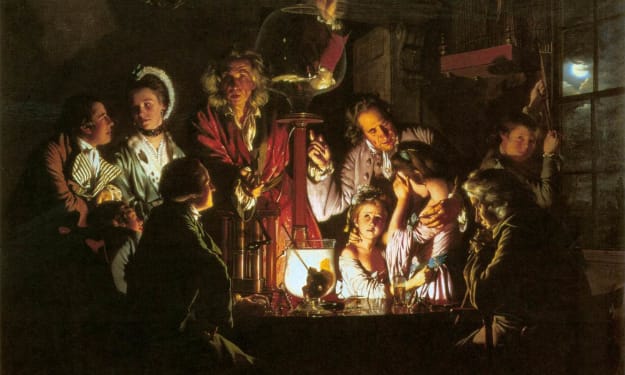
Three paintings by Joseph Wright of Derby
Joseph Wright (1734-97) spent much of his life in his birth town of Derby and is thus often referred to as “Joseph Wright of Derby”. He was an original painter who is generally renowned for his paintings that used science and industry for their subjects. He was, however, also an excellent portraitist and painter of landscapes. These three paintings were typical examples of his output
By John Welford5 years ago in Geeks
Joseph Wright of Derby
Joseph Wright (1734-97) spent much of his life in his birth town of Derby and is thus often referred to as “Joseph Wright of Derby”. He was an original painter who is generally renowned for his paintings that used science and industry for their subjects. He was, however, also an excellent portraitist and painter of landscapes.
By John Welford5 years ago in Geeks
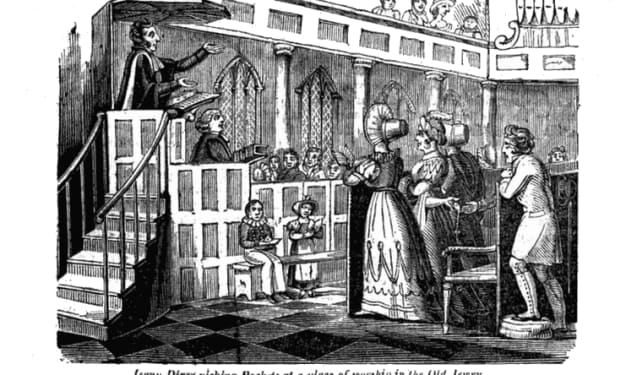
Jenny Diver: a clever London criminal
Jenny Diver was born in about 1650 and died on the gallows in 1710 after a lifetime of thievery, mostly in London, in which her cleverness at relieving wealthy people of their property excited a certain amount of admiration, although not from those who were her victims!
By John Welford5 years ago in Criminal
Jean-Henri Riesener, cabinet-maker to French kings
Jean-Henri Riesener was one of the finest cabinet-makers of his age, which, unfortunately for him, coincided with the French Revolution. The opulence that he played a major role in creating was fine for the court of King Louis XVI and Marie Antoinette, but when his aristocratic customers lost their heads, or at least their fortunes, his own fortune went downhill with theirs and he eventually died in poverty.
By John Welford5 years ago in FYI
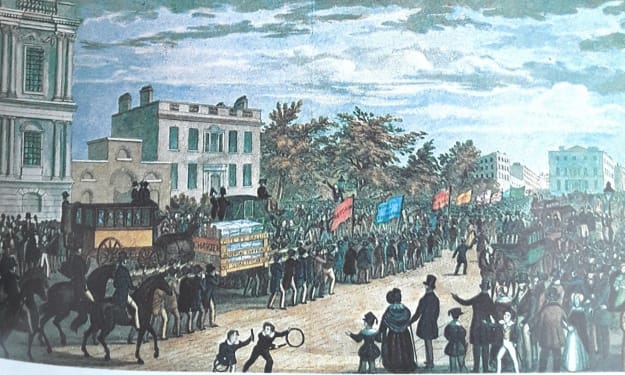
Chartism: a 19th century British political movement
Chartism was a working-class protest movement that was active in Great Britain during the 1830s and 1840s, with varying degrees of intensity. Its focus was on political reform as a way of addressing economic grievances, its premise being that with a fairer political system the victims of rampant capitalism would be able to escape their grinding poverty.
By John Welford5 years ago in The Swamp
How to read a Hertzsprung-Russell diagram
By using increasingly powerful telescopes, fitted with various instruments to analyse the quality of the light collected from objects such as stars and galaxies, and by making calculations based on their observations, astronomers down the centuries have been able to gather a considerable amount of information about a large number of stars and other objects.
By John Welford5 years ago in Futurism
What are human rights violations?
Once we fully appreciate what human rights are, we can understand what counts as a violation of them. We can, for example, turn to the Universal Declaration of Human Rights, formulated in 1948, and read a whole list of rights of individuals that governments are urged not to violate.
By John Welford5 years ago in Humans