John Welford
Bio
John was a retired librarian, having spent most of his career in academic and industrial libraries.
He wrote on a number of subjects and also wrote stories as a member of the "Hinckley Scribblers".
Unfortunately John died in early July.
Stories (501)
Filter by community
Lord Dufferin's ghostly encounter
Myths are extremely powerful. They have given rise to many religious movements and have thus played a massive role in the history of every country on the planet. But when it comes to determining how close the myth is to truth, huge difficulties arise. In one sense, this does not matter – what is important is how many people believe the myth to be true or are unwilling to dig too deeply in case their prejudices prove to be ill-founded.
By John Welford5 years ago in Horror
How the former planet Pluto got its name
In a sense, the planet Pluto had a short life, being discovered in 1930 but “demoted” to the status of “dwarf planet” in 2006. That life was exceeded at both ends by that of Venetia Phair (née Burney) who had a special claim to fame in respect of the planet.
By John Welford5 years ago in FYI
The British Empire
Every year, in September, the series of Promenade Concerts at London’s Royal Albert Hall reaches its last night and Britain suddenly rediscovers its patriotism. These days, we Brits are not much given to flag waving, but on the Last Night of the Proms (which is now extended to simultaneous events around the country and is broadcast live on TV and radio) there are flags a-plenty and enthusiastic renditions of patriotic songs including these lines from “Land of Hope and Glory”:
By John Welford5 years ago in The Swamp
How "green" is your diet?
An article in the “Times Magazine” (the London newspaper’s weekend colour supplement), posed some very interesting questions on the subject of whether we could all do a lot more to get our carbon footprints under control by adjusting our personal diets. The article was based on research in a book by Professor Sarah Bridle, an astrophysicist turned environmentalist, who has come up with amazing (and highly disturbing) facts and figures relating to the impact that our food choices make on global emissions of greenhouse gases, which in turn lead to global warming and ocean acidification.
By John Welford5 years ago in Earth
Why floods occur
Flooding of land and buildings causes enormous damage in many countries across the world, incurring vast expense as well as causing loss of life. Floods that occurred in England in 2007 led to 180,000 insurance claims, against which 3 billion pounds sterling was paid out (according to the review by Sir Michael Pitt). The 2010 floods in Pakistan affected 20 million people and there were at least 2,000 deaths. In Australia in 2010-11, according to the BBC, the area affected was as large as that of France and Germany combined.
By John Welford5 years ago in Earth
Is solar power the answer?
There is a sense in which all energy is solar energy. Every energy source we have on planet Earth derives originally from the Sun, although there could be arguments over those that depend on the heat trapped deep down in the Earth’s mantle and core. Every gallon of fuel you use started out as zillions of life-forms that derived their energy from the rays of the Sun.
By John Welford5 years ago in Earth
What is your escape plan?
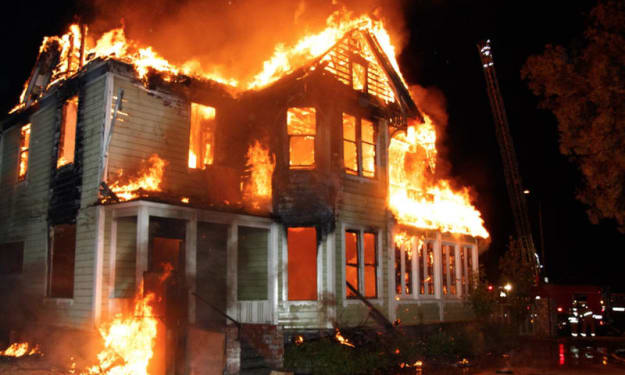
It is very important to know how you and your family would get out of your house in case of an emergency, such as a fire. Many lives have been lost because the inhabitants had not thought this through and therefore panicked when disaster struck.
By John Welford5 years ago in Lifehack
How flintlock firearms worked
The true successor to the matchlock firearm was the flintlock. In a matchlock weapon, a naked flame in the form of a smouldering piece of cord was brought into direct contact with gunpowder in an open pan, a process that was not only dangerous but unreliable. A far better method was to use friction to produce a shower of sparks that would do the job.
By John Welford5 years ago in FYI
We need to fly a lot less
It is well known that transport is a major contributor to greenhouse gas emissions, mainly due to the fact that most forms of transport are powered by fossil fuels, the burning of which leads to the release of carbon dioxide and other waste products, some of which are also greenhouse gases. In the UK, for example, 22% of greenhouse gases come from road vehicles.
By John Welford5 years ago in Earth