
Will U.S. Tariffs Push India Toward China? The High-Stakes Game in the Global Trade Arena
Washington’s new tariff strategy could drive India closer to BRICS allies—but lingering rivalries with China may complicate the shift.

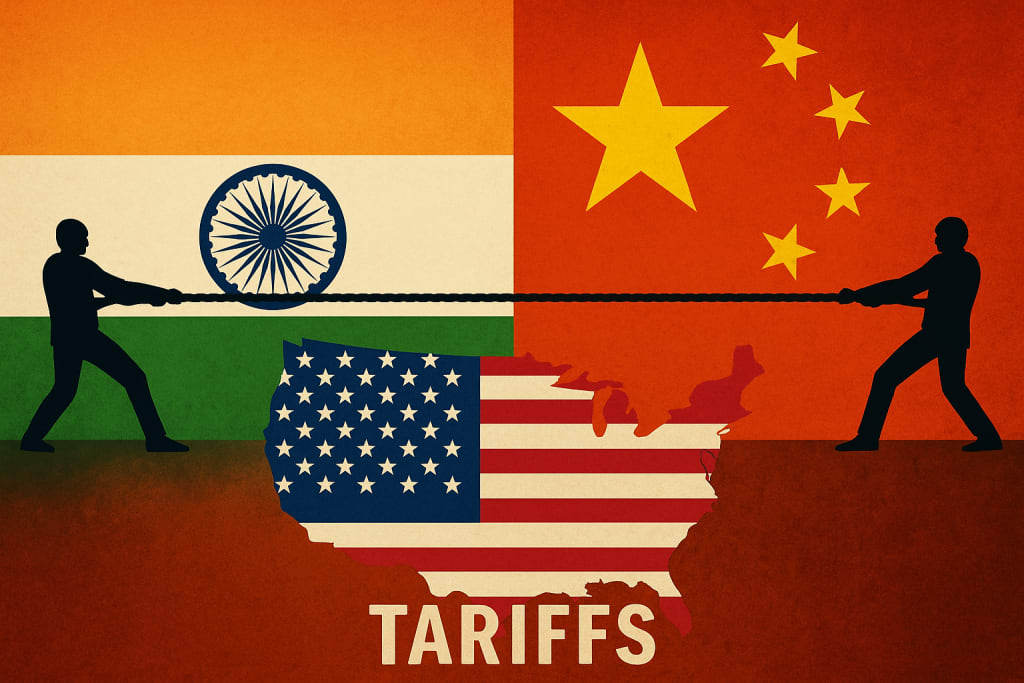
A New Chapter in Global Trade Tensions
The United States’ decision to impose significant tariffs on imports from multiple countries, including India, has sparked a wave of speculation about how New Delhi will respond. For decades, India has walked a careful line between East and West—deepening its economic ties with the United States while also engaging with other major powers like China, Russia, and members of the BRICS bloc.
Now, with U.S. tariffs threatening key export sectors, India faces a strategic dilemma. Will it lean more heavily toward its BRICS partners, potentially expanding trade with China? Or will deep-rooted political and security rivalries prevent any major shift in alignment? The answer is more complex than a simple yes or no.
The Economic Impact of U.S. Tariffs on India
The United States is one of India’s largest trading partners, especially for sectors such as:
Textiles and Apparel: India is a major supplier to U.S. retailers.
Pharmaceuticals: The U.S. imports billions of dollars in generic medicines from India each year.
IT and Services: India’s tech sector benefits from outsourcing contracts with U.S. companies.
Tariffs could make Indian products more expensive in the American market, reducing competitiveness. This would push Indian businesses to explore new export destinations, diversify supply chains, and invest in regional trade agreements.
China – An Unlikely but Possible Economic Partner
On paper, turning to China makes sense from a purely trade standpoint:
Massive Market: China offers a consumer base of over 1.4 billion people.
Manufacturing Synergy: India can supply raw materials and certain goods that complement Chinese production.
BRICS Platform: Both countries are part of BRICS+, alongside Brazil, Russia, South Africa, and newer members like Saudi Arabia and Egypt.
However, economic opportunity doesn’t erase political reality. India and China have a complicated relationship marked by:
Border Disputes: Skirmishes in Ladakh and tensions in Arunachal Pradesh.
Strategic Rivalry: Competing for influence in Asia, Africa, and the Indian Ocean.
Technology Concerns: India has banned many Chinese apps and scrutinized Chinese investments over security concerns.
The BRICS Factor – A Safe Middle Ground
Rather than aligning directly with China, India could use BRICS+ as a middle path. The bloc offers:
Trade Without Dollar Dependence: Expansion of local currency trade could shield members from U.S. financial sanctions and tariffs.
Shared Infrastructure Investments: Development projects that bypass Western financial systems.
Collective Bargaining Power: A larger say in setting global trade rules.
Through BRICS, India can increase trade with Russia, Brazil, South Africa, and Gulf members—strengthening its global position without appearing too dependent on Beijing.
Potential Rifts Within BRICS
While BRICS presents opportunities, it also carries the risk of internal friction.
Leadership Rivalry: Both India and China aspire to be the voice of the Global South.
Geopolitical Differences: India maintains strong ties with the U.S., Japan, and Australia through the Quad, while China is more closely aligned with Russia and Iran.
Economic Competition: Both countries target similar export markets in Africa, the Middle East, and Southeast Asia.
These dynamics mean that while India and China may cooperate within BRICS, they are equally likely to compete for influence.
India’s Balancing Act – Avoiding Overdependence
India’s foreign policy strategy is rooted in multi-alignment—the idea that it can engage with multiple power centers without committing exclusively to one. In response to U.S. tariffs, India is likely to:
Expand Trade with BRICS Partners: Boost exports to Russia, Brazil, South Africa, and Gulf states.
Negotiate Better Terms with the U.S.: Use tariffs as leverage for improved trade agreements.
Explore New Asian Markets: Deepen economic cooperation with ASEAN nations like Vietnam, Indonesia, and Thailand.
This approach allows India to cushion the blow from U.S. tariffs while maintaining strategic flexibility.
The Role of the United States – Risk of Pushing India Away
The U.S. has invested heavily in building a strategic partnership with India over the past two decades, particularly in the context of countering China’s influence in Asia. Tariffs, however, risk undermining that relationship.
If Washington pushes too hard, India may:
Strengthen its role in BRICS trade initiatives.
Participate more actively in non-dollar payment systems.
Increase cooperation with countries seen as counterweights to U.S. dominance.
While India is unlikely to fully abandon its U.S. ties, sustained economic pressure could gradually shift its center of gravity toward alternative alliances.
China’s Strategic Calculations
From Beijing’s perspective, U.S. tariffs on India create both risks and opportunities:
Opportunities: China could offer India favorable trade terms within BRICS, investment in infrastructure, and partnerships in manufacturing.
Risks: Greater Indian economic strength could make New Delhi a more formidable rival in Asia.
China’s challenge will be finding ways to integrate India into cooperative frameworks without fueling its geopolitical anxieties.
Could a Rift Between India and China Still Emerge?
Absolutely. Even if economic cooperation increases under BRICS, unresolved disputes could cause tensions to flare up. Possible flashpoints include:
Border Tensions: Any military incident could derail trade talks overnight.
Influence in the Indo-Pacific: Competing naval strategies in the Indian Ocean.
Global Leadership Ambitions: Disagreements over who should represent BRICS on the world stage.
Such rifts could slow down or reverse any economic gains achieved through cooperation.
Conclusion – Cooperation, Competition, and Caution
U.S. tariffs on India are reshaping the trade chessboard, but they won’t automatically push India into China’s arms. Instead, we’re likely to see:
More trade within BRICS+, especially with members other than China.
Selective cooperation between India and China in areas where mutual benefit outweighs rivalry.
Continued balancing between Eastern and Western power centers.
In this high-stakes environment, India’s best strategy is to remain flexible—maximizing short-term economic opportunities while avoiding long-term dependence on any single partner. For the U.S., the message is clear: economic pressure may yield short-term gains, but it risks weakening the very alliances that underpin its global influence.
About the Creator
INAM ULLAH
Inam Ullah, BS in Computer Science and MS in Wireless Sensor Networks. Passionate about blogging, history, wars, and science. A lifelong learner with a curious mind and diverse interests.
Keep reading
More stories from INAM ULLAH and writers in Trader and other communities.
The New Trade War: How U.S. Tariffs Are Reshaping the Global Economic Order
The Shockwave from Washington In a move that has sent tremors through the global economy, the United States has imposed sweeping new tariffs—some surpassing 10%—on imports from over 60 countries, including some of its closest allies. Billed as a bold step to protect American industry and jobs, this policy shift represents one of the largest trade upheavals in a century.
By INAM ULLAH7 months ago in Trader
Australia Data Center Market Growth, Forecast, and Strategic Insights by 2034
The rapid growth of digital technologies has transformed the way businesses store, process, and manage data. As companies across industries rely increasingly on cloud computing, artificial intelligence, and digital platforms, the demand for reliable data storage and processing infrastructure has surged. This shift has positioned data centers as one of the most critical components of modern digital economies.
By Amélie Belle5 days ago in Trader
The First Rainbow Baby
Pitter-patter, pitter-patter. The rain fell in rhythmic splatters, slowly slowing, but still constant. Mira rolled onto her side pulling the blanket tight against her ears, but still she could hear chitter-chatter and scurrying feet of the creatures that refused to sleep in the lower decks.
By A. J. Schoenfeld3 days ago in Fiction




Comments
There are no comments for this story
Be the first to respond and start the conversation.