Ian Sankan
Bio
Writer and storyteller passionate about health and wellness, personal development, and pop culture. Exploring topics that inspire and educate. Let’s connect and share ideas!
Stories (124)
Filter by community
The World's Deadliest Toxins
The plot is right out of a Bond movie. Georgi Markov, a communist defector from Bulgaria who worked for the BBC, felt a minor sting in his right thigh on September 7, 1978, as he crossed Waterloo Bridge in London. A man was picking up an umbrella off the ground when he turned to look behind him. He'd gotten a temperature by that evening. He died four days later. Poisoning was the cause of death. An umbrella modified to launch a pellet laced with ricin, one of the most potent naturally occurring toxins in the world, has been used to kill Markov. Unfound in animals, ricin is one of the most lethal natural chemicals. It is located in castor plant beans. Just 500 micrograms of this substance, or 5/10 000 the weight of a paperclip, is sufficient to kill an adult male. And despite its strength, ricin isn't anywhere close to becoming the most lethal natural poison on the planet. It's not just in exotic, tropical locations or, say, 1970s London where poisons can be found; they can be found everywhere in bacteria, plants, and fungus. They are essentially everywhere, and they are there for excellent reasons. But what about their molecular composition makes them so toxic? How do their chemicals assault the human body so effectively and fatally? Why does my leg start to tingle out of nowhere? Is that an umbrella? It would be morbid and all but impossible to enumerate the most lethal toxins found in nature. There are numerous plants, fungi, and bacteria that can kill you if consumed, inhaled, or injected. Additionally, there are many variables, making it challenging to determine an object's exact level of poisonousness. The potency of a chemical might vary depending on a variety of factors, including the victim's age and the presence of antibodies in your body. One exception does exist, though. There is no denying that the minuscule bacteria Clostridium botulinum produces the most deadly chemical known to man, natural or otherwise. The sickness it produces, botulism, is usually what you know about it. How dangerous is botulinum toxin? One technique used by professionals to gauge a poison's lethality is the "Lethal dose 50%" method, which determines the dose needed to kill 50% of the test population. Since it should go without saying that humans cannot be used for these experiments, toxicologists typically utilize the laboratory mouse to determine this value, which is frequently referred to as the LD50. The botulinum toxin's LD50, which is calculated as milligrams of toxin per kilogram of body weight, is around one nanogram, or a billionth of a gram, per kilogram. It follows that 9,600 people might be killed by a single sand-sized botulinum crystal. The bacteria are quite widespread, and the spores they release are found in water and soil all over the planet. They become an issue once they become active cells because at this moment they start to create seven different poisons, four of which are fatal to humans. The ten to thirty cases of C. botulinum reported annually in the United States are typically brought on by eating inadequately canned food because canning eliminates air from food to preserve it. The spores, however, may linger and establish a home in that can of Texas chili if the meal is not heated through thoroughly. Additionally, botulinum spores can be discovered in honey, where they can find a cozy spot in your body with no oxygen to keep them company. Children and adults can fight off these spores before they germinate, however, infants are unable to do so, thus babies under the age of 12 months should never consume honey. Because they release a neurotoxic as a waste product, the spores are toxic. It inhibits the release of acetylcholine, a neurotransmitter that regulates muscular contractions, to operate. This causes the victim's entire body to effectively become limp. Without antitoxin, the person will asphyxiate within a few days from a lack of oxygen. However, an antitoxin does exist, thanks to science and all those unlucky lab mice. But why, in Mathieu Orfila's name, would a bacterium evolve to fart the most lethal poison into its host? The solution is still unknown. One hypothesis is that the poisons target rival microorganisms rather than the host. They produce conditions where good bacteria cannot survive, allowing the bad bacteria to proliferate. This process is frequently simply impeded by the host, in this case, a human. Cyanide is thus similar to eating play dough in comparison to botulinum toxins. Not really, I guess. Never consume cyanide! It is one of the world's fastest-acting toxins and will not just kill your face. A surprising amount of natural foods, like almonds and the seeds of apricots and apples, as well as burning plastics and cigarette smoke also contain it. 6.4 mg per kg of body weight, or over 6 million times less lethal than botulinum, is the lethal dose (LD50) of sodium cyanide, a typical type. However, from Agatha Christie to Emperor Nero, it has been a well-liked and reliable means of execution. A triple connection between a carbon atom and a nitrogen atom forms cyanide. It binds to proteins in your cells' mitochondria, the microscopic power plants that keep your cells functioning, and prevents them from utilizing oxygen, thus asphyxiating the body at the molecular level. This is what makes it such a quick killer. The presence of cyanide in various fruits and nuts is true. For instance, the chemical included in apple seeds reacts with digestive enzymes to release cyanide. If you're a fruit, this is a great strategy to prevent animals from eating all of your seeds, but there isn't sufficient poison to kill either the animals or us. However, I suppose I wouldn't deliberately consume anything like a bowl of apple seeds. The positive aspect is that there is always vitamin B12 available if you end up with cyanide poisoning. High dosages of a precursor to the vitamin can physically pull the cyanide off of your poisoned mitochondria, after which you merely pee out the poison in the form of B12, which is why the B12 that you buy at the store contains cyanide as part of its fabulously intricate molecular structure. We will now return to our Bulgarian friend. The castor plant that caused his death is the next item on our list. Although it is indigenous to East Africa, it can be found growing in most warm climates, including the southwest United States. Castor beans contain ricin, a toxin that is produced by them. However, the actual poison is made from the mash that remains after the beans are ground into the oil. The ricin protein changes shape or denature when the oil is heated, rendering it harmless. This prevents the poison from getting into the oil, which is commonly used as a laxative. maybe it once was. not as much any longer. Result gross. Untreated ricin, however, quickly enters the body's cells when inhaled, consumed, or injected. When it gets inside, it deactivates the ribosomes, which generate the proteins your cells require to survive and multiply. When the protein train comes to an end, life comes to an end. As it kills the cell, a single ricin molecule can inactivate 1,500 ribosomes each minute. Although you might see the effects right away, ricin typically has a gradual poisoning impact that takes one to three days to kill you. Because of this, it has become popular among assassins over the years who seek to absolve themselves of their crimes. There were two extremely small passages bored into the tiny platinum plug that was discovered in Markov's leg, and each one could store roughly 1/5 of a milligram of the poison. To eliminate Markov or any other person, however, that was more than enough. And ricin's toxicity might vary based on how it reaches the body. Its lethal dose (LD50) when consumed orally is approximately 20 milligrams per kilogram of body weight or the equivalent of 8 castor beans, but when administered intravenously, as Markov did, it is only 1 minuscule microgram per kilogram. Since ricin takes several days to kill, chemicals that can prevent it from reaching ribosomes in newly formed cells in the body are being researched. Sadly, there are currently no effective antidotes for ricin. And interestingly enough, ricin is also being researched as a potential cancer treatment due to its capacity to drive cells, including cancer cells of course, to self-destruct by activating a protein-stopping mechanism. presently, if you ever come into a strychnine tree—yes, there is such a thing—stay as far away from it as you can. It is a native of Southeast Asia and India, and while its bark contains the poison brucine, the main lethality of the tree comes from its spherical, green to orange fruit, which includes the alkaloid strychnine. Strychnine's fatal dose (LD50) when taken orally has been determined through tests on sad pigeons and sad rats, putting it at the same level of lethality as ricin. The danger here, however, comes from a neurotoxin that affects the spinal cord nerves that regulate muscular contraction. Fundamentally, it suppresses the molecules that regulate nerve messages to muscles. Strychnine works by preventing that chemical, which causes your muscles to be constantly stimulated and cause convulsions that can lead to exhaustion as well as respiratory failure in as little as 30 minutes. This does not seem like a good way to go. A trip to the kingdom of fungi would round out any list of natural poisons, even if only a small portion of its hundreds of species are deadly. These poisonous species contain amatoxins, which are toxins that rival botulism in potency. The two most hazardous of these mushrooms have the not-exactly cryptic names of Death Cap and Destroying Angel, and they carry the most deadly poison of its kind, known as amanitin. Mushrooms that contain amanitin have an oral LD50 of 0.1 to 0.2 milligrams per kilogram. Thus, the amount of death is at least 30 times more than strychnine. In essence, amatoxins are rings of amino acids that obstruct the enzymes that, once again, are in charge of producing the proteins that provide life to your cells. However, in this case, they exclusively target the liver and kidney cells. They are particularly dangerous because victims don't experience symptoms for 6 to 24 hours after ingesting them; instead, they wait until their liver and kidneys start to fail and cause vomiting and diarrhea, which are frequently misdiagnosed as the flu in emergency rooms and contribute to the poisoning's high mortality rate. Immigration from Asia, where these specific species of fungi aren't found and instead have quite edible lookalikes, is to blame for the majority of these fatalities in the United States. Massive dosages of milk thistle extract, which include compounds that prevent the toxin from being absorbed by liver cells, can avert the worst harm in instances that are detected in time. But in the worst circumstances, a liver transplant is the only thing that can save the victim. I should stop now since I'm simply absolutely nervous about everything, from odd men with umbrellas to all of the once-beautiful mushrooms in the globe. The good thing is that scientists have been hard at work creating anti-toxins for these most dangerous natural compounds, and lab mice have been studying them, so if we do come upon one of them, we might not die. And in a small number of circumstances, these incredibly poisonous compounds might potentially be employed to save humans in the future by destroying cancer cells.
By Ian Sankan3 years ago in Earth
Even roaches Hate Locust Plagues
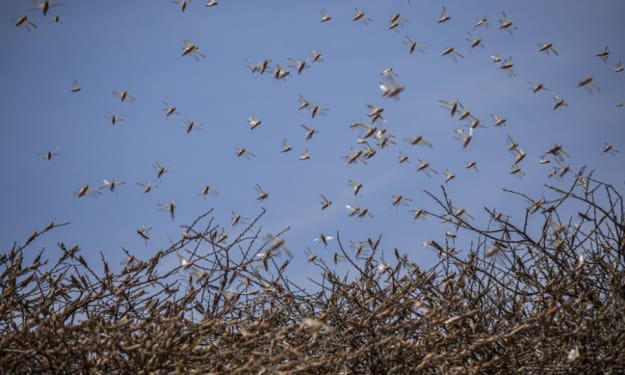
The Hebrew Bible outlines a plague of locusts encompassing the ground and eating everything in view and in the thousands of years because then they haven't truly let up locusts still routinely devastate crops in a lot parts of the world especially Africa and Asia in actuality they are thought to impact the food supply of one out of 10 individuals in the world but those Locust forms may be just as discontented about what they're doing as we are since according to some investigators a locust swarm is just a bunch of insects fleeing for their lives from one another locusts typically prefer to be on their own but sometimes they get jointly with other locusts kind of like college students on spring break and set about eliminating everything in sight and local storms are pretty complicated with swarming individuals undergoing shifts in behavior neurophysiology and also color there may be millions of locusts in one swarm and they can move thousands of kilometers stripping each leaf from every plant that gets in their way but they fail to just eat plants they will additionally eat each other which indicates that swarms aren't just terrifying for individuals they are also frightening for the locusts and even though Locust swarms have endured plaguing humans for thousands of years we still do not really know why they swarm what we do understand is as the population of locusts in a specific area increases they lose their choice for solitary living scientists do have some theories There are a number of reasons why insects may engage in cannibalism during swarms, but one of the most well-supported has to do with their propensity to eat one another. Insects are more prone to being eaten right after moulting, so if there are many molters in the group, that may encourage cannibalism. Additionally, when you're in a swarm, you have more chances to reproduce mating, which means you need lots of nutrients, which Swarming may genuinely be driven by behaviour, at least some of it. In 2012, researchers made the decision to build a computer simulation of swarming locusts. Computer-generated locusts were programmed to keep a minimal distance from other locusts, but they were also made to react to how quickly other locusts moved in their direction or away from them. As the simulation continued over several generations, behaviour might also change as certain locusts acquired behaviours that made them more probable to be eaten because they accrued rewards when they contacted other locusts and costs when they encountered by other locusts. When there were fewer of them, others were more inclined to conduct the eating, but computer-generated locusts would disperse and avoid one another. The avoidance behaviour at low concentrations and the swarming behaviour were induced by their propensities to chase and/or avoid one another, which prompted them to all go in the same direction. High-density behaviour could share the same overarching goal. If this is a good representation of reality, both behaviours assist in preventing individual locusts from being consumed. Locus Behavior it means that all the agricultural destruction that implies a locust swarm might not be so a great deal the purpose of the Swarm as a mere opposite effect so basically humans and locusts could be saved from a lot of issues if Locus could just embrace the strength of friendship research from 2023 though indicates it may not all be kill or be killed locusts may have a way to safeguard themselves from other locusts when they're swarming which may be why swarms don't just eat themselves into Oblivion prior to they can do any real damage in the Swarm phase and only in this form phase some locusts generate a pheromone called phenol acetonitrile or pan when scientists utilised genome editing to remove an enzyme responsible for making pan cannibalism in the Swarm headed up this means pan may be like a fail to eat me signal in other words locusts that produce the chemical are less likely to get eaten the study done so far doesn't totally clarify cannibalism and storming Behavior but it's a good begin and it does show that there might be a chemical way to end swarming by combating pan or inducing locusts to stop creating it for example at least the researchers say they'd like to appear into it they think that this may stop swarming behavior before it nonetheless starts by making the locusts simply eat each other rather of every plant in the vicinity not so excellent for the locusts but I think at least 10 percent of individuals out there would say it's a strategy worth going for.
By Ian Sankan3 years ago in Earth
How Unconscious Things Became Aware: The Origin of Consciousness
Perhaps the biggest mystery in nature is consciousness. When reduced to its purest form, consciousness is what enables us to be aware of both our external environment and our inner condition. However, contemplating consciousness tends to lead us in circles. Intuitively, we are all aware of what consciousness is. This is it. You are currently going through it here. But as soon as we attempt to nail it down, we find ourselves grasping at air. We're not the only ones who struggle to define consciousness; scientists and philosophers do too. Thoughts and schools compete with each other, but none has figured it out yet. Realizing that we don't know what causes us to be conscious of ourselves as well as the outside world is disconcerting. Even though they are not the same, intelligence and awareness are likewise associated in this hazy area. In later videos, we'll go into more detail about theories of consciousness and intelligence. Our mind presumably evolved from less complicated forms as a result of natural selection, much like many other aspects of what makes us human. It most likely came into existence over a long succession of micro-steps that lasted for more than 100 million years and combined to form a kind of gradient of consciousness. What was the initial step on this journey from non-awareness to fundamental consciousness, which eventually evolved into the complex consciousness we experience as humans today? [Intro] Pick up a stone. The general opinion is that a stone is not thinking. But even on this, not everyone agrees. Some panpsychists assert that a piece of rock might have a soul. However, as stones never exhibit behavior, there are no actual justifications for any such claim. It is impossible to confirm or refute their inner lives. Starting with live things is a more frequent starting point. An element of the world known as a living creature or a self maintains itself and produces more of its kind. It needs energy for this. So this is where having a global perspective is useful. The primary purpose of consciousness was likely to guide a mobile self in need of nourishment to a fresh source. You do not require to be conscious to find food on the lower scales of existence. One of the most basic mammals, Trichopax adhaerens, wanders around aimlessly. When there is food nearby, it slows down, and when there isn't, it speeds up. This is successful and causes the little creature to spend greater amounts of time where there is food than where there isn't. However, it never advances in a specific direction toward a specific destination, and it is not required to be aware of its surroundings. Mobile self likely took their first significant step towards consciousness when they began to move in a particular direction. Moving away from what was less desirable, such as someone else who believed they were food, and towards what was better for them, such as food. Consider Dugesia tigrina, a tiny worm distinguished by a comical visage. The worm may or may not be hungry at any one time. This implies that when the worm self moves, it is not only responding automatically to external stimuli; rather, the worm self's movements are determined by its internal, physiological condition, such as whether it is hungry or full. The worm is less active after being eaten, but after going without food for a period, it will crawl toward appetizing objects. It navigates its environment by using chemoreceptors on its head to detect the fragrance of food and point it in that direction. When our worm friend finds and consumes a meal, it returns to a dark, protected area to safely digest it until it becomes hungry again. However, animals who follow their sense of smell irrationally don't have a clear goal in mind. They are still clueless as to where they are going. The addition of distant perception like vision is the next rung on the ladder of awareness. Vision gives our world more context and richness. Vision gives us a feeling of the environment in which we and our food are located. It greatly expands awareness and moves consciousness closer to more common consciousness. We can visualize and focus on our objective with the use of an optical device, like an eye. A self can only pursue its food while it is visible, even at this stage. The logical next step must therefore take place internally. For instance, a self must construct some kind of internal model of the outside world to visualize food absent from it. An animal can now keep searching for food even after leaving its sensory range. It can keep its attention on its food and its hunger for it because of its internal picture of what is important in the outside environment. Now that it exists, we can settle into this new environment. The memory capacity has developed. Animals can be briefly diverted from the pursuit due to memory, but they swiftly resume their course afterward. 'Object persistence' is a related phenomenon. This expresses our understanding that things exist even when we are unable to see them. Some mammals, birds, and maybe other species enjoy using this cognitive ability. Baby chickens begin to demonstrate this skill within a day or two of birth, but human infants often begin to do so around the time they are eight months old. The ability to recall something while it is not there shows at least a fundamental understanding of time. On the path to consciousness, having a sense of time is a significant step. It could also provide someone the ability to look ahead from the present and anticipate the future. Adult chickens, for instance, might avoid being served food if they believe they will eventually be rewarded with a larger meal. Even for mature humans, this type of delayed gratification requires the ability to picture a reward that won't materialize for some time. Western scrub jays are masters of postponed pleasure. When they bury food in a cache to collect it later, they exhibit an even more sophisticated sense of the future. If the scrub jays suspect a possible burglar has been monitoring them, they may even rehide their food. This implies that they are aware of other hungry selves who are conscious and have a unique view of the world. Scrub jays are cunning birds that can almost read the thoughts of other birds. Deeper levels of consciousness need to be able to read minds. You may outsmart a wealthy rival or relate to a hungry friend by placing yourself in their shoes. Language allows us to portray what is missing and read minds at a whole different level. We may create elaborate plans and theories about the world using words, and we can share those plans with others. We'll be thinking more about our awareness in upcoming videos, as well as about who we are, where we fit in the cosmos, and other things thanks to words. So where does our consciousness come from? It presumably started as a hungry person moving deliberately in the direction of a food source. With the advantages for survival, this gave it an advantage over rivals who moved randomly or not at all. It all most likely began with the need for more food. Because of this, it is not strange that humans are constantly worrying about where we will acquire our next food despite having a complex mind that enables us to fantasize about space, construct skyscrapers, or get obsessed with books. We have collectively invested so much thought and creativity into obtaining food that we can now do it with minimal conscious effort.
By Ian Sankan3 years ago in Psyche
72-hour imprisonment with 72 venomous snakes. Content Warning.
I will share a tale of a man who chose to spend 72 hours in a room with snakes. He didn't do it for the thrill, don't worry. He did it to demonstrate that snakes aren't only the stuff of nightmares. In his opinion, most of them are just toothy introverts. It's important to note that the top 10 phobias include a fear of snakes, which is not surprising given that some snakes can quickly send you to the hospital, whether due to a primal defence mechanism or just because of a genuine hate of snakes. Critters Let's face it, snakes aren't precisely on our list of ideal pets, but this particular Indian man decided to face his general phobia head-on to make room for our thrilling story's protagonist, a 28-year-old desk clerk working at a Puna hotel in India in 1986. As luck would have it, heed was forced to deal with snakes during his shifts that had been blocked in the hotel for their vacations, and when he thought back to those times, he remembered feeling sorry for the snakes, which he described as gorgeous beings. yikes why since he said most of these reptiles were ineffective so he started transferring them to some nearby Hills one time he had to drive all the manner to an Institute in Bombay to deliver a snake only to discover out that his unlikely travellers was quite the dangerous type did he discover this experience terrifying completely not it only fed his desire to study and understand these beings even more sure he claimed to have performed an amazing 25 000 snake removals but admitted to receiving only about 6 000 bites a number that renders you think twice regarding his idea of acceptable now here's the really intriguing part this man upon hearing about a courageous South African person who pulled a 50-hour chill session with 24 snakes felt the desire to one-up him aim to offer the world record trophy to his own nation so he built a glass cage with a comfy chair for the ultimate snake occasion his preference of roomies for the afterwards 72 hours was a jaw-dropping gathering of over 70 snakes featuring cobras vipers banded Crites and a bunch of prevalent snakes too just a the heads up about 60 of them were quite capable of causing him harm Despite these improbable circumstances, our Valiant Heroes persevered in his glassy chamber for three days while being observed by a Guinness World Records official. He outperformed the previous record holder and proved his point that snakes are Zen Masters unless disturbed by gently moving the snakes around his private quarters without receiving a single bite in retaliation. Amazingly, this risky stunt made him even more obsessed with these arachnids. Isn't it amazing how some people can transform our perception of particular animals? Our Hero's dedication to these slithery Pals was so significant that a newly discovered snake was chosen to bear his name as a forever gesture of gratitude. Take Dr Jane Goodall along; we must return to 1960 to hear her story. Little did she know that she was on the verge of becoming a renowned Legend before seeing her 27th birthday in her childhood; her days were filled with a super-sized serving of animal love and an irresistible curiosity about Africa. At the time, she was just a 26-year-old chilling out in the wild and windy expanses of Tanzania's Gambay Stream National Park on a mission to cuddle up with a group of chimpanzees. In her twenties, she received an unexpected invitation from a former playground friend who took her on an African Adventure in Kenya. Other researchers and animal lovers quickly realized that she had a zen-like patient perfect for hanging out with chips and researching the origins of human behaviour. So our heroine found herself playing Gombe with wild chimpanzees and peek-a-boo with them while accompanied by her mother as a devoted sidekick. She was only equipped with a pen, and a brief six-month safari turned into a wildly epic 26-year saga of spending time with some of our closest living primate cousins. Jane discovered ground-breaking insects throughout her research, from the Artistry of Chimp Nest construction to their Eden preferences. She also rewrote the Chimp Playbook. Jane's methods were a bit unusual for the time; she even named The Chimps she observed rather than simply numbering them. Her most significant finding about chimpanzees is that these extremely cognitive monkeys employ tools in their daily lives. For example, chimps use stones to open nuts, so they may easily consume them. Jane also observed that chimps are lively, more outgoing than other primates like gorillas or orangutans. They love company and thrive in laid-back groups, sometimes called communities. Most chimps collect around a grown male specimen within a particular region. The sizes of these chimp families are comparable to that of humans, with some ranging from just 20 members. Jane also discovered that contrary to what was believed then, chimps weren't vegetarians. Scholars were less interested in modern creatures, but their research is excellent. To meet Mary Anning, the rock star of the fossil world, we must travel back to the late 18th century. Mary Anning was born in a charming seaside village in Dorset, England, and it was here that she compiled the list of fossil finds long before the films made dinosaurs cool once more. Mary didn't live a life of luxury because her family wasn't very wealthy, but that didn't deter her from pursuing her aspirations. Young Mary accompanied her father, Richard, a hobbyist fossil enthusiast who made furniture to help pay the bills, on his beach treasure hunts. Mary didn't spend much time at school either, but don't let that fool you; she had the intelligence of a university professor; she taught herself to read and even earned a degree in geology and anatomy; soon enough, Mary became the family's living fossil provider to pay off debt; fortunately, her hometown was rich in ammonites; these creatures were similar to the Sea World Super Ancient with stylized bodies. Shelly overcoats at some point in their lives, these creatures got stuck in the mud, and over time, their bodies left a shell-shaped imprint on the ocean floor. This cool natural bookmark eventually got a mineral-filled makeover and became a stone version of our cool ammonite in 1811. Mary's brother also discovered a strange-looking fossil skull in 1811. Mary then took on the task of uncovering the 17-foot-long skeleton and creating a monster-finding rumour. Mary pulled another rabbit out of her hat in 1823 when she discovered the first complete skeleton of a Plesiosaurus. This discovery was so extraordinary that some sceptics called it a hoax. Scientists initially believed it was a crocodile that got lost and concluded up endorsing Mary's mysterious fund. It was examined, argued over, and finally determined to be the ichthyosaurus or fish lizard we now know it was. However, Mary wasn't finished. In 1828, she displayed the bones of a long-tailed, wing-equipped creature, causing a sensation from London to Paris and marking the discovery of the first pterodactyl outside of Germany.
By Ian Sankan3 years ago in Horror
What About the Real Motive Behind Our Lack of Ocean Exploration?
Ever wonder why, despite our scientific and technological progress, there is so much of our world that we still know so little about? Over 80% of our seas are still unexplored. Why is this enormous body of water that covers most of our Planet also one of the most vulnerable and misunderstood areas in the universe? Pressure has a lot to do with it. Did you know that only about seven per cent of the world's oceans have a special tag called marine conservation areas or maps? We have this enormous aquatic playground in our backyard, but we've barely scratched the surface. Our deep ocean is a terrifying region with zero vision, subfreezing temperatures, and pressure so high that, in some places, you'd think you weighed fifty pounds. jumbo It makes sense that sending humans into space is easier than sending them to the ocean's bottom if you have jets on your body. the deeper you go into the waters the more stress piles up but let's not forget we have Tech on our side right researchers now use these cool satellite technologies that monitor the color of the ocean to examine how much phytoplankton is there for instance why is this important you might ask since these little plant-like Critters are genuinely pretty major players in our big blue oceans in the grand system of things in the Aquatic World phytoplankton is such as the Bedrock of the ocean food chain it provides Life to almost everything from the tiny zooplankton that are animal-like microorganisms to those colossal amazing whales when these Technologies first came within satellites could get clear images of the ocean faster compared to a ship could take the same number of measurements in 10 years but it's not all regarding looking at the ocean from space at times you gotta dive in there and see it for yourself gratefully we've come a long way in Ocean investigation Tech too we've got things like floats and Drifters that ride the ocean winds while collecting data and a whole Fleet of underwater Vehicles a few of which are manned some remote controlled and some even autonomous recall James Cameron the guy who made the movie Titanic he's super into examining the ocean and in 2012 he established a record by going down to the Mariana Trench in a vertical torpedo sub he believes there's nothing like being in the ocean and experiencing it firsthand Other companies use a variety of technologies for their ocean explorations, which has allowed them to find amazing things like the only deep sea coral reef in the Mediterranean Sea near Morocco. They have also discovered new species and documented ones thought to only exist in the Atlantic. These efforts have persuaded the local authorities to designate some locations as Marine Parks, but the road is challenging. We can't always rely on bathymetric information, which refers to the study of the ocean floor, because it's frequently unavailable, and that's the tricky part because it's not always available. We need to explore more to learn more, but raising money for these kinds of projects can be difficult when there are so many unknowable variables. The explorations of one particular company have so far assisted in protecting nearly 4 million square miles of ocean. The data they gather during their expeditions is invaluable; it is used to locate vulnerable habitats, identify new species, and even highlight areas where threatened species are being disregarded. Their work helps disprove justifications from local authorities who assert they lack the knowledge necessary to establish more marine protected areas. The same organisation supports the 30 by 30 initiative, which aims to safeguard 30% of our oceans by 2030. We must set aside areas for protection and research regardless of whether we don't have all the information just yet. On that note, some cool scientists have recently discovered a massive and Mysterious World beneath the Pacific Northwest Coast's ocean floor. The best part is that this massive realm of Life is essentially cut off from the rest of the Planet. Scientists call this type of Life chemosynthetic, which sounds complicated but simply means chemical reactions sustain Life. This type of Life has been found deep within the Earth and around seafloor hydrothermal vents. These tiny creatures aren't like you or me; they don't depend on sunlight or the organic products of aquatic and terrestrial ecosystems for sustenance instead. The team that discovered this finding included a geomicrobiologist from Denmark. The size at which these creatures are located beneath the oceanic crust is unparalleled; it may even be the most comprehensive ecosystem on Earth. He asserted that the oceanic crust, an average of four miles deep and makes up over 50% of our Planet's surface, is enormous; consider the magnitude of the chemosynthetic party taking place there. Since the 1990s, scientists have noticed strange, tiny holes in the basalt rocks that comprise a large portion of the Earth's outer crust. These holes appear to have been made by bacteria, but hey, there was supposed to be no life there; after all, imagine trying to survive in a place that's hot, dark, dense, and largely devoid of the organic compounds we require to sustain Life, yet here they are. Over the years, more puzzle pieces came together, and scientists made this discovery. Basalt After then, researchers wondered how long this Life would last. Drilling far below the ocean's surface, geologists obtained crust samples from a plate 120 miles off the coast of Washington. What they discovered down there was amazing. the Life down there runs on a distinctive fuel hydrogen yep in the lack of sunlight hydrogen offers the energy for all their biological processes these microbes use hydrogen to change carbon dioxide into organic have significance this matter and other byproducts like methane then fuel other organisms producing a network of light of obviously the Life down there isn't as complex as the one we understand up here scientists uncertainty there will be any multicellular life under the ocean since it's too hot and energy poor but hey who understands this universe under our oceans nevertheless has a lot to reveal this whole thing is important for many reasons first it indicates that Life can exist in places without oxygen which shifts our perspective on where we can find Life this makes us speculate if Life could exist under identical conditions on other planets where surface circumstances might be too harsh the implications on Earth are also significant if a large portion of Life exists in the oceanic crust then our comprehending of Life on our own Planet could be completely changed This fascinating Discovery pushes the boundaries of what we know about Life and encourages us to continue penetrating the enigmatic depths of our oceans. NASA is involved in the deep sea investigation project as well, so why shouldn't they be focused on space because they want to learn more about the possible characteristics of the oceans on other planets? NASA experts are highly optimistic that through uncovering undersea secrets, we will find answers to some of the key space-related mysteries, and they are also testing some cool technology for future trips across the solar system.
By Ian Sankan3 years ago in Earth
Consider the Reality That Crocodiles Haven't Changed in Millions of Years
If you ever got an an opportunity to travel back in time you know way back you would probably not be able to understand many animals but certainly you'd know the crocodilians caimans alligators crocodiles cereals and other associated species have barely transformed since the time of dinosaurs so why did they stop developing and did they really crocodilians have endured around for about 85 million years and they had diverse ancestors that developed to be even earlier over 205 million years ago all these ancestors are jointly known as crocodilemores many of them created their first appearance in the late Mesozoic as well as early Cretaceous periods and actually evolved pretty quickly there were all kinds of Crocs back then from earthly to water dwelling and even vegetarian ones yeah one kind looked a lot like its modern relatives with the only variance being that it was two times as long as a giraffe is tall there there were also some smaller kinds with mammal-like teeth and Crocs with tusks as well as super armor so where did all that diversity go and how did Crocs we know right now manage to stay alive well it all has to do with the way crocodilians have evolved we normally see Evolution as a the amount of gradual changes that take place over a long period of time but scientists suggested a theory that says Evolution doesn't always work like that they call this Theory the punctuated equilibrium sounds to me like a ruptured eardrum, but according to it there were long stretches of time where no changes occurred at all; there may have been some mutations, but they didn't live on; then all of a sudden something made the species evolve quickly; this something was probably a rapid change in the environment. For example, certain crocodiles lived in deep water rivers for a very long time; they were perfectly comfortable in that environment, and Since they evolved into aquatic animals, they had to find a way to avoid breathing water. That's how they developed a second pallet in the roof of the mouth that helps them keep air and water apart, and that's how the ancestor of modern-day crocodiles developed elongated snouts full of conical tea, a long and flexible tail, a membrane to protect their eyes, and a body armoured with spines. platypus stems from an ancestor that went its own way from other mammals within 150 million years ago a British paleontologist observes that the Platypus has a number of primitive features you can see them both in fossilised remains and their modern Anatomy the Platypus still lays leathery eggs and their milk oozes out of mammary gland ducts and gathering grooves on their skin this isn't a thing usual for mammals that evolved after this being only Platypus and two species of Echidna can boast this superpower between present-day mammals scientists were able to determine platypus fossils by their duck-like bills and unique Jaws the oldest ones that look like the Platypus we know right now stay to around two and a half million years ago there are further than 60 species of a possum snail and they live in the Americas Australia New Zealand Tasmania as well as New Guinea they're a compassionate of marsupial those animals who carry their offspring in a pouch they've hardly transformed in their external body form contrasted to their ancestors from over 65 million years ago mammals came to be around the same time as dinosaurs They came to the conclusion that the first marsupials resembled members of the contemporary opossum family. These adorable creatures have so many characteristics in common with their millions of years-old forebears that they are frequently called living fossils. Opossums exist in various settings and can adapt to a continuously changing environment because they are not fussy eaters; of all sharks, the cow shark is the evolution champion. This may be one reason why they have managed to survive so well. They will eat bugs, trash, and rotting fruit without batting an eye. Regarding cow sharks, four species have six or seven gills, a holdover from their extinct ancestors from millions of years ago. Scientists typically study the sharks of the distant past using their teeth since sharks do not possess bones but cartilage; that's mainly what is left of them based on their findings. However, most living shark species, including the famous great white, can boast five gills on the side. paleontologists have developed that cow sharks have existed for at least 175 million years it looks like they utilised to have their rough bladed teeth to feed on whatever they could find in the ocean and acted as the deep sea cleanup crew the way horseshoe crabs appear screens prehistoric survivors they're shield-like carapaces and long spine tails are the ideal proof that these creatures as we know them nowadays have been around for millions of years around 150 million based to scientists they changed contrasted to their ancestors and lost the nest of double branched legs utilised both for breathing and moving within modern horseshoe crabs use their segmented legs at the front for walking and consuming their rear legs are accountable for breathing as they form flattened gills this was not the solely change over millions of years of course but the shifts are really insignificant in the big evolution game this being has survived several mass extinctions the development and fall of the non-avian dinosaurs and the changing of continents which had literally altered the world but not these seabed crawlers and it appears like they're ready to carry on for another 100 million years or so and perhaps their attitudes will evolve after all this time they're nevertheless crabby meanwhile these guys might not have the most impressive appears and aren't exactly popular among individuals but lies can tell their own Survival Story and it might be one of the longest on Earth finding their fossils is uncommon so the scientists were pretty lucky to reveal a 44 million year old feather Laos that appear incredibly similar to lies that still live on water Birds plumes, however, are likely much older than that. Based on genetic analysis of fossils and living organisms, it appears that feathered life separated from its relatives between 115 and 130 million years ago, when feathered dinosaurs still ruled the planet. Because lice had evolved to live on early birds and feather-covered dinosaurs, they had to adapt to their new hosts after their previous landlords ended the lease. Horsetails are among the most impressive plants. You will discover them growing in patches along stream banks and other moist habitats, where a dino would blend in just fine. Horsetails still reproduce by sports, unlike all other plants, which abandoned this method in favour of seeds millions of years ago. Because of this reproduction method, horsetails are nearly impossible to remove from areas where they shouldn't be growing. Another fascinating fact about horsetails is that they are one of the few plants that can tolerate drought.
By Ian Sankan3 years ago in Earth
Could We Consider Colonising the Whole Solar System?
Imagine that humans have evolved to be able to live on planets with little to no oxygen, making Earth a no-go area for us. It's time to build new homes on Mercury and Jupiter, so let's investigate what life would be like if that happened. As you step foot on Mercury, you'll immediately notice how incredibly bright it is. Mercury is the closest planet to the Sun, so it's like a never-ending summer vacation. The surface of Mercury, however, can seem orange and yellow due to the planet's rocky terrain and the powerful sunshine; this makes for some fascinating views. How cool is that on Mercury, the air is relatively thin, causing the sky there to appear mostly dark and empty? Our events would be incredibly exciting. Imagine flying through the air with Incredible since the gravity on Mercury is extremely weak—almost three times lower than Earth's. The buildings in this world are both imaginative and practical; they are constructed of materials that can withstand the heat and shine with a metallic gold colour, reflecting the intense sunlight. As you can see, life in this small, hot world can still be quite exciting, but let's move on to Venus now that we've got ourselves quite a workload; this is the craziest and most bizarre planet. At a mind-boggling 900 degrees Fahrenheit, they sizzle, but guess what? Our bodies can withstand such high temperatures. 224 mph gusts are blowing there, and amid them are enigmatic dark streaks that won't go away. Scientists are baffled by these streaks because they absorb UV rays. Venus seems to have some hidden party tricks up its sleeve, and speaking of parties, the planet is home to many active volcanoes, all of which are constantly putting on a spectacular show for us. Molten lava flows and volcanic explosions provide our daily entertainment. Because Venus is almost the same size as Earth, the scenery appears familiar, but with a twist that would cause even the hardest creatures on Earth to quake, but not us. We blithely strut around Venus as if it were no big thing because our bodies are designed to handle it. The metallic architecture of our cities reflects the flaming brightness of the Venusian Sun inside, and they shine like beacons due to using materials that can withstand extreme heat and pressure. We also have extremely advanced cooling systems that keep us comfortable despite the extreme heat. We explore the volcanic landscape while surfing on streams of molten lava safely. Although migrating to a more hospitable environment like Mars is one of our main aims, the landscapes are interesting. We would also be surrounded by volcanoes, impact craters, crustal movement, and powerful dust storms as we look up into the sky and are met by Phobos and Deimos. The planet's surface is a colourful canvas with hues of brown, and golden tan, and it is coated in rusting iron regolith, similar to Martian soil and dust. Mars' moons, the sky itself is hazy as well as painted in shades of red that turn blue during sunset, in contrast to what we experience on Earth. Mars' temperatures can be quite extreme, ranging from a comfortable 70 degrees Fahrenheit to bone-chilling lows of about -225 degrees Fahrenheit. However, let's assume that our bodies have evolved to withstand these fluctuations. The thin atmosphere of Mars doesn't offer much protection from them, making it the easiest planet for us to adapt to. Our next candidates, however, are not that friendly, so living on Jupiter, the gas giant, is an entirely novel adventure since there isn't any solid ground to walk on. We've also developed ways to protect ourselves from meteorites and asteroids; these guys will be our frequent visitors. We have jet packs and hovercrafts to get around. Imagine floating in Jupiter's majestic atmosphere, surrounded by cold, windy clouds of ammonia and water. These vibrant stripes and swirls paint the planet with a colourful palette. We zip through the colourful clouds while admiring a mesmerising kaleidoscope. Floating cities resemble enormous bubbles suspended in swirling gases and liquids. They are specially built to withstand extreme pressures and temperatures. Bright colours and sparkling lights abound in our homes and cities. We've even developed "artificial gravity zones" where we can walk with a spring in our step and experience a semblance of gravity. While watching the mesmerising light displays of lightning flashing across the sky and marvelling at the unbridled power of nature, we can safely observe Jupiter's severe storms thanks to modern weather forecast technology. But what about the next gas giant? We can once more dwell in Saturn's heavens next to its stunning Rings. In this extraordinary place, we had to find new ways to generate power; we use the energy from Saturn's powerful storms. These energy sources help fuel our floating cities, allowing us to enjoy everything this incredible planet offers freely. Our cities are like big colourful balloons that sparkle and shine with bright lights inside; we have large domes where we can freely experience everything this incredible planet offers. instead of strolling, we use special devices that make us glide through the air, similar to Jupiter. Each of Saturn's numerous moons has unique characteristics. We've established outposts on some of these moons where we can embark on thrilling expeditions and explore their enigmatic landscapes. However, as if surviving on a gas giant weren't difficult enough, our solar system is also home to ice giants. Welcome to the fascinating world of Uranus! Despite its extremely chilly temperature of minus 353 degrees Fahrenheit, we've developed inventive ways to make this place livable. To create warmth, we can take inspiration from the Earth' Another option is to construct enormous mirrors to collect and reflect the Sun's heat; however, let's be honest, positioning all those enormous mirrors precisely would be quite a chore. We develop structures that keep us warm and comfortable in our habitats using thick fluids like methane, ammonia, and water. Our dwellings are made to survive harsh weather conditions. Finally, we have Neptune, the cool and distant cousin of the solar system. Neptune's atmosphere is primarily composed of hydrogen, helium, and methane. There is also no water, only a lot and lots of ice, but that's fine with us, right, so it's time to build habitats. Shelter from the freezing temperatures outside. We might even discover new forms of life that have evolved to survive the unique conditions of this icy giant. That would be chilling, for sure. Who doesn't like the idea of cities floating in the air? Imagine looking out from your sky city at the mesmerising hues as well as swirling storms of this ice giant. The vibrant colours of the sky would create an incredible backdrop for our daily adventures. Hey, a world where humans don't need oxygen or water to survive seems not bad. We'd soar through the skies and roam vast Landscapes; the only limits we'd have would be the limits of our imagination. We'd explore the mysteries of Neptune's moons, diving into their icy landscapes and revealing the secrets they hold.
By Ian Sankan3 years ago in Futurism
What About the Hypothesis That Gravity Is Just a Myth?
Sir Isaac Newton is said to have observed an apple fall from a tree in the 17th century and wondered why it had fallen to the ground rather than upward or sideways, which would have been freaky. After years of research, he concluded that gravity must be the culprit; scientists called it a force of attraction that was present between all objects, but Albert Einstein revolutionised these ideas about gravity many years later. As a young scientist, Einstein reportedly struggled to develop theories to explain the behaviour of moving objects. When an experiment came to his mind, he is said to have called it the "happiest of thoughts," according to legend. He reportedly wasn't entirely satisfied with Newton's findings because something seemed wrong. He compared the feeling of gravity to writing in an ascending lift. relativity in general. Simply put, Einstein started working arduously to establish this theory, and at a certain point, he even expressed concern that he would go insane. According to general relativity, space warps or curves due to gravity. Our sun is large enough to warp space throughout the entire solar system, which is why our planet and every other planet in the solar system orbit the star. This warping also affects how we measure time; if you look at your watch, time appears to pass at the same rate every day, but if you hike to the top of a mountain, time seems to pass at a different rate. that's because, bearing these studies in mind, gravity influences how quickly time passes. We experience gravity as a force simply because we are placed on a surface; however, if there were no service and no attraction between us and this surface, we would become weightless. If you don't mind some strange looks, Einstein concluded that gravity was not an attraction force but instead a curvature in the fabric of space-time. Attempt this experiment. You'll soon notice that your weight changes, requiring a bathroom scale and a lift to ride. At the International Space Station, astronauts move along with the station, so there is nothing to push them against the station's side so that they have some weight even if we continue to believe that gravity as a force it's the weakest one we know because it only attracts and there is no negative coercion. However, as you move up and down in the building in the lift, the gravitational Force is the same, but your weight varies because the lift speeds up and slows down. The Earth's gravitational pull is less powerful than that of a refrigerator magnet. All species on Earth are constrained in their growth by the height of their skeletons and by how much weight they can support, which is directly related to gravity, which is why some marine creatures are capable of getting bigger. The fact that our planet has gravity also influences the way people look and behave. the largest animal on our planet right now is the Antarctic blue whale it's regarding the size of two school buses paired that's because sea creatures can float which a bit counteracts gravity the effects of gravity can be seen in individuals too we are taller in the morning than we are in the evening our everyday duties and the added impact of gravity make the cartilage in our ankles knees hips back as well as neck compress once you have overnight sleep the cartilage swells back to normal gravity may also affect your shower everyday that is if you're an astronaut they have to depend on the old-fashioned way of bathing up there on the space facility they can't take a shower because the Force of gravity up there is unique and water doesn't flow as it ought to instead they use liquid soap water as well as no rinse shampoo they initially squeeze some liquid soap along with water from pre-made water pouches onto their skin afterwards they open the no rinse shampoo and add a little water to cleanse their hair towels are then utilised to wipe off the extra water which is really precious in space to make sure they recycle it Excess water is immediately evaporated using an airflow system. Weight and gravity should not be equated. Since weight is the Force an object exerts on a person back on Earth, astronauts on the space station do float, and you may occasionally hear that they are in a state of zero gravity, but this is untrue because gravity up there is only about 90% of what it is on Earth. However, astronauts appear and feel weightless because most creatures have evolved to sense and adapt to Earth's gravitational pull in the sea; for example, some fish have floating calcium carbonate deposits. Our own Moon also remains where it is due to the effects of gravity; if not for this Force, our satellite would have floated away by now. The objects with the biggest gravitational pulls in the universe are black holes; fortunately, our planet. Salmonella, the type of bacteria known to cause food poisoning, becomes three times nastier in the condition of microgravity, so you've got to cook your chicken. Even light itself cannot escape a black hole's gravitational pull. similarly gravity is different on each planet and due to of that things weigh differently depending on which planet they're on take Earth for instance an object that weighs 100 pounds here might only be 38 pounds on Mercury but if you're planning on losing weight fast try booking a trip to Pluto an individual who weighs 150 pounds on Earth would weigh no more than 10 pounds on Pluto the same person might weigh considerably more on Jupiter which is the planet with the most powerful gravity 150 pounds on Earth would consequently into more than 354 pounds there no thanks remember that experiment with watches ticking at distinct levels of elevation it transforms out that gravity isn't spread evenly on the surface of Earth why because our planet isn't a flawless sphere the mass of Earth isn't evenly distributed either that's why you get shifts in gravity in different locations more so gravity is weaker at the equator since of the centrifugal forces produced by the planet's rotation since we've always perceived gravity as a force we seem to suspect that it has somewhat of a suction motion but it's not precisely true back in 1998 scientists were baffled to see that the expansion of the universe was speeding up so they related this to the repulsive gravity of mysterious Dark Energy we now know that dark energy makes up for greater than 60 percent of the mass energy of our whole universe but because nobody knows what it actually is we can only make assumptions and when this largely accepted is quantum theory which appears to claim that gravity pushes rather than pulls things.
By Ian Sankan3 years ago in Journal
Imagine a time capsule that could predict the future.
In 1937, the phrase "Time Capsule" was first formally used. Although the concept has been used for much longer, whether on purpose or accidentally, a magazine publisher planted the first organised Time Capsule in the USA in 1879. This Century safe was an iron box filled with significant artefacts of the time that they hoped would be opened 100 years later; however, as the decades passed and the location wasn't properly recorded, it was almost lost but was eventually located in time for the USA Bicentennial celebrations. a picture of the previous president Ulysses S. Grant and an array of autographs from several famous persons were also present. Workers were fixing a historic church's Spire in Zambia, Poland, in 2020 when they unexpectedly discovered a sealed copper canister. This discovery marked the discovery of the oldest period capsule in Europe. The pristine papers inside the time capsule, filled with books and other documents from the 18th century, proved that it had been placed there on the day the church opened in 1797. Interestingly, other papers dated from 1902, along with photographs and coins. These were likely stated when the Spire was last renovated, the builders were probably also surprised by the capsule but later also desired to depart their memos before finishing the report. The documents listed all the people involved that constructed and funded the building. They also revealed that the village was known as Munsterburg and was part of the Kingdom of Prussia at the time. While finding a message in a bottle on Canada's northern coast may seem strange, geologist Paul Walker did just that in 1959. A Cairn is a group of artificial rocks that serves as a landmark, and Walker placed a speck of paper inside it. The documents have all been copied, replacing the originals in the Spire, and to keep with the tradition, the townspeople placed comparable items from the present. The scientists were thrilled to discover the message and learned that Paul was studying the movement of glaciers. In 1959, his Karen measured the distance to the glacier, about three feet. The message asked them to record their measurements, and they were happy to comply when they discovered that the distance had increased to 330 feet. Although it was impossible because it had been too long, the scientists restored the message to Paul's memory and even included their own letter for anyone else who finds it in the future. Paul also requested that any information be forwarded to him, and his contact information was also provided. An important group of citizens assembled the Detroit Century Box in 1900. When it was opened in 2000, it was discovered that they had stuffed letters and photographs into the box with a lot of attention to the technological state of their city. They wanted to provide a comparison of their time as well as their predictions for 100 years into the future. When it was opened, it was found that they had anticipated that the population of Detroit would significantly increase, with residents up to 4 million; this was a pretty close guess because the population of De Harold Davison purchased a massive 45-ton vault in 1975 and assembled a collection of about 5,000 items to place inside it in the hopes that his grandchildren would open it and be able to see what life was like for him at the time. When he finished it, he claimed it was the greatest time capsule in the world, but another one in Georgia had already claimed this title, so Davison built a sizable pyramid on top to protect it and make it more secure. It was then placed in front of A time capsule buried by George Lucas in 1981 and contained many artefacts from the Star Wars films, including merchandise, toys, and books that feature stories and footage from the series. Although there is no set date for it to be opened, the goal is for it to be done in about a thousand years. This will be an interesting experience for those present because the world will have changed considerably, and the Star Wars universe will probably be forgotten unless something extraordinary happens. This tall granite obelisk was built in 15 BCE, but it was later donated to the United States in 1881, and for generations, it has stood as the oldest artificial structure in Central Park. However, few people know that beneath the obelisk is a time capsule; there is no set date for opening it, and it's possible that the intention is to maintain the time capsule there for a very long time. Records indicate that the time capsule contains a U.S. census from 1870. The purpose of a time capsule is to store artefacts that will last so that they might be later unearthed and provide clues to their cultural and historical value. Using technology, archaeological evidence can also aid in understanding these topics. Several houses with pottery, as well as coins, helped us realise that Poulton has been an active Town dating as far back as the 8th Century BCE. A closer look at the pottery reveals they were used to cook food. An entire village was discovered in a field near the village of Poulton in the northwest of England. It dates back to the Iron Age, when its contents provided a glimpse of life with some of the best findings from pre-recorded history. Even though items like this weren't meant to be time capsules, they demonstrate how even the smallest details can reveal what life might have been like. What would you put in a time capsule that best represents the present? Colton was a wealthy as well as populist area thanks to actively trading along a river system.
By Ian Sankan3 years ago in Futurism
Secret City Beneath London
Imagine that while wandering around London, you're genuinely walking over hundreds of miles of tunnels, passageways and abandoned tube stations. Yes, there is a whole world underground. Let's try to learn more about what's hidden there. Until recently, nobody knew there was a vast network of underground tunnels and passages. It wasn't until 1980 that journalist Duncan Campbell could sneak into it. The history of this underground network is so extensive that no one has a complete map, which makes it even more intriguing. However, today we will look at some locations we know about. The first type is secret passageways, which include all shelters as well as tunnels between famous buildings, such as the passages leading from Buckingham as well as Westminster palaces. Additionally, more than 30 bunkers and tunnels are dispersed throughout the city. Many of these passages date back to the 20th century or even before, and some go back to the Industrial Revolution; they are all quite old and seem disturbing. The second category is postal passages; we know several of these across the underground network but are unsure of their precise locations. The postmaster general's secret tunnel, located in the centre of London, is the most well-known postal route. It was built in the middle of the 20th century to carry essential letters. The first tube in the world debuted in London. The city's subway system is extensive, but there were many more stations before. Deep beneath London's residential areas lies a network of abandoned tube stations, almost all of which have remained unaltered since the Last Passe. Tube in London This small round building is a reminder of when people used it to cross the river during the Victorian era when London's population experienced a big boom. Of course, the authorities needed to do something about the sudden increase in population, so they built a test version of the first underground system nearby. It once connected the northern and southern parts of the river, but now these are just the remains of the long-lost system. After much criticism, fear and improvements, the first full-fledged tube station was eventually built. It closed around 150 years ago. The fate of the station had been sealed when they built Tower Bridge right next to it, which sounds better—a walk in the fresh air over the bridge or an expensive journey through a dark, cramped tunnel. Of course, the tower. The tunnel was built in less than a year, and in February 1870, it carried its first passengers. Down Street Station was forced to close just 25 years after it opened for two reasons: first, there were other, more convenient stations nearby, and second, the locals were wealthy and could afford more expensive modes of transportation. However, Downstreet wasn't out of commission for long; in 1939, the platform was bricked up, and the terminal was clandestinely converted into the executive committee of the railroad's headquarters because many railroads at the time were experiencing financial dif Churchill used to refer to this location as a barn. Still, since then, it hasn't been used and remains vacant today, giving the station, to put it bluntly, a scary appearance. aldwich this station has an absurd backstory despite the fact that it was essentially useless it somehow lasted for about 80 years and individuals almost never went there since there were more convenient Alternatives close by but it's actually a good thing that they didn't near it for so long thanks to this aldwich station saved the most helpful Treasures of England here individuals once hid the most precious operates of art and Relics for example the world famous Elgin marbles in the 60s the station commenced working only throughout rush hours on weekdays and in 1994 it was mercifully spared from suffering simply since they didn't want to spend extra money to substitute the elevators here now this station is often utilised for filming many famous British TV series you can also check it out throughout the tour of hidden London Clapham South yes technically it's not an abandoned station but few individuals know that once it served as living quarters for new arrivals to Britain there were beds as well as wash basins for them it was quite noisy as individuals heard passing trains all the time so it couldn't be called the most comfortable accommodation You can still see the signs for the Medical Aid points and an improvised canteen when doing the tour of this station. Those who remained there paid six shillings per day, equivalent to 33 pence today. Numerous abandoned tube stations can be found along Brompton Road on the Piccadilly line. The authorities closed Brompton Road for five months in 1926, and less than ten years later, they closed it entirely. This station met the same demise as Down Street because it was too close to its neighbours and destined to be abandoned. However, in the middle of the 20th century, this station began to be used once more. Like the street, this location might be an underground bunker in an emergency, with command posts on the top levels and operation rooms converted into lifts. This station is a remnant, and its tunnels have seen significant occasions in British history. York Street The Piccadilly line once more—what a fortunate line. It's a shame because the station was truly beautiful. Just take a look at these amazing Oxblood tiles. Even now, York Road has a rather pleasant appearance, but there's still a chance that one day we'll see. York Road closed in 1932 on the same day that the portion of the line from Finsbury Park to Arnos Grove opened. As a result, the number of passengers fell, and for about two years, there was debate about whether to leave the station open. What a great world of underground London. Who might have known they have a whole web of constructions below that hold a lot of history? It's a Pity that the passengers are closed. It would've been very interesting to see all of this, but also pretty scary now that this city area is under reconstruction. If more individuals settled there, the station could be opened up again.
By Ian Sankan3 years ago in FYI
What About the Likeliest Way for Our Universe to End?
What will the Universe look like when it ends? Although it may be 100 billion years away, should we already be in a panic? Somewhere in the vastness of the Universe, there will come a time when memories of Legends like Einstein and Elvis will fade away. Just imagine what that last thought would be—a brilliant pearl of wisdom. A cosmologist who recently appeared at a screening of the captivating Netflix film A Trip to Infinity mentioned that there would be moments when the last sentient being is present, and the last flicker of thought fades away. Now that we know that the choices are as boundless as the stars in the night sky let's take a cosmic diversion and investigate how we ended up in this odd situation. Approximately 13.8 billion years ago, the Universe began with a bang. Since then, it has been expanding at an ever-increasing rate. For many years, scientists questioned whether this expansion would ever end. Or, if a catastrophic event involving the complete disintegration of the Universe lay in wait for us in the distant future, everything shifted in 1998 when astronomers made the startling discovery that the cosmic expansion was accelerating and that this turbocharged expansion was being driven by a mysterious force known as Dark Energy that was woven into the very fabric of space-time. It is eerily similar to the cosmological constant, a theory by Einstein to explain why the Universe didn't collapse but later abandoned as a mistake, but guess what? The cosmological constant turned out to be a stubborn concept that refused to fade away and now threatens physics and the Universe. If Dark Energy triumphs in the end, distant galaxies will ultimately collide. It will be like living within an inverted black hole where matter, energy, and knowledge are consumed as stars disappear and never reappear. The days of our Universe's star formation are over beyond The Event Horizon. Since star formation peaked almost 10 billion years ago, it has steadily declined. Our expanding Universe causes this waning of Stellar light because as the cosmos grows bigger with each passing day, the matter within it remains constant but gets spread out across more and more volume. As the universe ages, fewer opportunities arise to experience this compression, so we can expect to see more stars in the far future. Although we may still witness faraway galaxies due to the light they emitted in the past, their present light will never reach us as the Universe expands faster. The boundary will eventually obscure our vision of the larger cosmos. As the region beyond our field of vision gets closer and closer, one by one, galaxies will be pulled from our view by the relentless cosmic expansion, which is growing so quickly that we will never be able to see their light. Only the Milky Way and Andromeda Triangulum galaxies and a few satellite dwarf galaxies will remain in our vicinity after this onslaught, and anything not gravitationally bound to us will be unwilling to withstand it. However, this prolonged existence will be far from idyllic because our three galaxies will eventually merge into one Mega Galaxy, which will become completely isolated from everything else in the Universe and enter a solitary State. The Mega Galaxy will then slowly dissolve. To make matters worse, because thinking requires energy, there will eventually come a time when the Universe lacks the energy to sustain a single thought, and ultimately all that will remain are subatomic particles dancing in the vast expanse of intergalactic space engulfed by Eta. While others will escape into the void, never to be seen again after an unimaginable span, no complex systems will endure. As Brian Greene wrote in his book Until the End of Time, "it's a tale full of sound and fury signifying nothing." This will happen trillions upon trillions of years after the last glimmers of light and life have vanished. Then countless aeons will stretch onward to the point where even measuring the passage of space and time becomes impossible. We might feel a weight of insignificance in the face of this cosmic destiny. If this is the fate of the Universe, it is both humbling and demoralising. Our Universe may be 14 billion years old, but that pales compared to the unfathomable darkness ahead. This means that everything remarkable in our Universe happened in a single blink at its beginning, followed by an eternity of emptiness, finality, and futility on an unimaginable scale. But hold on a second before we give up and give in to despair, let's remember that we're still here. Michael Turner the brilliant cosmologist who coined the term Dark Energy highlighted that the cosmological constant might be the least interesting respond to to the dark energy puzzle so who knows what surprises the subsequent years holds but for now we cannot help but peer into the abyss as well as wonder we are but brief inhabitants of this Cosmic spectacle here for the grand party when the Universe brims with life and Light we may not have a declare in the Final Act but we may cherish the here and now reveling in the magic of the visible as astrophysicist and philosopher John Archibald wheeler once stated the past and the future are mere fictions existing only in the artifacts as well as imaginations of the present from that viewpoint the Universe ends with every one of us granting us a unique viewpoint and a chance to make our identify so let's embrace the fleeting nature of existence nevertheless the future may be finite it liberates us to fully cherish the wonders of this moment after all as the saying goes nothing lasts permanently whether it's the stock market the stars or even our own lives a consciousness of eternity's whiff can illuminate the Brilliance of a lifetime nonetheless if it's just mine or yours there is more than one theory about how the Universe is heading to be gone forever in the world of quantum field theory for example we come across a concept called a vacuum decay picture it as a vacuum that's kind of stable but not completely Rock Solid stable this false vacuum can hang within for quite a while chilling in its semi-stable state might eventually say nah I'm done and transform into a more stable vacuum we call this Wild event false vacuum Decay is like a cosmic game of Jenga where the unsteady blocks eventually fall and the Universe finds its true equilibrium. Therefore, cosmic explorers, let's cherish the Milky Way and its splendour while it still exists. Who knows, maybe there's still something unexpected waiting for us in the vastness of this ever-expanding Universe. What do you believe the final chapter of the Universe will look like for us humans? Will we even be here to see it? The story isn't ended yet, and the cosmos is full of secrets waiting to be revealed.
By Ian Sankan3 years ago in Futurism
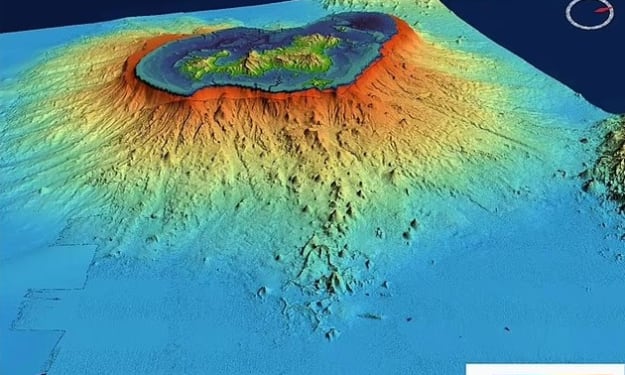
The Biggest Underwater Eruption Ever, perhaps?
The most powerful underwater earthquake occurred in 2018 between East Africa and Madagascar. There was a deep rift between the Earth's crust and the mantle, and thousands of tonnes of magma emerged onto the ocean floor. Subsequently, a massive underwater volcano with a height of 2,700 feet was formed close to Madagascar's coast. This is virtually twice the height of the Empire State Building, and it is all submerged beneath the water. French scientists research this place since it had regular seismic behaviour when the geologist went on a trips to the coast of Madagascar they noticed this giant underwater Rock which was not here until most recently with the assist of geological equipment they discovered the earthquake occurred deeper than usual beneath the Earth's crust geologists created a special Observatory to monitor the circumstance at this site in real time among February and may 2019 they recorded about 17 thousand seismic operations below the ocean floor scientists had rarely recorded such deep earthquakes this suggests that there are reservoirs as well as drainage systems inside our planet via which magma floods it's like the veins as well as vessels of a living organism volume of lava the volcano spews at this place may be compared with the volcanic eruptions in the hottest spots of Earth possibly this is one of the the majority catastrophic but at the same time appealing events in nature over the past few years to comprehend what can be beautiful regarding this let's first figure out what an underwater volcano is as well as how it works in our planet there are incandescent liquid metals and molten rocks with almost all the chemical elements from the periodic table all this hot material is called magma which constantly flows in the planet's bowels nevertheless magma is lighter than the surrounding Earth's crust so it constantly tries to break out upwards don't lay the exterior of our planet is powerful enough and doesn't allow magma to Splash out but occasionally it happens and here's why the Earth's crust comprises of many solid parts Imagine a large image of puzzles where each piece represents a tectonic plate and how they are all continually moving to trigger collisions with one another. Sometimes a puzzle piece falls out of place, creating a gap where flowing magma rushes out, creating what are known as volcanoes. When a volcano erupts, a new geology is initiated, and a splash of magma shocks the ocean floor. When lava and ash erupt from our planet's interior, a tremendous amount of destructive force is released, but because of the water, such a calamity can go unnoticed. There is a complete mess inside the ocean, but more than 70% of the seismic activity linked to volcanoes occurs underwater, and nearly no one perceives it. The ocean in this region boils, and gigantic air bubbles rise, but the enormous pressure of hundreds of millions of gallons of water inhibits the volcano's destructive force. Lava heats the water and destroys the seafloor. molten rocks of the Earth's crust are pressed against the seabed, which blocks the effects of the disaster. Still, occasionally the eruption reaches the surface as it did in 2012 when enormous pieces of pumice the size of a van started to float up in the Southeastern Pacific Ocean. There were hundreds of thousands of them, looking more like a group of unidentified Islands and volcanic rocks scattered in the ocean over an area twice the size of New Zealand. Scientists used deep-sea technology to study the phenomenon. There is a lot of vegetation, flowers, and trees around volcanoes because the volcanic ash, lava, and soil around the volcano are rich in minerals that nourish the soil and encourage the development of microorganisms on land and water. Underwater volcanoes can eventually form natural islands, but this long process causes a sizable piece of land to emerge from the water when magma goes out of the water. Over millions of years, layer by layer, the volcano has been growing. It has been slowly rising due to constant eruptions. Some volcanoes may go out forever, and some continue to erupt, and then eventually, the level of volcanic Rock gets to the surface in the form of a huge island after many more years. The release of magma raises the level of the seabed. After another hundred, maybe a thousand years. There are several creatures, trees, flowers, and plants in the region of the wrecked seabed. These volcanic islands evolved independently of all continents, giving them distinctive ecosystems. Numerous islands worldwide have formed due to underwater volcano eruptions; you may locate them in Hawaii. Observing such Islands aids scientists in understanding how life on Earth first began. Iceland and Indonesia. Many are populated, and people have built villages and small towns there. These locations may appear like paradise, with fruit and vegetable farms, fish-filled waters, and lush soil, but living there is risky due to the volcano. People built a beautiful city right in the crater of an active volcano on the island of Ogashima, south of Tokyo. In May 1785, the eruption started without anyone expecting it to. At some point, thousands of birds rose and flew away from the island, and then the ground started to shake with a heavy, low sound. originated from below the underworld dead. Thick smoke, enormous rocks, and red-hot bits of lava shot into the sky from the summit of the green volcano during the tragedy, which lasted for several weeks. People could flee, although it took a while for them to recover. Nearly 250 years have passed since then, and during that time, the volcano has remained dormant despite the threat of a new eruption. People have continued to live there, and the population is expanding because no one wants to leave this paradise-like location. After all, it has thermal Springs. Deep woods with many fish and fertile soil Movements and tectonic plate ruptures cause another natural calamity, which meteorological and seismological services continuously monitor. When seismic activity causes the crust to shift vertically up or down, destructive tsunamis are created, unlike volcanoes. When the ocean floor's water pressure changes, energy is released. This energy pushes the water and causes a tsunami using the same principle that causes a small wave to form when you throw a stone into the water. At first, the tsunami is small and moving towards the coast at 500 miles per hour, nearly twice as fast as a Formula One race car. Millions of gallons of water are involved. Nothing can withstand the catastrophic power of nature; on the Japanese coast, for example, tsunamis are a common occurrence. People have constructed enormous shields nearby to stop the waves from reaching the shore, but despite all preparation, nature always manages to win out.
By Ian Sankan3 years ago in Earth