Holianyk Ihor
Bio
Stories (419)
Filter by community
Why Scientists Are Searching for Neutrino Oscillations
One of the most fascinating puzzles in modern science is hidden in particles so small and elusive that billions of them pass through your body every second without you even noticing. These ghostly particles are called neutrinos, and they may hold the key to some of the deepest secrets of the cosmos. At the heart of this mystery is a strange phenomenon known as neutrino oscillations.
By Holianyk Ihor5 months ago in Education
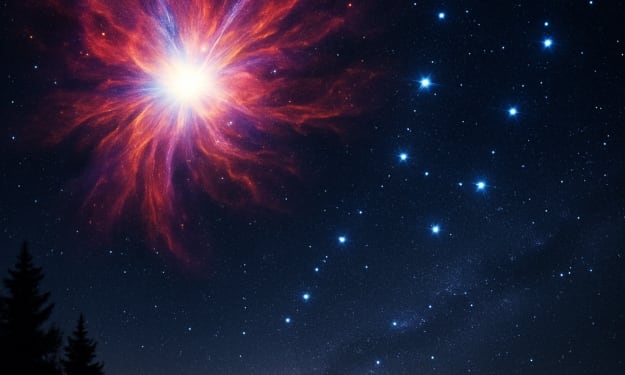
The Imminent Explosion of Betelgeuse: When Will It Happen, and What Will We See from Earth?
High in the constellation of Orion, a fiery red star has captured human imagination for centuries: Betelgeuse. This massive red supergiant, perched on Orion’s “shoulder,” is one of the brightest and most mysterious stars in the night sky. Roughly 640 light-years away, it is so huge that if it were placed at the center of our Solar System, its outer layers would swallow every planet up to Jupiter.
By Holianyk Ihor5 months ago in Education
The Mystery of “Dark” Galaxies Without Stars
When most of us picture a galaxy, we imagine vast spirals of radiant stars, glowing nebulae, and brilliant cores shining across unimaginable distances. Galaxies are often described as cosmic cities of light, each home to billions or even trillions of suns. But in recent decades, astronomers have stumbled upon a puzzling phenomenon that challenges this idea: so-called dark galaxies.
By Holianyk Ihor5 months ago in Education
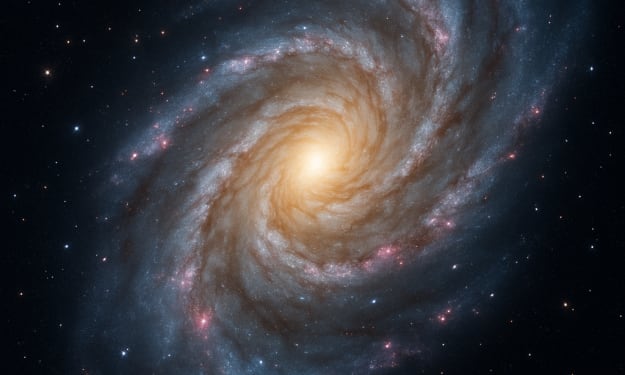
Why Do Spiral Galaxies Have Different Arm Shapes?
When we gaze at breathtaking images of galaxies captured by the Hubble Space Telescope or the James Webb Space Telescope, one thing immediately stands out: their astonishing diversity. Some galaxies look like elegant spirals with two perfectly defined arms, others appear messy and chaotic, with multiple branches twisting outward, while a few look so symmetrical and balanced that they resemble works of cosmic art. But why do spiral galaxies display such different arm shapes?
By Holianyk Ihor5 months ago in Education
How Magnetic Storms Influence Earth’s Climate
When most people hear the term magnetic storm, they picture dazzling auroras, disruptions in GPS signals, or even headaches and fatigue that some claim to feel during solar activity. But what if magnetic storms do more than just disturb our technology and bodies for a few days? What if they also play a role in shaping the long-term climate of our planet?
By Holianyk Ihor5 months ago in Education
Life in Space: Could O’Neill Cylinders Become Humanity’s New Home?
The dream of leaving Earth and building a new life among the stars has fascinated humanity for centuries. From ancient myths about heavenly realms to modern science fiction epics, we have always wondered what it might be like to live beyond our fragile blue planet. While visions of colonizing Mars or venturing to distant exoplanets capture our imagination, there’s another concept—conceived not in a novel, but in physics classrooms—that could bring space colonization much closer to reality. These are the O’Neill Cylinders, gigantic rotating habitats designed to house not just a handful of astronauts, but entire human civilizations.
By Holianyk Ihor5 months ago in Education
What Do Gas Giants Look Like on the Inside?
When we admire stunning images of Jupiter or Saturn, taken by spacecraft like Juno or Cassini, we see their swirling cloud bands, storms, and dazzling rings. But beneath those colorful atmospheric layers lies a world hidden from view — a strange interior unlike anything found on Earth. So, what do gas giants really look like inside?
By Holianyk Ihor5 months ago in Education
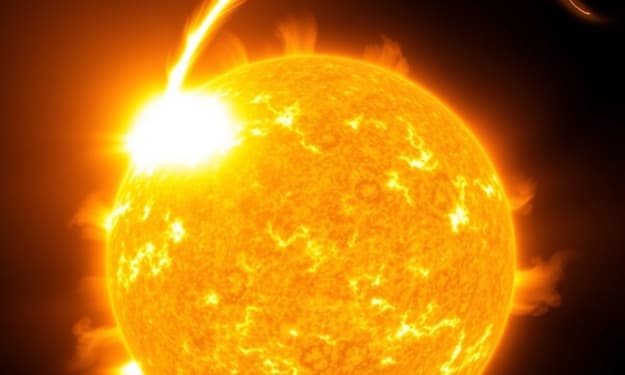
How Solar Flares Affect Earth
The Sun is more than just the bright star that warms our planet and makes life possible. It is a restless, turbulent sphere of plasma, constantly churning with energy and magnetic forces. Among its most dramatic expressions of power are solar flares—explosive bursts of radiation that can send shockwaves throughout the solar system. These fiery events might seem far away, but their impact on Earth can be both beautiful and dangerous.
By Holianyk Ihor5 months ago in Education
Could Dyson Spheres Exist Around Other Stars?
Imagine a civilization so advanced that it doesn’t just rely on the fraction of starlight reaching its planet, but instead captures nearly all the energy emitted by its star. To us, that sounds like pure science fiction. Yet, the idea has been seriously considered by scientists. Back in the 1960s, physicist Freeman Dyson suggested that if intelligent civilizations exist elsewhere in the galaxy, one of the most efficient ways they could power themselves would be to build enormous structures around their stars. This concept became known as the Dyson Sphere.
By Holianyk Ihor5 months ago in Education
Space and Quantum Teleportation: A Glimpse Into the Future of Interstellar Communication
When most people hear the word teleportation, their minds immediately jump to science fiction: starships that blink across galaxies, or characters who dissolve in one place and instantly reappear in another. But while we are still far from moving people or spaceships this way, scientists are already working on something equally fascinating — quantum teleportation.
By Holianyk Ihor5 months ago in Education
How Atmospheres Shape the Habitability of Planets
When we dream about life beyond Earth, oceans and rivers are usually the first images that come to mind. Water is often called the cradle of life, but having seas and lakes doesn’t necessarily mean a planet can sustain thriving ecosystems. The invisible hero of habitability is something far less tangible yet equally vital — the atmosphere.
By Holianyk Ihor5 months ago in Education
How Do Astronauts Return to Earth?
When we think about space missions, most people picture the thrilling moment of launch: a rocket roaring into the sky, flames and smoke trailing behind it. Yet, while liftoff may look like the most dangerous part of a mission, the journey home is often even more complex and nerve-wracking. Returning astronauts must not only re-enter Earth’s atmosphere at tremendous speeds but also land safely on solid ground—or in the ocean—after months in orbit.
By Holianyk Ihor5 months ago in Education