
Life in Space: Could O’Neill Cylinders Become Humanity’s New Home?
Space

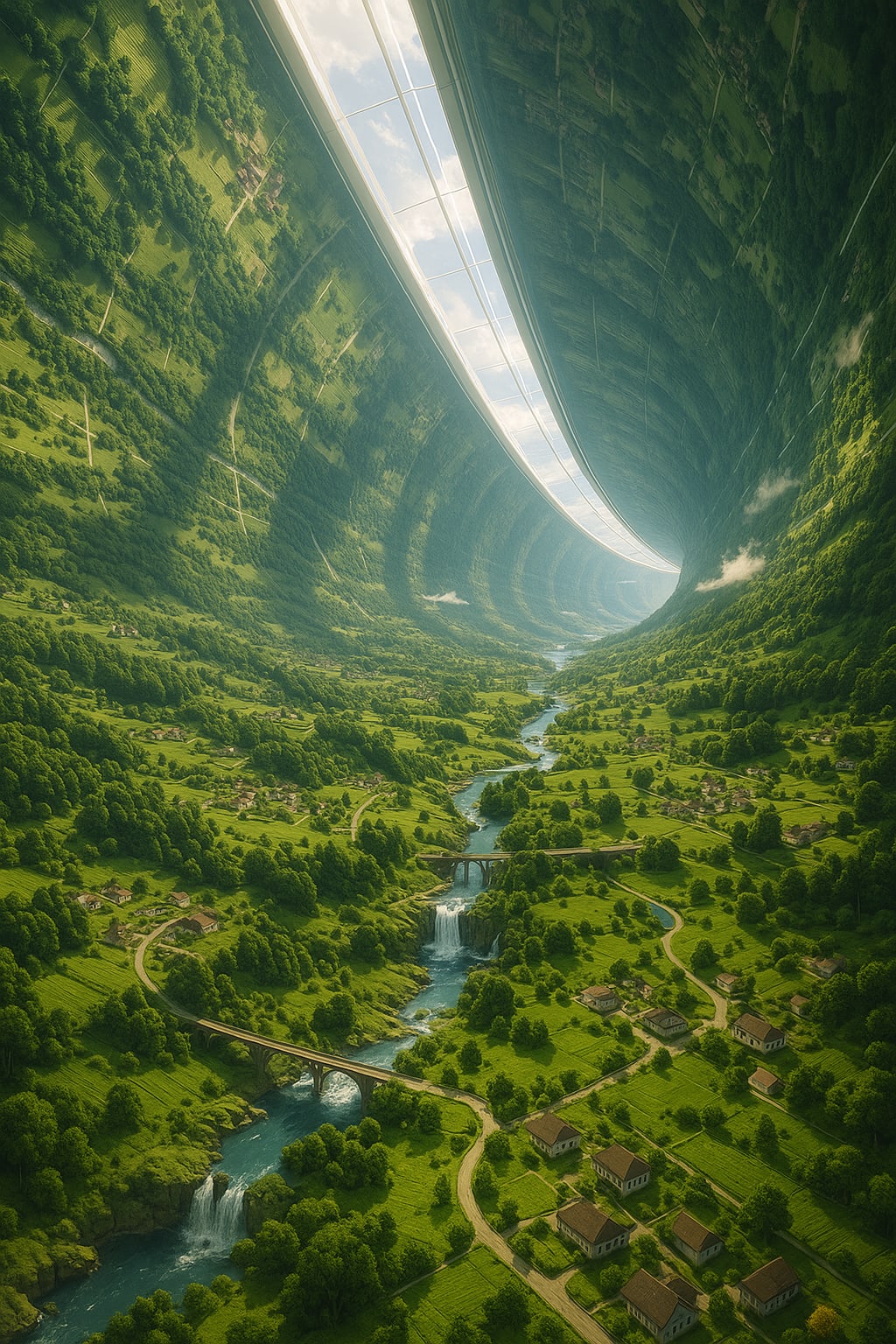
The dream of leaving Earth and building a new life among the stars has fascinated humanity for centuries. From ancient myths about heavenly realms to modern science fiction epics, we have always wondered what it might be like to live beyond our fragile blue planet. While visions of colonizing Mars or venturing to distant exoplanets capture our imagination, there’s another concept—conceived not in a novel, but in physics classrooms—that could bring space colonization much closer to reality. These are the O’Neill Cylinders, gigantic rotating habitats designed to house not just a handful of astronauts, but entire human civilizations.
What Exactly Is an O’Neill Cylinder?
In the 1970s, American physicist Gerard K. O’Neill asked his students a simple but profound question: Is the surface of a planet really the best place for an expanding technological civilization? His answer changed the way scientists think about life in space.
Instead of adapting humanity to the hostile environment of another planet, O’Neill envisioned creating massive, Earth-like habitats floating in space. The design consists of two counter-rotating cylinders, each about 30 kilometers long and 6 kilometers in diameter. By spinning, the cylinders generate artificial gravity through centrifugal force, allowing people to walk, farm, and build as if they were on Earth.
Inside these cylinders, you wouldn’t see a cold metal station. Instead, you might stroll through a lush park, cross a river on a wooden bridge, or relax in a sunlit café overlooking fields. The strangest part? If you looked upward, you’d see not the sky but the other side of the cylinder, where more houses, farms, and forests curve overhead—an entire world turned inside out.
Why Not Just Colonize Mars?
Mars has been the poster child for space colonization, and for good reason: it’s nearby, it has water ice, and its day is close to Earth’s 24 hours. But the Red Planet is far from welcoming. Its atmosphere is too thin to breathe, temperatures average well below freezing, and its gravity—just 38% of Earth’s—could cause long-term health issues for colonists. Even the dream of terraforming Mars would require millennia of engineering and unimaginable resources.
O’Neill Cylinders, by contrast, offer immediate customization. Need Earth-like gravity? Adjust the rotation speed. Want 12-hour days instead of 24? Tilt the mirrors that direct sunlight into the habitat. Instead of bending human biology to survive on an alien world, we design the environment to fit our needs.
And unlike Mars colonies, which would depend heavily on Earth for support, space habitats could be built using materials from the Moon or near-Earth asteroids. Iron, nickel, silicon, and water ice are abundant in space. With robotic mining and solar-powered construction, these resources could one day be transformed into livable megastructures.
Is This Actually Possible?
At first glance, O’Neill Cylinders sound like pure science fiction. Building something tens of kilometers long in orbit would require staggering amounts of material, engineering precision, and energy. But surprisingly, many of the basic technologies already exist—or are being developed today.
- Closed-loop life support systems: NASA and other agencies are testing ways to recycle air, water, and waste aboard spacecraft.
- Space agriculture: Plants have been grown on the International Space Station, proving that food production is possible beyond Earth.
- Large-scale construction in orbit: Companies are experimenting with 3D printing in space, laying the groundwork for future megastructures.
The main barrier is scale. No rocket today could deliver the mass required for a full cylinder. But advocates argue that once we establish automated mining and refining operations on the Moon or asteroids, the dream could become feasible within the next few centuries.
What Would Life Be Like Inside?
Imagine waking up in your apartment overlooking rolling green hills that stretch for kilometers—yet curve upward until they disappear above you. The “sun” is not a star, but light reflected by massive mirrors positioned outside the cylinder. Artificial weather systems create clouds and rainfall, while rivers flow along carefully designed channels.
Each cylinder could host millions of residents, forming floating cities with unique cultures and architectures. One habitat might be a dense, futuristic metropolis; another could be a pastoral paradise with villages and farmland. Some might serve as research hubs, others as trade centers, and others still as cultural or artistic communities.
The psychological benefits of such customization are huge. Unlike Mars colonies, where life would mean survival in a harsh environment, O’Neill habitats could be designed to feel better than Earth—cleaner air, no natural disasters, no extreme seasons. In a sense, they would allow us to “edit” our planet and make a tailored version of home.
The Future of Artificial Worlds
The beauty of O’Neill’s idea lies in its shift of perspective. Instead of asking, Which planet can we colonize? it asks, Why settle for planets at all? Space itself becomes the canvas, and habitats are the brushstrokes of human creativity.
While we are still far from building such megastructures, their philosophy reshapes our vision of humanity’s future. If we one day spread across the solar system, it may not be as Martians or lunar settlers—but as citizens of vast, rotating worlds of our own design.
When that time comes, the question “Where do you live?” could have an answer more extraordinary than anyone ever imagined:
“I live inside a world we built among the stars.”
About the Creator
Keep reading
More stories from Holianyk Ihor and writers in Education and other communities.
What Do Gas Giants Look Like on the Inside?
When we admire stunning images of Jupiter or Saturn, taken by spacecraft like Juno or Cassini, we see their swirling cloud bands, storms, and dazzling rings. But beneath those colorful atmospheric layers lies a world hidden from view — a strange interior unlike anything found on Earth. So, what do gas giants really look like inside?
By Holianyk Ihor5 months ago in Education
The Madness of King Trump
In light of what Trump has done in the wake of his unlawful attack on Venezuela and his unhinged quest to take over Greenland it becomes necessary for the military to refuse any and all orders coming out of the Dept. of Defense and the Trump Administration. Trump has once again proved to the rest of the world his delusions of grandeur have taken over from diplomatic solutions that would improve the quality of life for all populations.
By Dr. Williams4 days ago in Education
Emerging Trends in Hospitality Marketplaces Driving the Next Wave of Growth
Hospitality marketplaces are changing how travel businesses connect with guests. These platforms now shape pricing, visibility, and guest trust. As technology improves and travel habits shift, hospitality marketplaces are becoming more advanced and more selective. Businesses that understand these changes can stay ahead while others struggle to adapt.
By Jason Nissen5 days ago in Education


Comments
There are no comments for this story
Be the first to respond and start the conversation.