Fiaz Ahmed Brohi
Bio
I am a passionate writer with a love for exploring and creating content on trending topics. Always curious, always sharing stories that engage and inspire.
Stories (628)
Filter by community
Taiwan Stays on High Alert as Chinese Ships Pull Back After Massive Drills. AI-Generated.
Taiwan remains on heightened military alert even as Chinese naval and air forces begin pulling back following days of large-scale military drills around the self-governed island. While the immediate show of force appears to be easing, officials in Taipei warn that the threat is far from over. For Taiwan, the withdrawal of Chinese ships does not signal de-escalation—it signals a new phase of strategic pressure. A Show of Force That Shook the Region China’s recent military drills were among the most extensive conducted near Taiwan in recent years. Warships, fighter jets, drones, and missile units surrounded the island from multiple directions, simulating blockades and precision strikes. Beijing described the exercises as a “serious warning” against separatism and foreign interference, clearly aimed at both Taiwan and its international supporters. The drills disrupted commercial shipping routes, raised insurance costs for airlines and cargo vessels, and triggered concern across the Indo-Pacific. Neighboring countries, including Japan and the Philippines, closely monitored the situation, while the United States reiterated its commitment to regional stability. Although Chinese vessels have now retreated from Taiwan’s immediate vicinity, analysts stress that the exercises achieved their core objective: psychological pressure. Why Taiwan Is Not Relaxing Despite the pullback, Taiwan’s defense ministry has made it clear that vigilance will continue. Surveillance operations remain active, reserve forces stay on standby, and air defense systems are fully operational. The reason is simple—China’s military movements have become increasingly unpredictable. Taiwanese officials argue that such drills are no longer isolated events but part of a broader pattern. Each exercise grows more complex, more realistic, and closer to a potential real-world scenario. Pullbacks, therefore, are seen as tactical pauses rather than genuine steps toward calm. For Taiwan, the danger lies not only in invasion but also in miscalculation. Gray-Zone Warfare and Constant Pressure China’s strategy toward Taiwan increasingly relies on what experts call “gray-zone tactics”—actions that fall short of open war but steadily erode an opponent’s security. These include frequent airspace incursions, cyber operations, disinformation campaigns, and maritime harassment. The recent drills fit neatly into this approach. By demonstrating the ability to encircle Taiwan and then withdraw at will, Beijing sends a powerful message: it can escalate or de-escalate whenever it chooses. This constant pressure strains Taiwan’s military resources and tests public morale, even without a single shot being fired. Political Timing Matters The timing of the drills is also significant. Taiwan’s political landscape has been evolving, with leadership transitions and debates over relations with China playing a central role. Beijing views any move toward stronger Taiwanese identity or international engagement as a red line. By launching massive exercises and then pulling back, China reinforces its claim that stability depends entirely on Taipei’s behavior. It also signals to the international community that China sees Taiwan as an internal issue—one it is prepared to enforce militarily if necessary. International Response and Strategic Calculations Global reactions have been cautious but firm. The United States called on all sides to avoid unilateral actions that could destabilize the region, while quietly increasing coordination with allies. Japan, whose southern islands lie close to Taiwan, expressed concern over regional security and reaffirmed its defensive preparedness. For many observers, the drills underscore the growing risk of an incident spiraling out of control. With so many military assets operating in close proximity, a single error could trigger a much wider crisis. Life Under the Shadow of Conflict For ordinary people in Taiwan, life continues—but with an underlying sense of uncertainty. Air raid drills, military updates, and emergency preparedness campaigns have become part of daily life. While many citizens remain resilient, fatigue is growing. At the same time, the drills have strengthened Taiwan’s resolve. Public support for maintaining de facto independence remains strong, and confidence in democratic institutions continues to outweigh fear. Conclusion: Calm After the Storm, but Not Peace The withdrawal of Chinese ships may offer temporary relief, but it does not mark the end of tensions across the Taiwan Strait. Instead, it highlights a new reality—one in which pressure replaces peace, and drills replace dialogue. Taiwan’s decision to stay on high alert reflects hard-earned lessons: in today’s strategic environment, calm can vanish overnight. As China refines its tactics and the world watches closely, Taiwan prepares not just for the next drill—but for an uncertain future where readiness is the price of survival.
By Fiaz Ahmed Brohi2 months ago in The Swamp
Millions Worth of Property Stolen From German Bank Vault: A Shocking Security Breach. AI-Generated.
Germany has been rocked by one of the most audacious financial crimes in recent memory after millions of euros’ worth of property were stolen from a high-security bank vault. The incident has sparked nationwide concern, raised serious questions about banking security, and left hundreds of victims demanding answers about how such a breach could occur in a country known for its precision and regulation. A Carefully Planned Heist According to investigators, the theft was not a spontaneous act but the result of months of meticulous planning. The criminals targeted a private vault facility linked to a German bank, where customers rented secure boxes to store cash, gold, jewelry, documents, and other valuables. These vaults are often marketed as being safer than keeping valuables at home, protected by advanced surveillance systems and strict access controls. Yet, despite these assurances, the thieves managed to break in undetected for an extended period. Authorities believe the criminals accessed the vault during off-hours, disabling or bypassing security measures without triggering immediate alarms. By the time the crime was discovered, the suspects had vanished—along with property worth millions. Victims Left in Shock For customers, the discovery was devastating. Many had stored family heirlooms, retirement savings, or life documents inside the vaults, trusting the bank’s promise of maximum security. When they were informed that their boxes had been emptied, disbelief quickly turned into anger. Several victims have reported losing assets accumulated over decades. Some claim the stolen items were uninsured or underinsured, as banks often place limits on liability for privately rented vaults. This has intensified frustration and fears that compensation may fall far short of actual losses. How Secure Are Bank Vaults Really? The incident has shattered the perception that bank vaults are virtually impenetrable. While modern vaults use thick steel doors, biometric access, cameras, and motion sensors, experts note that no system is entirely foolproof—especially if insiders, technical flaws, or outdated systems are involved. Security analysts suggest that criminals may have exploited blind spots in surveillance, weaknesses in access logs, or even knowledge gained through prior reconnaissance. Investigators are not ruling out the possibility of inside assistance, although no bank employees have been formally accused so far. The case highlights a critical reality: high security often depends as much on human vigilance as on technology. Police Investigation Intensifies German police have launched a large-scale investigation involving forensic experts, cybercrime units, and organized crime specialists. Surveillance footage from surrounding streets, nearby buildings, and transport hubs is being reviewed to track the suspects’ movements before and after the theft. Authorities are also cooperating with international agencies, as stolen valuables—especially gold and jewelry—can be quickly moved across borders and sold on black markets. Time is crucial, as such assets become harder to trace once they are melted down or resold. Despite the scale of the crime, officials have so far released limited details to avoid compromising the investigation. Legal and Financial Fallout The heist has triggered legal battles between victims and the bank. Many customers argue that they were misled about the level of protection and are now demanding full compensation. Banks, however, often classify vault rentals as private agreements, limiting their responsibility unless negligence can be proven. Consumer protection groups have stepped in, urging tighter regulations and clearer disclosure rules. Legal experts predict lengthy court cases that could set new precedents for liability in private vault services. Meanwhile, the bank involved faces reputational damage that could impact customer trust far beyond this single incident. A Wake-Up Call for the Banking Sector This theft has become a wake-up call for Germany’s banking industry—and for customers worldwide. Experts are urging banks to conduct immediate security audits, upgrade surveillance systems, and review emergency response protocols. Customers, too, are being advised to reassess how and where they store their valuables. Diversifying storage locations, ensuring adequate insurance coverage, and regularly checking vault contents are now seen as essential precautions rather than optional ones. Conclusion: Trust Shaken, Questions Unanswered The theft of millions from a German bank vault is more than a crime—it is a breach of trust. As investigations continue, victims wait anxiously for justice, compensation, and clarity. For the banking world, the message is unmistakable: security claims must be backed by reality. Until arrests are made and safeguards strengthened, the case will remain a stark reminder that even the most secure doors can sometimes be opened by the determined and the daring.
By Fiaz Ahmed Brohi2 months ago in The Swamp
Never a Better Time to Be an Indian: Kumar Mangalam Birla Shares Lessons on KBC with Amitabh Bachchan. AI-Generated.
In a rare and enlightening conversation on the sets of Kaun Banega Crorepati (KBC), industrialist Kumar Mangalam Birla shared his reflections on leadership, resilience, and the unprecedented opportunities in India today. The discussion, moderated by the iconic Amitabh Bachchan, was not only a glimpse into Birla’s philosophy but also an inspiring message for millions of viewers across the nation. Kumar Mangalam Birla, the chairman of the Aditya Birla Group, is widely known for steering one of India’s largest conglomerates through decades of economic shifts. Yet, it was his personal insights and candid thoughts during the KBC session that captured the audience’s attention. He described the present as a golden era for Indians, where innovation, entrepreneurship, and global recognition converge like never before. A Conversation Beyond Business The dialogue between Birla and Bachchan transcended conventional corporate discussions. While many expected the focus to remain on business strategies, Birla chose to emphasize values and learning. “It is never just about profit or growth,” he told Bachchan. “It’s about building something sustainable, meaningful, and transformative for society. Today, India offers a unique confluence of talent, technology, and ambition.” Bachchan, who has hosted KBC for over two decades, has witnessed numerous public figures share their life stories. Yet, he remarked that Birla’s approach was refreshing because it blended personal reflection with societal insight. “The way Kumar Mangalam Birla spoke about responsibility and opportunity,” Bachchan noted, “reminded us that leadership is as much about giving back as it is about achieving.” Lessons for Young Indians One of the most poignant moments of the episode was Birla’s advice to the youth. He spoke about resilience in the face of challenges, the importance of lifelong learning, and the necessity of ethical decision-making. “Never shy away from failure,” he said. “Failure teaches you lessons that success never can. Embrace it, learn from it, and move forward.” Birla highlighted the rising wave of entrepreneurial ventures in India, pointing out that startups are now solving real-world problems with innovation and creativity. He encouraged young Indians to think globally while staying rooted locally. “There has never been a better time to be an Indian. The world is noticing our talent, our innovation, and our energy,” he added. The Role of Education and Technology A significant part of Birla’s conversation touched upon education and technology. As the world rapidly digitizes, he stressed the importance of skills that combine technical expertise with creativity. “India is producing a workforce that is capable, adaptable, and ready to compete on a global stage,” Birla observed. He cited examples from Aditya Birla Group’s ventures in technology-driven sectors, noting that innovation is the key to sustained growth. The industrialist also discussed corporate social responsibility, emphasizing that businesses should be catalysts for social change. Through various initiatives in healthcare, education, and sustainability, he explained how the corporate sector can contribute meaningfully to national development. “Economic growth is important, but inclusive growth is indispensable,” he noted. KBC: A Platform for Inspiration KBC has always been more than just a game show; it serves as a platform for learning, reflection, and inspiration. By inviting prominent figures like Birla, the show reinforces its commitment to highlighting diverse perspectives. Bachchan and Birla’s conversation resonated with viewers because it combined practical wisdom with hope for India’s future. Fans of the show took to social media to share their reactions. Many praised Birla for his humility, clarity, and optimism. “Hearing Kumar Mangalam Birla speak on KBC was truly motivating,” tweeted one viewer. “He reminds us that with hard work, ethics, and vision, anything is possible.” Looking Ahead As India continues to evolve on economic, social, and technological fronts, insights from leaders like Birla provide a blueprint for success. His message on KBC reinforces a fundamental belief: the potential of a nation is best realized when its citizens are empowered, responsible, and forward-looking. For Birla, the future is bright, and the present is a time of unprecedented opportunity. “This is India’s moment,” he concluded. “Embrace it, contribute to it, and take pride in what we can achieve together.” In a world where cynicism often overshadows optimism, Birla’s words on KBC serve as a reminder that vision, courage, and integrity remain the pillars of progress. And perhaps more than ever, his reflections affirm that indeed, there has never been a better time to be an Indian.
By Fiaz Ahmed Brohi2 months ago in Geeks
Saudi Arabia Bombs UAE-Backed Faction in Yemen: A New Rift Inside the Coalition. AI-Generated.
Yemen’s long and devastating war has entered yet another complicated phase as reports emerge of Saudi Arabia carrying out airstrikes against a faction backed by the United Arab Emirates (UAE). The incident has shocked observers because Riyadh and Abu Dhabi have, for years, stood on the same side of the conflict. The strikes signal not just a military escalation, but a deepening fracture within the Saudi-led coalition, raising urgent questions about Yemen’s future, regional alliances, and the limits of Gulf unity. A Coalition Under Strain Saudi Arabia and the UAE intervened in Yemen with a shared objective: preventing the Iran-aligned Houthi movement from consolidating power. Over time, however, their priorities diverged. Riyadh focused on restoring a centralized Yemeni state aligned with Saudi interests, while Abu Dhabi increasingly backed local militias and separatist groups, particularly in southern Yemen. The faction reportedly targeted in the Saudi strikes is linked to UAE-supported forces that have sought greater autonomy or outright independence for southern Yemen. These groups have often clashed with Saudi-backed government troops, exposing a rift that was once quietly managed but now appears to be boiling over. Why Would Saudi Arabia Strike an Ally’s Proxy? At first glance, Saudi airstrikes against a UAE-backed faction seem counterintuitive. But strategically, they reflect Saudi Arabia’s growing frustration with parallel power structures undermining its influence. Riyadh has invested heavily—politically, militarily, and financially—in preserving Yemen as a unified state under a friendly government. UAE-backed groups, on the other hand, often operate independently of that government, controlling ports, oil facilities, and territory critical to Yemen’s economy. From Saudi Arabia’s perspective, these factions complicate peace negotiations, weaken central authority, and risk turning Yemen into a patchwork of rival zones—an outcome Riyadh sees as dangerous for its own border security. The UAE’s Calculated Distance The UAE officially scaled back much of its direct military presence in Yemen years ago, but its influence remains powerful through trained and funded local forces. Abu Dhabi’s strategy has emphasized counterterrorism, maritime security, and control of strategic ports, especially along the Red Sea and Gulf of Aden. While the UAE has not openly condemned Saudi actions, the strikes place it in an awkward position. Public disagreement would fracture Gulf unity, yet silence risks alienating allies on the ground. This delicate balancing act highlights how coalition warfare often unravels once immediate threats evolve into long-term political disputes. What This Means for Yemen For Yemenis, already suffering from one of the world’s worst humanitarian crises, the implications are grim. Infighting among anti-Houthi forces weakens any chance of stability. Each new clash delays reconstruction, deepens economic collapse, and fuels displacement. Moreover, divisions within the coalition inadvertently strengthen the Houthis, who can exploit rivalries to consolidate control and present themselves as a more coherent force. The longer anti-Houthi groups fight each other, the harder it becomes to reach a comprehensive political settlement. Regional and Global Implications The incident also sends a wider regional signal. Gulf unity, long projected as solid, is proving fragile when national interests diverge. This matters not only for Yemen but for broader Middle East dynamics, from Red Sea security to energy trade routes. International actors watching the conflict—particularly Western governments—are increasingly concerned that Yemen could become a permanent low-intensity battleground rather than a post-war state. Diplomatic efforts aimed at ending the conflict face fresh obstacles when coalition partners appear willing to use force against each other’s allies. Is Peace Slipping Further Away? Saudi Arabia has recently shown interest in de-escalation, holding indirect talks with the Houthis and emphasizing border security over outright victory. Strikes against UAE-backed factions, however, suggest that Riyadh is unwilling to tolerate challenges to its vision for Yemen’s future—even from nominal allies. Whether this marks a temporary show of force or a longer-term breakdown remains unclear. What is certain is that Yemen’s war is no longer just about Houthis versus the government; it is about competing visions of power, governance, and influence within the same coalition. Conclusion Saudi Arabia’s bombing of a UAE-backed faction in Yemen is more than a battlefield incident—it is a warning sign. It exposes the fragile nature of wartime alliances and underscores how strategic interests can override shared history. For Yemen, it means continued uncertainty. For the region, it reveals that unity against a common enemy does not guarantee agreement on what peace should look like afterward.
By Fiaz Ahmed Brohi2 months ago in The Swamp
Amid Tu Meri Main Tera Box Office Dip, Karan Johar Urges People to Stop Celebrating “Failures”. AI-Generated.
Bollywood filmmaker and producer Karan Johar has once again found himself at the center of an industry-wide conversation—this time not for a glamorous launch or a blockbuster announcement, but for a strong emotional appeal following the box office underperformance of Tu Meri Main Tera. As social media buzzed with memes, sarcastic posts, and celebratory takes on the film’s dip, Johar urged audiences and commentators to rethink the culture of celebrating cinematic failures. His statement has reignited an important debate: When did film criticism turn into public gloating? The Film and the Fallout Tu Meri Main Tera arrived in theaters with reasonable expectations. Backed by a prominent banner and marketed as a modern romantic entertainer, the film carried the usual hopes attached to a Karan Johar–associated project. However, despite initial curiosity, its box office numbers failed to match projections. In today’s digital age, such dips rarely stay confined to trade columns. Almost instantly, social media platforms were flooded with reactions—many of them less analytical and more celebratory in tone. Instead of discussing storytelling flaws or audience disconnect, a section of users focused on mocking the film’s failure, often framing it as a “lesson” for big producers. Karan Johar’s Appeal: Criticism vs Cruelty Breaking his silence, Johar addressed the discourse by drawing a clear line between constructive criticism and what he described as “joy in someone else’s failure.” He emphasized that films are not just products but the result of years of creative labor, involving hundreds of technicians, artists, and crew members whose livelihoods are affected by box office outcomes. His appeal wasn’t defensive—it was reflective. Johar acknowledged that not every film succeeds and that criticism is essential for growth. What concerned him was the lack of empathy and the eagerness to turn commercial setbacks into viral celebrations. Why Do Audiences Celebrate Failure? The phenomenon isn’t limited to Bollywood. Globally, entertainment culture has shifted toward instant reactions, where numbers—opening weekend collections, first-day footfalls, social media trends—often overshadow artistic discussion. In India, this tendency is amplified by: Industry fatigue, where audiences feel overwhelmed by star-driven films Anti-nepotism sentiments, which resurface whenever a big-banner film underperforms Social media virality, where negativity spreads faster than nuance For many, celebrating failure becomes a form of perceived accountability. But critics argue that this approach oversimplifies a complex ecosystem and reduces cinema to a scoreboard. The Human Cost of a “Flop” Johar’s statement highlighted an often-ignored reality: when a film fails, the impact extends far beyond producers and stars. Background dancers, spot boys, assistant directors, junior artists, and post-production teams all depend on a film’s success to sustain future work. Unlike social media narratives that frame losses as moral victories, the reality is deeply human. A box office dip can stall careers, shrink opportunities, and create long-term financial stress for people who rarely appear in headlines. A Call for Mature Film Culture Johar’s appeal is part of a broader call for a more mature viewing culture—one that critiques content without dehumanizing creators. Cinema thrives on risk. If every failure becomes a public spectacle, creators may retreat into safer, formulaic projects, ultimately hurting innovation. True film literacy lies in asking: Why didn’t the film connect? What worked despite the failure? How can storytelling evolve? Celebrating failure answers none of these questions. Industry Reactions and Divided Opinions Reactions to Johar’s comments have been mixed. Some filmmakers and actors echoed his sentiment, calling for empathy and responsible criticism. Others argued that public figures must accept scrutiny as part of commercial cinema. Yet even among dissenting voices, there is agreement on one point: mockery is not critique. Laughing at losses does little to improve the quality of films or audience engagement. Looking Ahead Tu Meri Main Tera may not have delivered at the box office, but the conversation it sparked could be more impactful than its numbers. Karan Johar’s message serves as a reminder that cinema is both art and industry—and that empathy should not disappear when tickets don’t sell. In an era where success and failure are measured in real time, perhaps the real challenge is learning how to respond to disappointment with thoughtfulness instead of triumph.
By Fiaz Ahmed Brohi2 months ago in Geeks
Number of People Who Say Britons Must Be Born in the UK Is Rising, Study Shows. AI-Generated.
A new social study has revealed a noticeable shift in public opinion across the United Kingdom: a growing number of people now believe that to be truly British, a person must be born in the UK. This finding highlights changing attitudes toward national identity at a time when Britain continues to grapple with questions around immigration, citizenship, and cultural belonging.
By Fiaz Ahmed Brohi2 months ago in The Swamp
Why Saudi Arabia Just Moved Into Syria’s Oil and Gas Fields. AI-Generated.
Saudi Arabia’s recent involvement in Syria’s oil and gas sector has surprised many observers, marking a significant shift in Middle Eastern geopolitics. After more than a decade of war and diplomatic isolation, Syria is slowly re-entering regional calculations, and Riyadh’s move signals changing priorities driven by energy security, regional stability, and strategic influence. A Strategic Energy Calculation At the heart of Saudi Arabia’s interest lies energy. Syria’s oil and gas reserves are modest compared to Gulf giants, but their strategic location matters. Syria sits at the crossroads of the Middle East, linking the Mediterranean, Iraq, and broader Levant. Control or influence over energy infrastructure in Syria provides leverage over regional energy routes, pipelines, and future reconstruction projects. Saudi Arabia is also recalibrating its long-term energy strategy. While it remains a global oil powerhouse, the Kingdom is diversifying investments and securing regional energy assets to reduce vulnerabilities. By stepping into Syria’s energy sector, Saudi Arabia positions itself early in a market that could expand rapidly once sanctions ease and reconstruction accelerates. Shifting Regional Politics This move reflects broader diplomatic changes. In recent years, Saudi Arabia has softened its stance toward Syria after years of backing opposition forces. The reopening of diplomatic channels and Syria’s gradual reintegration into Arab forums signal a regional consensus: isolation has failed to produce stability. By engaging economically rather than militarily, Saudi Arabia aims to shape Syria’s post-war future while counterbalancing rivals. Iran and Russia have long dominated Syria’s energy and military sectors. Saudi involvement introduces a new power dynamic, reducing Tehran’s monopoly over Syrian resources and offering Damascus alternatives. Economic Leverage Over Conflict Zones Energy investment is also a political tool. By supporting oil and gas development, Saudi Arabia gains influence in areas critical to Syria’s economic recovery. Energy revenues can stabilize state finances, rebuild infrastructure, and reduce reliance on illicit trade networks that flourished during the war. For Riyadh, this creates leverage. Economic engagement allows Saudi Arabia to push for political moderation, reduced militia influence, and regional cooperation. It is a softer approach compared to past confrontational policies, aligning with Saudi Arabia’s recent emphasis on diplomacy and economic statecraft. A Signal to Global Powers Saudi Arabia’s move also sends a message beyond the Middle East. The Kingdom is asserting itself as a regional problem-solver rather than merely an oil exporter. By stepping into Syria’s energy sector, Riyadh demonstrates independence in foreign policy, balancing relations with the United States, Russia, and China. This strategy fits Saudi Arabia’s broader Vision 2030 goals, which emphasize diversification, foreign investment, and regional leadership. Energy diplomacy becomes a tool to expand influence while avoiding direct military entanglement. Risks and Challenges Despite the opportunities, the move is not without risks. Syria remains under heavy international sanctions, particularly from the United States and Europe. Any large-scale Saudi investment must navigate legal and financial restrictions carefully to avoid penalties. Security is another concern. Many oil and gas fields are located in unstable regions where militias, foreign forces, and local factions operate. Ensuring safe operations will require coordination with Syrian authorities and possibly regional security guarantees. There is also the reputational risk. Critics argue that engaging economically with Damascus could legitimize a government accused of severe human rights violations. Saudi Arabia must balance pragmatic interests with regional and international perceptions. What This Means for the Region Saudi Arabia’s entry into Syria’s oil and gas fields marks a turning point. It suggests that the Middle East is moving away from endless proxy wars toward pragmatic engagement. Economic influence is replacing military confrontation as the preferred tool of power. For Syria, Saudi involvement offers a chance to diversify partnerships and accelerate reconstruction. For Saudi Arabia, it strengthens regional leadership and limits rival influence. For the broader region, it hints at a future where energy cooperation may help stabilize long-fractured states. Conclusion Saudi Arabia’s move into Syria’s oil and gas sector is not just about energy—it is about reshaping regional power, reducing conflict through economic leverage, and positioning the Kingdom as a central architect of Middle Eastern stability. While challenges remain, the decision reflects a calculated shift toward diplomacy, investment, and long-term strategic influence in a region eager for reconstruction and peace.
By Fiaz Ahmed Brohi2 months ago in The Swamp
UK Armed Forces Personnel Recognised in New Year Honours: A Tribute to Service and Sacrifice. AI-Generated.
Every year, the UK New Year Honours list shines a spotlight on individuals whose dedication has strengthened the nation. In the latest honours list, members of the UK Armed Forces have once again been recognised for their exceptional service, bravery, and commitment—often carried out far from public attention. These awards are not just ceremonial titles; they represent years of sacrifice, leadership, and unwavering duty to the country. Honouring Commitment Beyond the Battlefield The New Year Honours system recognises a wide range of contributions, from frontline operations to training, logistics, humanitarian missions, and veteran welfare. For armed forces personnel, these honours often reflect service that goes far beyond combat. Many recipients have played key roles in peacekeeping missions, disaster relief operations, and international security partnerships. In recent years, UK forces have been involved in complex global challenges, including NATO deployments, counter-terrorism operations, cyber defence, and humanitarian assistance. Honours awarded to service members acknowledge their adaptability in an era where military service increasingly demands diplomatic, technical, and humanitarian skills alongside traditional defence roles. Recognising Leadership and Courage Among those honoured are senior officers whose leadership has guided units through demanding operations and periods of rapid change. Effective leadership in the armed forces is not only about strategy but also about protecting the wellbeing of personnel under command. Many award recipients are praised for fostering morale, inclusivity, and professionalism in high-pressure environments. At the same time, junior ranks and non-commissioned officers are also recognised, highlighting that bravery and excellence are not limited by rank. Acts of courage, innovation, and selfless service—often performed quietly—are central to the honours awarded. Service During Challenging Times Recent honours also reflect the armed forces’ role during national and global crises. From supporting civil authorities during emergencies to assisting with international humanitarian efforts, UK military personnel have repeatedly stepped in when civilian systems were stretched. During times of global uncertainty, armed forces personnel often face extended deployments, family separation, and personal risk. The New Year Honours serve as public acknowledgment of these sacrifices, reminding society that security and stability depend on people willing to serve beyond the call of duty. Diversity and Modern Military Values The honours list increasingly reflects the diversity of today’s UK Armed Forces. Men and women from varied backgrounds are being recognised, underscoring the military’s evolving culture and commitment to equality and inclusion. This diversity strengthens operational effectiveness and ensures the armed forces better represent the society they serve. Recognition is also being given to individuals who have championed mental health support, veteran reintegration, and welfare initiatives. These efforts highlight a growing understanding that caring for service members does not end when their deployment does—it continues throughout their lives. The Impact on Families and Communities While honours are awarded to individuals, the impact extends to families and communities. Behind every service member is a network of loved ones who share the burden of service. Long absences, relocations, and uncertainty are part of military life, and recognition offers families a moment of shared pride and validation. For communities, these honours reinforce the connection between civilians and the armed forces. They humanise military service, shifting the focus from abstract defence policies to real people who dedicate their lives to national service. More Than Medals: A National Message Public recognition through the New Year Honours sends an important message: service matters. In a world where military roles are often debated or misunderstood, these awards reaffirm respect for professionalism, integrity, and sacrifice. They also inspire future generations. Young people considering military careers see that dedication and excellence are valued and acknowledged. This recognition plays a role in sustaining a capable and motivated defence force. Conclusion The recognition of UK Armed Forces personnel in the New Year Honours is more than a formal tradition—it is a meaningful tribute to those who protect, serve, and support the nation in visible and unseen ways. These honours celebrate courage, leadership, and service while reminding the public of the human commitment behind national security. As the UK faces evolving global challenges, the individuals honoured this year stand as examples of resilience and duty. Their recognition is a moment for the nation to pause, reflect, and say a collective thank you to those who serve.
By Fiaz Ahmed Brohi2 months ago in The Swamp
Army’s New Acquisition Structure, a New Tank Prototype, and More Drones: A 2026 Preview. AI-Generated.
As global security challenges continue to evolve, armies around the world are racing to modernize their forces. The year 2026 is shaping up to be a pivotal moment, marked by sweeping reforms in military procurement, the unveiling of next-generation armored vehicles, and a rapid expansion in drone warfare. Together, these changes signal a fundamental shift in how modern armies prepare for future conflicts. A New Acquisition Structure: Faster, Smarter, More Flexible One of the most significant developments expected by 2026 is the introduction of a revamped army acquisition structure. Traditional procurement systems have long been criticized for being slow, bureaucratic, and ill-suited to the pace of modern warfare. In response, military planners are now prioritizing speed, adaptability, and innovation. The new acquisition model focuses on shorter development cycles and closer collaboration with private industry, particularly technology startups. Instead of waiting years for fully perfected systems, armies are increasingly adopting a “deploy, test, improve” approach. This allows new equipment to be fielded quickly and refined based on real-world feedback from soldiers. Another key feature of the new structure is decentralization. Commanders at lower levels are being given greater input into equipment decisions, ensuring that what is purchased actually meets battlefield needs. This shift is expected to reduce waste, cut costs, and deliver more effective tools to troops on the ground. The New Tank Prototype: Reinventing Heavy Armor Despite predictions that tanks would become obsolete, armored warfare is far from dead. In fact, 2026 is expected to bring the debut of a new tank prototype that reflects lessons learned from recent conflicts. Unlike traditional heavy tanks, the next-generation prototype emphasizes survivability, digital integration, and versatility. Advanced composite armor, active protection systems capable of intercepting incoming missiles, and reduced crew requirements are at the heart of the design. Automation and artificial intelligence are playing a growing role, helping crews detect threats faster and respond more effectively. The new tank is also expected to be lighter and more mobile, allowing for rapid deployment across different terrains. Hybrid or alternative propulsion systems may reduce fuel dependency and improve operational range. Most importantly, the tank is being designed to operate as part of a networked battlefield, sharing real-time data with drones, infantry units, and command centers. Drones Take Center Stage Perhaps the most dramatic change heading into 2026 is the explosion in drone capabilities. Unmanned systems are no longer limited to surveillance roles; they are becoming essential tools for reconnaissance, logistics, electronic warfare, and direct combat. Armies are investing heavily in a wide range of drones—from small, soldier-launched systems to larger unmanned aircraft capable of long-endurance missions. Swarm technology, where multiple drones coordinate autonomously, is expected to become more common, overwhelming enemy defenses and gathering intelligence at unprecedented speed. Ground-based and maritime drones are also gaining attention. Unmanned ground vehicles can transport supplies, evacuate wounded soldiers, or scout dangerous areas without risking human lives. Meanwhile, naval drones are enhancing coastal surveillance and anti-submarine operations. Integration and Networked Warfare What ties together the new acquisition structure, tank prototype, and drone expansion is integration. The army of 2026 is being built around the concept of networked warfare, where every platform—manned or unmanned—shares data seamlessly. This digital battlefield allows commanders to make faster, more informed decisions. Artificial intelligence systems can analyze vast amounts of information, identify patterns, and suggest tactical options. While human judgment remains central, technology is increasingly acting as a force multiplier. Challenges and Ethical Questions Despite the promise of these advancements, challenges remain. Cybersecurity threats pose a serious risk to highly networked systems. Supply chain resilience, training requirements, and interoperability with allied forces are also major concerns. There are also ethical debates surrounding automation and autonomous weapons. As drones and AI systems take on greater roles, militaries must balance operational effectiveness with accountability and international law. Conclusion The 2026 preview of the army’s future reveals a force in transformation. A streamlined acquisition structure promises faster innovation, a new tank prototype redefines armored warfare, and drones are reshaping how battles are fought. Together, these developments reflect a military adapting to a world where technology, speed, and integration are as important as firepower. As armies prepare for the challenges ahead, one thing is clear: the battlefield of tomorrow will look very different from that of the past—and 2026 may be the year that future truly arrives.
By Fiaz Ahmed Brohi2 months ago in The Swamp
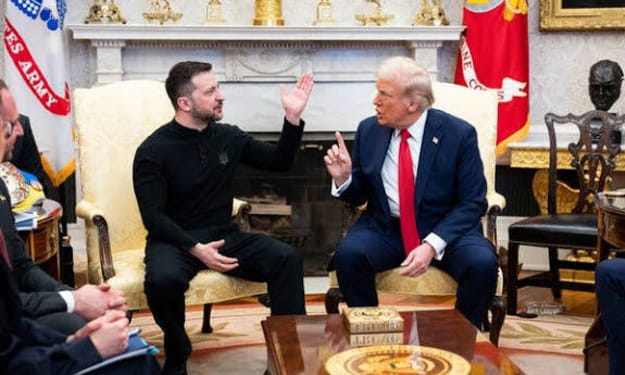
Trump and Zelensky Appear More Upbeat — But Peace Still Feels Distant for Ukraine. AI-Generated.
Despite warmer rhetoric and renewed dialogue, deep divisions, battlefield realities, and political constraints suggest an end to the war remains far from reach. In recent public appearances and statements, former U.S. President Donald Trump and Ukrainian President Volodymyr Zelensky have struck a noticeably more upbeat tone when discussing the possibility of ending the war in Ukraine. The language of optimism, negotiation, and “new approaches” has replaced months of hardened rhetoric. Yet behind the smiles and hopeful words, there is little concrete evidence that peace is genuinely close. For Ukrainians living under the shadow of daily air raids and for global observers watching one of Europe’s most consequential conflicts since World War II, the contrast between tone and reality is striking. Diplomatic warmth may generate headlines, but wars are not ended by mood alone. A Shift in Tone, Not in Terms Trump’s recent comments suggest he believes the war could be resolved “quickly” under different leadership, while Zelensky has emphasized openness to dialogue—provided Ukraine’s sovereignty and territorial integrity are respected. On the surface, this convergence appears promising. Both leaders project confidence and a willingness to talk, which is often a prerequisite for peace. However, optimism without clarity can be misleading. Neither side has presented a detailed framework for negotiations that addresses the core disputes: occupied territories, security guarantees, accountability for war crimes, and Ukraine’s future alignment with the West. Without movement on these fundamentals, upbeat rhetoric risks becoming little more than political theater. The Battlefield Tells a Different Story While diplomatic language softens, conditions on the ground remain brutal. Fighting continues along multiple fronts, with incremental gains and losses costing thousands of lives. Russia maintains control over significant portions of Ukrainian territory, while Ukraine remains determined to reclaim what it considers sovereign land. Military realities often dictate diplomatic outcomes, and at present, neither side appears decisively positioned to force a settlement on its own terms. This stalemate reduces incentives for compromise, making peace talks politically risky and strategically uncertain. Trump’s Calculus and Global Signals Trump’s optimistic messaging also reflects domestic political considerations. Positioning himself as a dealmaker capable of ending foreign wars resonates strongly with parts of the U.S. electorate. Yet translating campaign rhetoric into international agreements is far more complex—especially when the conflict involves multiple actors, alliances, and long-standing geopolitical rivalries. For European allies and NATO partners, Trump’s tone raises questions rather than reassurance. Would a peace deal prioritize speed over sustainability? Would Ukraine be pressured into concessions? The lack of specifics fuels anxiety among countries that view Ukraine’s resistance as critical to regional security. Zelensky’s Narrow Path Zelensky, meanwhile, walks a diplomatic tightrope. His openness to dialogue must balance international diplomacy with domestic expectations. After years of sacrifice, Ukrainian society remains deeply resistant to any settlement that legitimizes territorial loss. Any hint of compromise risks political backlash and public disillusionment. At the same time, Ukraine’s dependence on Western military and financial support means Zelensky cannot ignore shifts in tone from influential figures like Trump. Appearing receptive keeps doors open—but receptiveness does not equal readiness to concede. Peace Requires More Than Positivity History shows that successful peace processes depend on more than goodwill. They require enforceable agreements, trusted mediators, and credible security arrangements. At present, none of these elements are firmly in place. Mutual distrust remains profound, and previous diplomatic efforts have collapsed under the weight of broken promises and ongoing violence. Moreover, Russia’s strategic objectives and Ukraine’s national aspirations remain fundamentally incompatible. Until there is evidence of meaningful change in those positions, peace will remain aspirational rather than achievable. Why the Optimism Still Matters Despite the skepticism, the shift in tone is not meaningless. Language shapes possibilities. An environment where leaders speak about peace—even cautiously—can lower tensions, create diplomatic space, and prepare public opinion for difficult conversations in the future. However, optimism must be matched with substance. Without timelines, proposals, or confidence-building measures, hopeful rhetoric risks raising expectations only to dash them later. The Long Road Ahead For now, Trump and Zelensky’s upbeat demeanor offers a psychological pause in an exhausting conflict—but not a turning point. The war’s root causes remain unresolved, and the distance between words and action is still vast. Peace in Ukraine, if it comes, is more likely to be slow, complex, and imperfect rather than quick and triumphant. Until clear steps replace encouraging phrases, the world should view optimism with caution—and prepare for a conflict that continues to test diplomacy, endurance, and global stability.
By Fiaz Ahmed Brohi3 months ago in The Swamp
North Korea’s Kim Oversees Test Launch of Long-Range Cruise Missiles. AI-Generated.
North Korea has once again captured global attention as leader Kim Jong Un personally oversaw the test launch of long-range cruise missiles, underscoring Pyongyang’s continued focus on strengthening its military capabilities despite international pressure and sanctions. The missile test, reported by state media, signals not only technological progress but also a calculated political message to regional rivals and the wider international community. A Demonstration of Strategic Capability According to North Korean officials, the cruise missiles flew along a pre-set trajectory and accurately struck their targets, showcasing precision, endurance, and reliability. Unlike ballistic missiles, cruise missiles travel at lower altitudes and are harder to detect by radar systems, making them a particularly concerning weapon for neighboring countries. By testing long-range variants, North Korea appears to be emphasizing its ability to conduct sustained and precise strikes beyond its immediate borders. Kim Jong Un’s presence at the launch site was no coincidence. His attendance signals the importance of the test and reinforces his role as the ultimate authority over the country’s defense strategy. State media images often show Kim observing missile launches with senior military officials, a visual reminder that military strength remains central to his leadership and governance. Why Cruise Missiles Matter Cruise missiles differ significantly from the ballistic missiles that usually dominate headlines. They are designed to fly at low altitudes, maneuver around terrain, and evade missile defense systems. This makes them valuable assets in modern warfare. Analysts note that long-range cruise missiles could potentially carry conventional or nuclear warheads, raising concerns about their role in North Korea’s broader weapons program. For North Korea, cruise missile development offers strategic advantages. These weapons can complement ballistic missiles, creating a more diverse and flexible arsenal. By improving accuracy and range, Pyongyang enhances its deterrence posture, signaling that it can respond to perceived threats in multiple ways. Regional and Global Reactions The test launch is likely to alarm South Korea, Japan, and the United States, all of whom closely monitor North Korean military activity. While cruise missile tests have sometimes drawn less international attention than ballistic missile launches, their strategic implications are no less serious. Regional governments typically respond with heightened surveillance, diplomatic statements, and coordination with allies. South Korea and Japan have consistently called for restraint, emphasizing that such actions increase tensions and undermine regional stability. The United States, meanwhile, has reiterated its commitment to the defense of its allies and continues to advocate for dialogue alongside deterrence. A Message Beyond the Battlefield Missile tests in North Korea often serve political purposes beyond military evaluation. Domestically, they reinforce the narrative of strength, self-reliance, and technological advancement promoted by the regime. At a time when the country faces economic challenges and international isolation, successful weapons tests can be used to bolster national pride and loyalty. Internationally, the timing of such tests is often strategic. They can coincide with diplomatic developments, military exercises by rival nations, or shifts in global politics. By conducting missile launches, North Korea reminds the world that it remains a significant security player that cannot be ignored. Sanctions and Strategic Persistence Despite facing some of the toughest international sanctions in the world, North Korea has continued to invest heavily in its weapons programs. These sanctions aim to restrict access to materials, technology, and funding, yet Pyongyang has demonstrated resilience and adaptability. The continued testing of advanced missile systems suggests that sanctions alone have not halted its ambitions. Some analysts argue that the persistence of these tests reflects North Korea’s belief that military strength is essential for regime survival. From Pyongyang’s perspective, a credible deterrent reduces the likelihood of external intervention and strengthens its bargaining position in any future negotiations. What Lies Ahead The latest cruise missile test raises questions about what North Korea’s next steps might be. Will it continue to refine cruise missile technology, or shift focus back to ballistic missiles and other advanced systems? Observers also wonder whether these demonstrations are a prelude to renewed diplomatic engagement or a sign of prolonged confrontation. What is clear is that North Korea remains committed to expanding and showcasing its military capabilities. As Kim Jong Un oversees these tests, he sends a clear message: the country intends to advance its defense programs regardless of external criticism. Conclusion North Korea’s test launch of long-range cruise missiles under Kim Jong Un’s supervision is more than a routine military exercise. It is a strategic statement aimed at both domestic and international audiences. By highlighting precision, range, and leadership involvement, the launch reinforces Pyongyang’s determination to remain a formidable force in an increasingly complex global security landscape. For the world, it serves as a reminder that tensions on the Korean Peninsula remain unresolved—and closely watched.
By Fiaz Ahmed Brohi3 months ago in The Swamp
Turkish Airlines Pilot Says “I Don’t Follow Orders” to ATC: A Troubling Aviation Incident Explained. AI-Generated.
Aviation is built on discipline, coordination, and strict adherence to rules. Every flight in the sky depends on seamless communication between pilots and air traffic control (ATC). That is why a recent incident involving a Turkish Airlines pilot allegedly saying, “I don’t follow orders,” to air traffic control has sparked serious debate across the global aviation community. While rare, such incidents raise critical questions about cockpit authority, aviation safety culture, and how airlines manage crisis situations. Why ATC Compliance Is Non-Negotiable Air traffic controllers are responsible for maintaining safe distances between aircraft, managing takeoffs and landings, and preventing mid-air collisions. Pilots are required by international aviation regulations to follow ATC instructions unless doing so would directly endanger the aircraft. When a pilot openly challenges or refuses ATC instructions without declaring an emergency, it disrupts the delicate system that keeps millions of passengers safe every day. This is why aviation experts consider such statements alarming, regardless of context. Possible Reasons Behind the Pilot’s Response While the phrase “I don’t follow orders” sounds shocking, aviation professionals caution against drawing conclusions without understanding the full context. There are several possible explanations for such a response: Miscommunication due to language barriers or radio interference Cockpit workload pressure, especially during high-stress phases of flight Disagreement over safety judgment, where the pilot believes compliance could create risk Fatigue or stress, which can impair decision-making In rare cases, pilots may exercise pilot-in-command authority, which allows them to deviate from ATC instructions if safety is compromised. However, such actions must be clearly communicated and documented. How Airlines Typically Handle Such Incidents For a major international carrier like Turkish Airlines, even a single incident of ATC non-compliance is treated with extreme seriousness. Airlines usually initiate: An internal safety investigation Review of cockpit voice recordings Analysis of flight data Interviews with both the flight crew and ATC personnel Depending on findings, consequences may range from retraining and counseling to suspension or termination. Airlines are also required to report serious incidents to national and international aviation authorities. The Human Factor in Aviation Modern aircraft are technological marvels, but aviation safety still depends heavily on human behavior. Studies consistently show that human factors, such as stress, fatigue, ego, and communication breakdowns, contribute to the majority of aviation incidents. This incident highlights the importance of Crew Resource Management (CRM)—a training system designed to promote teamwork, communication, and decision-making in the cockpit. CRM emphasizes that no individual, regardless of rank, operates in isolation. Public Reaction and Industry Concerns News of a pilot challenging ATC has naturally unsettled passengers and aviation observers. For frequent flyers, trust in airlines is closely tied to confidence in pilot professionalism. Any suggestion of defiance or disregard for procedure can damage that trust. Aviation analysts warn against sensationalism but agree the incident should serve as a reminder that safety culture must remain uncompromising, even in high-pressure environments. Lessons for the Aviation Industry This episode underscores several important lessons: Clear communication saves lives Professional discipline is essential, regardless of experience level Mental health and fatigue management deserve more attention Safety reporting systems must be transparent and blame-free Airlines that foster open communication and continuous training are better equipped to prevent such incidents from escalating. A Wake-Up Call, Not a Verdict While the words attributed to the Turkish Airlines pilot sound troubling, aviation safety demands careful investigation rather than immediate judgment. The industry thrives on learning from near-misses and unusual events, not hiding them. If anything, this incident serves as a wake-up call for airlines worldwide to reinforce communication protocols, invest in human-factor training, and ensure that safety always comes before ego or authority. In aviation, following orders is not about control—it’s about coordination. And coordination is what keeps the skies safe.
By Fiaz Ahmed Brohi3 months ago in The Swamp