
Transcendental Play
Body and expression in the painting of Marcia Falcão

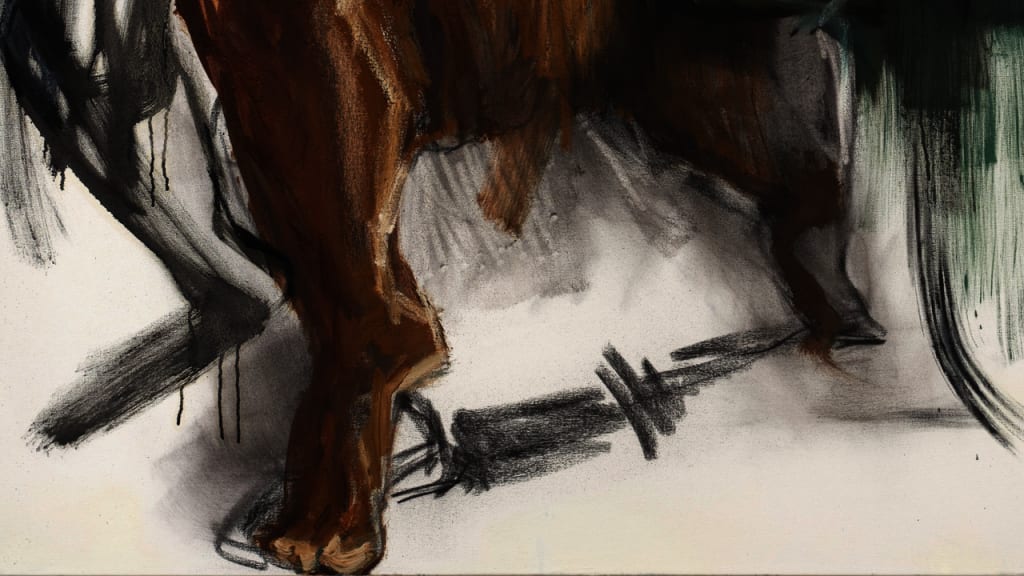
In a vigorous journey of symbolic broadening, Márcia Falcão achieves a distinct visual vocabulary in the series ‘Capoeira em Paleta Alta’. Relishing the evolution of her work in recent years, the painter's dedication to investigate her sign repository becomes evident and clear, accessing an accentuated and profound motivation, thus reaching new levels of expressiveness. Her sources are the suburbs and life on the hills of Rio de Janeiro, domestic life, and the identity representations of gender and race, which gain prominence in the series. The Rio native painter then undertakes a pictorial exploration unifying the human figure and capoeira, an intangible cultural heritage of humankind according to UNESCO. The series of paintings is developed simultaneously with others that address similar concepts and share pictorial affinity with each other; among these consonances is the prominence of human anatomy as the main motif. The nude, a genre present since the dawn of figurative art and which, in the timeline of art history, has been recognized as tradition and rebellion, also oscillating between the sacred and the profane. By undressing her figures on her canvases, the artist imposes her conceptions in an undeniable and objective way right in front of the observer and simultaneously investigates the body as an essential element in the construction of individuality.
"The history of symbolism shows that anything can take on symbolic significance […] With his propensity to create symbols, man unconsciously transforms objects or forms into symbols (thus conferring enormous psychological importance to them) and gives them expression, both in religion and in the visual arts."
- Marie-Louise von Franz in ‘Man and his symbols’ (Orig. pt.)
Exploring a new variant of beauty through the broadening of aesthetic principles, Falcão asserts herself in the contemporary painting scene with determination and skill, materializing movements in an intense investigation of the anatomical and cultural complexity of capoeira, as well as how it's resonance on bodies unusual to this practice, bringing forth on her canvases a surreality that oscillates between the epic and the heterotopic. Capoeira as a context is a pivotal environment for the cultural expression of the socially oppressed and, concomitantly, a conflicting frontier for gender equity and the fight against fatphobia.
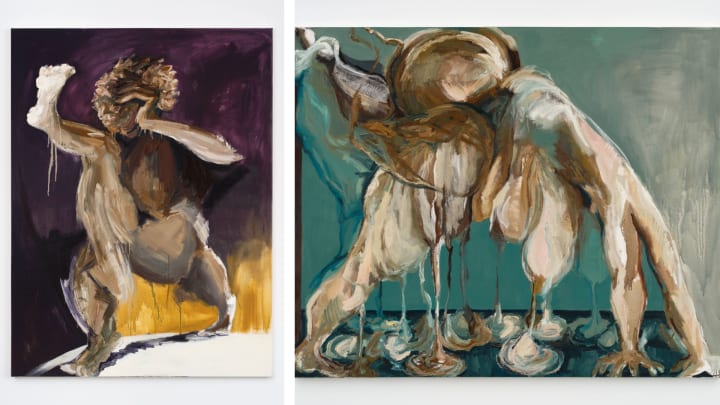
"[...] a cultural corpus, which in its varied scope and multiple profiles, becomes a locus and privileged environment for numerous poetics intertwined in aesthetic making. A body historically connoted through a pulsating language that, in its circuits of resonances, inscribes the emissary enunciating subject, its surroundings and ambiences in a specific circuit of expression, potency, and power."
- Leda Maria Martins in ‘Performances do Tempo-Espiralar: poéticas do corpo-tela’ (Orig. pt.)
With determination, the artist renders images that could likely not be appreciated anywhere other than in paint on canvas. With a reduced color range, volumes are suggested in skillful overlays of tones, transcribing the texture of skin, along with a vigorous light delineating bold contrasts. The intense light through the white tint and deep shadows constructed with black is another characteristic that permeates the works, uniting them within the series. With brushstrokes laden with gesture, bringing form and content closer, the works materialize the body and its multiple expressive possibilities when subjected to the artistic game of capoeira. Despite the evidently intense work with the brush in hand, Falcão bases her work on canvas on croquis and sketches on paper, making use of remarkable skill when working on this medium and exploring a method that blends rationality and artistic instinct. The impact of the canvases at first glance can disguise a complex and eloquent pictorial composition achieved by the artist. Capoeira is imbued with an imposing and innovative aspect, a rich reward determined by the challenge of transposing its movements into a static image. The eyes travel across the canvas like an inexhaustible journey of expressiveness and discoveries, from abstract details, where the artist's energetic and uninhibited gesture becomes more evident, to glimpses of limbs and parts of the anatomy that combine verisimilitude and personality in their making.
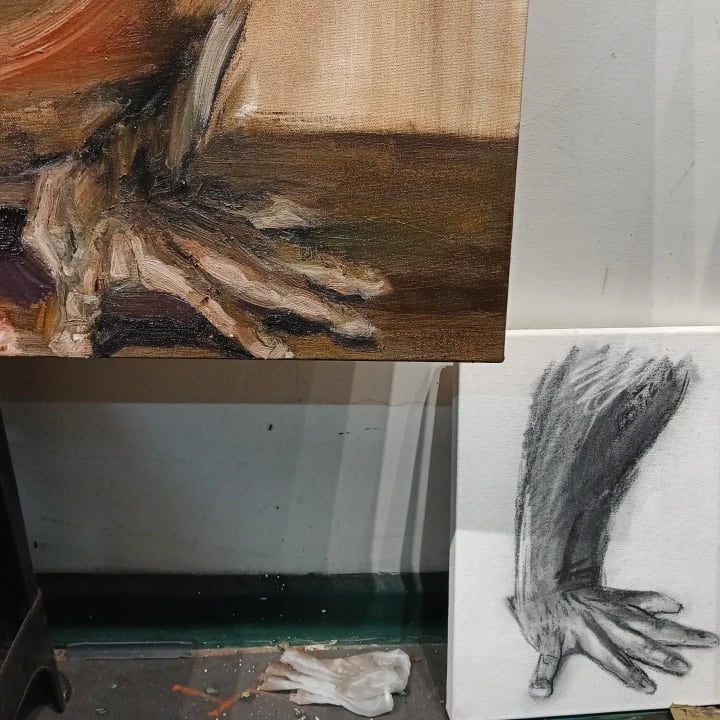
“[…] a Figure whose back is “diminished,” but whose leg is already complete, and another Figure whose torso has been completed, but who is missing one leg and whose other leg runs. These are monsters from the point of view of figuration. But from the point of view of the Figures themselves, these are rhythms and nothing else, rhythms as in a piece of music, […] ”
Gilles Deleuze em ‘Francis Bacon: The logic of sensation’
The initial impact of the canvases might conceal the complex pictorial composition achieved by the artist. Capoeira is imbued with an imposing and innovative aspect, a rich reward defined by Falcão's self-imposed challenge of transposing its movements into a static image. The eyes then journey through the works as an inexhaustible exploration of expressiveness and discoveries, from abstract details where the artist's energetic and uninhibited gesture becomes more evident to glimpses of limbs and anatomical parts that combine verisimilitude and personality in their execution.
Subjugating the background, making it a backdrop to the human anatomy, creating a support environment with colors and textures. Within the congested composition of the series ‘Capoeira em Paleta Alta,’ where, in the figure-ground relationship, the focus is on the bodies and consequently on the foreground, Falcão embraces the limitations and potentialities of the flat surface of the canvas, a paradigm that marked modern and contemporary painting. However, the balance of the composition as a whole depends on the meticulous treatment that the painter dedicates to this space, at times accentuating and diminishing the tone, employing textures, or fading them. In some pieces, however, there are brighter and more vibrant colors in the obstructed background, accentuating the play of light and shadow that, in turn, contributes to the oneiric and tenebrous aura of the work in addition to intensifying the prominence of the capoeiristas.
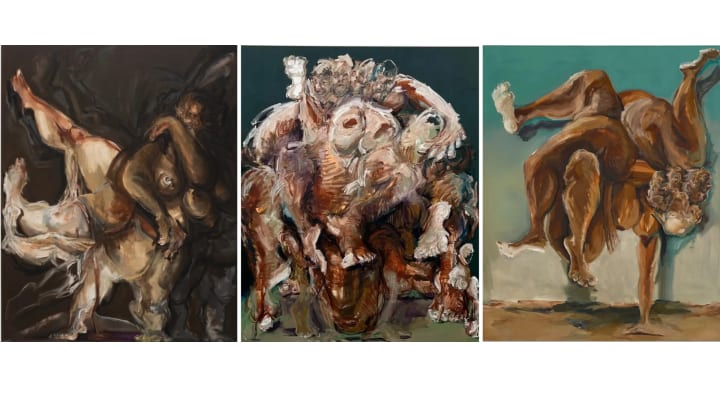
Present in contemporary literature as autofiction, being, summarily, a way for the artist to fictionalize, that is, to transform their personal experiences into an object laden with aesthetic value, Falcão delves into her inner world, starting from the body and returning to it. Thereby highlighting the precept of valuing the individual in artistic practice, a subjective norm present in the social and educational context of the visual arts, more evidently since the Italian Renaissance. By merging the non-standard body with the exoticism and complexity of capoeira, which oscillates between dance art, martial art, a game and which also incorporates music, philosophy, and historical relevance, Márcia Falcão undertakes and completes a unique challenge within contemporary visual arts in the country and, to our delight, is already skillfully playing in international circles as well.
About the Creator
Bruno Bispo
Passionate about advertising, design and art. You can read some of my writings about this subjects in English here on Vocal. If you prefer, read it in Portuguese here.
Keep reading
More stories from Bruno Bispo and writers in Art and other communities.
Whispers and Cries
"The great history painters created occasionally a portrait, out of love for glory, friendship, or great beauty, or even because powerful princes demanded their portrait or that of a favorite protégé; several masters, finally, painted their self-portrait." Jacob Burckhardt in ‘O retrato na pintura italiana do Renascimento’ (Orig. pt.)
By Bruno Bispoabout a year ago in Art
Dog Shoes for Small Dogs and Puppy Shoes A Practical, Paw-Friendly Guide
Small dogs and puppies may look tough, but their paws often need more protection than people realize. Their bodies are lighter, their paws are smaller, and many of them spend a lot of time on surfaces that were never designed for delicate paw pads. Add cold sidewalks, hot pavement, rough gravel, wet grass, or even slippery indoor floors, and you start to see why dog footwear has become more than just a cute trend.
By aliyashahzadi4 days ago in Art




Comments