
Whispers and Cries
The portraits and colors of voices no longer silenced in Jeff Alan's images.

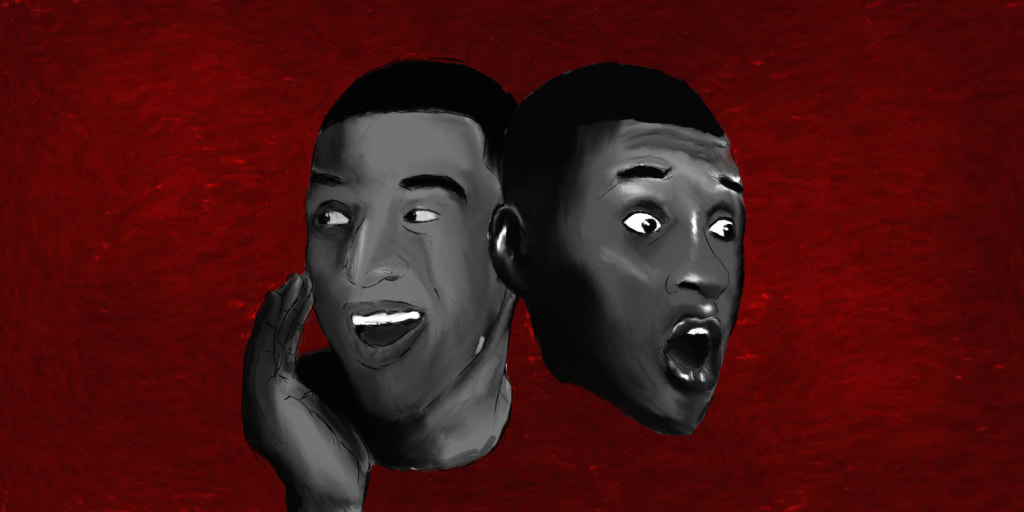
"The great history painters created occasionally a portrait, out of love for glory, friendship, or great beauty, or even because powerful princes demanded their portrait or that of a favorite protégé; several masters, finally, painted their self-portrait."
Jacob Burckhardt in ‘O retrato na pintura italiana do Renascimento’ (Orig. pt.)
A gag was tied to a portion of the Brazilian population for dozens of decades. However, is it still too early to believe in the loosening of this binding? Hearing the announcement of a new time embraced by a new song, however, already seems possible. And Jeff Alan's art is part of this chorus. Born and raised in the periphery of Greater Recife, the Pernambuco artist practices his craft in harmony with the people around him, acting as a catalyst for collective aspirations. Laden with a humanist motivation, Jeff dedicates his artistic production to those who have been historically underrepresented in various spheres, promoting their stories through portrait painting.
“Time has wrought some changes in the negro's face. All attempts to make him exactly like us have failed, though the general intention, it seems, is to make of him a blank page since he cannot turn a white face […] paradoxically, it is we who prevent this from happening […] uncontrollably, passionately, driven by an unconscious need to be absolved.”
James Baldwin in ‘Notes of a native son’ (Orig. pt.)
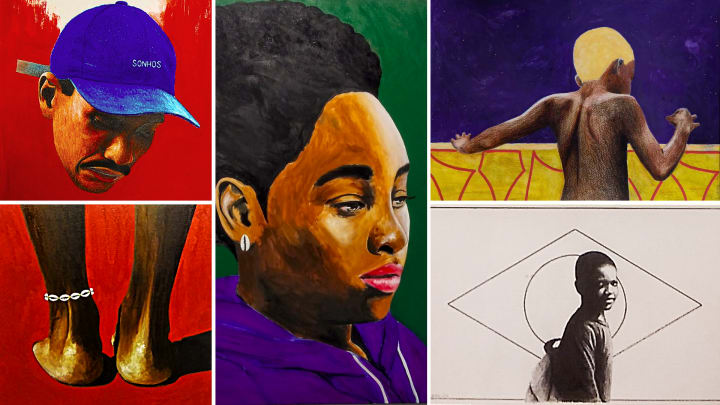
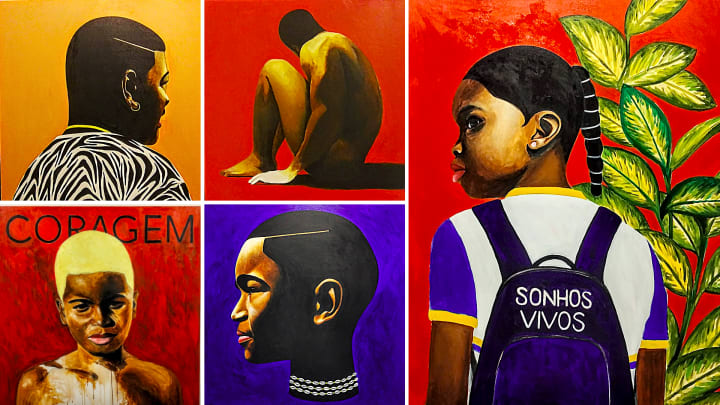
In the ‘Comigo Ninguém Pode’ exhibition, the public can appreciate the works recently emerged from the artist's studio in Barro, a neighborhood in the west zone of the Pernambuco capital. Some pictures will return to be finalized. Without setting aside the inherent activist tone, the paintings currently on display in São Paulo vocalize, through acrylic paint on canvas, a restorative yearning against social erasure. Despite featuring other variations of human representation beyond portraiture, the intent of identity affirmation echoes beyond the choice of the pictorial exhibition of young Black people, with the recurring incorporation of elements such as cowrie shells and clothing accessories into the images. The type of plant that names the exhibition, present in many homes in the region where Jeff lives and also in various others throughout the country, can also be seen in some examples. In addition to paint, drawings and mixed media works on paper are presented, where the artist integrates elements such as pixo (a specific type of Brazilian graffiti) and the national flag. In a culturally diverse country, Jeff reaches unique notes, firmly portraying a singular Brazilian identity.
“[…] in the West, since Antiquity, color has been systematically marginalized, reviled, diminished and degraded. Generations of philosophers, artists, art historians and cultural theorists of one stripe or another have kept this prejudice alive, warm, fed and groomed. As with all prejudices, its manifest form, its loathing, masks a fear: a fear of contamination and corruption by something that is unknown or appears unknowable.”
David Batchelor in ‘Cromophobia’
The faces depicted on the canvases have strong contrasts, suggesting a special attention from the artist to tonal composition during his artistic process. Colorblind, Jeff Alan discovered his condition during his architecture graduation, which led him to dedicate himself diligently to monochromatic studies, solidifying his technical foundation regarding this fundamental aspect of pictorial language. In the current phase of his production, the visual artist experiments with color while inspiring with the overcoming of his visual restriction. In short, in the collection that makes up the ‘Comigo Ninguém Pode’ exhibition, the color is vibrant and of varied hues, while the facial expressions are serious and closed, with a reddish coloration noticed in the eyes of the figures in some cases, imbuing the works with dramatic weight. Regardless of the reason for the occurrence of this phenomenon and the choice to represent them in this way, the ocular redness suggests a high emotional charge experienced by the people in the portraits. From afar, his works possess an intense chromatic richness, however, a somewhat more prolonged appreciation reveals the seriousness of the models. The dissonance between form and subject in these works gives shape to an aesthetic challenge that Jeff skillfully resolves."
“[…] they cause to emerge the network of significations that baptize it, determine it, fix it in the universe of discourses. Double trapdoor; inevitable snare: where, from now on, would escape the flight of birds, the transient form of flowers, the rain that flows?”
Michael Focault in ‘This is not a pipe’ (Orig. pt.)
Beyond the use of color, line, and subject choice, requiring great skill to achieve the evident quality of the presented work, the painter further expands the creative potential of his works by incorporating words in various ways. On clothing, accessories, or school uniforms, instead of the brand names or the logo of the Pernambuco public educational system, the word ‘dream’ is found. In other works, however, the words ‘courage,’ ‘power,’ and ‘dreams’ appear at the top, under the models, resembling magazine covers. In an even more explicit way, Jeff attributes unorthodox nomenclatures to most of the works, forcing the viewer to connect the dots in search of a connection between what is seen and read. Names and excerpts of songs, aphorisms, motivational or protest words and phrases create a strong synesthesia during the appreciation of the exhibition, increasing its cognitive and emotional impact.
The ‘Comigo Ninguém Pode’ exhibition is on display at Caixa Cultural until February 9, 2024. Follow Jeff Alan to keep up with his work.
About the Creator
Bruno Bispo
Passionate about advertising, design and art. You can read some of my writings about this subjects in English here on Vocal. If you prefer, read it in Portuguese here.
Keep reading
More stories from Bruno Bispo and writers in Art and other communities.
Noises in the scene
“The challenge to grand, unifying narratives and the centralized discourse of a universal art has extended to other marginalized groups, who have begun to redefine their place in the globalized cultural exchange. [...] these artists use their marginalized status as a starting point to create works that attest to the diversity of their sources and affirm their evolving identities.” — Maria Melendi in ‘Estratégias da arte em uma era de catástrofes’
By Bruno Bispoabout a year ago in Art
Valentino Garavani
In the golden age of couture, when fashion was less about speed and more about soul, one name quietly rose to become synonymous with timeless elegance: Valentino Garavani. To speak of Valentino is to speak of romance, discipline, beauty, and a lifelong devotion to the art of dressing the world’s most admired women.
By S.A Charlesabout 19 hours ago in Art



Comments
There are no comments for this story
Be the first to respond and start the conversation.