
The House That Whispers
Some houses don't just remember the dead — they hunger for the living.

Sometimes the past doesn’t just linger — it waits.
When Elena bought the old farmhouse at the edge of Ashridge Hollow, she thought she’d stumbled onto a miracle. A century-old home for less than the cost of a downtown studio? It was hard not to sign on the dotted line.
The real estate agent was evasive when she asked about its history. “It’s been empty a long time,” he said, too quickly. “Just needs some TLC.”
That suited her fine. After the divorce, she needed a place where no one knew her. No one remembered her husband’s betrayal. No one pitied her for staying so long.
The house was crooked, as if it had sunk deeper on one side. Paint peeled like sunburnt skin. Shutters hung by rusted nails. But the land was quiet, and Elena liked the quiet.
The first night, she told herself the creaking was normal. Old wood settled in strange ways. The sighing through the vents, the distant tapping — just drafts. She was jittery, that’s all. New place, unfamiliar sounds. The wind had a voice in these hills. She almost liked it.
But by the third night, the noises had taken on a pattern. They came from the walls. Faint and breathy. Murmuring.
Whispering.
She paused in the hallway, head tilted, breath caught. It was a woman’s voice. Barely audible.
“Leave…”
She blinked and shook it off. Too many hours unpacking. Not enough food. Not enough sleep. It was nothing.
Still, she left a light on in the hall.
The next morning, a picture she’d hung in the kitchen had fallen — glass shattered across the floor, frame split clean down the center. She blamed the old nails and dry plaster. But the photo itself — a black-and-white snapshot of her grandparents — had deep scratches across their faces, like claw marks.
That evening, she called a friend.
“Want to come by?” Elena said, trying to sound casual. “I could use a second opinion on… everything.”
Her friend, Monica, arrived with wine and a concerned smile. They drank on the porch as the sun sank behind the trees. Elena hesitated, then told her about the whispers. The cold spots. The mirror in the hall that sometimes seemed… off. Blurry. Delayed.
“You’re just lonely,” Monica said gently. “You need people. This place… it’s a lot.”
That night, Monica stayed over. She slept in the guest room — and left before dawn.
Elena found her car gone, the bed unmade, the pillow soaked with sweat. Monica wouldn’t answer texts for three days. When she finally replied, it was brief.
“Don’t go back down there. I’m serious. Sell the house.”
Elena hadn’t told her about the cellar.
It was locked when she moved in. The door swollen from moisture, sealed with layers of paint. She hadn’t tried to open it. She didn’t want to. But after Monica left, the urge grew. Like a splinter under the skin. Something beneath her feet had begun to move. She heard it sometimes at night — a soft dragging sound. Scraping.
She pried the door open one rainy morning. Flashlight in hand, she descended into the damp black. The air was thick with mildew and something else — metallic, coppery.
The walls were stone and dirt. But what struck her first were the marks. Symbols carved deep into the support beams, burned into the floorboards. Some crude. Some disturbingly precise.
She found the journal in a tin box under the stairs. Water-damaged, mold-stained, but still legible. The name inside: Silas Morn, 1952.
The entries were rambling. Paranoid. He wrote of shadows in the corners. Cold fingers touching his face at night. Voices that wouldn’t stop.
In the final entry, scrawled across several pages:
“The house knows. The house watches. The house feeds. I see them in the dirt. The walls are not walls. The air is full of teeth.”
Elena shut the book and backed up the stairs.
For days, she couldn’t sleep. The whispers grew louder. More insistent.
“Elena… come down…”
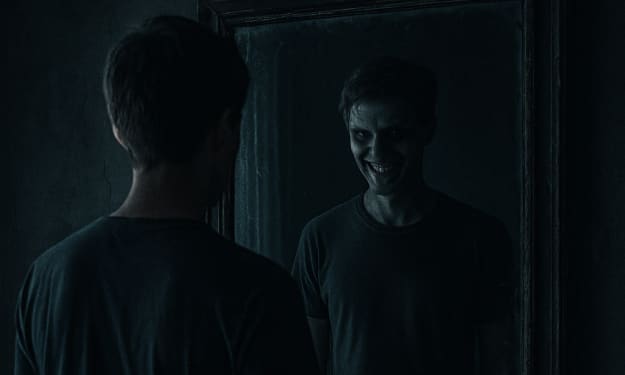
Her reflection in the hall mirror began to lag behind. Just a second. But enough. Enough to make her turn away, every time.
She tried to leave once. Bags packed, car running. But as she backed out of the driveway, she saw someone standing in the upstairs window.
A woman. Pale. Motionless. Watching.
There was no one upstairs.
She told herself it was a trick of the light. She turned the car off and carried her bags back inside.
The next night, the cellar door was open.
Not wide. Just enough.
She stood at the top, staring into the dark. The flashlight was already in her hand. She didn’t remember picking it up.
“Elena…” the voice said, clearer than ever. Closer.
Her fingers gripped the railing. Her feet moved on their own.
She descended.
No screams echoed that night. No frantic footsteps. Just the wind brushing through the trees. Just silence.
Later, the neighbors would notice the house seemed… quieter. As though it had settled, finally. At peace.
Until the next voice moved inWeeks later, a For Sale sign went up again.
A young couple came to view the property. The agent — the same one who sold it to Elena — smiled too wide, his handshake too firm.
“It’s been recently vacated,” he said. “Previous owner left in a hurry. Some family emergency, I think.”
The wife wandered toward the hall mirror, frowning. “Feels… strange in here.”
“Old houses have character,” the agent said.
In the basement, beneath the thin layer of dirt, something watched. Something waited.
And upstairs, behind the glass, Elena’s reflection still stood — smiling.
About the Creator
Keep reading
More stories from Hamza khan and writers in Art and other communities.
Affection and Healing for Yourself
During the night of the last quarter moon, I gathered my ritual supplies. I carefully handled the chunk of black tourmaline that would protect me from your overall negative and narcissistic energy. I carefully walked the house with my stick of selenite in hand, asking the universe to cleanse our working space.
By Alisha Wilkins ✒️🦋🖋️a day ago in Fiction



Comments
There are no comments for this story
Be the first to respond and start the conversation.