
Z-Image vs. GLM-Image
Which AI Image Generator Reigns Supreme?

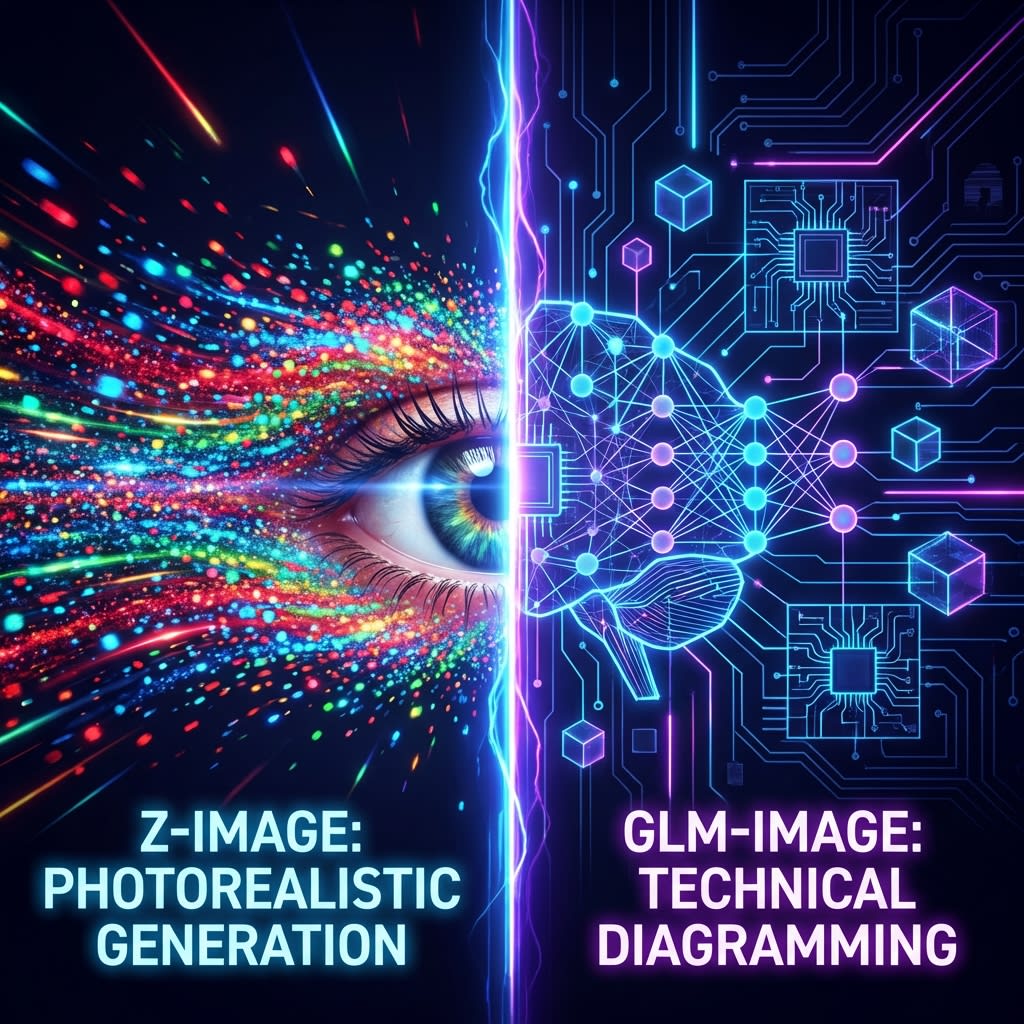
The landscape of AI image generation is evolving at a breakneck pace. Just when we thought we had seen it all with stable diffusion, new contenders emerge, pushing the boundaries of speed, fidelity, and semantic understanding. Two of the most talked-about models recently are **Z-Image** and **GLM-Image**. Both promise to revolutionize how we create digital art, but they take drastically different approaches.
In this deep dive, we’ll compare Z-Image and GLM-Image to help you decide which one fits your creative workflow.
Z-Image: The Speed Demon
Z-Image has been making waves primarily for its incredible efficiency. Built on a Scalable Single-Stream Diffusion Transformer (S3-DiT) architecture, it represents a significant departure from the traditional U-Net designs we’ve seen in earlier models.
Key Features
- Blazing Fast Generation: The "Turbo" variant is capable of generating high-quality images in sub-second times on consumer hardware.
- Photorealism: It excels at creating lifelike textures and lighting, making it perfect for photorealistic outputs.
- Efficiency: Z-Image serves as a highly efficient AI image generator, requiring fewer resources to produce stunning results.
The real game-changer here is the Z-Image Turbo technology. By optimizing the diffusion process into a single stream, it cuts down inference steps dramatically without sacrificing quality. For artists who need to iterate quickly or for applications requiring real-time generation, Z-Image is hard to beat.
GLM-Image: The Semantic Architect
On the other side of the ring, we have GLM-Image. Developed by Z.ai, this model takes a hybrid approach, combining a massive 9-billion parameter autoregressive model with a 7-billion parameter diffusion decoder.
Key Features
- Deep Semantic Understanding: Thanks to its LLM roots, it understands complex prompts and nuances better than most competitors.
- Text Rendering: It is exceptionally good at rendering accurate text within images, a common stumbling block for diffusion models.
- Complex Layouts: It can plan image layouts logically, ensuring that elements are placed exactly where you want them.
GLM-Image is less about raw speed and more about precision and "reasoning." It builds the image by first "understanding" the scene structure and then painting the details.
Conclusion
So, which one should you choose?
If your priority is speed and photorealism, especially for running locally on consumer GPUs, Z-Image is the clear winner. Its ability to churn out high-quality images almost instantly changes the dynamic of creative iteration. You can try the Z-Image Turbo features to see this speed in action.
However, if you are designing complex posters, infographics, or scenes requiring precise text, GLM-Image offers a level of control and semantic accuracy that is currently unmatched.
Ultimately, we are lucky to have both options. The future of AI art isn't about one model ruling them all, but about having the right tool for the job.
Have you tried Z-Image or GLM-Image yet? Share your experiences in the comments below!
About the Creator
TimDok
AI Explorer
'Till Death We Do Art
There would be nothing divine in this world without art. Nature may surpass the divine to all intents and purposes, but like everything it absorbs and is absorbed by, it remains here, stuck on the surface of this world, ever-present, physically bound to the universe.
By Avocado Nunzella BSc (Psych) -- M.A.P 21 days ago in Art
Things to do in Casablanca:
Casablanca is one of lovely destinations around Morocco. Casablanca is considered the largest city in Morocco. It's famously known for its historic attractions, cultural sites and natural landscapes. Additionally, the city is well- known for its clean beaches offering visitors a lifetime experience. This blog cover the top things to do in Casablanca:
By Othmane Anaam6 days ago in Art




Comments
There are no comments for this story
Be the first to respond and start the conversation.