Painting
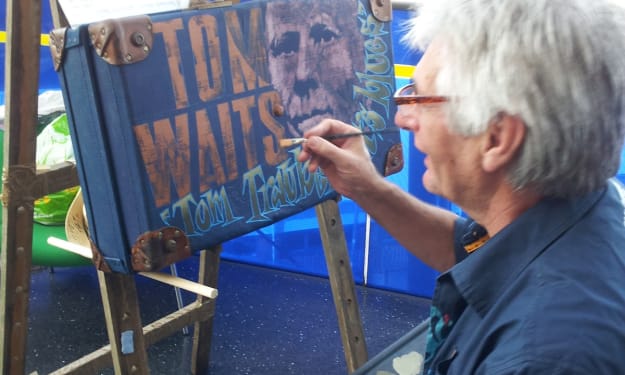
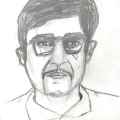
The Art Of Geoff Marston
Introduction This is a Seven Days In post that keeps getting a lot of reads so I thought I would share this amazing original artwork with you. I think I only met Geoff twice. This was the second time I met him and I have not seen him since and can't find any sign of him online.
By Mike Singleton 💜 Mikeydred 11 months ago in Art
Blue!
The color blue has always held a strange power over me. It’s not just a color—it’s an experience, a feeling, a presence that stretches across time and space, deeply embedded in the human psyche. I’ve come to realize that blue isn’t merely about the visual—it’s about what it represents, how it speaks to us. From books to paintings, blue is omnipresent, a thread that intertwines stories and images, ideas and emotions, through the centuries. Let me take you on its journey, as I have experienced it, learned it, and heard it speaking to me in art.
By Rezwanul Haque 11 months ago in Art
The Evolution of Art . AI-Generated.
A Journey Through Creativity and Expression: Art's enduring essence For millennia, art has been a part of human civilization because it reflects culture, feelings, and imagination. Art has shaped societies and inspired generations, from prehistoric cave paintings to contemporary digital works. The essence of art is still the same: a profound means of expression, communication, and emotional connection, despite changes in its forms and mediums. The Development of Art Art dates back to the earliest human societies, with cave paintings from over 17,000 years ago found in places like Lascaux, France. These simple but profound illustrations were probably made for stories, rituals, or to record everyday life. The magnificence of Egyptian hieroglyphs, the sculptures of Ancient Greece, and the frescoes of the Renaissance are all results of the development of artistic techniques as civilizations advance. One of the most transformative periods in art history is frequently referred to as the Renaissance (14th–17th centuries). Perspective, anatomy, and realism were brought to painting and sculpture by masters like Raphael, Michelangelo, and Leonardo da Vinci. The transition from religiously centered art to explorations of humanism, science, and nature took place during this time. In the 19th and 20th centuries, art became a place where experimentation was encouraged. Surrealism, Impressionism, Cubism, Surrealism, and Abstract Expressionism all broke with conventional wisdom and allowed for individual interpretations. Work by Jackson Pollock, Pablo Picasso, Claude Monet, and Salvador Dal defied conventional aesthetics and pushed boundaries.
By Iraz Ahmed11 months ago in Art