History
The Beauty Battle: Rhode vs. e.l.f. – Hailey Bieber, Net Worth & the Cosmetic Industry . AI-Generated.
Welcome to the world where glam meets genius, and skin is the ultimate currency. The beauty industry is exploding, and two brands are turning heads: Rhode, founded by Hailey Bieber, and e.l.f. Cosmetics, the budget-friendly empire. Whether you're obsessed with Hailey’s glazed-donut skin or loyal to e.l.f.’s viral dupes, this showdown has it all – celebrity power, market moves, and millions in net worth.
By Kandage Vimukthi Reshan Dulakshana8 months ago in Art
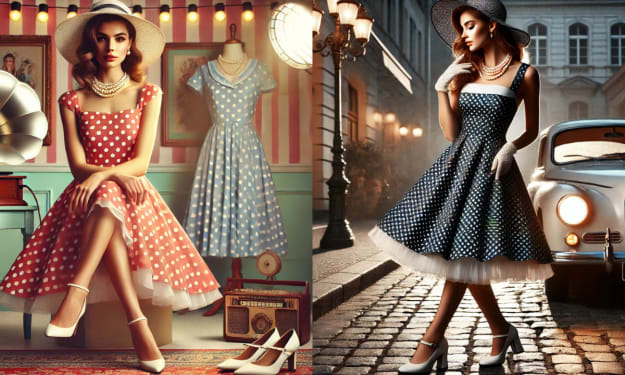
Retro Style Dress to Impress: The Ultimate Guide for a Fashionable Style.
Embracing a retro style dress to impress is a delightful way to infuse your wardrobe with timeless charm. By blending vintage elements with contemporary fashion, you can create standout looks that exude confidence and individuality.
By Shekh Sakil8 months ago in Art
The Weight of a Son’s Love. AI-Generated.
Life had never been kind to Abdul Raheem. At just fifteen years old, he lost his father, leaving behind a coughing, ailing mother and two younger brothers who were too innocent to understand the gravity of their suffering. Overnight, the weight of survival fell on his thin shoulders. There was no money, no food—only the gnawing hunger in their stomachs and the fear of what tomorrow would bring.
By Rafi Ullah Khan 8 months ago in Art
The Man from Taured – A Mystery at Tokyo Airport
In the sweltering heat of July 1954, Tokyo’s Haneda Airport buzzed with the usual crowd of businessmen, tourists, and diplomats arriving from around the globe. Among them was a sharply dressed man in his mid-40s. He appeared European, polite, and fluent in several languages, including Japanese. There was nothing remarkable about him—until he handed over his passport at customs.
By Muhammad Saeed8 months ago in Art
The "Last Da Vinci" Mysteries and the $450 Million "Salvator Mundi"
Introduction Leonardo da Vinci's Salvator Mundi, or "Savior of the World," sold for a record-breaking $450.3 million in November 2017 at Christie's New York, making it the most expensive painting ever sold at auction. The sale not only captivated the general public, but it also sparked ferocious arguments among scholars, art historians, and collectors. Was this Leonardo da Vinci's lost masterpiece, or was it a work that was overhyped and lacked authenticity?
By Silas Blackwood8 months ago in Art
Traditional Music of the Indian Subcontinent
Traditional Music of the Indian Subcontinent: A Symphony of Heritage The Indian subcontinent boasts a rich musical legacy spanning millennia, deeply intertwined with its cultural, spiritual, and social fabric. Rooted in ancient Vedic traditions and shaped by diverse regional and historical influences, its music reflects a harmonious blend of melody, rhythm, and improvisation. This article explores the key traditions, instruments, and philosophies that define the subcontinent’s musical identity.
By MD. HEDAYTUN NABI8 months ago in Art
What Is Contemporary Art?
Introduction Contemporary art is a dynamic and ever-evolving field that reflects the ideas, concerns, and innovations of the present time. Unlike traditional art forms, which often adhere to established techniques and styles, contemporary art pushes boundaries, challenges conventions, and engages with modern society in thought-provoking ways. But what exactly defines contemporary art? How does it differ from modern art? And why is it so diverse and sometimes controversial? This article explores the meaning of contemporary art, its key characteristics, major movements, influential artists, and its significance in today's world. Defining Contemporary Art Contemporary art refers to art created in the late 20th and early 21st centuries, roughly from the 1970s to the present day. Unlike "modern art," which generally covers the period from the 1860s to the 1970s, contemporary art is rooted in the current era and responds to today's cultural, political, and technological landscape. One of the defining features of contemporary art is its lack of a single dominant style. Instead, it embraces a wide range of mediums, including painting, sculpture, installation, digital art, performance, video, and conceptual works. This diversity reflects the globalized, interconnected world we live in, where artists draw inspiration from various cultures, histories, and disciplines. Key Characteristics of Contemporary Art Contemporary art is known for several defining traits: 1. Conceptual Focus Many contemporary artists prioritize ideas over aesthetics. The meaning behind the artwork is often more important than its visual appeal. Conceptual art, for example, challenges viewers to think critically about the message rather than just admire the craftsmanship. 2. Breaking Traditional Boundaries Contemporary artists frequently experiment with unconventional materials and techniques. They may combine digital media with traditional painting, use found objects in sculptures, or create immersive installations that transform entire spaces. 3. Engagement with Social and Political Issues A significant aspect of contemporary art is its commentary on current events, such as climate change, identity politics, migration, and technology. Artists like Ai Weiwei, Banksy, and Kara Walker use their work to critique power structures and advocate for social justice. 4. Global and Multicultural Influences With the rise of globalization, contemporary art incorporates diverse perspectives from around the world. Artists from Africa, Asia, Latin America, and the Middle East have gained prominence, enriching the art world with new narratives and traditions. 5. Use of New Technologies Digital art, virtual reality (VR), artificial intelligence (AI), and NFTs (non-fungible tokens) have become integral to contemporary art. Artists like Beeple and Refik Anadol explore how technology shapes human experience and creativity. Major Movements in Contemporary Art While contemporary art is highly diverse, several influential movements and trends have emerged: 1. Postmodernism (1970s–1990s) Postmodernism rejected the rigid rules of modernism, embracing irony, pastiche, and hybridity. Artists like Cindy Sherman and Jeff Koons played with identity, consumer culture, and media representations. 2. Street Art and Graffiti (1980s–Present) Originating from urban subcultures, street art has become a legitimate form of contemporary expression. Banksy, Shepard Fairey, and Jean-Michel Basquiat brought graffiti into galleries, blending activism with aesthetics. 3. Installation and Performance Art (1990s–Present) Artists like Yayoi Kusama and Marina Abramović create immersive environments and live performances that engage audiences physically and emotionally. 4. Digital and New Media Art (2000s–Present) With advancements in technology, artists now use software, 3D printing, and AI to create interactive and digital works. TeamLab and Rafael Lozano-Hemmer are pioneers in this field. 5. Social Practice Art (2010s–Present) This movement emphasizes collaboration and community engagement. Artists work directly with people to address social issues, blurring the line between art and activism. Influential Contemporary Artists Several artists have shaped contemporary art with their innovative approaches: Ai Weiwei – A Chinese dissident artist known for his political activism and large-scale installations. Yayoi Kusama – Famous for her infinity mirror rooms and polka-dot motifs, exploring themes of infinity and mental health. Damien Hirst – A leading figure in the Young British Artists (YBA) movement, known for controversial works like The Physical Impossibility of Death in the Mind of Someone Living (a shark in formaldehyde). Kara Walker – Explores race, gender, and history through silhouettes and provocative installations. Olafur Eliasson – Creates environmental and light-based installations that challenge perceptions of nature and space. Why Is Contemporary Art Sometimes Controversial? Contemporary art often sparks debate because it challenges norms and provokes strong reactions. Some common reasons for controversy include: Shock Value – Artists like Andres Serrano (Piss Christ) and Maurizio Cattelan (Comedian, the banana duct-taped to a wall) use provocative imagery to critique religion, consumerism, and art itself. Ambiguity – Unlike traditional art, contemporary works may not have a clear meaning, leaving viewers puzzled or frustrated. Political Statements – Art that critiques governments, corporations, or social issues can attract censorship or backlash. Despite—or perhaps because of—these controversies, contemporary art remains a powerful medium for questioning reality and inspiring change. The Role of Contemporary Art in Society Contemporary art serves multiple functions in today's world: Cultural Reflection – It mirrors societal values, conflicts, and aspirations. Innovation – Artists experiment with new forms, pushing the boundaries of creativity. Education – Museums, galleries, and public art projects foster dialogue and critical thinking. Economic Impact – The art market, including auctions and NFTs, generates billions, influencing global economies.
By Silas Blackwood8 months ago in Art
The Work of Art in the Age of Mechanical Reproduction
Introduction Walter Benjamin’s seminal essay, The Work of Art in the Age of Mechanical Reproduction (1936), remains one of the most influential texts in the fields of art theory, media studies, and cultural criticism. Written during the rise of fascism in Europe, Benjamin explores how technological advancements—particularly photography and film—have transformed the nature of art, its reception, and its political implications. Benjamin argues that mechanical reproduction strips artworks of their "aura," a unique presence tied to their originality and historical context. This shift has profound consequences for art’s role in society, democratizing access while also making art a tool for political manipulation. This article examines Benjamin’s key concepts, their relevance in contemporary media, and the ongoing debate about authenticity and reproduction in the digital age. 1. The Concept of the "Aura" At the heart of Benjamin’s argument is the idea of the aura—an artwork’s unique presence in time and space. Traditional art, such as a Renaissance painting or a Greek sculpture, possesses an aura because it is tied to a specific history, ritual, and authenticity. For example, the Mona Lisa is not just an image; it is an object with a singular existence in the Louvre, bearing the marks of its creation by Leonardo da Vinci. Benjamin writes: "Even the most perfect reproduction of a work of art is lacking in one element: its presence in time and space, its unique existence at the place where it happens to be." Mechanical reproduction (photography, film, lithography) destroys this aura by making artworks infinitely replicable. A poster of the Mona Lisa lacks the aura of the original because it is detached from its historical and ritualistic context. 2. The Rise of Mechanical Reproduction Benjamin traces the historical shift from handmade art to mass-produced images: Pre-Industrial Art: Before the 19th century, art was primarily unique, tied to religious or aristocratic patronage. Photography (19th Century): The invention of the camera allowed exact reproductions of reality, challenging painting’s dominance. Film (Early 20th Century): Cinema introduced moving images, editing, and mass distribution, further diminishing the aura. Unlike a painting, which is a singular object, a film exists in multiple copies, shown simultaneously in different theaters. This reproducibility changes how audiences engage with art—no longer through contemplation (as with a painting) but through distraction (as with movies). 3. Art, Politics, and Mass Culture Benjamin argues that the loss of aura has political consequences. In the past, art was tied to ritual (religious icons, royal portraits); now, it serves mass consumption and propaganda. A. Fascism and the Aestheticization of Politics Fascist regimes (like Nazi Germany) used mass media to create spectacle—rallies, films, and posters—that glorified power while suppressing critical thought. Benjamin warns: "Fascism attempts to organize the newly created proletarian masses without affecting the property structure which the masses strive to eliminate. Fascism sees its salvation in giving these masses not their right, but instead a chance to express themselves." By turning politics into an aesthetic experience, fascism manipulates public emotion rather than engaging in rational discourse. B. Communism and the Politicization of Art In contrast, Benjamin suggests that communism should respond by politicizing art—using mass media (like Soviet montage cinema) to raise class consciousness rather than reinforce oppressive structures. 4. The Shift from Cult Value to Exhibition Value Benjamin distinguishes between two functions of art: Cult Value: Art as part of ritual (e.g., religious icons, masks used in ceremonies). Exhibition Value: Art made for public display (e.g., galleries, cinemas). Mechanical reproduction shifts art from cult value to exhibition value. A statue once worshipped in a temple becomes a museum artifact; a film is made for mass audiences, not private ritual. 5. The Role of Film and Photography Benjamin sees film as the ultimate example of mechanical reproduction’s effects: Destruction of Aura: Unlike theater (where each performance is live), film is edited, replicated, and viewed in fragments. New Modes of Perception: Film introduces techniques like close-ups and slow motion, altering how we see reality. Mass Participation: Anyone can be filmed, turning ordinary people into actors (e.g., newsreels, home videos). Photography also changes art by making exact reproduction possible. A photograph of a mountain is not the mountain itself but a detached image, lacking the aura of an original landscape painting. 6. Contemporary Relevance: Digital Reproduction and the Internet Benjamin’s ideas remain crucial in the digital age: A. The Death of the Aura in the Internet Age Social Media: Images are endlessly copied, shared, and modified (e.g., memes, digital art). NFTs and Digital Art: Some argue that NFTs (non-fungible tokens) attempt to restore aura by creating "unique" digital ownership, but Benjamin might see this as an illusion since the image itself remains infinitely reproducible. B. Art as a Tool for Political Control Algorithmic Censorship: Governments and corporations control digital art distribution. Deepfakes and AI Art: Mechanical reproduction reaches new levels with AI-generated images, raising questions about authenticity. C. The Democratization of Art Accessibility: More people can create and share art (e.g., YouTube, TikTok). Loss of Authority: The line between professional and amateur art blurs. 7. Criticisms and Counterarguments While Benjamin’s essay is groundbreaking, some critiques include: Overemphasis on Aura: Some argue that aura was always an elite concept, and mass reproduction liberates art from exclusivity. Nostalgia for Originality: Digital artists embrace remix culture, where originality is less important than creativity in recombination. Technological Optimism: Benjamin underestimates how capitalism commodifies even reproduced art (e.g., streaming platforms controlling film distribution). Conclusion Benjamin’s The Work of Art in the Age of Mechanical Reproduction remains a vital text for understanding how technology transforms culture. The loss of aura has democratized art but also made it a tool for political control. In today’s digital landscape—where images are endlessly copied, altered, and weaponized—Benjamin’s warnings about fascist aesthetics and the power of mass media are more relevant than ever. As we navigate AI-generated art, virtual reality, and algorithmic curation, Benjamin’s insights urge us to question: What is lost when art is detached from its original context? And how can we ensure that mechanical reproduction serves liberation rather than oppression? Final Thought "Mechanical reproduction emancipates the work of art from its parasitical dependence on ritual." —Walter Benjamin
By Silas Blackwood8 months ago in Art