


Artist Rembrandt Van Rijn, best known as Rembrandt, was a Dutch painter in the 17th century. The Baroque style came shortly after the Renaissance, and Rembrandt was influenced by some of the most prolific Italian artists who had arrived in the Netherlands a century before.
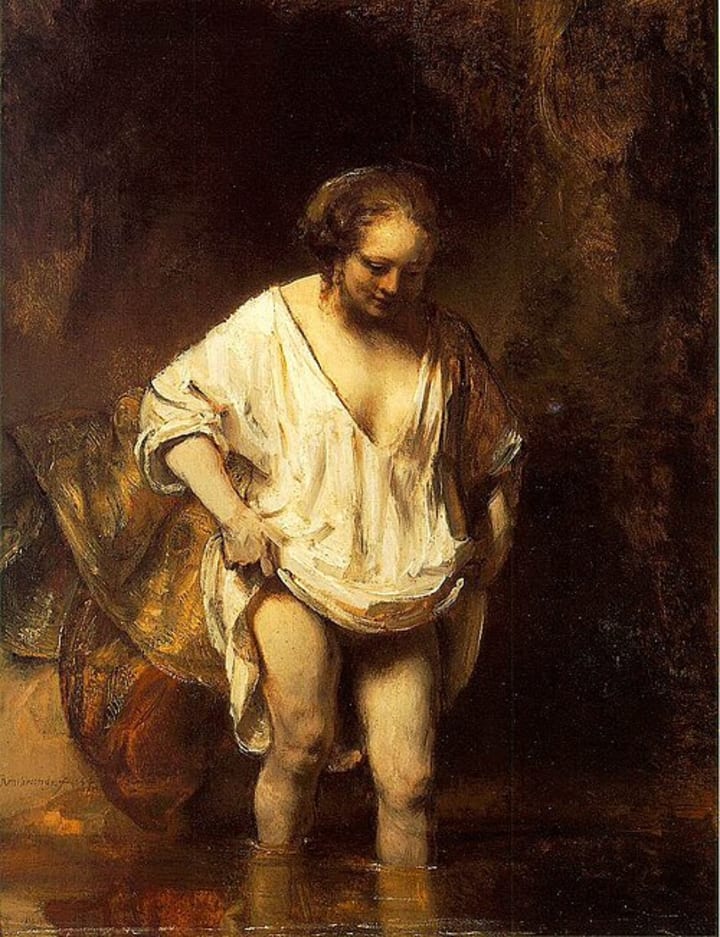
“A Woman Bathing in a Stream” was created in 1654 and is among the artist’s most intimate artworks. It depicts a young woman stepping carefully into water with soft lighting to create a sense of quiet solitude. It shows Rembrandt’s creative use of light and shadow.
Aristotle with a Bust of Homer is an artwork created in 1653 and is one of Rembrandt’s most profound and philosophical artworks. The painting depicts the Greek philosopher Aristotle placing his hand on the bust of the blind poet Homer. The painting explores themes of knowledge, legacy, and the relationship between material wealth and intellectual achievement.
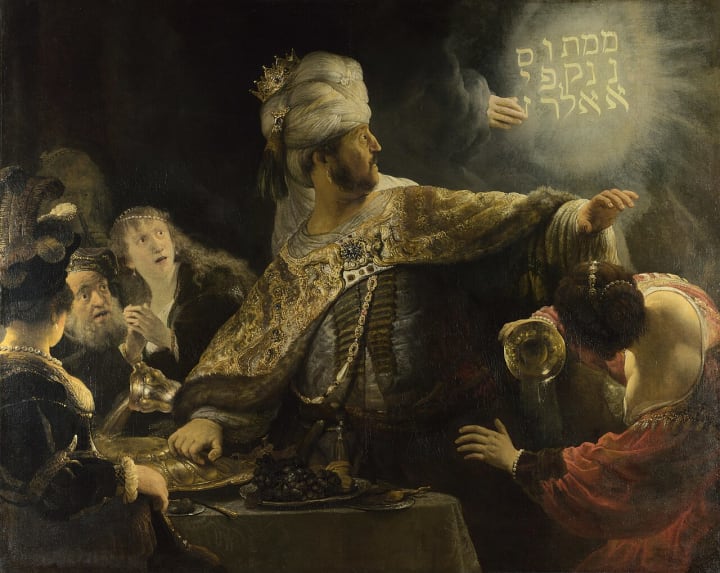
Belshazzar’s Feast is an artwork created by Rembrandt to establish himself as an artist of huge, Baroque historical paintings. The story of Belshazzar and the writing on the wall originated in the Old Testament Book of Daniel. The Babylonian king Nebuchadnezzar looted the Temple in Jerusalem and stole sacred artifacts like golden cups. His son Belshazzar used the cups for a great feast where the hand of God appeared and wrote the inscription on the wall prophesying the downfall of Belshazzar’s reign—“mene“, mene, tekel, u-farsin.” Biblical scholars interpret this to mean "God has numbered the days of your kingdom and brought it to an end; you have been weighed in the balances and found wanting; your kingdom is given to the Medes and Persians."

Danae is a life-sized representation of the Greek mythological heroine Dana, who was the mother of Perseus. She is presumably depicted as welcoming Zeus, who impregnated her in the form of a shower of gold. Although Rembrandt’s wife Saskia was originally the model, he eventually replaced her face with that of his lover Geertje Dircx.

Self-Portrait with Two Circles is among Rembrandt’s most enigmatic self-portraits. It depicts the artist standing with a palette, brushes, and a maulstick, gazing out with an intense and contemplative expression. In the background are two incomplete circles.

The Jewish Bride: This painting depicts a passionate meeting between two lovers. The artwork shows a man holding a lady tenderly. As she puts her hand over his, they do not look at each other.

The Night Watch was created in 1642 and is among Rembrandt’s most famous paintings. This artwork depicts the municipal militia guards, headed by Captain Banning, getting ready to march out from their barracks. The painting is known for its dramatic use of light and shadow to draw the viewer’s attention to the main protagonists. The artwork is in the Rijksmuseum in Amsterdam.
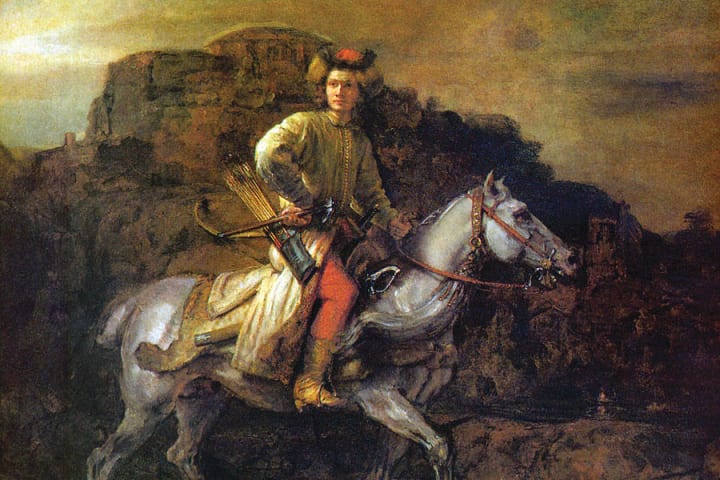
The Polish Rider was created in 1655. The painting depicts a lone horseman dressed in exotic Eastern European attire, riding through a rugged landscape. The artwork is made more dramatic with Rembrandt’s use of light and shadow, with the rider emerging from the dark background with great detail paid to the horse.

The Return of the Prodigal Son is an artwork that depicts one of Jesus’ most well-known parables, where the parent and son reconcile. The artist completed this artwork in 1669. According to the story in the Bible, the Prodigal Son departed from his father’s house with his early inheritance and returned years later poor and begging to be let back into the family home as a servant because he no longer felt worthy of his father’s dignity. However, his father welcomes him with open arms and rejoices that he has returned. In this painting, we see the moment of the Prodigal Son’s return, kneeling before his father for forgiveness.

The Storm on the Sea of Galilee tells the Biblical story of Jesus calming the storm on the Sea of Galilee from Mark’s fourth chapter. The vertical format of the artwork depicts a close-up perspective of Christ’s disciples desperately attempting to recover control of their fishing boat in the face of a fierce storm.
About the Creator
Rasma Raisters
My passions are writing and creating poetry. I write for several sites online and have four themed blogs on Wordpress. Please follow me on Twitter.
Keep reading
More stories from Rasma Raisters and writers in Art and other communities.
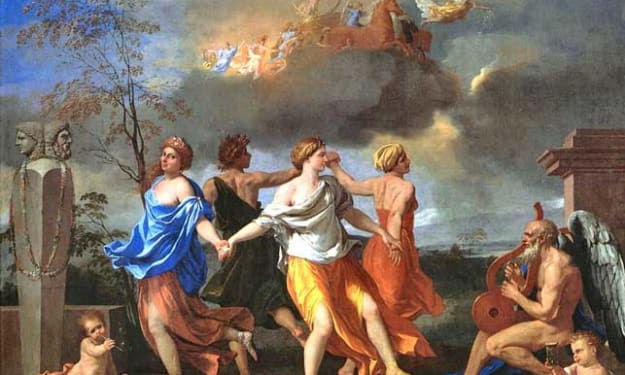
Popular Artwork by Nicolas Poussin
Baroque artist Nicolas Poussin moved from France to Rome during the 1620s and made a name for himself in the world of art in Rome. He became well-known for his creations of mythological and religious subjects. His paintings became one of the main inspirations for neoclassical artists like Jacques-Louis David.
By Rasma Raisters2 months ago in Art
Male Tattoo Artist Roles in Contemporary Tattoo Culture
Walking into a studio today feels very different from the old days of loud music and tough talk. Modern tattoo shops can be calm, warm and welcoming, and the person guiding you through the whole process is often a male tattoo artist who takes his job very seriously.
By Tools of Trade Studios4 days ago in Art


Comments
There are no comments for this story
Be the first to respond and start the conversation.