
Popular Artwork by Nicolas Poussin
Baroque artist

Baroque artist Nicolas Poussin moved from France to Rome during the 1620s and made a name for himself in the world of art in Rome. He became well-known for his creations of mythological and religious subjects. His paintings became one of the main inspirations for neoclassical artists like Jacques-Louis David.
A Dance to the Music of Time is a painting commissioned by Giulio Rospigliosi, who later in life became Pop Clement IX. The painting depicts four people dancing in a circle while an allegorical representation of time plays the lyre. In the background are Aurora, the goddess of dawn and Apollo, the sun god, being pulled by a chariot.

Blind Orion Searching for the Rising Sun is a painting depicting the mythological figure of Orion, who is blind and looking for the rising sun. He was a huntsman placed among the stars by Zeus, forming the constellation of the same name. This artwork was completed in the final decade of Poussin’s life.

Et in Arcadia is also known as The Arcadian Shepherds. It depicts a pastoral scene featuring several shepherds wearing ancient clothes. Arcadia is a locality in Greece that became a synonym for pastoral harmony. This artwork, created around 1637-1638, depicts a group of shepherds discovering a tomb in a pastoral landscape, symbolizing the theme of mortality and the fleeting nature of life.

Landscape with Saint John on Patmos is among several landscape paintings by Poussin. This painting depicts Saint John, who was banished to Patmos, a Greek island in the Aegean Sea. He is writing the Book of Revelation, the final book of the New Testament. In the background, ancient monuments can be seen.

The Abduction of the Sabine Women also creates a Roman mythological story. The story is about young women and girls from neighboring areas who were massively abducted by Roman men. The abduction was done by Romulus, the legendary founder of Rome, and his followers. This was initiated by a new law imposed by the Sabines in which their women couldn’t marry Romans.

The Death of Germanicus is a painting commissioned by Francesco Barberini, the nephew of Pope Urban VIII. The artwork depicts the death of an important Roman general named Germanicus. He was the brother of the Roman Emperor Claudius. His name was derived from important victories in Germania, a historical region in north-central Europe during the Roman era.
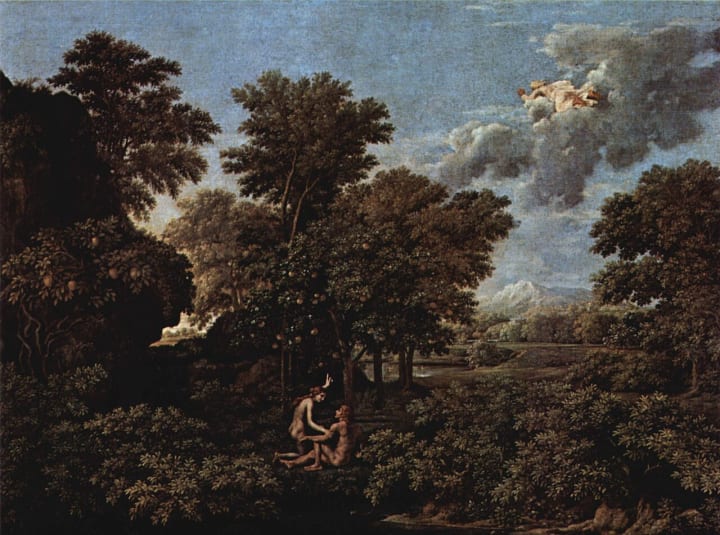
The Four Seasons is a collection of four oil paintings and the final paintings created by Poussin before his death in 1665. He created allegorical paintings of spring, summer, autumn, and winter, featuring figures from the Old Testament.


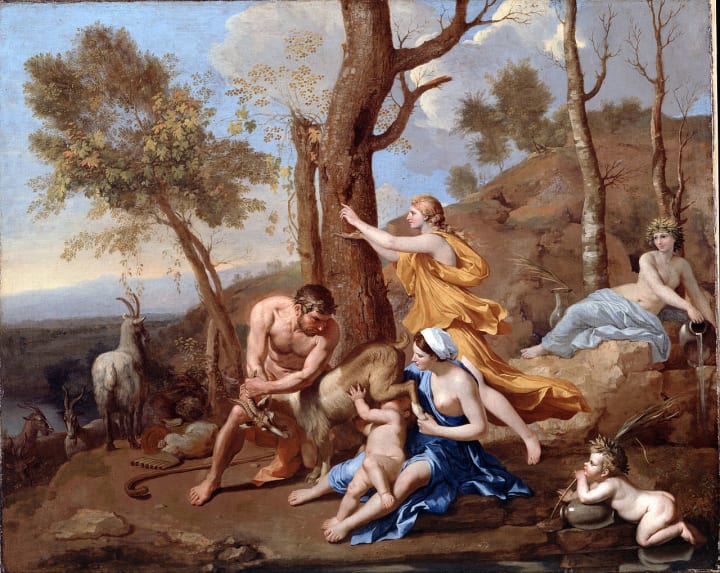
The Nurture of Jupiter is also known as The Childhood of Jupiter. This artwork depicts the infant Jupiter, the son of Saturn, and his wife, who gave birth to him in a hiding place on the modern-day island of Crete. The viewer can see Jupiter fed milk from the goat Amalthea. The scene unfolds on Mount Ida in Crete.
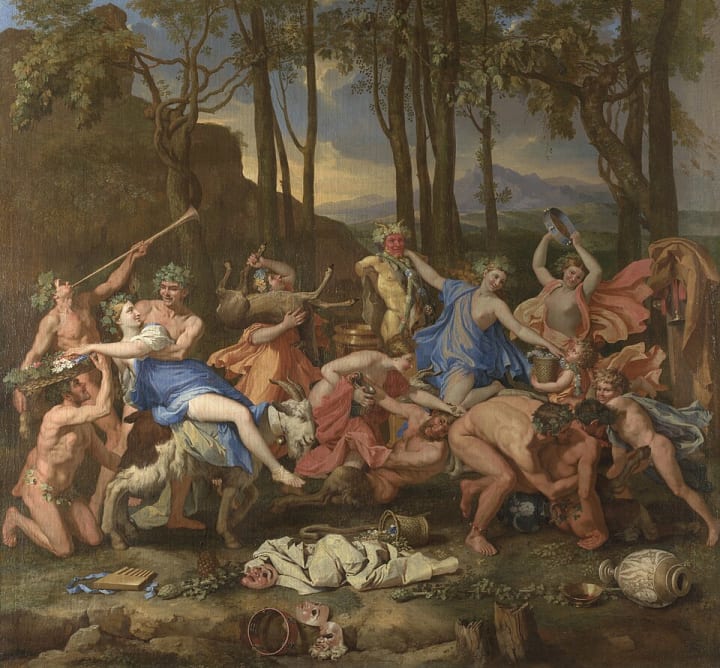
The Triumph of Pan depicts a party in a woodland setting with laughter, cavorting, and drinking. It is all centered around a statue of a red-faced satyr with horns, representing Pan, the god of shepherds and herdsmen.

Triumph of Neptune and Amphitrite is a mythological painting with many nude figures near the sea. The artwork depicts the mythological union of Neptune, the god of the sea, and Amphitrite, the goddess of the sea's bounty. The painting features a dynamic arrangement of figures, with Neptune at the center, surrounded by sea creatures and nymphs, symbolizing the celebration of their marriage. The work reflects themes of love, nature, and the power of the sea, common in Poussin's mythological works.
About the Creator
Rasma Raisters
My passions are writing and creating poetry. I write for several sites online and have four themed blogs on Wordpress. Please follow me on Twitter.
Keep reading
More stories from Rasma Raisters and writers in Art and other communities.
'Till Death We Do Art
There would be nothing divine in this world without art. Nature may surpass the divine to all intents and purposes, but like everything it absorbs and is absorbed by, it remains here, stuck on the surface of this world, ever-present, physically bound to the universe.
By Avocado Nunzella BSc (Psych) -- M.A.P 23 days ago in Art
Rewire Your Mind for Success
brilliant inventor and worked day and night in her small lab, filled with glowing screens and strange gadgets. Despite her talent, she struggled to find success. Her inventions were often overlooked, and her ideas remained trapped in her mind.
By Hamad Afridi about 24 hours ago in Art




Comments
There are no comments for this story
Be the first to respond and start the conversation.