
Famous German Paintings
Artwork by German artists
The Renaissance showed a renewed interest in the ancient Greco-Roman culture that originated in the 14th century and spread to Germany by the following century. Among German artists, Albrecht Durer was looked at as one of the greatest artists of the German Renaissance.
Romanticism originated in the late 18th century with Caspar David Friedrich among the most important German artists of this movement.
Expressionism originated in Germany at the beginning of the 20th century and played a major role in shaping the modern art world. It was led by such artists as Anselm Kiefer and Gerhard Richter who were considered among the greatest painters in the world.
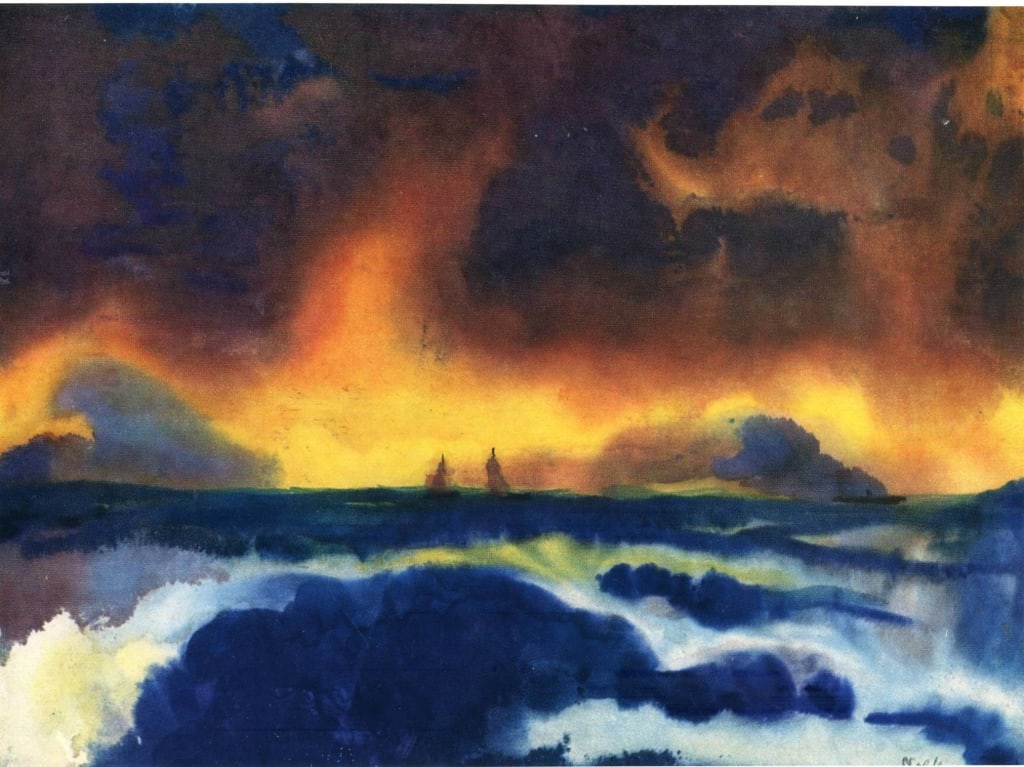
Stormy Sea Emil Nolde
German artist Emil Nolde was looked at as one of the most important contributors to Expressionism. He was a member of Die Brucke (The Bridge) a group of German artists who had a major impact on Expressionism and the evolution of modern art. Nolde reintroduced religious subject matter and revitalized the medium of printmaking. He was one of the first 20th-century artists to explore color in detail.
Among his most famous paintings is Stormy Sea, a watercolor landscape he created in 1930. The painting can be viewed at the Sprengel Museum in Hanover, Germany.
The painting has an organic line with many bright spots of color mostly blue and orange. It depicts two boats on the horizon and a steamboat on the right side giving a not to Modernism and Industrialization, The bright orange horizon gives the artwork drama with white color in the foreground showing the crests of waves.
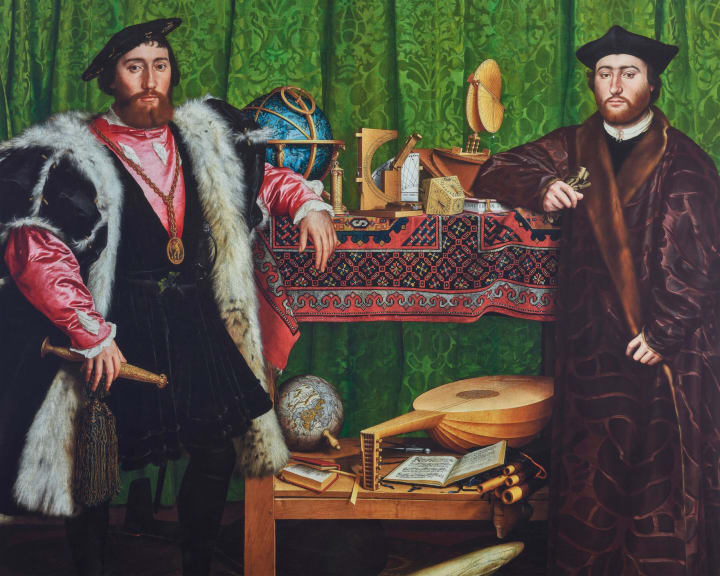
The Ambassadors Hans Holbein the Younger
German artist Hans Holbein the Younger was one of the leading artists when the German Renaissance was part of the Northern Renaissance movement. This movement occurred in Europe north of the Alps. His father German artist Hans Holbein the Elder was an accomplished painter of the Late Gothic School. Hans Holbein the Younger created many portraits of North European royalty and notables. He is renowned as one of the greatest portraitists of the 16th century.
The Ambassadors is a painting the artist created in 1533. It portrays French diplomats Jean De Dinteville and Georges de Selve. The artwork was created in the Tudor Period. It is thought that the Queen of England Anne Boleyn commissioned this painting as a gift for Jean de Dinteville, the French Ambassador on the left. The painting can be viewed at the National Gallery in London, England.
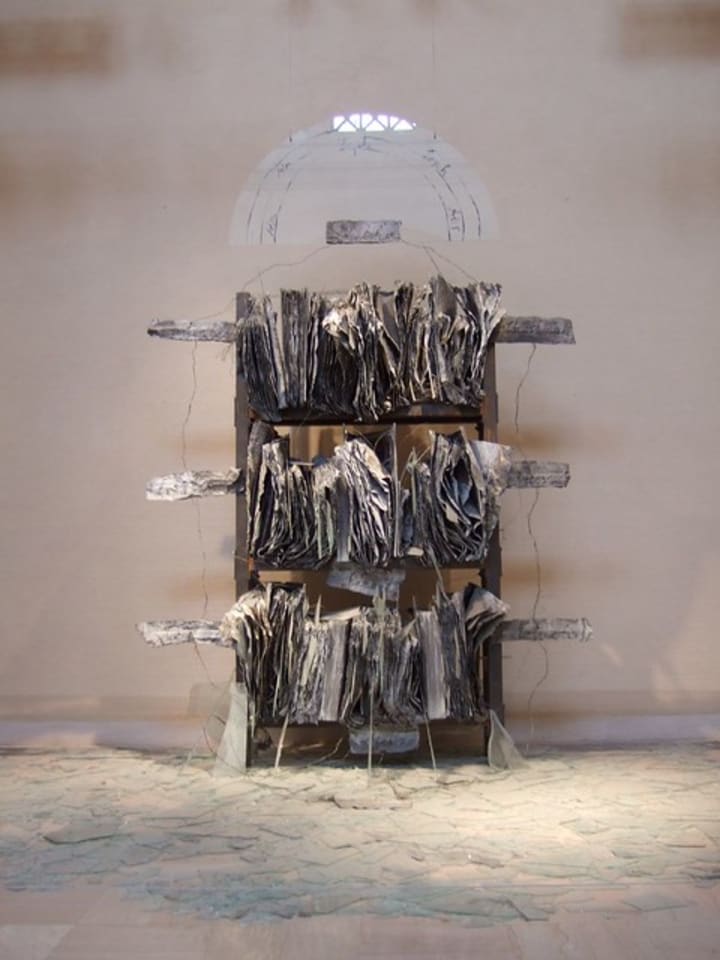
Breaking of Vessels Anselm Kiefer
German artist Anselm Kiefer is renowned for his monumental canvases that explore German history. Kiefer incorporates heavy impasto, a technique where paint is laid in layers so thick brushstrokes are visible. In 2005 Kiefer was awarded the Order of Merit of the Federal Republic of Germany and remains one of the most famous contemporary German artists.
This artwork Breaking of Vessels represents the introduction of evil and the human condition into the universe. This sculpture metaphorically presents the human tragedy and the cycle leading to rebirth and regeneration.
Blue Horses Franz Marc
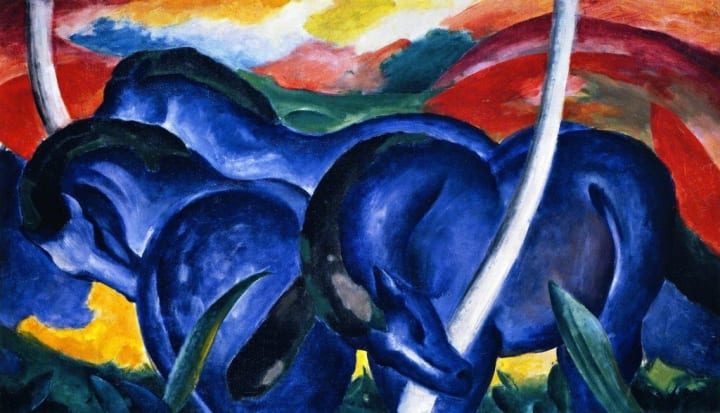
German artist Franz Marc was part of Der Blaue Reiter which along with Die Brucke was one of the two groups of German painters fundamental to Expressionism. Marc was the central figure of Der Blaue Reiter. He’s most famous for his depictions of brightly colored animals, particularly horses.
Blue Horses is a painting that was completed in 1911. It is one of the artist’s earliest major artworks and is considered one of the most important of his series of portraits of horses.
The War Otto Dix
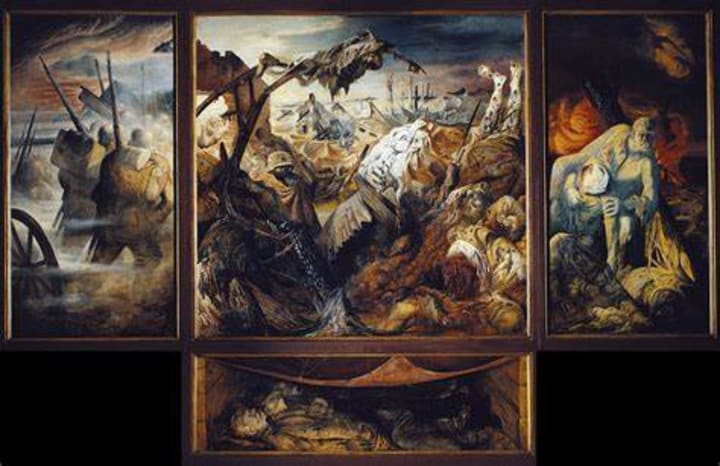
German artist Otto Dix is considered to be the most important artist of the Neue Sachlichketi Movement. This German movement arose in reaction against Expressionism. It rejected the introverted emotionalism and romantic longings of Expressionists. Dix became one of the most famous German artists of the 20th century.
The War is a large oil and tempera painting that Diz created on four wooden panels. This artwork is based on religious triptychs of the Renaissance. It is one of the several anti-war artworks created by Dix in the 1920s and was inspired by his experience of trench warfare in WW I. It can be viewed at the Meister in Dresden, Germany.
Abstraktes Bild Gerhard Richter
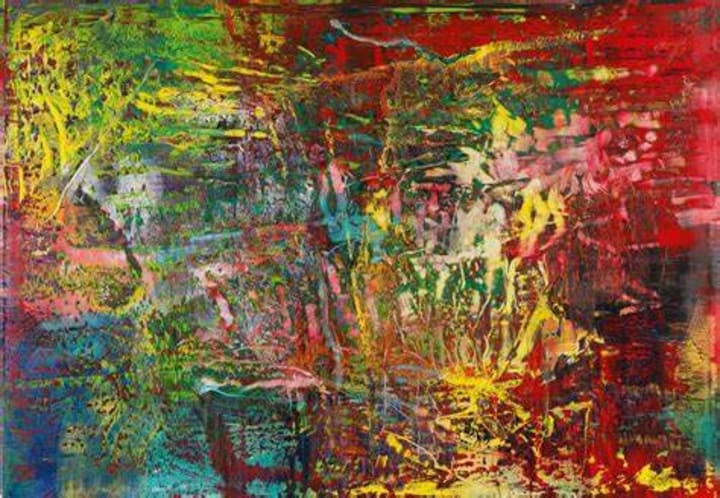
German artist Gerhard Richter produced abstract, photo-realistic, sculptures drawings, photos, and glass pieces.
Abstraktes Bild was created in 1994 and is the first from a series of four paintings. The artwork shows the fall colors of scarlet, emerald green, gold, and lemon yellow with some violet and Prussian blue. It can be viewed at the Tate Gallery in London, England.
Melencolla I Albrecht Durer
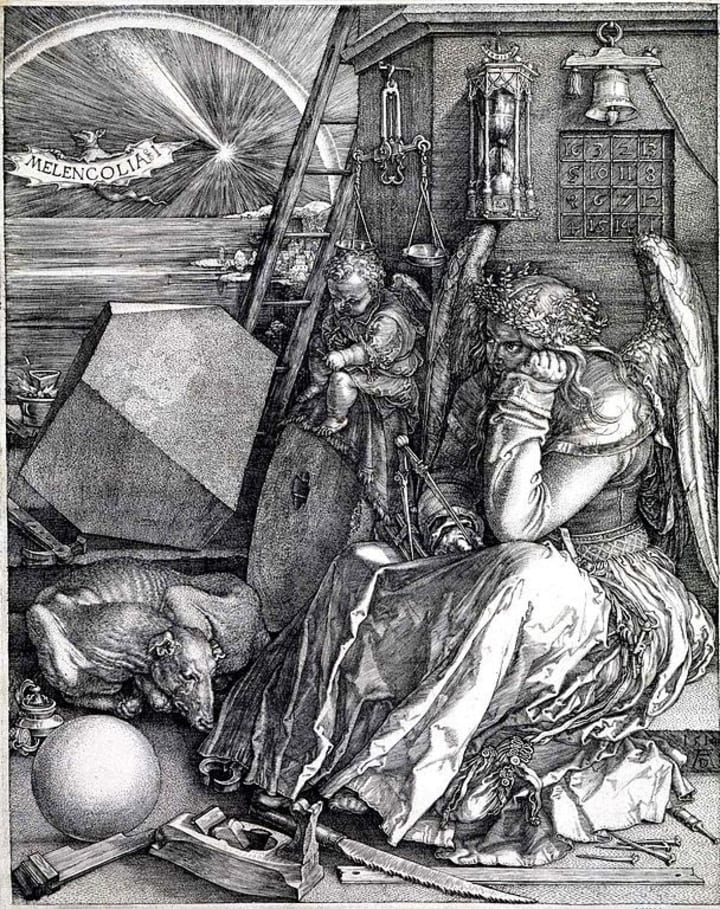
German artist Albrecht Durer had a great artistic impact on printmaking. He established his reputation and influence across Europe with his high-quality woodcut prints. His introduction of classical motifs to Northern Art was an important contribution to the German Renaissance.
Melencolla I is a large artwork completed in 1514. It is an engraving with the central subject being an enigmatic and gloomy-winged female figure thought to be a personification of melancholia. She holds her head in her hand and stares past the busy scene in front of her. The area is strewn with symbols and tools associated with craft and carpentry. Other objects relate to alchemy, geometry, or numerology. Behind the central figure is a structure with an embedded magic square and a ladder that leads beyond the frame. The sky in the artwork has a rainbow, a comet or planet, and a bat-like creature.
The Elephant Celebes Max Ernst

German artist Max Ernst was a pioneer of Surrealism and the Dada Movement. Surrealism was influential in the 20th century whose artists rejected rationalism and realism and focused on channeling the subconscious mind to unveil the power of imagination.
The Elephant Celebes is a painting completed in 1921 and is among the most famous artwork of Ernst’s early Surrealist works. It combines the vivid dreamlike atmosphere of Surrealism with the collage aspect of Dada. The central focus of the painting is a giant mechanical elephant. The round body of the figure was modeled after a photograph by Robert Schomburgk of a three-legged clay guinea corn bin from West Africa.
Wanderer Above the Sea of Fog Caspar David Friedrich
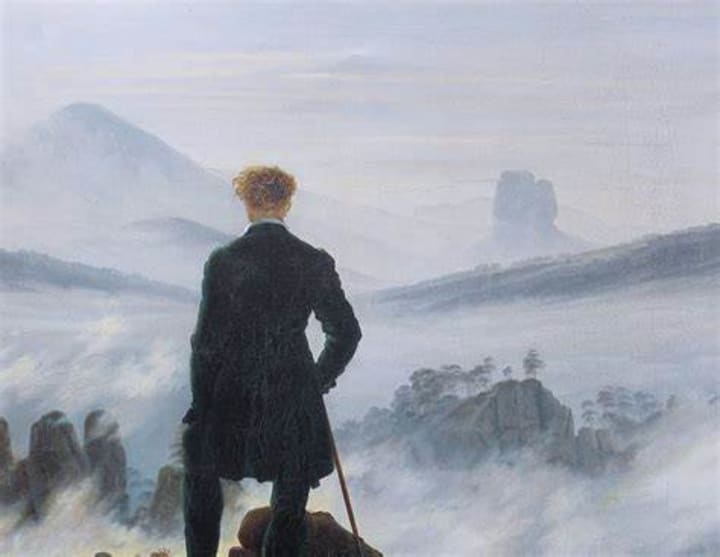
German artist Caspar David Friedrich is considered the most important German artist of the Romanticism Movement. His best-known artworks put humans amid night skies, morning mists, and barren trees among others.
Wanderer Above the Sea of Fog was created in 1818. It depicts a man standing on a rocky precipice with his back to the viewer. The man is gazing out on a landscape covered by a thick fog through which ridges, trees, and mountains can be glimpsed. This painting has been considered one of the masterpieces of the Romantic Movement.
Ad Parnassum Paul Klee

German artist Paul Klee was a prolific painter producing more than 9000 artworks. His works of art have been associated with various art movements among them Expressionism, Cubism, Surrealism, and Abstraction.
Ad Parnassum is a pointillist painting. The artwork is dominated by a pyramid-like shape outlined by stamped lines. It was likely inspired by the Egyptian pyramids, the Niesen that overlooks Lake Thun in the artist’s home country, and Mount Parnassus. Above the pyramid to the right is a bright orange circle representing the Sun. It can be viewed at the Kunstmuseum in Bern, Switzerland.
About the Creator
Rasma Raisters
My passions are writing and creating poetry. I write for several sites online and have four themed blogs on Wordpress. Please follow me on Twitter.
Keep reading
More stories from Rasma Raisters and writers in Art and other communities.
Dog Shoes for Small Dogs and Puppy Shoes A Practical, Paw-Friendly Guide
Small dogs and puppies may look tough, but their paws often need more protection than people realize. Their bodies are lighter, their paws are smaller, and many of them spend a lot of time on surfaces that were never designed for delicate paw pads. Add cold sidewalks, hot pavement, rough gravel, wet grass, or even slippery indoor floors, and you start to see why dog footwear has become more than just a cute trend.
By aliyashahzadi4 days ago in Art
So You Decided To Become a Nurse Practitioner:
So you decided to become an "Advanced Practice" nurse. Congratulations!... is what I would say if this was a good idea. Grad school? In this economy? What were you thinking? Likely it was something along the lines of either 1) “I've seen these other chucklefucks do it— Why can't I?” or even 2) “I've got a nice career, I should shake it up. I miss feeling like I have no clue what I'm doing.”
By Sandor Szabo5 days ago in Fiction



Comments
There are no comments for this story
Be the first to respond and start the conversation.