
The Hall of Fame Didn’t Snub Bill Belichick — It Used Him
How the Hall of Fame Turned Bill Belichick Into a Marketing Strategy

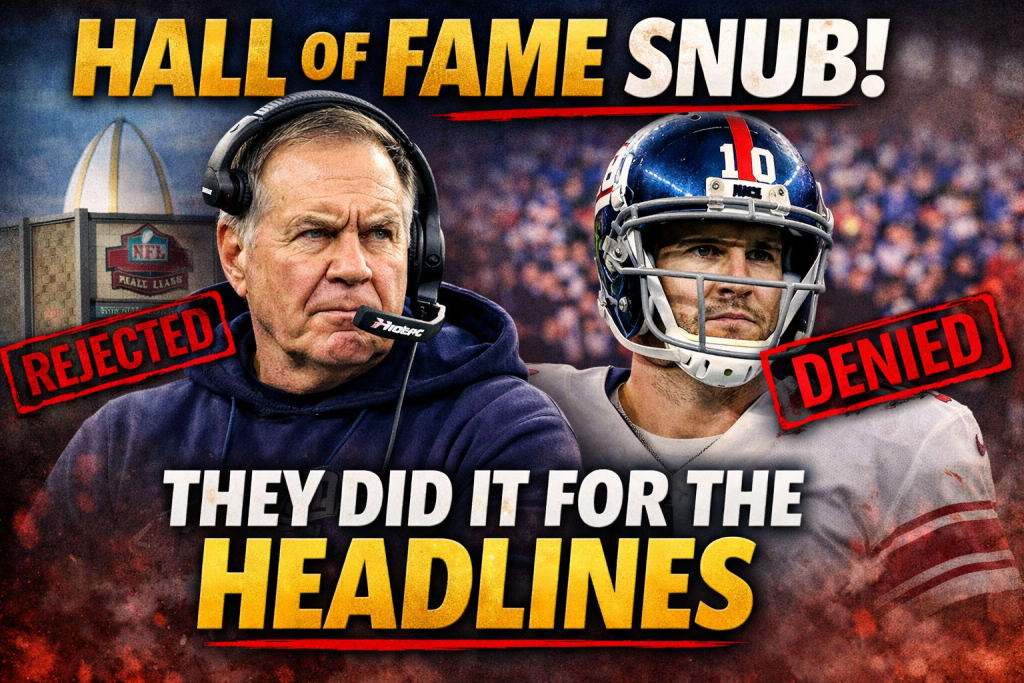
When the Pro Football Hall of Fame announcements dropped and both Eli Manning and Bill Belichick were left out, the reactions were immediate and predictable. Shock. Outrage. Endless TV segments. Social media melting down.
Two legendary names. Zero gold jackets.
But here’s the thing: only one of those omissions actually deserves serious debate. And the other? That one tells us far more about what the Hall of Fame has become than who it chose to honor.
Let’s start with the easier one.
Eli Manning not making the Hall of Fame—at least not yet—should not be controversial. Popular? Yes. Memorable? Absolutely. Hall of Fame caliber? That’s where the case gets a lot thinner than people want to admit.
Eli was never an elite quarterback during his playing career. Not for a season. Not even for a stretch. He was never consistently top five at his position, never an MVP candidate, never the engine that made his teams great year after year. He finished his career with a .500 record and spent most of his time firmly in the middle of the quarterback hierarchy.
Yes, he won two Super Bowls. And yes, both came against Tom Brady and the Patriots, which has inflated the mythology around him. But those runs were driven by dominant defenses and timely—not transcendent—quarterback play. We remember the helmet catch. We remember the moments. What we forget is how rare true elite play actually was from Eli Manning across nearly two decades.
The Hall of Fame is supposed to be about sustained greatness, not nostalgia. It’s not the Hall of “Really Good Stories.” And when you strip away the last names and the Super Bowl rings, Eli’s résumé looks more like a long, solid career than an immortal one.
So Eli not getting in? That makes sense. You can disagree, but at least the argument lives on the field.
Bill Belichick is a completely different story.
Or at least, it should be.
Belichick is the most accomplished head coach in NFL history. Six Super Bowl titles as a head coach. Nine appearances. Two more rings as a coordinator. Two decades of sustained dominance in the most parity-driven league in sports. His place in football history is not debatable, not controversial, and not dependent on opinion.
Everyone knows he’s getting in.
Which is exactly why keeping him out—whether officially due to eligibility timing or not—was the most valuable outcome the Hall of Fame could have hoped for.
Because Bill Belichick getting inducted would have been boring.
It would’ve been a one-day news cycle. A quick congratulatory graphic. A few talking points about legacy. Then on to the next thing. No outrage. No debate. No clicks.
Bill Belichick not getting inducted? That’s content.
That’s a week of television. That’s radio arguments. That’s social media engagement. That’s casual fans asking questions and diehards yelling at each other online. That’s the Hall of Fame dominating the NFL conversation without a single snap being played.
This is where we need to stop pretending the Hall of Fame exists in a vacuum.
The Hall of Fame is not just a museum anymore. It’s a media entity. It lives in the same attention economy as the league itself, competing with coaching hires, quarterback drama, and nonstop news cycles. Relevance matters. Visibility matters. Engagement matters.
And controversy is currency.
Keeping Belichick out—for now—created infinitely more attention than honoring him ever would have. It turned a procedural moment into a talking point. It transformed inevitability into outrage. And most importantly, it reminded everyone that the Hall of Fame still has the power to shape the conversation.
This isn’t about denying Belichick his place in history. He’s not being punished. He’s not being questioned. His legacy isn’t at risk. He’ll be inducted. First ballot or second ballot, it won’t matter in the record books.
But it matters right now.
Delaying his induction stretches the story. It keeps his name circulating. It guarantees another wave of coverage next year. Another announcement. Another moment. Another cycle of attention.
That’s not an accident. That’s strategy.
And if that sounds cynical, ask yourself this: which outcome benefited the Hall of Fame more? A quiet, obvious induction everyone expected—or a decision that sparked outrage, debate, and wall-to-wall coverage?
The answer is obvious.
This doesn’t mean the Hall of Fame is corrupt or illegitimate. It means it’s modern. It understands the landscape it operates in. It understands that ceremony alone doesn’t drive relevance anymore—conversation does.
And that’s the uncomfortable truth fans don’t like to admit.
The Hall of Fame isn’t just preserving football history. It’s managing it.
Eli Manning will likely get in eventually. Bill Belichick absolutely will. Their legacies aren’t being rewritten or erased. But the process—the timing, the optics, the controversy—has become part of the business.
The gold jacket still means something. But the road to it now comes with headlines, hot takes, and calculated pauses.
Bill Belichick didn’t get snubbed.
He got leveraged.
And in today’s NFL, that might be the most fitting tribute of all.
About the Creator
Logan M. Snyder
https://linktr.ee/loganmsnyder
Keep reading
More stories from Logan M. Snyder and writers in Unbalanced and other communities.
Todd Monken and the Cleveland Browns: A High-Risk, Offensive Gamble
On January 28, 2026, the Cleveland Browns officially named Todd Monken as their new head coach, marking his first opportunity to lead an NFL franchise. Monken’s hire is intriguing, promising, and risky all at once—a reflection of both the Browns’ desperate desire to fix a struggling offense and the league’s appetite for offensive-minded coordinators. While Monken brings a track record of modern, effective offensive scheming, questions about his ability to manage an entire team and navigate Cleveland’s notoriously volatile environment make this hire a high-stakes gamble.
By Logan M. Snyder4 days ago in Unbalanced
Wild Card Weekend Recap: What Happens Now?
I think I figured out why I love Wild Card Weekend so much. It's because it's the first playoff anything of the calendar year. The NFL season starts in the fall, and once upon a time, the champion was crowned either on or slightly before New Year's. The evolution of the NFL schedule has resulted in the playoffs starting just into the New Year, and currently, the final week of the season falls on the first weekend of the New Year, with Wild Card Weekend coming a week after that. So yes, chronologically, the NFL's Wild Card Weekend serves as the first playoff anything of the calendar year.
By Clyde E. Dawkins19 days ago in Unbalanced
Gervonta ‘Tank’ Davis is arrested on battery, kidnapping charges after two-week manhunt
When beating up people in the ring just isn’t enough ... .Gervonta “Tank” Davis has been arrested and charged with battery, false imprisonment, and attempted kidnapping. After weeks on the lam, police finally captured Tank and he is now waiting to post a $16,000 bond.
By Skyler Saunders2 days ago in Unbalanced



Comments
There are no comments for this story
Be the first to respond and start the conversation.