
Todd Monken and the Cleveland Browns: A High-Risk, Offensive Gamble
Breaking Down the 2026 NFL Coaching Carousel

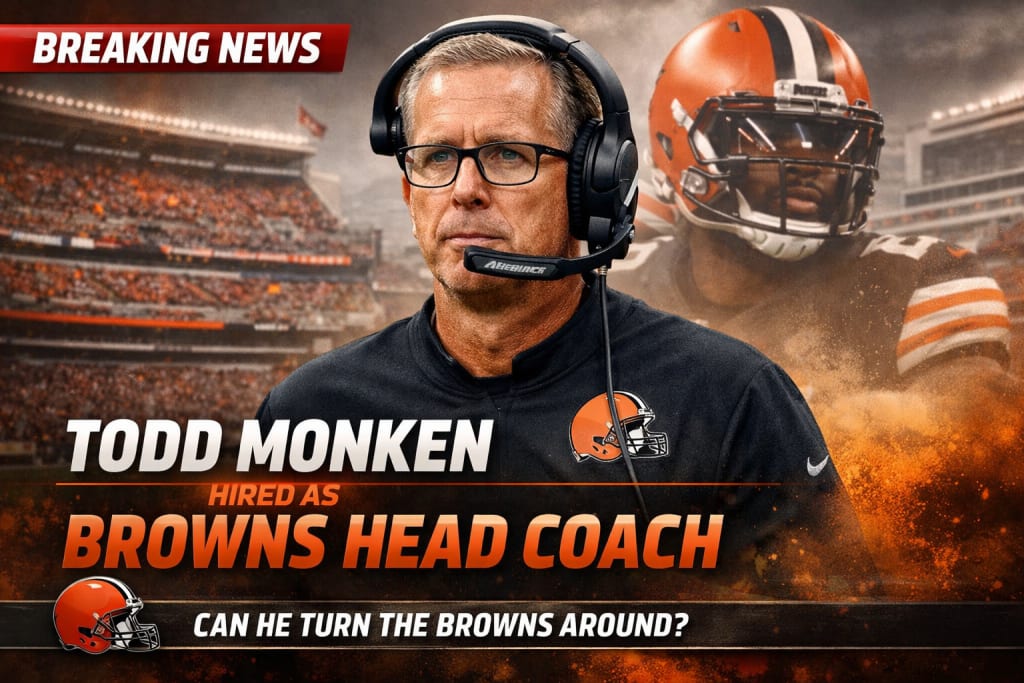
On January 28, 2026, the Cleveland Browns officially named Todd Monken as their new head coach, marking his first opportunity to lead an NFL franchise. Monken’s hire is intriguing, promising, and risky all at once—a reflection of both the Browns’ desperate desire to fix a struggling offense and the league’s appetite for offensive-minded coordinators. While Monken brings a track record of modern, effective offensive scheming, questions about his ability to manage an entire team and navigate Cleveland’s notoriously volatile environment make this hire a high-stakes gamble.
Todd Monken is best known as an offensive architect. His tenure as offensive coordinator for the Baltimore Ravens from 2021 to 2025 saw him modernize the team’s passing game, working closely with Lamar Jackson to create a dynamic, MVP-level attack. In addition to his NFL experience, Monken has coached at the college level and in the NFL previously, including stints as offensive coordinator with the Tampa Bay Buccaneers (2016–2018) and Georgia, and a head coaching role at Southern Miss from 2013 to 2015. While his Southern Miss record—13–25 over three seasons—raises eyebrows, context is essential: he inherited a program hampered by sanctions and roster instability, turning it into a competitive unit by his third year. Nonetheless, the record remains a red flag for any team considering him for a high-pressure NFL head coaching job.
Despite the uneven record at Southern Miss, Monken’s NFL résumé is impressive. During his time in Tampa Bay, he presided over an offense that evolved steadily, peaking in 2018 when he effectively ran the passing game, producing one of the league’s most efficient and high-powered offenses. In Baltimore, Monken was instrumental in refining Lamar Jackson’s game, turning a raw MVP talent into a more polished quarterback capable of executing a complex, adaptive scheme. Still, even with these accomplishments, Monken has never been the final decision-maker at the head coach level in the NFL—a fact that complicates expectations for what he can deliver in Cleveland.
Cleveland’s hiring of Monken signals a very specific organizational philosophy. The Browns have long been desperate for offensive competency and quarterback development, and Monken fits the mold of a short-term offensive expert capable of extracting the most from his players. This hire appears less about building a long-term culture or installing a franchise-defining leader and more about buying time and stabilizing the offense while the roster improves. The Browns are not a contender this season, and with stars like Myles Garrett previously demanding trades when the team fell short, the front office clearly wants someone who can manage the offense without immediately tanking the locker room or derailing the team’s talent.
The risks of this hire are considerable. Monken is untested as an NFL head coach, and Cleveland has a history of short patience for new coaches who struggle early. The Browns’ roster has significant gaps that could limit offensive performance, and if Monken cannot deliver immediate results, the organization may move on quickly. In addition, Monken must navigate the challenging dynamics of Cleveland media and fan expectations. While he may be insulated from some criticism due to his offensive credibility, early struggles will not be tolerated in a market that has burned through coaches before.
Furthermore, the historical lens is not encouraging. The hire evokes echoes of the Hue Jackson era, a first-time NFL head coach brought into Cleveland with hopes of immediate improvement. While Monken’s résumé as an NFL coordinator is objectively stronger than Jackson’s was at the time of his hiring, Monken lacks the visibility and hype that Jackson enjoyed, and the Browns’ expectations are unlikely to be that he “saves the franchise” overnight. Like Jackson, Monken faces the reality of a team with limited roster depth and high organizational pressure, but he also inherits a more clearly defined mandate: fix the offense and develop the quarterback while surviving the first year under intense scrutiny.
Monken’s success will ultimately depend on several factors. First, he must maximize his quarterback’s abilities, ensuring the offense is productive without relying solely on individual talent. Second, he needs to adapt to a roster with clear weaknesses, creatively scheming to mask deficiencies on the line or in skill positions. Finally, he must navigate Cleveland’s volatile environment, balancing front-office expectations, media scrutiny, and player management to maintain stability. Failure in any of these areas could result in an early exit, while success may quietly prove Monken capable of more than his résumé currently suggests.
In the end, Todd Monken’s hiring is emblematic of the Browns’ current strategy: a high-risk, moderate-upside gamble on an offensive-minded coordinator with a solid track record, but limited experience leading a team. He is being entrusted to modernize the offense and develop the quarterback, with the implicit understanding that he may be replaced if immediate results do not materialize. The move reflects a pragmatic, short-term approach to a franchise desperate to improve while keeping options open for future coaching hires. Whether Monken thrives or struggles, this hire is likely to be remembered as a critical moment in the ongoing narrative of a Browns organization still searching for stability, success, and “their guy” at head coach.
About the Creator
Logan M. Snyder
https://linktr.ee/loganmsnyder
Keep reading
More stories from Logan M. Snyder and writers in Unbalanced and other communities.
Bills Hire Joe Brady: Comfort Over Courage
The Buffalo Bills’ decision to promote Joe Brady to head coach is one of the most polarizing moves of the 2026 NFL coaching carousel — not because Brady is unqualified to coach offense, but because of what this hire says about how the organization evaluated its own failures.
By Logan M. Snyder5 days ago in Unbalanced
Wild Card Weekend Recap: What Happens Now?
I think I figured out why I love Wild Card Weekend so much. It's because it's the first playoff anything of the calendar year. The NFL season starts in the fall, and once upon a time, the champion was crowned either on or slightly before New Year's. The evolution of the NFL schedule has resulted in the playoffs starting just into the New Year, and currently, the final week of the season falls on the first weekend of the New Year, with Wild Card Weekend coming a week after that. So yes, chronologically, the NFL's Wild Card Weekend serves as the first playoff anything of the calendar year.
By Clyde E. Dawkins19 days ago in Unbalanced
Queen Camilla “Is Acutely Aware of Context” as She Brings Back Queen Victoria’s 129‑Year‑Old Brooch, Per Jewelry Expert
Queen Camilla has once again turned heads — not just for her presence at a major commemorative event, but for the historic piece of jewelry she chose to wear. On January 27, 2026, during a reception at Buckingham Palace marking Holocaust Memorial Day, Camilla donned Queen Victoria’s Hesse Diamond Jubilee Brooch, a nearly 129‑year‑old heirloom that carries deep historical resonance. Experts say the selection was far from random; it was a conscious, context‑sensitive choice that communicated more than just royal fashion.
By Salaar Jamali4 days ago in Unbalanced


Comments
There are no comments for this story
Be the first to respond and start the conversation.