
Europe Ultrasound Devices Market Forecast 2025–2033: Technology, Demand, and the Future of Diagnostic Imaging
How innovation, aging populations, and non-invasive diagnostics are reshaping Europe’s medical imaging landscape

Introduction
Ultrasound technology has long been a cornerstone of modern medical diagnostics, valued for its safety, versatility, and real-time imaging capabilities. Unlike X-rays or CT scans, ultrasound uses high-frequency sound waves rather than ionizing radiation, making it a preferred option for repeated examinations, prenatal care, and point-of-care diagnostics. Over the past decade, Europe has witnessed a steady expansion in the use of ultrasound devices across hospitals, diagnostic centers, and specialty clinics, driven by technological progress and changing healthcare needs.
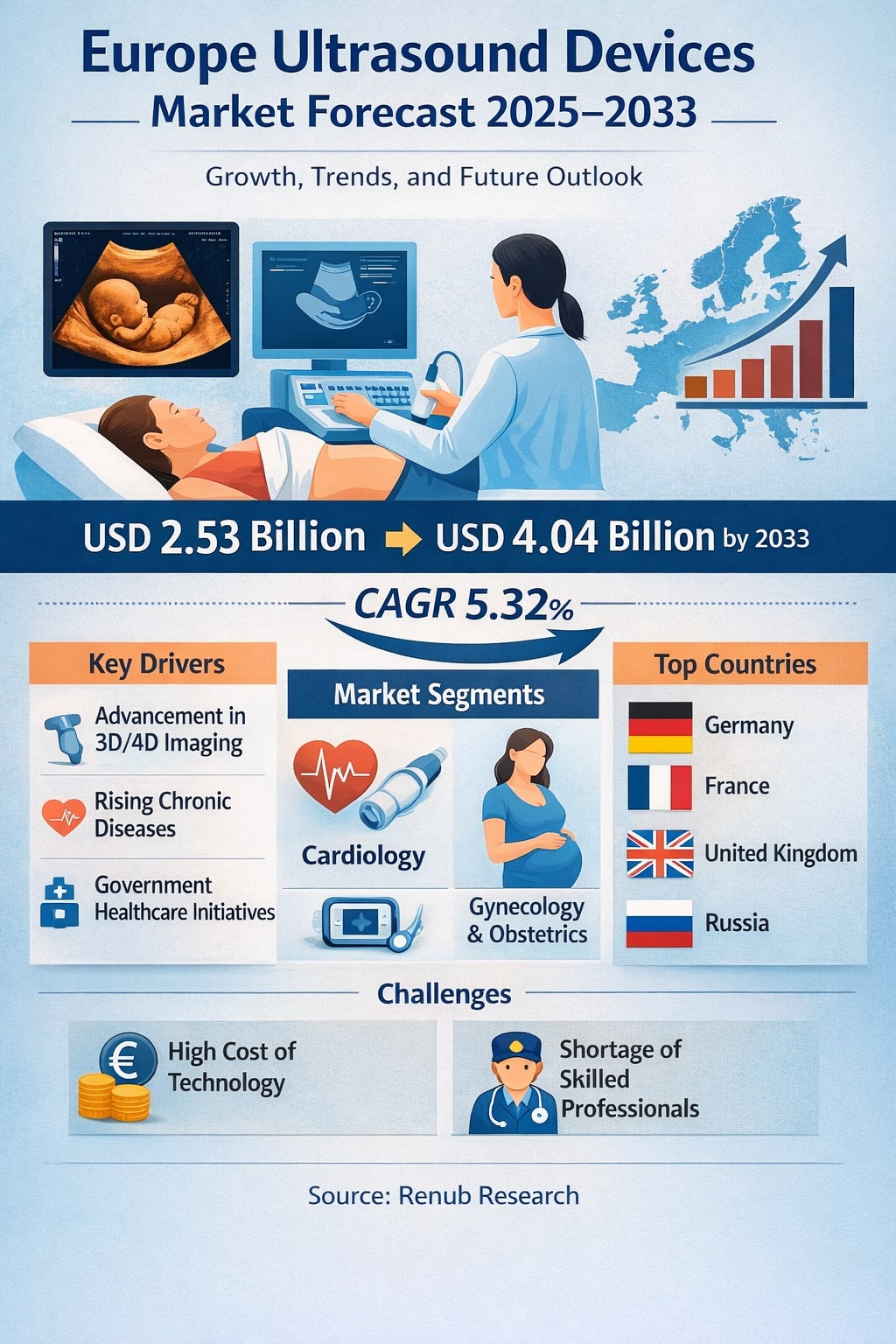
According to Renub Research, the Europe Ultrasound Device Market was valued at USD 2.53 billion in 2024 and is projected to reach USD 4.04 billion by 2033, growing at a CAGR of 5.32% during the forecast period 2025–2033. This growth is being fueled by multiple converging factors, including rapid advances in imaging technology, increasing demand for minimally invasive diagnostic procedures, and the rising prevalence of chronic diseases across the region.
From cardiology and obstetrics to oncology and emergency medicine, ultrasound has evolved from a basic imaging tool into a sophisticated diagnostic and therapeutic platform. The emergence of portable devices, 3D/4D imaging, Doppler technologies, and high-intensity focused ultrasound (HIFU) is transforming how clinicians diagnose and treat patients. At the same time, healthcare systems across Europe are under pressure to deliver faster, safer, and more cost-effective care—an environment in which ultrasound devices fit perfectly.
This article explores the key trends shaping the Europe ultrasound devices market, the major growth drivers and challenges, segment-wise developments, and country-level dynamics, offering a clear outlook for the period 2025 to 2033.
Understanding Ultrasound Devices and Their Role in Healthcare
An ultrasound machine is a medical imaging device that produces real-time images of the body’s internal structures using high-frequency sound waves. It is widely used for diagnostic purposes, guiding medical procedures, and monitoring fetal development during pregnancy. Because ultrasound does not involve radiation, it is considered safer for repeated use, making it especially valuable in pediatrics, obstetrics, and chronic disease management.
In Europe, ultrasound devices are now an essential part of routine clinical practice. They are commonly used in cardiology, gynecology, urology, musculoskeletal imaging, vascular assessments, and emergency medicine. The combination of non-invasiveness, cost-effectiveness, and immediate results has made ultrasound one of the most accessible and reliable imaging modalities in modern healthcare.
Moreover, the integration of digital technologies, artificial intelligence (AI), and portable designs has expanded the scope of ultrasound beyond traditional hospital settings. Today, ultrasound is increasingly used in ambulances, remote clinics, sports medicine, and even home healthcare, supporting faster decision-making and improving patient outcomes.
Market Outlook: Europe Ultrasound Devices Market 2025–2033
The Europe ultrasound devices market is on a steady growth trajectory. Valued at USD 2.53 billion in 2024, the market is expected to reach USD 4.04 billion by 2033, reflecting a CAGR of 5.32% during the forecast period. This expansion is not driven by a single factor but rather by a combination of demographic, technological, and policy-related developments.
Europe’s aging population is a major contributor to rising demand for diagnostic imaging. Older populations are more susceptible to chronic conditions such as cardiovascular diseases, cancer, kidney disorders, and musculoskeletal problems—all of which often require regular imaging for diagnosis and monitoring. Ultrasound, being safe and relatively affordable, is increasingly chosen as a first-line imaging tool.
At the same time, healthcare systems across Europe are placing greater emphasis on early diagnosis and preventive care. Government-backed screening programs, improved access to healthcare services, and the expansion of diagnostic centers are further boosting the adoption of ultrasound devices. In parallel, technological innovation is making ultrasound more powerful, user-friendly, and versatile, widening its clinical applications.
Key Growth Drivers
1. Rapid Technological Advancements
Technological innovation is at the heart of the ultrasound devices market’s growth in Europe. The transition from traditional 2D imaging to advanced 3D/4D ultrasound, Doppler imaging, and High-Intensity Focused Ultrasound (HIFU) has significantly enhanced diagnostic accuracy and clinical value. These technologies provide clearer images, better tissue characterization, and improved visualization of blood flow and organ structures.
Artificial intelligence is also beginning to play a transformative role. AI-powered ultrasound systems can assist clinicians by automating image analysis, reducing operator dependency, and improving workflow efficiency. Handheld and portable ultrasound devices have further increased accessibility, allowing imaging to be performed at the point of care, in emergency situations, and in remote or underserved areas.
A notable development came in September 2024, when Sonio achieved CE mark certification for its AI-enabled Sonio Detect, strengthening its ultrasound reporting software in France following FDA clearance and success in the US market. Such innovations highlight how software and AI are becoming as important as hardware in the future of ultrasound.
2. Rising Prevalence of Chronic Diseases
Europe faces a growing burden of chronic diseases, including cardiovascular disorders, cancer, diabetes, and kidney disease. Ultrasound plays a critical role in the early detection, diagnosis, and monitoring of many of these conditions. Its non-invasive nature makes it particularly suitable for repeated examinations and long-term patient management.
For example, cardiovascular diseases remain one of the leading causes of death in Europe, driving strong demand for echocardiography and vascular ultrasound systems. Similarly, oncology applications are expanding, with ultrasound increasingly used for tumor detection, biopsy guidance, and treatment monitoring. The rising disease burden, combined with greater health awareness among the population, is expected to continue driving market growth throughout the forecast period.
3. Government Policies and Healthcare Spending
European governments are actively investing in healthcare infrastructure and promoting the adoption of advanced medical technologies. Countries such as Germany, France, and the United Kingdom are increasing healthcare budgets, supporting hospital modernization, and encouraging early disease detection through public health initiatives.
According to Eurostat, healthcare spending in Europe accounted for 7.7% of GDP in 2022, equivalent to approximately USD 1,334.7 billion. This sustained investment creates a favorable environment for the adoption of advanced diagnostic tools, including ultrasound devices. In addition, the expansion of telemedicine and remote diagnostics is further supporting demand for portable and connected ultrasound systems.
Challenges in the Europe Ultrasound Device Market
1. High Cost of Advanced Systems
While technological advancements improve diagnostic capabilities, they also increase the cost of ultrasound equipment. High-end 3D/4D systems, AI-enabled platforms, and HIFU devices require significant capital investment, which can be a barrier for smaller hospitals and clinics. In addition to the purchase price, maintenance, software updates, and staff training add to the total cost of ownership.
These financial constraints can slow adoption, particularly in smaller healthcare facilities or in regions with tighter healthcare budgets.
2. Shortage of Skilled Professionals
The effective use of ultrasound equipment depends heavily on the skill and experience of operators. Europe faces a shortage of trained sonographers and radiologists in several countries, which can limit the full utilization of advanced ultrasound systems. Inconsistent image acquisition or interpretation can reduce diagnostic accuracy and clinical efficiency.
To address this issue, greater investment in medical education, training programs, and certification initiatives will be essential over the coming years.
Segment Analysis
By Application
Cardiology: The cardiology segment is one of the largest and fastest-growing, driven by the high prevalence of cardiovascular diseases. Echocardiography is widely used for diagnosing heart conditions, monitoring cardiac function, and guiding treatment decisions.
Anesthesiology: Ultrasound-guided anesthesia is increasingly adopted for nerve blocks, vascular access, and regional anesthesia, improving accuracy and patient safety.
Gynecology/Obstetrics: This remains a core application area, especially with the growing use of 3D/4D imaging for fetal monitoring and reproductive health.
Musculoskeletal and Vascular: These segments are expanding due to rising sports injuries, aging populations, and increased focus on vascular health.
By Technology
2D Ultrasound Imaging: Still widely used due to its affordability and reliability.
3D and 4D Ultrasound Imaging: Gaining strong traction, especially in obstetrics and oncology, for enhanced visualization.
Doppler Imaging: Essential for assessing blood flow and cardiovascular conditions.
High-Intensity Focused Ultrasound (HIFU): Growing rapidly for therapeutic, non-invasive treatments in oncology and neurology.
By Type
Stationary Ultrasound Systems: Common in hospitals and large diagnostic centers, offering high performance and advanced features.
Portable Ultrasound Systems: One of the fastest-growing segments, driven by demand for point-of-care diagnostics, emergency medicine, and home healthcare.
By End User
Hospitals: The largest end-user segment due to high patient volumes and broad clinical applications.
Diagnostic Centers: Growing rapidly with the expansion of outpatient imaging and specialized diagnostic services.
Other End Users: Including clinics, ambulatory care centers, and research institutions.
Country-Level Insights
Germany
Germany represents one of the largest ultrasound device markets in Europe, supported by strong healthcare infrastructure, high healthcare spending, and a robust medical technology sector. In March 2024, Berlin-based InSightec received NUB status 1 for its MR-guided focused ultrasound treatment for essential tremor, expanding access to advanced ultrasound therapies in the country.
France
France’s market is growing steadily due to healthcare reforms, increased investment in diagnostic imaging, and rising demand for advanced and portable ultrasound systems. In December 2022, Siemens Healthineers announced the launch of its first European ultrasound manufacturing plant in France, with a capacity of 120 systems per week, strengthening local production and supply capabilities.
United Kingdom
The UK market benefits from strong support from the National Health Service (NHS), technological innovation, and the growing use of telemedicine. In May 2022, Clarius Mobile Health launched high-performance wireless ultrasound scanners in the UK and EU, highlighting the shift toward portable and connected imaging solutions.
Russia
Russia’s ultrasound device market is expanding due to increased healthcare investments and modernization efforts. In November 2022, Glavkosmos JSC announced plans to export Russian ultrasound scanners under the “RuSkan” brand, signaling growing domestic capabilities and international ambitions.
Competitive Landscape
The Europe ultrasound devices market is highly competitive, with leading global players focusing on innovation, product launches, and strategic partnerships. Key companies include:
Fujifilm Holdings Corporation
GE Healthcare
Hitachi Medical Corporation
Philips Healthcare
Samsung
Siemens Healthineers
Canon Medical Systems Corporation
Mindray Medical International Limited
These companies compete across product portfolios, technological advancements, geographic reach, and service offerings, continuously shaping the market’s evolution.
Final Thoughts
The Europe ultrasound devices market is entering a dynamic phase of growth, supported by technological innovation, demographic shifts, and increasing emphasis on early and non-invasive diagnosis. With the market expected to grow from USD 2.53 billion in 2024 to USD 4.04 billion by 2033 at a CAGR of 5.32%, ultrasound will remain a cornerstone of Europe’s healthcare ecosystem.
While challenges such as high equipment costs and workforce shortages persist, ongoing investments in healthcare infrastructure, training, and digital technologies are likely to offset these barriers. The future of ultrasound in Europe points toward smarter, more portable, and more accessible imaging solutions—bringing high-quality diagnostics closer to patients than ever before.
About the Creator
Keep reading
More stories from shibansh kumar and writers in Trader and other communities.
Europe Cervical Cancer Market Set for Steady Growth Through 2033
Europe Cervical Cancer Market: Size and Forecast 2025–2033 The Europe Cervical Cancer Market was valued at USD 9.83 billion in 2024 and is projected to reach USD 15.27 billion by 2033, expanding at a CAGR of 5.01% from 2025 to 2033. This steady growth reflects a powerful combination of technological advances in early detection, expanding HPV vaccination programs, rising public awareness, and strong government-backed screening policies across the region.
By shibansh kumara day ago in Trader


Comments
There are no comments for this story
Be the first to respond and start the conversation.